Загрузка видео...

Не удалось загрузить видео

На главную

Another 4-way split screen clip with Flux 3! Prompt : Four-way split-screen showing the same emergency airplane river landing from four synchronized camera perspectives. Each panel follows the aircraft continuously while the visuals change as the event unfolds. Top left: interior cabin view showing passengers, crew, shaking seats, overhead...

34,569 просмотров • 2 дней назад •via X (Twitter)

Комментарии: 0

Нет доступных комментариев

Здесь появятся комментарии из оригинального поста

Похожие видео

Gun camera footage from Captain Ralph Parr in an F-86 Sabre as he scores the final and possibly most controversial aerial victory of the Korean War F-86 Sabre gun camera compilation: Shortly after noon on July 27th 1953, U.S. Air Force Captain Ralph S. Parr Jr. with the 335th Fighter Interceptor Squadron of the 4th Fighter Interceptor Wing was flying an escort mission near Chunggang-jin is his F-86F Sabre (51-12959) when spotted an unidentified transport aircraft traveling unescorted. Parr reportedly made several passes and identified the plane as a North Korean Ilyushin Il-12. Although later that same day the newly signed armistice was to bring an end to hostilities in the Korean War, he decided to attack the aircraft regardless. A long burst from his battery of six .50 caliber machine guns with a combined rate of fire of over 100 rounds per second ripped through the Ilyushin and brought it down in flames. It would later transpire that the aircraft he targeted was in fact a Soviet Navy transport traveling through North Korean airspace from Port Arthur to Vladivostok. The plane came down on Chinese soil four kilometers from Mao-erh-shan and all 21 people on board, six crew and fifteen passengers, were killed. Judging by the concentration of fire on the fuselage visible in the gun camera footage, it's likely many were dead before the Ilyusin hit the ground. There are suggestions that even if the legitimacy and timing of the act was questionable, Parr was keen to make the kill as he already had nine victories under his belt and needed one more to achieve the status of double ace. Some Russian sources suggest an even more sinister motive, that the aircraft was deliberately targeted either because it was suspected that an important prisoner of war was being transferred to the Soviet Union or because the aircraft was supposed to be carrying top officials of the Soviet Pacific Fleet. A monument to commemorate the event was erected in Vladivostok.

hw97karbine

28,638 просмотров • 1 год назад

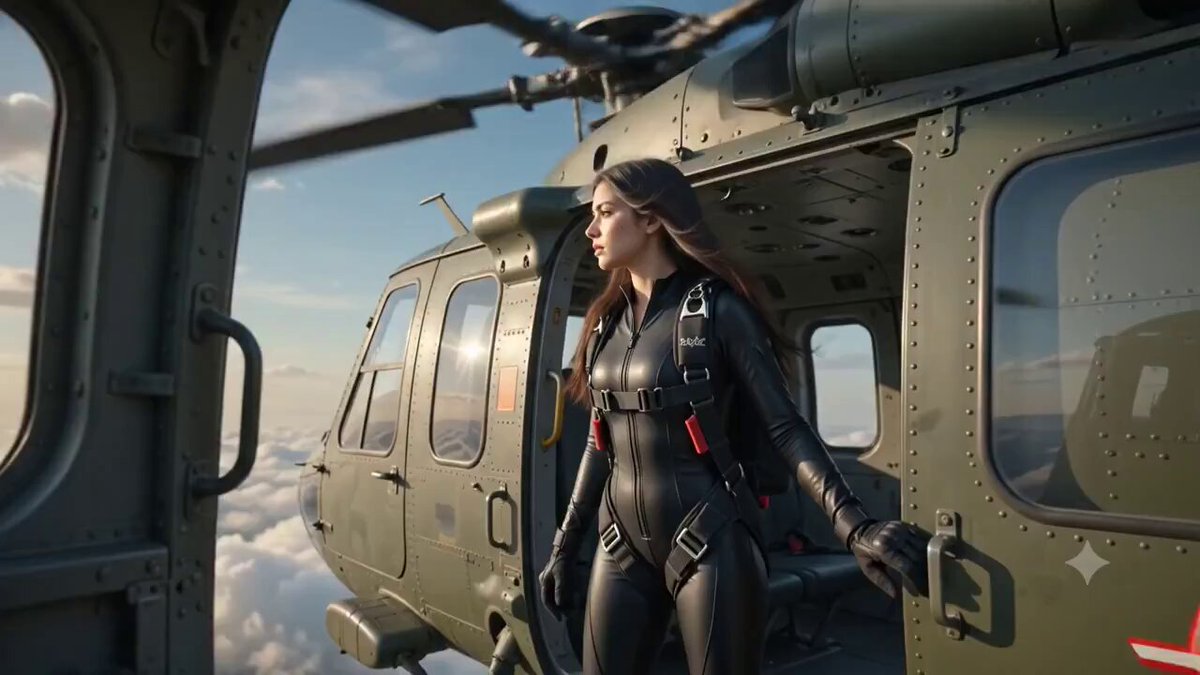
Created with Gemini Nano Banana Pro Prompt: A breathtaking cinematic skydiving sequence begins inside a military-style helicopter flying at 15,000 feet above a sea of clouds during golden hour. The camera slowly moves through the helicopter cabin, revealing a fearless young woman skydiver wearing a sleek black wingsuit-inspired jumpsuit, professional parachute harness, tactical gloves, and aerodynamic goggles. Her long dark hair moves gently in the wind coming through the open side door. The helicopter's powerful rotor blades spin overhead, creating realistic motion blur and dynamic vibrations. Sunlight streams through the cabin, casting dramatic rays and cinematic shadows across her determined face. The camera captures an intense close-up of her eyes as she looks toward the endless horizon. As epic orchestral music builds, she steps to the edge of the helicopter. The camera switches to a dramatic low-angle shot showing the vast sky and breathtaking world below. In slow motion, she leaps into the open air. Time seems to freeze as she exits the aircraft, with tiny particles of dust and sunlight sparkling around her. The camera follows her from multiple cinematic angles: front-facing tracking shots, side-profile action shots, over-the-shoulder aerial perspectives, and wide drone-style views. Her body glides smoothly through the atmosphere as clouds rush past. Her hair flows dynamically in the wind while realistic fabric physics animate her suit and parachute straps. Below her lies an incredible landscape of towering mountain ranges, turquoise lakes, winding rivers, deep valleys, dense forests, and snow-capped peaks stretching endlessly to the horizon. Volumetric clouds cast moving shadows across the terrain. The sun creates golden highlights on the mountains and sparkling reflections on the water. The camera circles around her at high speed while she performs controlled aerial maneuvers and graceful spins. Tiny water droplets and cloud mist pass the lens, creating immersive realism. Lens flares, atmospheric haze, HDR lighting, and cinematic depth of field enhance the visual impact. As the music reaches its climax, she bursts through a layer of clouds into brilliant sunlight. The camera captures a stunning 360-degree orbit around her, revealing the entire world beneath. She smiles confidently while freefalling at high speed. Near the end, she reaches for the parachute cord. Time slows dramatically. A close-up shot shows her hand pulling the release handle. Instantly, the parachute deploys with a powerful burst of motion. The colorful canopy opens above her against a vivid blue sky. The final scene shows her peacefully gliding through the sky as the sun sets on the horizon, painting the clouds with orange, pink, and gold colors. The camera pulls back farther and farther until she becomes a tiny silhouette floating above the majestic landscape. Epic cinematic ending, ultra-realistic visuals, Hollywood blockbuster quality, National Geographic aerial cinematography, 8K HDR, hyper-realistic lighting, realistic wind simulation, volumetric clouds, smooth camera movements, masterpiece, viral social media quality.

Yashal Ai

17,581 просмотров • 1 месяц назад

💥 This is an online briefing circulating about the incident (The incident site was only about four miles from Zhongnanhai) : Incident No.: 2026-06-26-STFS-01 Incident Type: Suspected crash after loss of contact during general aviation local training Date of Incident: June 26, 2026 Time of Incident: 17:30–17:40 Location: Beijing Shifosi General Aviation Airport and the airspace near the East Fifth Ring Road to its west Operating Unit: Dongshi Shuangyue (Beijing) General Aviation Co., Ltd. Aircraft Information: Registration No. B-12PP Flight Personnel: Liu Junhua, a club member conducting a local solo flight I. Flight Overview This was a solo training flight by a club member within the local airspace, with the planned training subject being local takeoffs and landings. At 17:30, the aircraft took off normally from Shifosi Airport. At 17:40, as the crew prepared to return for landing and join the westbound traffic pattern for Runway 18, abnormal control behavior occurred. The aircraft did not properly enter the local traffic pattern. Instead, it continued maintaining a heading of 270 degrees due west and flew beyond the local controlled airspace. Local ADS-B monitoring continued until the aircraft reached the area near Beijing’s East Fifth Ring Road, after which its signal disappeared. The ground control tower then coordinated with regional approach control and Air Force control authorities, making repeated radio calls, but received no response. The aircraft lost contact. II. Key Timeline At 17:30, B-12PP took off from Shifosi Airport for a local solo training flight. At 17:40, it prepared to join the west-side traffic pattern for Runway 18 for approach and landing. The aircraft’s heading became abnormal, continuing on a 270-degree heading and flying westward out of the local airspace. The flight track reached the area near the East Fifth Ring Road, where the ADS-B signal was lost. Approach control and Air Force control were contacted, but the aircraft never responded by radio and was considered missing. III. Preliminary Risk and Problem Analysis Insufficient solo-flight control: The member was flying alone, without instructor monitoring, meaning there was no condition for intervention or emergency handling once a special situation occurred. Severe deviation from the flight pattern: During the approach phase, the aircraft failed to fly according to the standard traffic pattern. Its heading continued to deviate, causing it to cross the boundary and enter sensitive airspace over the city. Complete failure of communication and surveillance: ADS-B and radio communication failed, creating extremely high risk. Serious airspace safety hazard: A low-altitude general aviation aircraft crossed the boundary into the airspace above a built-up urban area, posing major safety risks on the ground. IV. Possible Causes Pending confirmation by official investigation Human factors: Pilot error, spatial disorientation, physical incapacitation, etc. Mechanical failure: Failure of the flight control system, engine, or electrical system, causing the heading to become uncorrectable and communication/surveillance to be interrupted. Equipment failure: Failure of ADS-B or the radio transponder, resulting in loss of signal and inability to establish contact. Some people online also found a photo of a Liu Junhua who is deputy general manager of the Discretionary Mandate and Solutions Department at CITIC Bank’s Asset Management Business Center, and claimed that she was the aircraft’s pilot. The building that was struck, China Zun — also known as CITIC Tower — is precisely where CITIC Group is headquartered. However, others have come forward saying that the pilot was not the Liu Junhua from CITIC. There are also two LinkedIn photos of Liu Junhua from CITIC in the comment section.

Inconvenient Truths — Jennifer Zeng Reports

433,155 просмотров • 1 месяц назад

Imagine yourself swimming with dolphins . . . Grok Imagine. Prompt: Ultra-realistic cinematic ocean fantasy video, 1:1 square, 10 seconds. A beautiful woman with long wet black hair floats on her back in clear turquoise-blue ocean water, surrounded by several realistic dolphins. She wears a flowing royal-blue sheer gown with ornate gold embroidery and semi-transparent sleeves, elegant and regal, the fabric spreading softly in the water around her. Bright daylight, rich tropical ocean color, sparkling highlights on the water, premium cinematic realism. Start with a top-down aerial view. The woman is floating calmly and gracefully, eyes soft, face relaxed, arms slightly open, dress drifting underwater in soft blue layers. Several dolphins circle around her in a peaceful, magical but realistic way. Their skin is smooth, wet, and highly detailed, natural grey tones, realistic anatomy, realistic scale. As the shot continues, one dolphin swims closer to her upper body and rises partly out of the water beside her. She slowly lifts one hand toward the dolphin in a gentle, elegant motion, as if greeting or touching it. Keep her movement slow and graceful. The dolphins continue circling smoothly, creating ripples and splashes around her. Camera remains mostly overhead with a slight drifting cinematic motion, subtle zoom and gentle rotation. Water movement should feel natural, with soft wave patterns and realistic fabric motion underwater. The mood is dreamy, serene, luxurious, and enchanting. Photorealistic, high detail, cinematic color grading, realistic skin, realistic wet hair, realistic dolphin motion, premium fantasy fashion film.

Mario Nawfal

49,224 просмотров • 4 месяцев назад

Made with Seedance 2.0 by Yapper Prompt: MASTER CINEMATIC PROMPT — ROOFTOP CHASE (INTENSE VERSION) SUBJECT: image1 Use the first image as the main subject. Maintain consistent face, body shape, hairstyle, clothing, and proportions throughout the entire video. Use the image2 as the primary storyboard reference. The second image strictly defines scene order, framing, and timing. Prioritize matching the second image over any creative interpretation. ⸻ FACE LOCK The face must remain sharp at all times. No blur, no distortion, no flickering. Expression progression: focused → tense → survival instinct → aggressive. ⸻ OUTFIT LOCK (STRICT) White undershirt (lightweight, slightly sweat-soaked, visible fabric texture, natural wrinkles) Red shorts (knee-length, soft fabric, natural folds, slightly loose fit) Barefoot (no footwear, visible natural foot movement and contact with surfaces) Rules: * Outfit must remain identical in all frames * No color change, no design change, no wardrobe switching * Clothing must stay consistent even when wet * Fabric reacts naturally to wind, movement, and water * Feet must remain barefoot at all times (no shoes appearing) ⸻ ENVIRONMENT Jakarta dense urban rooftop (corrugated metal roofs, rough concrete, tightly packed buildings) Golden hour lighting with strong backlight Hazy atmosphere with airborne dust particles Environment feels hot, dense, and visually chaotic ⸻ STYLE CORE Live-action, ultra-realistic, AAA cinematic quality High contrast, gritty, intense tone Natural motion blur (strong during fast movement) Heavy debris interaction and environmental destruction emphasis ⸻ CAMERA SYSTEM Handheld tracking, very close to the subject Micro-shake increases slightly on impact (controlled, not chaotic) Dynamic continuous movement following subject momentum Rule: Camera must feel physically present in the action No teleporting, no glitching Subject remains dominant in frame ⸻ TIMELINE (STRICT — HARD ACTION) 0.0 – 1.2s Wide rooftop view of Jakarta. Subject sprinting. A loud CRACK — bullet hits metal very close. Large sparks burst, slight camera shock reaction. ⸻ 1.2 – 2.5s Tight rear tracking shot. Heavy barefoot footsteps on metal roof (visible contact and impact). Bullet nearly hits the foot — debris flies toward camera. Clothesline hits his face; he forcefully pushes through without slowing. ⸻ 2.5 – 4.0s Fast slide under water tank. Bullet pierces the tank — heavy water burst crashes down. Clothing becomes wetter, sticks slightly to body. Camera partially passes through the water splash. He rolls hard and drops to a lower rooftop with impact weight. ⸻ 4.0 – 5.5s Running along a narrow ledge. Two rapid shots — concrete explodes beside his shoulder. Debris flies past camera. He nearly loses balance but recovers instantly. ⸻ 5.5 – 7.0s Full sprint into a large building gap jump. Slow motion mid-air. Bullet hits the edge behind him — fragments scatter in the air. Landing is unstable but controlled (barefoot impact visible). ⸻ 7.0 – 8.5s Grabs fire escape railing aggressively. Bullet slams into metal right beside his face — intense sparks. Camera swings with the momentum. He pulls himself up with force. ⸻ 8.5 – 9.5s Fast aggressive climb using windows and AC units. Bullet shatters glass right beside his head. Glass shards fall downward. Movement is fast, urgent, controlled panic. ⸻ 9.5 – 10.0s Reaches rooftop. Bullet hits near his feet. He pauses briefly, spots a hidden sniper suitcase under a water tank. Immediately sprints toward it. ⸻ PHYSICS & EFFECTS Bullet impacts create strong sparks, debris bursts, and visible force Water hits with weight and affects clothing behavior Barefoot contact interacts realistically with surfaces Camera reacts subtly to shock impacts Environment responds dynamically ⸻ CONSTRAINT No cuts No gore No additional scenes No timeline changes No mirrored movement No face distortion

Zar⭕on

11,116 просмотров • 2 месяцев назад

A bag for life? In an airplane emergency evacuation, you should not bring your carry-on luggage. This is not a suggestion. It is a life-saving principle. Here’s why: 1. It slows down the evacuation. An evacuation is designed to be completed in 90 seconds or less. Every second matters. Opening overhead bins, pulling bags out, and maneuvering them down the aisle creates congestion and blocks exits. 2. It endangers other passengers. A narrow aisle becomes impassable when even a few people stop to retrieve luggage. Those behind may be trapped in smoke, fire, or toxic fumes with no way forward. 3. It can damage evacuation slides and rafts. Cabin baggage can puncture or tear slides. If a slide fails, an entire exit becomes unusable. That directly reduces survival chances for everyone on board. 4. It increases the risk of injury. Bags can strike people in the face, hit children, or cause passengers to fall while exiting. In a high-stress environment, even small obstacles become dangerous. 5. It shows disregard for crew authority. Cabin crew are trained to shout commands like “Leave everything!” for a reason. In some cases, they are trained to physically remove bags from passengers if necessary because the risk is that serious. Now consider two real-world scenarios: The 2019 crash of Aeroflot SSJ-100 Flight 1492 The aircraft made an overweight emergency landing in crosswind and windshear conditions after lightning strike and loss of key electrical systems. It bounced three times. On the third impact, the main landing gear collapsed, punctured the wing, and caused a major fuel spill and fire. Only 37 of the 78 occupants survived. Forty-one died. The final report blamed several passengers for retrieving cabin baggage from overhead bins during evacuation. While difficult to quantify exactly, it almost certainly slowed the process in a rapidly worsening fire. In a post-crash fire, seconds determine survival. On 2 January 2024, a Japan Airlines Airbus A350 was engulfed in flames after a runway collision in Tokyo. The cabin quickly filled with smoke, and the fire intensified outside. All passengers followed crew instructions and left their baggage behind. All 379 passengers and crew evacuated successfully. No fatalities. No serious injuries. The difference was discipline and strict adherence to instructions. If passengers are determined to take baggage, there is very little cabin crew can realistically do in the chaos. That is why passenger behaviour is critical. So let’s settle this: No bag is worth a life. Not yours. Not someone else’s. In an evacuation, leave everything behind and get out.

Turbine Traveller

52,433 просмотров • 4 месяцев назад

🚨 #BREAKING: Helicopter crashes into Hudson River near NYC. 6 on board—pilot + 5 tourists from Spain (2 adults, 3 kids). At least 3 dead. FDNY performed CPR on a child; survivors in grave condition. Witnesses saw chopper split in two. #NYC #HudsonRiver On April 10, 2025, a tragic helicopter crash occurred in the Hudson River near Lower Manhattan, New York City, prompting a swift response from emergency services and drawing significant attention from media and social platforms. This report provides a comprehensive overview of the incident, synthesizing information from news articles and X posts to ensure a thorough understanding of the event as it unfolded by 4:28 PM EDT. Incident Details and Timeline The crash was reported just before 3:30 p.m., with initial alerts from the New York Police Department (NYPD) and Fire Department of New York (FDNY) indicating a helicopter in distress in the Hudson River. According to ABC News, the incident occurred near Lower Manhattan, while ABC7 New York specified the location as near Jersey City, New Jersey, highlighting the proximity to both states across the river. The crash time aligns with reports of a loud noise heard around 3 p.m., as noted by witnesses in nearby areas. Passenger and Casualty Information Initial reports varied on the number of people on board. Early accounts from ABC7 New York suggested four people were pulled from the water in unknown condition, but later updates clarified the total as six: one pilot and five passengers, comprising two adults and three children, all identified as tourists from Spain. This detail was confirmed by ABC News, which reported at least three fatalities, with survivors in grave condition and transported to a local hospital. The presence of children was particularly noted, with X posts from accounts like ExxAlerts and RedWave_Press mentioning FDNY performing CPR on a child, aligning with the passenger manifest including three children. The discrepancy in early reports, with some X posts like BackfireBros mentioning five people involved and unconfirmed reports of fatalities, was resolved with later news updates confirming six on board and three dead by 4:15 PM, as per a Hoboken Girl article citing ABC7NY. Emergency Response and Witness Accounts Emergency services responded promptly, with the FDNY and NYPD on scene, alongside the Coast Guard, which stopped vessel traffic and established a safety zone to facilitate rescue operations. An X post from NYPDnews at 3:37 PM warned of traffic delays near the West Side Highway and Spring Street due to the crash. Witness accounts, as detailed in ABC News, included reports of hearing "five or six loud noises like gunshots" and seeing the helicopter "fall out of the sky," with pieces detaching before it crashed. Another witness, Sara Jean Raymond, as per ABC7 New York, saw the plane go down and attempted to call 911, expressing shock at the event. X posts like RedWave_Press shared video footage showing propellers detaching and the helicopter splitting in half, corroborating the visual accounts. Contextual Background This incident adds to a history of helicopter crashes in New York City, with ABC7 New York noting at least 32 deaths in such incidents since 1977, the most recent being in 2019 when a pilot was killed hitting a Manhattan skyscraper roof in restricted airspace. The Hudson River has seen previous aviation incidents, such as the 2009 US Airways Flight 1549 ditching, but this crash's proximity to urban areas and involvement of tourists underscores its severity. Developing Story and Future Updates As of 4:28 PM EDT, the story remains developing, with investigations likely to focus on the cause of the crash, potentially involving mechanical failure or pilot error, given witness descriptions of the helicopter splitting. The Citizen App, as mentioned in ABC7 New York, showed footage of emergency response, and media outlets like Lauren Glassberg from ABC7NY were providing live updates from the Hudson River banks in Jersey City. Further details on the survivors' conditions, exact casualty figures, and official statements from authorities are expected, with this report serving as a snapshot based on available information at the time.

Project Constitution

271,029 просмотров • 1 год назад

We have released Seedance 2.0. Due to the 2500-character limit, please translate the following prompts into Chinese before use. [Technical Specs] Generate a 10-second, 16:9, 720p cinematic video. Smooth continuous camera motion with no cuts. The overall pacing is fast and tightly compressed, with rapid escalation from start to finish. Audio evolves quickly from a high-performance engine idle into intricate mechanical shifting and clicks, culminating in a soft electronic chime and the distinct sound of a "mwah" blowing kiss. [Global Constraints] Only the evolving mechanical character appears; no other humans or characters. All transformations must follow physical logic and maintain structural continuity. No object should pass through or intersect with other solid objects. Every robotic component must originate from visible parts of the Porsche 911 (doors, hood, wheels, chassis) through unfolding, splitting, or reconfiguration. [Scene Setup — 0:00–0:01] A sleek, metallic silver Porsche 911 sits on a rain-slicked futuristic city street at night, neon lights reflecting off its polished surface. The camera starts at a low-angle front-quarter view and begins a fast, smooth tracking-arc towards the side. [Rapid Transformation Initiation — 0:01–0:03] Transformation triggers instantly. The car’s suspension drops, and the frame begins to fracture into a complex grid of panels. The doors swing open and begin to segment into articulated arm structures. The front hood splits down the center, folding inward to reveal a glowing internal core. The headlights flicker and start to reorient as the "eyes." [Accelerated Feminine Reconfiguration — 0:03–0:07] The mechanical action is dense, overlapping, and fluid, emphasizing graceful but powerful motion. Lower Body: The rear wheels and wheel arches split and rotate downward, reassembling into slender, high-heeled mechanical legs. Torso: The roof and rear engine cover slide and compress, forming a sleek, curvaceous hourglass torso that retains the car’s aerodynamic lines. Arms & Hands: The side mirrors and door panels unfold into delicate but strong hands and fingers. Head: The front bumper and emblem area segment and rise, folding into a feminine-shaped head with a sleek metallic "helmet" visor. [Logical Transformation Constraints — No Spontaneous Appearance] The robot’s "skin" is composed of the car's outer silver panels. The internal frame and wiring emerge from the engine and undercarriage. No parts appear out of thin air; every joint is a reconfigured automotive component. [Transformation Completion — 0:07–0:08.5] The robot stands tall and elegant. The silver panels lock into place with a satisfying "click," revealing glowing blue LED accents in the seams. The silhouette is clearly feminine, humanoid, and sophisticated, reflecting the premium design of the original vehicle. [Final Hero Ending — 0:08.5–0:10] As the robot stabilizes, the camera performs a rapid, smooth zoom-in (Dolly-In) directly to her face. The robot tilts its head slightly, and the optic sensors (eyes) brighten. It brings its mechanical hand to its metallic lips and performs a graceful blowing kiss (fly-kiss) gesture toward the camera. The video ends with a close-up of the face, capturing the reflection of neon lights in its visor just as the kiss is released. [Cinematography Notes] Continuous Motion: No cuts or fades; the camera must transition from the car-tracking shot to the face-zoom seamlessly. Material Consistency: The robot must maintain the exact metallic silver paint, texture, and reflections of the Porsche. Energy: The transformation should feel high-energy and "force-driven," while the final gesture is soft and charismatic.

underwood

19,462 просмотров • 3 месяцев назад

NASA's 'quiet' supersonic jet completes first flight in potential breakthrough for commercial air travel | Morgan Phillips, Fox News X-59 aircraft designed to reduce sonic boom to a 'thump' could revolutionize commercial aviation A new "quiet" supersonic X-59 jet designed to revolutionize air travel successfully completed its first test flight, Lockheed Martin announced this week. The sleek, needle-point aircraft built for NASA is designed to break the sound barrier while reducing the sonic boom to a "thump," according to the aerospace contractor. The aircraft aims to overcome one of the major hurdles to supersonic travel, which is noise restrictions over land. The plane took off from Palmdale, Calif., at Skunk Works' facility at U.S. Air Force Plant 42, accompanied by a NASA chase plane. It landed safely about an hour later at NASA's Armstrong Flight Research Center. The plane’s unique shape is designed to greatly lower the volume of the sonic boom typically produced when a plane breaks the sound barrier. The long, pointed nose prevents adequate forward-facing visibility, so the pilot flies relying on a monitor in the cockpit. NASA has paid Lockheed over $500 million since 2018 to develop the plane. The plane, which measures just under 100 feet nose to tail, flew at subsonic speeds on its first flight, around 230 mph and reached 12,000 feet. The plane is built to eventually reach a cruising speed of 925 mph, or Mach 1.4, and fly at an altitude of 55,000 feet. "This aircraft is a testament to the innovation and expertise of our joint team, and we are proud to be at the forefront of quiet supersonic technology development," OJ Sanchez, vice president and general manager of Lockheed Martin Skunk Works, said in a statement. "X-59 is a symbol of American ingenuity. The American spirit knows no bounds. It's part of our DNA – the desire to go farther, faster, and even quieter than anyone has ever gone before. This work sustains America's place as the leader in aviation and has the potential to change the way the public flies," said Sean Duffy, acting NASA administrator. The supersonic Concorde aircraft, developed by France and the U.K., began transatlantic flights in 1976, reached max speeds of over 1,300 mph and flew passengers from New York to London in just 3.5 hours. But high operating costs meant ticket costs were about four times higher than a standard first-class ticket, and the supersonic boom meant the plane could only fly at such high speeds over water. A crash in 2000 deeply affected public confidence in the plane, and it was retired in 2003. NASA plans to fly the X-59 over several U.S. cities in the coming years, gathering public feedback that could help regulators update decades-old bans on supersonic flight over land. If successful, the data could open the door for a new generation of commercial jets capable of cutting cross-country flight times in half — bringing back supersonic travel for the first time in more than two decades, but this time with far less noise.

Owen Gregorian

38,848 просмотров • 9 месяцев назад

💥 The Chinese authorities have known for 4 years that a pilot of a China Eastern Airlines jet — flight MU5735 — deliberately crashed the aircraft, killing all 132 aboard, according to data from the US. The data, released by the 🇺🇸 National Transportation Safety Board (NTSB), confirms earlier leaked US accounts that Flight 5735, a Boeing 737, was intentionally crashed into mountains in Guangxi in Mar 2022. The NTSB readings from the flight recorders show two pilots wrestling over the controls after both engines were shut down by hand, the automatic pilot was switched off and the jet was pushed into a nosedive as it cruised between Kunming and Guangzhou. In the face of public anger, Beijing has failed to publish a report. Last July the Chinese Civil Aviation Administration responded to an inquiry with a warning that “disclosure [about the crash] may, if released, endanger national security and social stability”. Beijing is under pressure from international aviation organizations to come clean over the disaster, which appears to have followed a similar pattern to suspected murder-suicide acts by airline pilots that have killed hundreds since 2014. The NTSB was asked to decode the flight recorders of Flight 5735 and transmitted its readings to China two weeks after their recovery in 2022. The US agency released extracts from its findings on Thursday in response to a Chinese citizen’s freedom of information request. “It was found that while cruising at 29,000ft, the fuel switches on both engines moved from the run position to the cut-off position,” the NTSB said. “Engine speeds decreased after the fuel switch movement.” Graphs of control inputs and the aircraft’s movement showed a pilot’s yoke pushing the aircraft into a steep dive and efforts by the other pilot to halt the dive. The two pilots were turning their yokes in opposite directions, commanding left or right rolls from the ailerons on the edges of the wings. The report said that a power failure had halted the data recorder after 90 seconds but the battery-powered crew voice recorder had continued. The agency did not reveal the contents, which it transmitted to Beijing at the time and said it had not stored a copy. Video from the ground showed the Boeing plunging vertically. The crew made no radio calls and no emergency radar code was transmitted. Previous Chinese reports have said that all systems appeared to have been functioning normally. Two months after the crash, a US investigator said “the plane did what it was told to do by someone in the cockpit”. China removed all references to that report, including screenshots, from social media. Three pilots were on the flight deck. Captain Yang Hongda, Zhang Zhengping, the first officer, and Ni Gongtao, a second officer in training. Speculation in China has centred on Zhang, one of the airline’s most experienced pilots, who had recently been demoted from his captain’s rank.

Byron Wan

348,300 просмотров • 2 месяцев назад

4th Kōkūtai Mitsubishi G4M1 "Betty" missing its port engine falls into the sea just short of USS Lexington on February 20th 1942 during the action off Bougainville This was a naval and air engagement in the South Pacific Theater of World War II near Bougainville, Papua New Guinea where a United States Navy aircraft carrier task force centered around USS Lexington on its way to raid the Imperial Japanese military base at Rabaul was attacked by a force of land-based bombers of the Imperial Japanese Navy. In the ensuing engagement, the Japanese air group lost 15 of 17 bombers sent to attack the American carrier group. The United States lost only two fighters in defense, and no ships were damaged. As a result of the loss of surprise, however, the Americans retired without raiding Rabaul as originally planned. The aircraft visible in the clip is a G4M1 of 4th Kōkūtai's 1st Chûtai commanded by Lieutenant Commander Takuzo Ito, the group's commanding officer. Together with seven other "Betties" his formation was attacked by two Wildcats, flown by Lieutenant Edward "Butch" O'Hare and Lieutenant (junior grade) Marion Dufilho. During the first pass, Dufilho's guns jammed, leaving O'Hare to attack the bombers alone. O'Hare employed a high-side diving attack from the right side of the formation, accurately placing bursts of gunfire into the outside "Betty"'s right engine and wing fuel tanks. When the stricken craft, commanded by Petty Officer 2nd Class Ryosuke Kogiku (3rd Shotai), lurched to starboard, O'Hare switched to the next plane up the line, that of Petty Officer 1st Class Koji Maeda (3rd Shotai leader). Maeda's plane caught fire, but his crew managed to put out the flames with "one single spurt of liquid...from the fire-extinguisher." Neither Maeda or Kogiku had sustained fatal damage, and would catch up with the group before bomb release. With two "Bettys" knocked out of formation, albeit temporarily, O'Hare initiated another firing pass, this time from the left side. His first target was the outside plane, flown by Petty Officer 1st Class Bin Mori (2nd Shotai). Aiming across to the far side of Mori's bomber, O'Hare's bullets damaged the right engine and left fuel tank, forcing Mori to dump his bombs and abort his mission. With Mori out of combat, O'Hare next targeted Ito's senior wingman, Petty Officer 1st Class Susumu Uchiyama (1st Shotai), whose plane did not recover from its dive. Having shot up four bombers, O'Hare returned to the left side for a third firing pass. By now, Ito was nearing the bomb release point, which left very little time to take action. The first plane to go down was Ito's deputy, Lieutenant (junior grade) Akira Mitani (2nd Shotai leader). Mitani's departure left Ito's command plane exposed, and O'Hare opened up on it. O'Hare's concentrated fire caused the plane's port engine nacelle to break free of the wing. The resulting explosion was so violent that the 1st Chûtai pilots were convinced that an AA burst had struck their commander's plane. With a gaping hole in its left wing, Ito's plane fell out of formation. As the surviving "Bettys" withdrew, Ito's command pilot, Warrant Officer Chuzo Watanabe, managed to regain enough control to level his plane. He tried to steer his damaged plane into Lexington, but missed and flew into the water near the carrier at 17:12. Maeda, witnessing the event, believed that both Ito and Mitani (who had gone down moments earlier) had crashed "bombs, crew and all" into the carrier. The crippled plane is seen barely remaining airborne while flying on one engine and does not survive the concentrated anti-aircraft fire coming from the carrier.

hw97karbine

59,788 просмотров • 1 год назад

USAAF 14th PRS Spitfire PR Mk XI gunned down at point blank range likely by a Luftwaffe Me 262 jet fighter in 1944 The incident pictured most likely involved Spitfire PR Mk XI PL782 flown by 2nd Lt Robert B Hilborn. The aircraft was intercepted over Lechfeld by Leutnant Alfred Schreiber of Erprobungskommando 262 in Me262 A-1a WerkNr. 110372 "White 3". This latter unit was the first to deploy the Messerschmitt jet and would later form Kommando Nowotny. Hilborn managed to bail out of his stricken aircraft and was taken prisoner. The USAAF insignia on the top of the port wing is clearly visible as the aircraft banks away and both the severe vibration on firing and size of the cannon shell impacts suggest 30mm gunfire consistent with the Me 262's MK 108 battery in the nose, and the jet aircraft would also have been able to comfortably keep up with the fast unarmed photoreconnaissance Spitfire variant at altitude. The 3cm Minengeschoss high-capacity shells were formidable projectiles each containing over 70 grams of high explosive and were designed to detonate within six or so inches of having penetrated the aircraft skin, destroying the aircraft structure in the process and rendering the aircraft unflyable after only a few hits. The amount of debris flying off the Spitfire after only three visible detonations is testament to the devastating effect of such fire. The US 14th Photographic Reconnaissance Squadron began to train with British-made Supermarine Spitfire Mk V fighters in July 1943 before equipping with the photographic reconnaissance PR Mk XI variant later that year. The squadron flew combat reconnaissance missions in the European Theater of Operations from August 12th 1943 until April 25th 1945. The squadron's Spitfires flew the majority of the target photography missions, including the first Spitfire reconnaissance mission over Berlin in March 1944, while the other squadrons of the 7th Photographic Group (Reconnaissance) equipped with F-5 Lightnings concentrated on photographic mapping. Deep penetration missions included reconnaissance of oil refineries to determine when repairs had been performed that could justify returning them to Eighth Air Force's target list. The Squadron earned a Distinguished Unit Citation for reconnaissance missions flown over France between May 31st 1944 and the end of June. The squadron flew over 300 successful sorties to support Operation Overlord, the invasion of Normandy. It flew missions over the Netherlands to support Operation Market Garden in October 1944 and conducted damage assessment of Germany until July 23rd 1945. In late 1944, the Spitfires, flying solo missions and relying only on speed and altitude for defense, began to prove vulnerable to the jet powered Messerschmitt Me 262 fighters entering service with the Luftwaffe. A squadron aircraft lost on September 5th 1944 was probably the first Army Air Forces loss to a German jet fighter. Erprobungskommando 262 had been formed in April 1944 at Lechfeld just south of Augsburg, as a test unit (Jäger Erprobungskommando Thierfelder, commanded by Hauptmann Werner Thierfelder) to introduce the Me 262 into service and train a corps of pilots to fly it. This was not Leutnant Schreiber's first go at an Allied reconnaissance plane, while flying over Munich on July 26th he encountered a Mosquito PR Mark XVI of No. 540 Squadron RAF piloted by Fl. Lt. A.E. Wall. Schreiber attempted to shoot down the unarmed Mosquito, though Wall evaded Schreiber's three attack runs and was able land safely at Fermo in Italy after what was the first air to air interception by a jet fighter in history.

hw97karbine

106,763 просмотров • 1 год назад

GPT Image 2.0 won the round. Here is the transition from 2D to Real with Seedance 2.0 on Dreamina. Prompt: Title: “Blueprint to Reality” Duration: 12 seconds Style: Hyperrealistic architectural visualization, luxury real-estate cinematic, ultra-smooth timelapse transformation, precise omnireference consistency, elegant lighting transitions, photoreal materials IMPORTANT: The blueprint and final house MUST match EXACTLY: — same layout — same room positioning — same roof geometry — same garage placement — same window locations — same backyard pool placement — same proportions and structure Absolute architectural consistency required throughout the entire transformation. Camera: Perfect top-front aerial angle matching the reference image. Slow cinematic floating motion only. No sudden camera cuts. One continuous seamless shot. Music: Elegant cinematic electronic soundtrack with deep bass pulses, soft piano accents, futuristic architectural atmosphere, emotional buildup [00:00 - 00:02] Start EXACTLY on the glowing luxury blueprint shown on top of the image. Dark navy blueprint background. Gold architectural lines glowing softly. Labels and dimensions visible. Subtle animated blueprint shimmer. Camera slowly pushes inward. Ambient sound: soft electrical hum, faint drafting sounds, digital blueprint energy. [00:02 - 00:04] The blueprint lines begin activating. Gold outlines illuminate brighter. Walls start extruding upward from the blueprint. Thin wireframe geometry rises from the floorplan. Pool edges and deck appear first. Garage walls rise in correct position. Roof boundaries form precisely. Transformation feels engineered and realistic. [00:04 - 00:06] The wireframe structure rapidly develops into a white architectural massing model. Concrete walls materialize. Glass windows appear. Front porch forms. Garage door slides into existence. The house geometry must remain EXACTLY identical to the blueprint layout. Lighting transitions gradually from blueprint darkness into sunset realism. [00:06 - 00:08] Roof sections lock perfectly into place. Exterior textures become photoreal: — stone walls — wood paneling — glass reflections — landscape lighting — driveway concrete Backyard pool fills with reflective water. Timelapse landscaping grows naturally around the house. [00:08 - 00:10] The house is now nearly complete. Warm interior lights turn on room by room. Pool lights glow softly. Exterior pathway lights illuminate. Camera continues smooth cinematic movement. Luxury modern atmosphere. [00:10 - 00:12] Final fully completed hyperrealistic luxury home matching EXACTLY the bottom image. Golden hour lighting. Soft reflections on windows. Pool water moving naturally. Subtle environmental movement: trees swaying, light breeze, warm ambient glow. End on a polished cinematic hero shot of the completed home. No inconsistencies between blueprint and final architecture. Perfect continuity from start to finish.

Keskin

114,187 просмотров • 2 месяцев назад

Let’s talk reflecting pool. Warren G. Harding built it on swampland and the structure beneath it would have been fine - if it had been built on stable ground. The whole thing started sinking slowly. Presidents all the way up through Carter kept trying to prop it up with little cement pours, and regularly draining and cleaning it. Algae was a problem even then because there was no real circulation system. No pumps. No filters. Reagan added some more concrete, realizing the entire pool was now 12 or 13 inches lower than it should be. It had sunk over a foot and pulled loose from its structure. Clinton publicly acknowledged that the entire pool needed demolished and rebuilt, and that it would take hundreds of millions of dollars to do it right. The Bushes just kept trying to plug leaks and clean it. Every time they had to drain and scrub the thing, it cost around $100,000 to do so. George W. Bush actually had plans drawn up to rebuild it.  Obama decided to revise and execute the Bush renovation, which was needed, but it was flawed, and he spent tens of millions of dollars on it. He raised the pool up with a timber under-structure so the water ended up being even shallower, which means that’s the point at which the water started getting warmer. He also turned off the chlorinated city water supply into the pool and began pumping water in from the tidal basin - that’s the somewhat stagnant water that comes in from the Potomac River and surrounds the Jefferson Memorial. There was algae before, but with those changes came even more algae. Obama‘s reasoning was that the basin water would be cheaper instead of using the city water supply. He had the pool tiles removed from the bottom and another layer gray cement put in place along with gray-tinted reflective paint, which gradually faded away. By the time Trump’s first term came around, the cleaning had to be done every three or four months, some of the Obama structural repairs were failing, and the leaks were rampant again. By the time Biden got into office, Obama’s reflecting pool fixes were cracked and the pool was leaking hundreds of thousands (probably millions) of gallons of water. Biden opted to clean the pool, but performed little maintenance, and did no substantial refurbishment. Trump’s fix was to try something that the other presidents hadn’t. Whereas Obama had used a gray reflective paint and cement, Trump tried a combination sealant liner - it isn’t paint. Those sealants are similarly light-reflective to what Obama used. Trump switched up to blue from the dark gray. He added nanobubblers. When we walked around it the other day, there was only a small patch on the middle of the left side that may have been coming up. It was too windy and stormy to see why. It was not as if the sealant was coming up all over the pool and floating to the top because it wasn’t. We did see the algae cleaning going on and the crews, you could tell, were tired of being harassed for doing their jobs.  Vandals have damaged the grass, they’ve cut into the liner in other places and the knife lines are clear in the videos. We did see the National Guard soldiers coming in. We also saw them placed around the America 250 construction area and in between the museums. Five vandals have been arrested since we walked through. It’s unbelievable to me that they want to destroy something we could all enjoy out of hatred for a president whose policies they don’t even understand.  And the mainstream media is reprehensible. They aren’t reporting. They’re spinning propaganda as usual.

Kerry McQuisten’s Common Sense Sanctuary

695,202 просмотров • 1 месяц назад

🚨 Spin recovery in a Cessna 172 – know the steps, save the day! 🛩️ Spins can be intimidating, but with the right technique, you’ve got this. Here’s the PARE method for safely recovering from a spin in a C172. Practice with a qualified instructor and stay sharp! 💪 #Aviation #PilotLife #Cessna172 #FlightTraining #SpinRecovery Image Idea: A cockpit view of a Cessna 172 in flight, with text overlay labeling the “PARE” steps (Power, Ailerons, Rudder, Elevator) for quick reference. Alternatively, a diagram of a spin with arrows showing recovery actions. Text/Content for Post: Spins in a Cessna 172 are recoverable with the standard PARE technique, as outlined in the FAA’s Airplane Flying Handbook and the Cessna 172 Pilot’s Operating Handbook (POH). Here’s how it works: 1️⃣ Power: Idle the throttle. Reducing power minimizes the spin’s intensity. 🛑 2️⃣ Ailerons: Neutralize the ailerons. This prevents aggravating the spin. 🙌 3️⃣ Rudder: Apply full rudder opposite the spin direction. Look outside to confirm spin direction (e.g., left or right) and stomp on the opposite rudder pedal. 🦶 4️⃣ Elevator: Push forward to break the stall. This reduces the angle of attack, allowing the wings to regain lift. 📉 Once the spin stops, smoothly pull out of the dive to avoid overstressing the airframe, and gradually add power to return to level flight. 🛫 ⚠️ Pro Tip: Always train with a certified flight instructor (CFI) in an aircraft approved for spins. The Cessna 172 is spin-approved in the Utility category (check weight and balance). Never attempt spins solo without proper training! 📚 Source: FAA Airplane Flying Handbook & Cessna 172 POH ✈️ Have you practiced spin recovery? Share your tips below! 📸 by ig/flightpathpioneers

aircraftmaintenancengineer

17,573 просмотров • 1 год назад

She said nothing… until everything came out 😌 Generated with Seedance 2.0 on BudgetPixel AI Prompt : Main Character: A beautiful Korean high school girl wearing a realistic Korean summer school uniform (하복). Natural skin texture with no beauty retouching. Hair becomes messy during combat, with expressive emotional acting. Facial proportions remain fully consistent throughout all shots. She begins timid and shocked, then gradually becomes determined and defiant. 0–1.5 seconds: The female lead quietly studies at her desk. Four delinquent schoolgirls surround her and begin bullying her. They mock her for studying, aggressively sweep her books off the desk, and shove her shoulders. Wide-angle handheld camera movement. Books fly in slow motion. Tense classroom atmosphere. Realistic school bullying energy, shaky camera motion, cinematic realism. 1.5–3 seconds: Close-up of the protagonist’s face. She slowly stands up. Her expression shifts from fear to cold determination. The bullies remain blurred in shallow depth of field behind her. A 0.5-second moment of silence. Slow cinematic push-in shot. Silence except for ambient classroom sound and tense breathing. 3–5 seconds: First confrontation. One bully throws a punch; the protagonist blocks and counters with a strike to the stomach. Another attacker rushes from the side; she dodges and retaliates with a spinning elbow strike. Handheld tracking shots follow the motion closely. Dynamic motion blur, impact camera shake, realistic fight choreography. No supernatural effects. 5–8 seconds: The remaining two bullies attack simultaneously with punches and kicks. The protagonist uses quick footwork and evasive movement to avoid hits. Dynamic 360-degree rotating camera movement. Rapid chained kicks and elbow attacks knock the attackers down. Classroom desks and objects shift from the impacts. Intense cinematic action pacing. 8–10 seconds: The final attacker charges toward the protagonist. The female lead leaps high into the air. Low-angle shot from the ground. 30% slow motion. Hair and skirt flow naturally. Dramatic cinematic lighting. Floating dust and airborne particles drift slowly through the air. 10–12 seconds: Midair 360-degree spinning kick. Slow-motion impact directly hits the final bully’s chest. Extreme close-up of the collision. The bully is launched backward into the classroom wall. Debris and dust explode outward. All bullies collapse onto the floor. Immediately after landing, the camera speed snaps back to normal for dramatic impact. 12–14 seconds: Victory moment. The protagonist stands alone in the center of the classroom, breathing heavily. The four bullies lie defeated around the room. The camera slowly and dramatically pushes toward her face. Soft cinematic bokeh background. Her expression is determined yet emotional. 14–15 seconds: Freeze-frame close-up. The protagonist stares directly into the camera and calmly says in Korean: (“I need to get into college.”) Delivery is realistic and emotionally restrained. After the line ends, she returns to looking like an ordinary student. Calm, emotional ending. The film emphasizes the intense academic pressure faced by Korean students. Style References: Korean action cinema, ultra-realistic cinematography, cinematic handheld action, emotional realism, grounded fight choreography, realistic Korean classroom atmosphere, high-budget Netflix K-drama aesthetics, cinematic lighting, dramatic silence beats, powerful female protagonist, grounded emotional tone. Negative Prompt: Cartoon, anime, CGI-looking textures, fake skin, extra limbs, distorted faces, exaggerated fantasy armor, unrealistic physics, low quality, blurry faces, overexposed lighting, comedic tone, childish style, fantasy classroom, male protagonist, bad anatomy, unrealistic body proportions, supernatural effects, glowing eyes, energy auras, magic.

Ai Arainz

82,611 просмотров • 2 месяцев назад

Would you underestimate her just because she wears a school uniform? GPT Image 2 + Seedance 2.0 on Sjolt Try Canvas: prompt Character Identity Lock (Highest Priority): Use the exact same young East Asian woman from the provided reference character sheet. Preserve 100% identical facial features, face shape, eye shape, nose, lips, skin tone, hairstyle, hair color, proportions, and overall identity throughout the entire video. Do not redesign, reinterpret, or substitute the character. She must remain instantly recognizable as the same person from the reference image. She has shoulder-length wavy silver-gray hair with subtle blue undertones, bright expressive eyes, fair skin, and a confident slight smile that naturally transitions into a focused, determined combat expression. She wears the identical navy blue Korean high school uniform blazer over a gray sweater vest, white collared shirt, striped tie, and matching school skirt from the reference character sheet. Video Prompt: A cinematic, hyper-realistic action sequence inside a chaotic South Korean high school classroom. The classroom is filled with overturned desks, scattered chairs, flying notebooks, broken pencils, and papers drifting through the air. Bright natural daylight streams through large classroom windows, creating realistic highlights, soft shadows, and cinematic contrast. The young female student moves with incredible speed, confidence, and precision as she expertly defends herself against multiple aggressive male students wearing matching Korean school uniforms. Every movement is fluid, athletic, and grounded in realistic martial arts choreography. The camera remains highly dynamic, featuring cinematic handheld tracking shots, fast push-ins, orbit shots, dramatic slow-motion moments, whip pans, low-angle hero shots, and close-up impact shots. Capture rapid combinations of punches, clean high kicks, evasive footwork, parries, elbow strikes, blocks, and throws. Desks slide across the floor, chairs topple over, and dust particles catch the sunlight, emphasizing the intensity of the action. Maintain a high shutter-speed action-photography aesthetic with crisp motion detail, subtle motion blur only during extremely fast movements, physically accurate body mechanics, realistic cloth simulation, natural hair physics, authentic facial expressions, and believable impact reactions. Keep the camera frequently returning to sharp close-ups of her face to reinforce character continuity and emotional intensity. Her silver-gray hair flows naturally with every movement while her determined eyes remain locked on her opponents. Photorealistic cinematic quality, 4K HDR, ultra-detailed skin textures, realistic lighting, volumetric daylight, physically based rendering, shallow depth of field during close-ups, blockbuster Korean action film aesthetic, empowering heroine energy, consistent facial identity throughout every frame, no face drift, no character variation, no animation-style exaggeration.

Sharon Riley

26,184 просмотров • 9 дней назад

Watch this 17-second clip carefully. What you are about to see is not what it claims to be. For over 25 years I’ve worked as a specialist forensic analyst, both within the intelligence world as well as private security sector. So I’m going to show you how forensic analysis really works to uncover the truth about what we see put in front of us. TRT World, Turkish state media, released this video claiming it shows an Israeli airstrike on a residential building in Al Zaitoun, Gaza on January 5, 2025. The dramatic footage with emotional Arabic overlay text was designed to generate instant outrage. While obvious Pallywood often uses fake blood and staged injuries, this one is more sophisticated. It relies on perfect timing and internal preparation. Here is the second-by-second breakdown: Seconds 0 to 1: The camera is already perfectly framed on the building. White smoke begins venting from multiple windows simultaneously. At around the one-second mark, a bright red dot appears on an upper window for a fraction of a second right before the blast. This is the trigger light that lights up the instant before an explosive charge is detonated. It also acts as a marker for the cameraman. No incoming missile, no external impact flash. Seconds 1 to 2: A massive dark smoke plume erupts violently outward and upward. Debris is ejected. When a real missile strikes a building, you typically see large flames from the missile’s fuel and the force ripping apart major sections of concrete, producing large chunks of debris. Here, we see no significant flames and only small debris mixed with heavy dust, exactly what you would expect from a small internal explosive device designed mainly to blow out windows and create a dramatic smoke plume. The explosion originates from inside the building and expands symmetrically. Seconds 2 to 4: The smoke cloud balloons dramatically. The cameraman, already positioned and recording, smoothly tilts up to capture the most cinematic part of the plume. Seconds 4 to 6: The camera tilts down to street level. A girl in bright pink walks across the dusty area almost casually, not showing the expected panic. Seconds 6 to 9: Civilians appear relatively composed. Then the man in the red hoodie runs in, stops dramatically, and points upward while shouting in a theatrical manner. Seconds 9 to 17: People mill about with surprising calm as dust swirls. The camera work remains composed enough to capture the drama while TRT World adds the emotional propaganda text. This was not an airstrike. It was a carefully timed internal detonation, triggered from within (signaled by the red dot), filmed by someone who knew exactly when it would happen. The internal multi-window venting, perfect camera placement, and staged reactions all confirm it was manufactured for propaganda. If you value the truth and appreciate such detailed analyses, please share. Real tragedy does not need this level of staging. The information war continues.

Mor Edge Insight

66,939 просмотров • 1 месяц назад