Loading video...

Video Failed to Load

Go Home

Anthropic ex-engineer runs an internal graph that costs $6 a month and catches what a $300,000 eval suite misses. No retrieval layer. Seven nodes and one rule about who's allowed to change their mind. He published the whole schema. His version starts from the opposite idea. A graph is...

302,334 views • 6 days ago •via X (Twitter)

0 Comments

No comments available

Comments from the original post will appear here

Related Videos

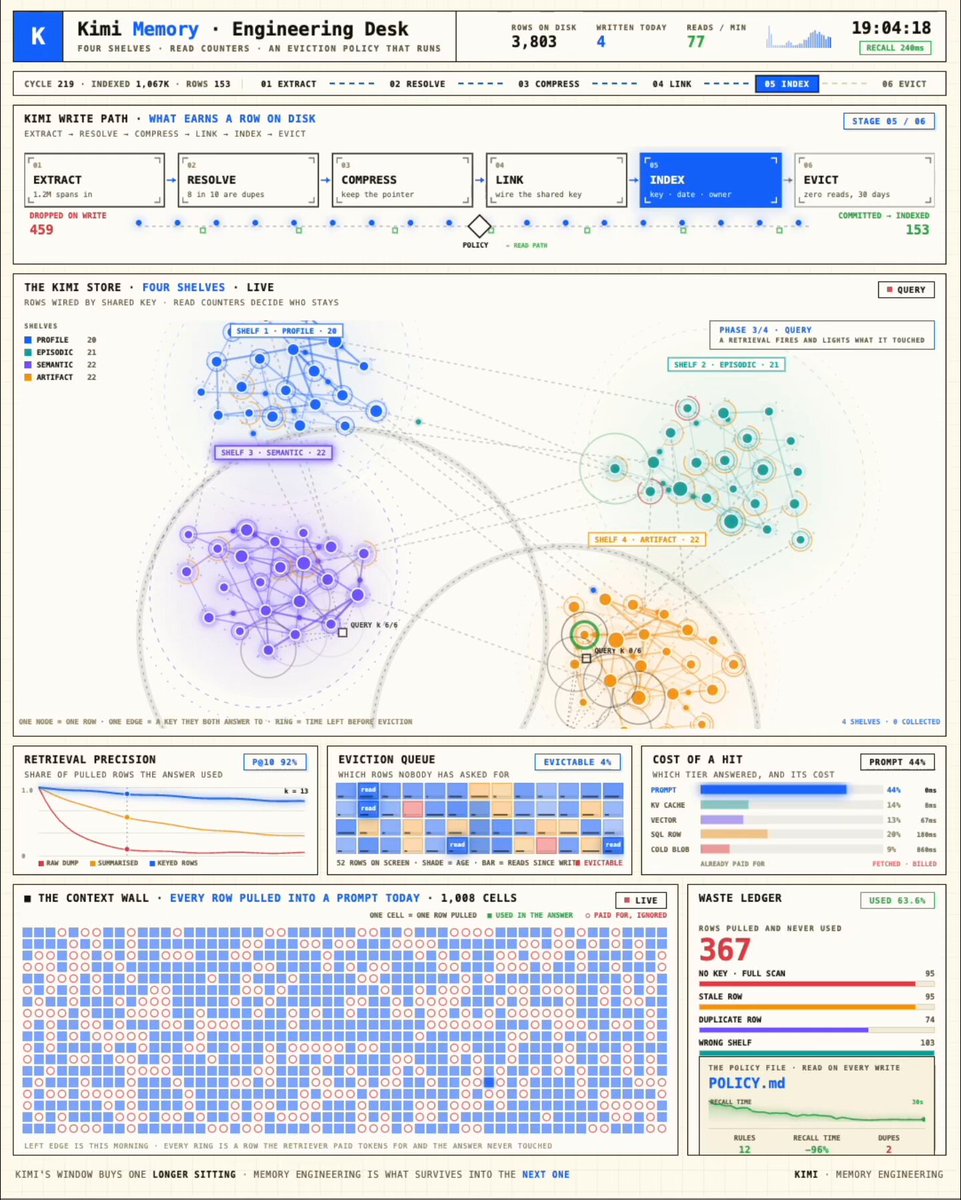
Engineer runs a Kimi K3 memory layer that costs $11 a month and remembers what a $500,000 vector database keeps losing. No embeddings. Four nodes and one rule about what's allowed to be forgotten. He published the whole schema. His version starts from the opposite idea. Memory is not a pile you search. It's a set of claims that expire unless something keeps paying to keep them. Four nodes. Every memory carries a clock someone has to reset: > WRITER - stores a fact with the reason it mattered, never raw text > DECAY - ages every memory down. Silence is deletion > RENEWER - only re-lifts a memory the model actually used again > GRAVE - holds what died, and why nobody reached for it Three nodes keep memory alive. One keeps the dead ones. Recall isn't storage here. It's rent a fact has to keep earning. That's the entire design. When everything is remembered forever, the useful and the stale retrieve identically. He replayed two months of agent context. 90,000 stored facts. 71,000 never retrieved once. The vector store returned all of them on similarity. Similarity graded closeness. Nobody graded whether the memory was ever right. Everyone else stuffs more into the context window and calls it memory. He built a layer that lets a fact die unless it keeps proving itself. The cost isn't storage. It's finding out how much of what your agent "knows" it has never once used. The article below is the full build - node prompts, the decay curve, the renewal rule. Save it. You'll want it open in the other tab.

wast3

64,039 views • 2 days ago

i just built a 4-agent software team. everything runs from Telegram and gets managed on a kanban board. a project manager who plans the work, a backend developer, a frontend developer, and a tester. the PM reads a goal, breaks it into linked tasks, and assigns each to the right agent. the thing that makes them a team instead of four strangers is a shared kanban board. every task is a row that survives crashes, and when an agent finishes, it writes a summary of what it built and what the next agent needs to know. the next agent reads that summary before it starts. so the frontend developer never has to guess the API shape, and the tester knows exactly what to verify. the hardest part was not the coordination. it was building an agent that could actually act like a backend engineer. a backend engineer stands up a database, wires auth, manages storage, deploys functions, and keeps all of it consistent while the rest of the team builds on top. an agent doing this from scratch drowns. it burns its context window remembering which tables exist and which endpoint it created three steps ago, and the work degrades fast. so the backend agent needs a backend built for agents, not for humans clicking through a dashboard. that is where InsForge came in. it is an open-source, agent-native backend, and i added it to my backend developer agent as a skill. a skill is a step-by-step guide that teaches the agent how to do a specific kind of work. with InsForge installed, the agent stopped improvising infrastructure and followed a reliable path: create the project, define the database, set up auth, deploy functions. to test the whole team, i had them build a working Google Docs clone, AI features included. the backend agent spun up the full service on its own. database tables, user auth, document handling, and edge functions running real TypeScript, all in one dashboard. the frontend agent read that summary and built the UI on top of it, and the tester closed the loop. the result was a backend an agent could reason about end to end, instead of one it kept getting lost inside. if you are building an AI backend engineer, InsForge is worth a look, it's 100% open-source. InsForge GitHub: (don't forget to star 🌟) the full article on Hermes Kanban: Mission Control for your Agents is quoted below.

Akshay 🚀

122,548 views • 2 months ago

Agents vs. Graphs, clearly explained! spawning more agents is great, but it has a ceiling nobody says out loud: five agents is a count. a graph is a shape. only one of them changes the answer. point five agents at the same pile with the same window and they converge. the first one writes a finding, the rest read it, and all five reports centre on the same thing. you paid five times for one opinion with four echoes. Graph engineering fixes this by moving the decision up a layer: not how many agents, but who is allowed to look at what. you need both. here's how it works: ↳ the count buys you throughput. five things happening instead of one ↳ the shape buys you coverage. five different things happening instead of the same one five times Prompts → Context → Harness → Agents → Graphs the node that does this is the splitter, and it decides more than any other node in the system. cut a repository by folder and four workers audit the same three files. cut it by blast radius and each one sees something the others cannot. the trick is being selective about what each lane is allowed to see. separate contexts are not a nice-to-have, they are the mechanism. if two agents are meant to produce different things, they must not share a window. if they are meant to produce the same thing, you did not need two agents. one thing to know before you scale it. a branch that throws does not reject the batch. it resolves to null, and that is the containment. which means your merge quietly receives a short list. ↳ filter the nulls before the merge, or one dead lane poisons the whole result ↳ never index a merge by position. eight good branches and one failure will shift everything by one, silently skip that and the run looks like it worked. the output is just missing a lane, and nothing errored. and the one that eats whole nights: multi-agent setups can use up to fifteen times the total tokens of a single chat, because every lane reloads its own core. you are trading total tokens for a clean main window. usually the right trade, always a choice. below i have quoted my full guide on graph engineering. it covers the three topologies, the verifier patterns, and where the gate should actually open. save this and read it below ↓

Hanako

95,369 views • 6 days ago