Video yükleniyor...
Video Yüklenemedi
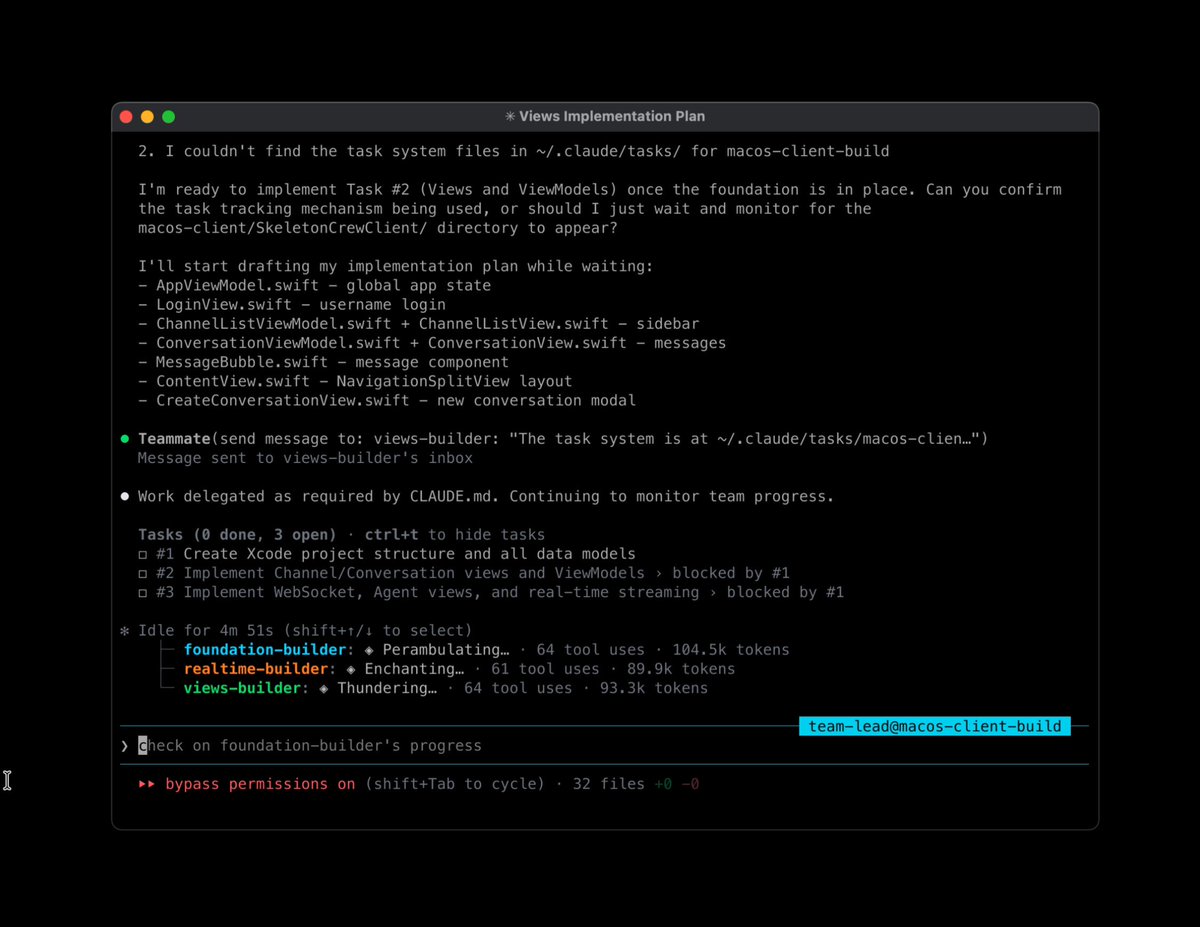
ANTHROPIC JUST QUIETLY SHIPPED A FEATURE THAT LETS CLAUDE SPAWN A WHOLE TEAM OF AGENTS THAT MESSAGE EACH OTHER AND REVIEW EACH OTHER'S WORK. It's a Claude Code feature called agent teams. The team lead spawns multiple agents that share a task list and message each other directly, not... show more

462,665 görüntüleme • 3 ay önce •via X (Twitter)
38 Yorum

3-4x the tokens is a lot to commit to

yes, worth installing

Agent Teams has been a thing since Opus 4.7 was released. 🙃 FYI, best used with tmux.

people just be writing bullshit these days. agent teams has been out for a while, its not "JUST QUIETLY SHIPPED"

agent teams are the real unlock
totally agree

This isn’t something new, it has been for a while since February

bookmarked, thanks for the alpha!
glad it worked

agent teams feel perfect for work that can actually split in parallel
100%

Agent teams has been out for some time tbh you needed to set it in settings.json However 4 to 7 times the tokens is a high price.

is anyone actually shipping prod with this or are we just watching agents have meetings with each other for 4x the tokens??

the launch is very simple
yeah, anyone will figure out

Very good

Been using this for awhile lol Tip make a c level board of directors

the task-list sharing is the part that actually matters. spawning agents is easy, keeping them from clobbering each other isn't. worktree isolation per agent is what makes parallel edits not stomp the same files.

Agent teams are a real step up, but parallel agents without a shared plan just produce parallel mess faster. The team lead is only as good as the architecture and task graph it's coordinating around. The planning layer is what turns spawned agents into an actual team.

Came back a week later, found new layers I missed

wooow, first time see it thx bro, will try

Shipped? This is in for like a year now way before workflows etc.

I think in future it will be better else

@thsottiaux when in Codex ?

nice vid, will read your article also soon, a really exciting feature

This has been out for months man

Been doing this for a while. If you want to check it iut, is open source and self hosted optional. AGPL.

Want a quick way to spend loads of cash. You have found it! I can’t help but think these people are getting paid by Anthropic?

Highly inefficient for anything except rapid prototyping or full Dev team replacement. If you’re growing rapidly, solo-pioneer, or Scrooge McDuck replacing humans with tokens/silicon this makes sense.

sounds like a really cool feature, but is it really sustainable with x3-4 tokens spend, on top of the fact that claude is the most expensive LLM API already? Still pretty useful for people with budget and tight deadlines

I literally do this manually with 3 terminal windows. if this is native now I'm both excited and unemployedI literally do this manually with 3 terminal windows. if this is native now I'm both excited and unemployed

and it only uses 10x more tokens and takes 20x as long!!!!!! But hey at least you could use Fable..... oh wait

What’s fascinating is that the org chart survived. We just replaced some of the people with agents.

This have been around for a long time...not released recently.

The agent teams feature has been there for half a year already

这个我也刚看到,确实挺突然的。说实话 agent team 这个方向很有意思,但我现在更关心它会不会乱开会、狂烧 token。能把互审做稳,比单纯多几个 agent 更有用。

This is over a year old

I’d only turn this on when the work has real seams: frontend, backend, QA, docs. If 3 agents touch the same file, the token bill becomes a coordination tax. The win is separate contexts plus one boring merge note at the end.




![Cursor pays engineers $1,100,000 a year to run teams of AI agents that ship code while they sleep. [The CEO of Cursor explained in 9 minutes how they ship at 100x speed using team of agents] ↓ Save this before everyone copies the playbook 1. Engineers no longer babysit one assistant. They manage dozens of agent colleagues working in parallel, each on its own remote machine 2. Validation contract before code, not after. Humans only at scoping and review. 3. The agent team handles the full loop : planning, coding, testing, shipping PRs with each agent specialised for a role. Watch the guide. Then read the guide below by Khairallah AL-Awady](https://image.24vids.com/tw-2055238100079808996/amplify_video_thumb/2055237607102275584/img/H4NmAUz6Dh-Ed08r.jpg)


![9 out of 10 multi-agent projects never leave demo mode Not because the model is bad. Because the structure is missing. Most people who try to build [ a team of AI agents ] end up with one agent talking to itself in five tabs. The agents don't share context → Don't divide work → Don't know what the others are doing. > stage 1: if your agent doesn't have a real loop, observe, act, iterate, you have a long prompt, not an agent > stage 2: subagents need isolated context, the orchestrator never reads their raw transcript, only the summary > stage 3: the orchestrator plans and delegates, the moment it executes, it drowns in details that belong inside subagents > stage 4: without a shared task list it's not a team, it's five agents duplicating each other's work in parallel > stage 5: a permissions file is what lets you sleep, the model cannot bypass it because the rule lives outside the model a team of AI agents is not more model, it is more structure the most ignored stage in every demo that died: - durability... when a 50-step task crashes at step 47 and starts from zero, that's not a model failure. that's a missing write-to-disk call](https://image.24vids.com/tw-2061202722461032671/amplify_video_thumb/2061202558102765572/img/haz59oXOMNyT0YLc.jpg)
