Video yükleniyor...

Video Yüklenemedi

Ana Sayfaya Dön

👋 Austin — we’re back! ✨ Bitcoin Builder ATX returns with a Bitcoin Builder fireside ft. Jimmy Song (송재준), hosted by Car, Cofounder of PlebLab. Why Jimmy? 🧠He has over 20+ yrs coding. Major #Bitcoin contributions. Taught at UT Austin, Entrepreneur. Author: Programming Bitcoin, The Little Bitcoin Book, Thank...

20,522 görüntüleme • 11 ay önce •via X (Twitter)

0 Yorum

Yorum bulunmuyor

Orijinal gönderinin yorumları burada görünecek

Benzer Videolar

BITCOIN RAILS EPISODE #16: How Alkanes Are Changing the 'Programmable Bitcoin' Meta—and paving the path for true interoperability with Oyl Dynamics Airhead - Building Alkanes founders Tagga & RWP IV The founders of Oyl have been obsessively focused on making the Bitcoin trading experience as seamless and flexible as on other chains. This effort has led to a series of experiments, including the creation of Alkanes—one of the first programmable metaprotocol implementations on Bitcoin—and perhaps the only implementation pushing towards interoperability as a goal. In this episode, the Oyl boys and I sat down to discuss: - The real and perceived technical limitations of Bitcoin (and where Bitcoin surprisingly outperforms). - The "Programmable Metaprotocol" Boom and how Proto-Runes & Alkanes change the narrative - Why "composability" and interoperability are the real end game for Bitcoin metaprotocols - Oyl’s collab with Arthur Hayes on Airheads and why Ordinals may outperform tokens for fundraising This episode is powered by Best In Slot—the leading API for Ordinals and BRC20 data aggregation and indexing. This episode can be viewed on YouTube: or Spotify here: TIMESTAMPS: 00:30 What is Oyl Dynamics? 02:30 Alec’s entry into Ordinals 05:33 The need for Bitcoin wallets and indexing 06:50 Indexing with Bitcoin vs Ethereum nodes 09:10 Selling indexing tools to Bitcoin builders 10:10:Metashrew: Spinning up any Bitcoin metaprotocol 12:00 Ethereum vs Bitcoin wallets 12:55 Unisat and OKX dominating the indexer 13:55 The hardest asset should be easy to trade 15:05 How BRC20s and Domo influence Oyl’s design 16:00 Aggregating marketplace data for Runes, Ordinals, BRC20s 18:00 Building a trustless AMM for Bitcoin 18:40 From BRC20s, to Runes, to Programmable Runes 22:20 What does “composable” mean? 25:30 Alkanes: creating interoperability between all of the Protorunes 29:55 The Oyl strategy: ultimate builder support 33:10 Solving cross-metaprotocol interoperability 35:00 The spectrum of programmability on Bitcoin 36:00 Casey’s genius with Runes 37:20 Where did the name “Alkanes” come from? 39:00 Only BTC needed at Alkanes 40:20 Using Ethereum as Bitcoin’s testnet 42:00 Are there unique advantages of building on Bitcoin? 43:00 What is special about Wasm? 44:25 Will Wasm overwhelm EVM’s network effects? 46:10 Is there any downside to building with Wasm? 49:00 Wasm wasn’t ready when Ethereum launched 50:25 Oyl’s Ordinal Collection: Airheads and Arthur Hayes 54:38 Marketing tied to an asset you can trade 55:30 Fundraising and Oyl’s $DIESEL EXP system 01:00:20 How do people mine $DIESEL?

Isabel Foxen Duke⚡️

34,529 görüntüleme • 1 yıl önce

🎙️Bitcoin, Texas & the Fight for Sovereignty Ep. 80 with Parker Lewis My guest today is Parker Lewis, the author of “Gradually Then Suddenly” and head of business development at Zaprite. A long-time fixture in the Bitcoin community, Parker is known for making complex monetary ideas accessible and for championing Bitcoin’s role in restoring long-term thinking, personal responsibility, and economic sovereignty. Born and raised in Austin, Texas, Parker is a vocal advocate for the state’s unique culture of freedom and its potential to lead the next chapter of Bitcoin adoption. In this episode, we explore why Texas attracts high-agency individuals and how its frontier history shaped Parker’s views on liberty and resilience. We also dive into the debate around OP_RETURN, what it reveals about centralization risks in Bitcoin Core and mining, and why Parker believes a second implementation of Bitcoin software may be critical to preserving the network’s decentralization. This is a conversation about the roots of sovereignty and the technical vigilance required to protect it. ► If you got value, please like, comment, share, follow and support my work. Thank you! 00:00 Coming Up… 01:26 Intro to Parker, TFTC Takeover & Bitcoin Park Austin 04:12 Why is Texas a Hub for Freedom? 08:18 Ad Break: Trezor & BTC Prague 09:40 The Cultural Significance of Texas History 21:08 Gradually, Then Suddenly: Understanding Bitcoin's Adoption 29:00 Ad Break: Plan B / Expat Money & New Totalitarian Order Masterclass 31:00 Shortcomings of Cash as a Fiat Currency and the Need for Bitcoin 38:30 Bitcoin's Future as a Medium of Exchange 51:01 Bitcoin in Action: Real-World Applications and Acceptance 53:20 OP_Return Saga: Parker’s Take & What Risky Precedence Is Being Set 1:03:00 Centralization & Decision Making Risks in Bitcoin 1:19:40 The Future of Bitcoin: Hope and Challenges 1:24:30 Message of Hope from Parker >>

Efrat Fenigson

39,395 görüntüleme • 1 yıl önce

E176: Eric Larchevêque - Why Bitcoin Is the Only Money You Actually Own Eric Larchevêque is the co-founder of Ledger, the hardware wallet used to secure billions in crypto worldwide. He built his first company from zero, sold it for €27 million, lost his savings in a Latvian bank collapse, had his gold bars confiscated by a Luxembourg bank, and went 100% Bitcoin in 2013. He's now building TBSO - La Société Bitcoin - a publicly listed company co-founded with NBA legend Tony Parker Timestamps: 0:00 Introduction 2:00 Eric’s First Podcast In English 2:32 Where Does Eric’s Optimism Come From 3:31 The First Thing Eric Thinks Of Every Morning 4:03 What Eric’s AI Agents Do 5:47 What Does Eric Do & Why 6:53 Are The Majority Of People Ready For Responsibility? 8:01 Why People Need To Hit A wall 9:42 When Did Eric Take Responsibility For His Future? 11:48 Eric Had No Idea What Building A Company Meant 12:39 Who Is Eric Larcheveque? 13:21 Eric’s First Major Leap For His Company 14:30 What Will Become A Commodity In 5+ Years 18:21 Going From Building Websites To Bitcoin 27:31 Partnerships: Trezor @BitwiseInvest 28:17 Why Eric Went All In On Bitcoin 34:37 Did Eric Question The Volatility Of Bitcoin 38:52 Eric Believes He Could Still Be Wrong About Bitcoin 40:24 100% Of Eric’s Liquid Networth Is In Bitcoin 41:39 Eric’s Explanation Of Bitcoin & Time Preference 46:50 Why Look At Bitcoin As A Long-Term Asset Only 49:59 You Should Build A Bitcoin Strategy 53:07 Where Does Bitcoin Go In 10 Years 54:47 What Does A Bitcoin Dominant World Look Like 59:24 Partnership: KAST 1:00:12 Why Bitcoin Will Never Hit 0 1:03:54 How To Understand Bitcoin, Explained Simply 1:10:47 What Eric Learned While Building Ledger 1:16:03 Co-Founder Kidnapping Discussion & Advice 1:23:11 How Eric Sleeps Knowing Bad Situations Happen 1:25:56 Why Eric Stays In France 1:27:23 Partnerships: Jupiter Ethena 1:28:07 What Is The Bitcoin Society 1:32:25 Who’s Backing Bitcoin Society 1:32:51 What Does Tony Parker Do With Bitcoin? 1:33:46 Eric’s View On Learning To Learn 1:34:38 Why Eric Creates Videos When He Could Chill 1:37:19 Is Eric Building A Personal Brand? 1:39:00 Does Eric Feel Happier Now With Money? 1:40:04 Being An Entrepreneur Requires Sacrifice 1:41:22 Experiences Over Buying Extra Bitcoin 1:44:06 Do Everything To Achieve This One Thing 1:45:11 Closing Thoughts

MR SHIFT 🦁

103,729 görüntüleme • 1 ay önce

Making Sense Of Strategy What is happening with $MSTR? If you’ve been following me on X for any meaningful length of time, you will know that I have been attempting to calibrate people’s expectations of the stock's performance for the best part of 2025. Here I have synthesised all of my thoughts and distilled them into a single video. If you prefer YouTube, you can watch it here: If you prefer written format, continue reading. The first thing we need to understand is what Strategy is and why people invest in it. Strategy At the highest level, Strategy is leveraged Bitcoin. That’s it. Strategy leverages debt to acquire more Bitcoin. Therefore, the main reason you invest in Strategy is because you want to outperform Bitcoin. The only thing better than Bitcoin is more Bitcoin. The second thing we need to understand is mNAV. mNAV Generally speaking for a pure-play Bitcoin Treasury Company like Strategy, mNAV is a reflection of the market's expectation of future Bitcoin Yield. Bitcoin Yield comes with diminishing returns because each additional Bitcoin purchase contributes less to Bitcoin Per Share. Thus, the larger your Bitcoin stack, the harder it becomes to generate Bitcoin Yield and by extension the harder it becomes to outperform Bitcoin. This is why on a Bitcoin Standard, over a long enough time horizon, mNAV trends towards 1 since the maximum amount of Bitcoin you can own is 21M. With all this in mind, why is Strategy trading where it is and why is it trading at such a low mNAV? There are a few reasons. 1. Strategy Is A Different Company In 2025 Firstly, Strategy is a totally different company in 2025 to the one it was in 2020. For context, believe it or not, the company only introduced Bitcoin Yield and Bitcoin Per Share in the July 2024 Q2 Earnings Call and so it was only after that that they began optimising for those metrics. In my view, that is also when Michael Saylor truly started to understand the opportunity that was in front of him, which is why in October 2024 we saw Strategy announce the 21/21 plan which became the catalyst for the parabolic run we saw in November 2024 where $MSTR went on to briefly hit an all-time-high of around $550. Since people are comparing $MSTR this cycle to the $MSTR of last cycle when it briefly traded at an mNAV of over 8x, it is distorting their expectations. Again, Strategy is a totally different company today with a totally different set of dynamics. 2. New Industry Secondly, we need to recognise that the Bitcoin Treasury Company industry is entirely new which means that the market has been forced to learn and adapt in real-time. With Strategy being the first and by far the largest Bitcoin Treasury Company, it has gained a disproportionate amount of attention and as a result it has attracted a disproportionate amount of speculative capital along the way while everyone has been trying to figure out how to value it. Consequently, in my view, the move we saw in November 2024 was an over-correction to the upside — which by the way coincided with Bitcoin’s parabolic run following Donald Trump’s election win — and what we’re now seeing is an over-correction to the downside. 3. Bitcoin Yield Thirdly, as I mentioned at the beginning, Bitcoin Treasury Companies are currently valued based on how much Bitcoin Yield they are expected to generate in the future. At the time of recording, Strategy currently holds precisely 637,460 Bitcoin — that’s over 3% of the total Bitcoin supply — which means that it is much, much harder to generate meaningful Bitcoin Yield, which again is why we’re seeing the mNAV compress. However, there is a caveat here. There is another metric that Strategy have introduced which is Bitcoin $ Gain. Bitcoin $ Gain is defined as the $ value of newly acquired Bitcoin within any period. Strategy — and I don’t blame them — have been attempting to encourage the market to interpret Bitcoin $ Gain as “earnings” and to value the company based on how much earnings it is expected to generate in the future. For full disclosure, I personally dislike Bitcoin $ Gain as a valuation metric. I think framing it as “earnings” is misleading and disingenuous. I understand why it has been introduced because it speaks the language of Wall Street. However, traditional earnings are final. Bitcoin $ Gain is not because it is forever subject to the price of Bitcoin. Therefore, for Bitcoin $ Gain to be embraced by Wall Street, the market must collectively agree that Bitcoin is going up forever. I remain very sceptical of that happening — especially in the short-to-medium term. However, I am also not attached to my beliefs and so if Wall Street does decide to embrace Bitcoin $ Gain as its primary valuation metric, then $MSTR is likely undervalued by a factor of 5-10x. If not, then $MSTR is likely undervalued by a factor of 1-2x. If you’re not content with the latter being the worst case scenario, then the stock probably isn’t for you. 4. Preferred Products Fourthly, the Strategy thesis right now revolves entirely around the success of its preferred products. Remember, Michael Saylor wants Strategy to become the Amazon of the fixed income market. Thus, we’re not talking about a small innovation here — we are talking about completely transforming global finance. This means that the process of generating awareness and educating the market that will ultimately drive demand for these products is going to take years — not months — which is why you need to have a long time-horizon. Presently, the market is completely discounting the success of Strategy’s preferred products. What it’s not factoring in however is that the capital markets are desperate for yield right now. Thus, when — not if — but when, they eventually wake up to Bitcoin, how do you think they’re going to get that yield? Who is going to be the entity that is offering Bitcoin-backed credit instruments at scale? The answer is obviously Strategy, but again, this is a 5-to-10 year and beyond story. So with all that said, if you’re reading this right now, what should you do? Valuing Strategy There are 3 steps you need to take: 1. Firstly, you need to define your time horizon. In other words, how long do you intend on holding the stock for? 2. Secondly, you need to estimate either — depending on your preferred metric — how much Bitcoin Yield or how much Bitcoin $ Gain you expect Strategy to generate during that period and then calculate how much you expect $MSTR to outperform Bitcoin based on those values. 3. Thirdly, ask yourself whether you’d be satisfied with the level of outperformance you have calculated? In other words, is the trade-off worth it? Or would you be better off investing in either spot Bitcoin, an alternative Bitcoin Treasury Company or a Bitcoin ETF. If you’re satisfied with the level of outperformance that you’ve calculated, then $MSTR it probably a good choice of investment for you. If you're not satisfied, then $MSTR is probably a bad choice of investment for you. I personally believe that $MSTR will outperform Bitcoin by a minimum factor of 1-2x over the next 5/10 years and potentially much more if Bitcoin $ Gain becomes the primary metric by which it is valued, but again, I remain sceptical of that happening. Regardless, the best is yet to come.

Chris Millas

36,835 görüntüleme • 10 ay önce

Making Sense Of Bitcoin Treasury Companies If you've been following me on X you’ll know that I have recently been floating a lot of my updated thoughts on the Bitcoin Treasury space. Here I have synthesised all of my ideas and distilled them into a single video. If you prefer YouTube, you can find the link in the comments. If you prefer written format, continue reading. The first thing we need to do is acknowledge an important fact which is that Strategy, as a Bitcoin Treasury Company, is an anomaly. What do I mean by that? Strategy’s success has been defined by a number of unique factors and circumstances, most of which cannot be replicated again by other Bitcoin Treasury Companies. Specifically, there are 6 things that stand out to me. 1. Before adopting Bitcoin, Strategy was a billion dollar company with an operating business that was generating roughly $50M in cash a year. 2. Until the introduction of the ETF's in January 2024, Strategy was the only way for the average investor to gain passive exposure to Bitcoin. 3. Until this year, Strategy was the only way for the average investor to gain leveraged exposure to Bitcoin. 4. Strategy was issuing multiple, billion dollar, zero coupon, unsecured convertible notes at +50% conversion premiums. 5. Strategy has Michael Saylor, who, you don’t need me to tell you, is in a league of his own. 6. For many reasons, including those I’ve just mentioned, Strategy has benefitted disproportionately from the broader sentiment around Bitcoin. In other words, for the best part of 4 years, Strategy had zero competition for either capital or attention. As a result, it became a magnet for capital from anyone who wanted exposure to Bitcoin and it attracted inflows that were beyond what fundamentals alone would maybe justify. Therefore, using Strategy as a blueprint for the performance that you can expect from other Bitcoin Treasury Companies is a bad idea. Using Strategy as a blueprint for how to operate a Bitcoin Treasury Company is a good idea. Now let’s break down what’s unfolded over the last 6 months or so. Between May and June of this year, when we witnessed a flood of new Bitcoin Treasury Companies, we entered what I refer to as the frenzy phase. The frenzy phase was driven almost entirely by sentiment. By sentiment I simply mean emotion. Since then, as sentiment has slowly faded, the market has increasingly priced Bitcoin Treasury Companies based more on fundamentals. By fundamentals I simply mean facts. So where as sentiment is driven by emotion and hype, fundamentals are driven by facts and reason. The problem is that when you price Bitcoin Treasury Companies on fundamentals, you realise that many of them are almost entirely dependent on sentiment in order to expand mNAV so they can raise capital via the common stock ATM to buy Bitcoin and generate Bitcoin Yield. However, for me, raising capital via the common stock ATM and recycling it into Bitcoin is not genuine value creation — it’s value transfer. That’s not to say you shouldn’t leverage the ATM as and when necessary — you should. However, if your business model as a Bitcoin Treasury Company no longer works when “sentiment is low” then you have neither a business model nor a business. You’re the equivalent of a meme stock except with Bitcoin on your balance sheet. On that basis, companies shouldn’t expect to trade at a premium if the common stock ATM is the only way they raise capital. I’m not saying they won’t trade at a premium — I’m saying that companies shouldn’t expect to. Now, between July and now, we’ve obviously seen mNAVs compress substantially and so the frenzy phase is over which means that the days of automatically being granted generous mNAV multiples is also over. So now we are in the maturity phase. The maturity phase is going to be defined by being able to offer a differentiated value proposition and having a sustainable business model that can generate Bitcoin Yield in any environment independent of sentiment. In other words, they can generate Bitcoin Yield when trading at or below 1 mNAV. So essentially now, Bitcoin Treasury Companies have to work for their mNAV multiples — as it should be. Following the maturity phase will be the consolidation phase where capital, Bitcoin and ultimately market share will converge towards a small number of Bitcoin Treasury Companies that will dominate the entire industry. I should clarify that I am referring predominantly to pure-play Bitcoin Treasury Companies — companies who are valued based solely on their Bitcoin strategy. Now, with everything that I’ve said, how should you evaluate Bitcoin Treasury Companies? Hopefully over the next few weeks I’m going to string together a video with my valuation framework. In the meantime, a basic test is that I use is this: How much Bitcoin Yield can the company generate over X period of time — you decide what that period of time is — if it traded at 1x mNAV over that entire period? If the answer is 0, then they are probably entirely dependent on raising capital via the common stock ATM which means they likely don’t deserve a premium. If the answer is >0, then they are probably innovating through the use of other instruments — like converts and preferred products — which means they likely do deserve a premium and so whatever number you come up with should be used as the base for your valuation. Now, don’t be fooled. The Bitcoin Treasury Company space is, not entirely, but to a large degree, a zero-sum game. Every Dollar raised by one Bitcoin Treasury Company is at the expense of every other Bitcoin Treasury Company. Every Bitcoin purchased by one Bitcoin Treasury Company is at the expense of every other Bitcoin Treasury Company. It’s only because we are early that everyone is incentivised to essentially hold hands and cheer each other on. However, make no mistake, everyone involved is tacitly well aware that they are all competing for the same finite amount of capital and the same fixed amount of Bitcoin. Thus, the reality is that, by definition, not every Bitcoin Treasury Company is going to succeed. So choose your horses and jockeys wisely. As a side note, with the amount of Bitcoin Treasury Companies now desperately chasing and competing for the same capital from institutions, who do you think has the leverage; the Bitcoin Treasury Companies or the institutions? I’ll let you decide. Before I close, I want to leave you guys with this. There is a small subset of people invested in Bitcoin Treasury Companies who are desperately clinging on to their bags because they believe “sentiment will return.” These people are completely missing the point. My friends, if your investing philosophy is based on sentiment, you are simply not going to last. You want to base your decisions, as far as possible, on fundamentals. As investors, you either adapt and update your mental models based on how things are and not how you want them to be — or you get left behind. With that in mind: Never get caught up in tribalism. Never get attached to your beliefs. Always think critically. Always think independently. Always seek Truth.

Chris Millas

34,483 görüntüleme • 9 ay önce

BITCOIN RAILS EPISODE #13: Searching for "Real Yield" on Bitcoin | With Core DAO 🔶 contributor richrines.core 🔶 Even the most hardline Bitcoin maxis would be hard-pressed not to admit that if there was a safe, trustless, and permissionless way to get yield on their Bitcoin—they might be interested. The question really is—how would that work? What does that look like? And is that possible? I brought on CoreDAO contributor Rich Rines to discuss, largely because—little known fact—they are currently the largest TVL 'scaling solution' on Bitcoin offering staking. Not an episide to be missed if you are a builder or entrepreneur in the space... Rich has strong opinions on why the dog-eat-dog approach to building doesn't work—and what founders should be focused on instead. This episode is powered by Best In Slot—the leading API for Ordinals and BRC20 data aggregation and indexing. This episide can also be seen on YouTube or Spotify—linktree in bio. TIMESTAMPS: 00:50 What is CoreDao? 01:50 Satoshi+: How Core Network is secured 02:55 What’s wrong with Merged Mining? 04:00 How CoreDao contributes to Bitcoin security 05:10 Is CoreDao a Bitcoin L1 or an L2? 06:27 Creating native staking yield for BTC 08:30 Yes, the staking is trustless 10:00 Why proof of stake doesn’t need slashing 11:10 There is no trustless slashing on Bitcoin today 12:50 How CoreDao hit product-market fit 14:30 What problems does CoreDao solve? 16:20 BTC is collateral - not currency 17:10 How did Core’s TVL grow so fast? 20:00 Converting normies to Core 21:35 Core’s “fair launch” token approach 24:50 Why bother with crypto tribalism? 26:00 The death of VC tokens, rise of fair launches 30:50 Could utility coins boom now that Trump is back? 33:20 Who will survive in this token market? 36:30 Market saturation and lack of flows 39:40 Bitcoin staking through ETFs? 41:35 Institutional vs retail staking with Core 43:30 Cool technology is not enough 46:15 Stacks and its staying power 47:10 Rich’s advice: play infinite games 48:55 Growing to scale and fee revenue 50:45 The biggest potential use case: lending/ borrowing 54:15 Rich isn’t bullish on OP_CAT happening soon… 56:30 …but is still cheering for Taproot Wizards

Isabel Foxen Duke⚡️

34,866 görüntüleme • 1 yıl önce

El Salvador: Pioneering a Bright Future Through Innovation and Vision In recent years, El Salvador has emerged as a beacon of innovation and progress under the visionary leadership of President Nayib Bukele. From groundbreaking legislation to transformative initiatives, the country has been at the forefront of ushering in a new age of growth and development. In this article, we delve into El Salvador role as a global leader of Bitcoin and the positive trajectory for its economic and technological future El Salvador made history by being the first country to enact the Bitcoin Law, establishing a legal framework for the use of cryptocurrency in everyday transactions. This landmark legislation was followed by the creation of the Strategic Bitcoin Reserve, signaling the country's commitment to embracing digital currency as a means to drive economic empowerment and financial inclusion. Further cementing its position as a trailblazer in the digital realm, El Salvador unveiled the first Bitcoin Embassy, a hub for fostering innovation and collaboration within the cryptocurrency ecosystem. In a bold move, the country also implemented the first AI Law and Robot Law, setting the stage for the ethical and responsible integration of artificial intelligence and robotics in various sectors. Expanding its technological footprint, El Salvador introduced the cutting-edge B300 chips, demonstrating its commitment to advancing digital infrastructure and connectivity. In a bid to foster financial literacy and empowerment, the country launched the first financial literacy program for public schools, equipping the younger generation with the tools to navigate the complexities of modern finance. El Salvador's visionary approach extended beyond technology and finance with the introduction of the first Blue Ocean Strategy of the 21st century, charting a new path for sustainable growth and innovation. President Bukele's leadership has been instrumental in shaping El Salvador's trajectory as a forward-thinking nation that embraces change and progress. President Bukele, hailed as the first Great Man in modern history by many, has been instrumental in spearheading these transformative initiatives and propelling El Salvador into a new era of technological advancement and economic prosperity. His vision and leadership have not only earned global recognition but have also inspired a wave of optimism and innovation within the country. Bitcoin Historico: El stage is set for a groundbreaking moment in San Salvador as El Salvador gears up to host the highly anticipated "Bitcoin Histórico" event on November 12 and 13, 2025. This event signifies a pivotal moment not only for the country but for the entire global Bitcoin ecosystem. With the National Bitcoin Office (ONBTC) at the helm, "Bitcoin Histórico" is not simply a conference on financial technology; it is a cultural, educational, and economic festival designed to bring Bitcoin closer to all Salvadorans. This event will shine a spotlight on El Salvador's trailblazing role as a pioneer in the adoption of cryptocurrency. Gathering some of the most notable figures in the Bitcoin ecosystem, including luminaries like Don Ricardo Salinas Pliego, Max Keiser, Milena Mayorga, ZUBY:, Jeff Booth ⚡️, Jack Mallers, Pierre Rochard, Jimmy Song (송재준), isa⚡️, Bitstein, Darin Feinstein, Giacomo Distributed-AuthoritariPuritan Zucco⚡️🌋🧀, …::: jon, wiz 🇸🇻, Fadi Elsalameen فادي السلامين ⚡️, Knut Svanholm ∞/21M, Preston Pysh, Efrat Fenigson, Lina Seiche, Eric Yakes and Stacy Herbert 🇸🇻🚀, "Bitcoin Histórico" is poised to be an unprecedented gathering of minds. Through keynote addresses and panel discussions, attendees will explore topics such as the future of money, monetary sovereignty, and the cultural implications of decentralization. However, what truly sets "Bitcoin Histórico" apart is its inclusive nature. The event promises a wide array of activities for attendees of all ages, from face painting for children to mural creation for youth. The highlight of the festival will be a professional mural painted by graffiti artists, showcasing Salvadoran creativity and innovation. For those eager to delve deeper into the world of Bitcoin, free classes will be offered by students from the CUBO+ program, providing an educational opportunity for all. Moreover, the event will feature live translations of keynote speeches on giant LED screens, ensuring that the insights shared reach a wide audience. "Bitcoin Histórico" is a celebration of not just technology but also of culture and community. By opening its doors to the public and offering free activities, El Salvador aims to democratize access to Bitcoin knowledge and foster a spirit of innovation among its citizens. As El Salvador continues to make strides in the realm of cryptocurrency, "Bitcoin Histórico" stands as a testament to the country's commitment to embracing the future. By hosting this historic event, El Salvador is not only solidifying its position as a global epicenter of Bitcoin but also projecting a vision of optimism for its economic and technological future. "Bitcoin Histórico" is more than an event; it is a declaration that a new era requires new ideas and new thinkers. Join Bitcoin Historico in San Salvador on November 12 and 13, 2025, as El Salvador embark on this transformative journey towards a decentralized future. To learn more about the event and secure your spot, visit and be a part of history in the making. Embrace the future with El Salvador, the pioneer of Bitcoin country. For further updates, follow The Bitcoin Office and Stacy Herbert 🇸🇻🚀 on Twitter. "Come to Visit El Salvador and make history, we invite you to live “The Salvadoran Dream” where we dare to dream, dare to innovate, dare to believe in the limitless potential of a nation that is rewriting its own story. El Salvador: where innovation meets inspiration, and the future is ours to shape." #Bitcoin #ElSalvador #NayibBukele

Translating El Salvador

23,975 görüntüleme • 9 ay önce

Good afternoon, everyone. It was an honor to meet everyone and talk with you at MSTR True North World — among friends, pioneers, skeptics, and the quietly curious. Since January of 2021, I’ve been studying Bitcoin. And over the last 6 months, I’ve spent more than 121 hours interviewing executives, analysts, allocators, CFOs, board members, and everyday Bitcoiners across New York, Miami, Boston, Paris and beyond. I’ve sat in boardrooms and basements, on stages and at poolside bars. I’ve heard ideas sharpened by experience — and caution shaped by capital risk. And what I’ve come away with is simple: Bitcoin treasuries are no longer theory. They are becoming practice. Quietly, strategically, and at the edges of the legacy system. I've come away with three lessons. Lesson 1: No one’s asking “why” anymore—they’re asking “how.” The shift is subtle, but it’s everywhere. In 2021, the question was: Why would we hold Bitcoin on a corporate balance sheet? In 2023, it became: What are the risks? How do we explain this to auditors and boards? Now in 2025, it’s: What’s our timing strategy? What percentage makes sense? Which vendors do we engage with for custody and beyond? Lesson 2: The conversation isn’t just financial—it’s philosophical. This isn’t just about a hedge—it’s about preparing for a world that feels less anchored. Bitcoin represents something beyond volatility charts. It’s about opt-out optionality. It’s about control. That’s why it’s attractive to sovereigns, startups, and mid-market CEOs alike. Lesson 3: Geography matters—but mindset matters more. In El Salvador, Bitcoin is infrastructure. In Paris, it’s a hedge against monetary orthodoxy. In New York, it’s a bet on innovation. But everywhere I go, the common thread isn’t politics or price—it’s resilience. The smartest people in capital markets today are quietly exploring how Bitcoin can help them withstand turbulence — not chase returns. The world is shifting beneath our feet. Inflation targets are guesses. Debt ceilings are flexible. Global trust in fiat systems is fraying. And in that context, Bitcoin isn’t just a tech play — it’s a strategic reserve choice. The positioning has shifted. We’re no longer betting on Bitcoin. We’re acknowledging it. That’s the future we’re walking into — not maximalist or minimalist, but realist. Realists are saying: “Let’s not put 100% of our reserves into this—but let’s not ignore it either.” They’re adding 1%, 2%, 3%—quietly. And what that means is: the next chapter of adoption won’t necessarily be loud. It’ll be layered into spreadsheets, policies, and quarterly risk disclosures. But none of this happens in a vacuum. Bitcoin isn’t just about bytes and blocks — it’s about people. The community I’ve met through these 121 hours—analysts, entrepreneurs, regulators, CFOs—they all have something in common: They’ve had the conversation. They’ve questioned the system. They’ve reached for something sturdier, even when it felt risky. In that way, Bitcoin treasuries aren’t just about capital reserves. They’re about emotional reserves. About saying: “We want to build something we believe in—even if it’s hard to explain on CNBC.” So what’s next? We’re entering a phase where Bitcoin will coexist with the legacy system—not replace it overnight. Treasuries won’t go all in. But they’ll lean in. They’ll study, they’ll test, and eventually, they’ll move. And as that happens, it won’t be a parade. It’ll be a process. So my invitation to you—whether you’re a Bitcoiner, a builder, a skeptic, or a steward of capital — is this: Keep having the conversation. Keep asking “how.” And most importantly—stay connected to the people who are asking questions of you. Because at the intersection of code and community, we’re building the next generation of financial truth. Thank you. Let’s keep going.

Tim Kotzman

30,181 görüntüleme • 1 yıl önce

BITCOIN'S "DIGITAL GOLD" NARRATIVE JUST FAILED ITS BIGGEST TEST While gold surged past $5,000 and silver hit record after record... Bitcoin dropped 6% in 2025. Silver is up 138%. Bitcoin? Down 30% from its October high. The "digital gold" thesis is collapsing. But here's what most people are getting wrong about WHY... My good friend Michael Howell at CrossBorder Capital/ GLIndexes nailed it: This isn't a "Great Debasement" trade. If it were, Bitcoin would be celebrating and bonds would be in freefall. Neither is happening. THE REAL DRIVER: CHINA The People's Bank of China has added $1.1T to Chinese money markets over the past year. And they'll likely do the same again this year. This aggressive monetary debasement is pushing Chinese residents into gold as an inflation hedge. You see, Chinese residents are big gold buyers but NOT big Bitcoin buyers. Why? The PBoC banned cryptocurrencies onshore. So when China prints money, it flows into gold, not crypto. And because the Yuan is stable against the dollar (capital controls and trade surplus), changes in the Yuan gold price transmit virtually 1:1 into the US dollar gold price. Bitcoin gets none of this flow. THE LIQUIDITY PROBLEM Michael's research shows something critical: Cryptocurrencies are the most liquidity-sensitive assets on the planet. And Global Liquidity is starting to slow. During the last liquidity downswing from late 2021 through 2022, Bitcoin fell from $65k to under $20k. In the next upswing, it gained over $100k. Now liquidity is peaking again. Bond term premia have stopped rising. Bitcoin is flatlining. The correlation between Global Liquidity and Bitcoin is ironclad. And the cycle is turning against crypto. THE OCTOBER CRASH EXPOSED EVERYTHING On October 10, 2025, Trump's 100% China tariff threat triggered the largest single-day liquidation in crypto history. $19B wiped out in 24 hours. 1.6M accounts blown up. Bitcoin plunged from $126,000 to below $105,000. Order book depth collapsed 98%. This was a stress test And Bitcoin failed. THE "HEDGE" THAT ISN'T During recent geopolitical tensions over Greenland: Gold rose 8.6%. Bitcoin dropped 6.6%. NYDIG found that Bitcoin behaves like an "ATM" during crises. Investors sell it first to raise cash. That's not a hedge. That's a liquidity source. Meanwhile, central banks are buying gold at record levels. They're not touching Bitcoin. THE MINING DEATH SPIRAL Hashprice - the key profitability metric - fell to $35-36 per PH/s/day in November. Below breakeven for most operations. 2025 was the "harshest margin environment of all time." ROI on new mining rigs? 1,000 days. In 2017? Same equipment paid for itself in 3-6 months. AI data centers are outbidding miners for cheap electricity. The squeeze is structural. WHERE THIS IS HEADING Paolo Ardoino, Tether's CEO, said it himself last week: "There are foreign countries buying a lot of gold, and we believe these countries will soon launch tokenized versions of gold as a competitive currency to the US dollar." Gold is being repositioned as foundational collateral beneath a fragmented digital monetary landscape. The BRICS are building gold-backed currencies to accelerate dedollarization. And ironically, the US will use gold-backed stablecoins to DEFEND the dollar's dominance. Gold, forever the bane of the dollar's existence, is being resurrected as its savior. A new monetary age is coming. And Bitcoin isn't part of it. MY TAKE My good friend Michael is right: Monetary debasement is a long-term investment strategy, not a short-term trade. But Bitcoin's cycle is no longer a simple 4 year halving cycle based on supply. It's a complex demand cycle driven by Global Liquidity. And that liquidity is peaking. When Chinese liquidity floods into gold while Bitcoin sits banned on the mainland... When Global Liquidity peaks and crypto flatlines... When the asset fails every stress test thrown at it... There's a serious problem.

George Noble

133,893 görüntüleme • 6 ay önce

A central bank. And Bitcoin. My speech at The Bitcoin Conference 2026 in Las Vegas on 28 April 2026. Video and text; the slide link is below: Today, I want to talk about a strange combination: A central bank. And Bitcoin. Most people do not put these two things together. I do. In monetary policy, a central bank must be conservative. But it must think ahead. When I became Governor of the Czech National Bank in mid-2022, inflation in my country was close to 20 percent. Twenty percent. It was a serious moment. When I took office, I said we would bring inflation back to 2 percent within two years. And we did. Not with magic. With discipline. I said this clearly: Even before covid, money was too cheap for too long. For too long, the system promoted borrowing. For too long, the currency was weakened. We changed that. We kept policy tighter for longer. We supported saving. And the koruna became strong. That, for me, is conservative monetary policy. Our rule is simple: stay hawkish forever. We also manage very large foreign exchange reserves. Very large. We manage about 180 billion dollars in reserves. That is about 44 percent of GDP. Relative to the size of our economy, our reserves are among the largest in the world. So we have to build the right portfolio for the future. Here, you can see the long-term risk and return. It is based on Czech koruna data, the currency in which our books are kept. Bonds are at the low end. Low risk. Low return. Stocks and gold can offer higher returns. But they also bring higher risk. The next point is the Czech National Bank’s portfolio. Over the past four years, we increased the share of equities from 15 to 26 percent. We also increased the share of gold from almost zero to 6 percent. We built a diversified portfolio. A higher expected return than before. Lower risk than an all-stock portfolio. And even lower risk than an all-bond portfolio. But then came the next question. Can we do more? Can we build an even stronger portfolio for the future This is where Bitcoin comes in. The first time I used Bitcoin, I bought a coffee in Prague about ten years ago. Today, that coffee comes to about 350 dollars. It was the most expensive coffee of my life. Bitcoin has had very high returns. But honestly, it looks risky. It is much more volatile than other assets. One day, its price may be much higher. Or it could go to zero. Yes, zero. And that is true for other assets too. A stock can go to zero. Even a bond can fail. That is why it is not wise to bet on just one asset. We have to think about the whole portfolio. The next point on the chart is what we found in our new analysis. This is our model portfolio with 1 percent in Bitcoin. And here comes the interesting part. With 1 percent in Bitcoin, the expected return goes up. And the overall risk stays about the same. That is what our new study shows. Why? Because Bitcoin has low long-term correlation with many traditional assets. It does not move in the same way. And that matters. When you add an asset like this, the whole portfolio can work better. The return can go up. And the risk can stay about the same. That is diversification. Over the long term, Bitcoin can provide returns that are not closely linked to other assets. In some ways, it is similar to venture capital. But it is much more liquid. So we started a separate test portfolio with Bitcoin. A test portfolio. Not a revolution. Not a political statement. A test. We will run it for two years. Then we will publish the results. Then we will decide what comes next. Be conservative in monetary policy. Be innovative in how we work. This is the future. Česká národní banka

Aleš Michl

68,592 görüntüleme • 3 ay önce

BREAKING: $2.5 trillion just got wiped from global markets in 24 hours. Bitcoin crashed below $60,000. The Nasdaq dropped 4% in a single session. And every retail trader's feed is full of people posting their losses in real time... Bitcoin fell from $78,000 to $59,300 in 5 days. A 24% drop in under a week. $1.5 billion in leveraged crypto positions got liquidated in 24 hours. Long positions made up $1.28 billion of that. The fourth time in 5 days that daily liquidations crossed $1 billion. US spot Bitcoin ETFs have now posted 11 consecutive days of outflows. $3.5 billion pulled out by institutions in less than two weeks. Then the equity side cracked. Broadcom dropped 13%. Micron dropped 9.5%. SanDisk dropped 11%. Western Digital dropped 8.5%. Roughly $1 trillion in market cap erased from semiconductors alone. Strategy, the largest corporate Bitcoin holder on earth, dropped 10% after disclosing its first Bitcoin sale in years. 32 coins. $2.5 million. A rounding error against their $59 billion stack. It didn't matter. When the maximalist sells one coin, everybody else hears permission to dump everything. Now here's what actually triggered all of this. The May jobs report came in too strong. 172,000 new jobs against an 85,000 estimate. Prior months revised up by another 93,000. That single data point killed the rate cut narrative. If the economy is too strong, the Fed doesn't cut. If the Fed doesn't cut, risk assets get repriced. Crypto first. Tech stocks second. Everything else last. The entire rally of the past 12 months was built on one assumption. Rates are coming down. That assumption got vaporized in one report. And the market reacted exactly the way it always reacts: Panic. Right now Twitter is full of people posting their losses. "Down $40,000 this week." "Sold my entire crypto position." "Out of the market until things calm down." This is the exact moment retail always loses. Not because the market crashed. Because they're making decisions while watching the crash happen in real time. Every single one of these crashes follows the same pattern. October 2025: $19 billion in liquidations. The biggest wipeout in crypto history. Bitcoin made a new all-time high three weeks later. March 2026: S&P 500 dropped 7% on the Iran war. Retail panic sold at the bottom. The index recovered to a new all-time high in 18 days. February 2026: Bitcoin dropped 15% in one day. Two days later it had bounced 11%. Same script. Every time. The crash creates the opportunity. The panic transfers the assets. The people who sell at the bottom always fund the returns of the people who don't. Here's what's actually different this time: Crypto is no longer separate from equities. Bitcoin used to be the "uncorrelated asset." That story died this week. Bitcoin moved down with the Nasdaq. Down with semis. Down with tech. Down with everything. The diversification most retail investors thought they had? They never had it. They held the same trade in three different wrappers. A Nasdaq ETF. A Bitcoin position. A pile of tech stocks. All three crashed together because all three were the same bet on cheap money. This is the moment that exposes who has a system and who was just riding a narrative. The narrative investor sees their feed full of losses and panics. They sell at the bottom. They sit in cash through the recovery. They buy back in 6 months later when the headlines feel safe again. They have already locked in the worst possible outcome. The systematic investor sees the same feed and doesn't react. Because the system already decided what to do at every price level before today happened. Surmount was built for exactly this moment. Automated, rules-based strategies that execute when the market crashes, not when your emotions do. No panic selling. No FOMO buying. Just rules. Running. While everyone else is screenshotting their losses.

Surmount

48,046 görüntüleme • 1 ay önce

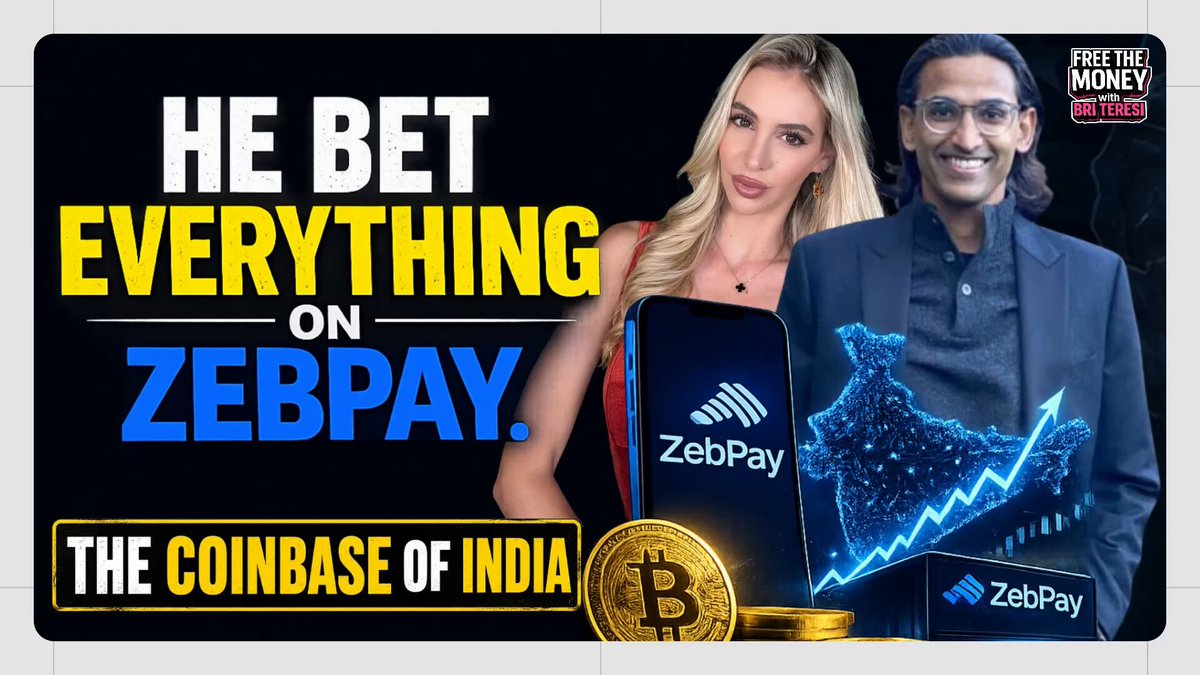
He Bet Everything on ZebPay: Inside the Coinbase of India | Free the Money Ep. 34 Rahul Pagidipati is the CEO of ZebPay, one of India's largest cryptocurrency exchanges. He's been investing in digital assets since 2011. Beyond crypto, Rahul (ZebPay) Pagidipati is a successful serial entrepreneur and investor. He co-founded Freedom Health, which grew into the largest private health insurance company in the United States with $1.8 billion in annual revenue before being acquired by Anthem in 2018. Today, Rahul is also the Managing Partner of Ayon Capital and a Board Member at Brave Software, the company behind the privacy-focused Brave browser. Through Ayon Capital, he has led investments in multiple unicorn healthcare companies, including Oscar Health, RxAdvance, and Rise. In this episode, we discuss: •Why Rahul made an all-in bet on ZebPay during India's crypto crackdown •How ZebPay survived when many believed crypto in India was finished •The lessons behind building and scaling a multi-billion-dollar healthcare company •Why long-term conviction beats short-term speculation •Brave's mission to restore privacy and give users control over their data •Why Rahul believes privacy will become one of the defining issues of the AI era •Why he thinks the Basic Attention Token (BAT) (BAT) is one of the most overlooked opportunities in crypto •How Brave's roadmap could bring BAT into everyday payments through agentic commerce •His long-term outlook on Bitcoin, Ethereum, and the future of digital assets Remember to subscribe and hit the bell "🔔" icon to get notifications. Check out my favorite privacy coin, Zano and follow Zano for updates. You can buy Zano seamlessly on MEXC using a VPN, or browse the full list of exchanges where Zano is available here: You can also find educational content, tutorials, and interviews on the official Zano YouTube Channel: 0:00 Intro 3:16 Building a $2 Billion Healthcare Company as a Family 6:53 How Rahul Discovered Bitcoin in 2011 12:10 How India's Crypto Crackdown Created the ZebPay Opportunity 14:07 Why India Has 100+ Million Crypto Holders 15:49 The Story Behind Buying India's Largest Bitcoin Exchange 19:26 Rahul's Advice for Young Entrepreneurs 21:25 Buying Bitcoin, Ethereum & BAT Every Single Day 26:13 Why Privacy Coins Like Zano Matter 30:04 Why Basic Attention Token (BAT) Is Massively Undervalued 33:34 Brave Browser: Fighting Big Tech with Privacy 40:03 How AI Is Quietly Shaping Our Opinions 44:08 AI Agents, BAT & the Future of Digital Commerce 49:23 Rahul's Favorite Books on Bitcoin & Entrepreneurship

Bri Teresi

124,819 görüntüleme • 22 gün önce

E158: Avichal - Electric ϟ Capital - The $5M Bitcoin case, ETH is 2019 Bitcoin, and why crypto is still very niche Avishal who co-founded Electric Capital, was the first investor in Bitwise, and has backed some of the most important crypto infrastructure companies at seed before any of it was cool. He also shares how growing up as the outsider, the only brown kid in 90s Kentucky, gave him a lens on crypto that most Silicon Valley couldn't see. Timestamps: 0:00 Introduction 1:38 Please Subscribe 2:04 Plastic Surgery, Important For Online Presence? 4:26 KAST Card Plug & My Life Is Built On Stable Coins 6:24 Why Avichal Wears A Cap All The Time? 8:05 What Can You Tell Us About Bitwise 9:51 The People Who Built Bitwise Are Geniuses Or? 10:53 Lessons From Silicon Valley About Beliefs 12:30 Partnerships: Jupiter KAST 13:06 What Fuels Belief For Successful Entrepreneurs 15:17 Will The Next 50 Elon’s Be Found Or Make It Themselves 18:22 Your Mission Is Finding This Talent & Unlocking 100x Potential In Humanity 19:34 How Early Did You Invest In These Companies 20:15 Is It Luck Or Genius That You Invested 22:04 How Do You Realize Who’s Worth Investing In? 27:03 Spending Time With People Is The Best Identifier For Investing 28:37 Partnerships: Paradex Zashi is now Zodl 29:19 The Commonalities Of Successful Businesses Avichal Invested In 32:37 How Of Your Decision Is Based On The Principle Of “They’re Born To Do It” 34:00 Avichal’s Backstory 40:05 Connection Between Crypto & “The Little Guy” 43:32 How Does Silicon Valley Look At Crypto Investors 44:48 Partnerships: Trezor Sui 45:40 What Happens To Those Who Are In Crypto But Don’t Believe In It 47:26 Why The Majority Of People Can’t Buy & Hold In Crypto 53:28 Missionary vs Mercenary Explained 55:03 How High Can Bitcoin, ETH, & Crypto Get Based On These Principles? 1:01:06 The Compounding Effect & Logic Behind Bitcoin Investing 1:02:19 Applying This “Compound Effect” To ETH, SOL, & Bitcoin 1:06:15 Any Other Crypto Assets That May Have Reached Insane Velocity In 2026 1:07:51 Avichal’s Thesis On SUI 1:10:20 Closing Thoughts

MR SHIFT 🦁

258,646 görüntüleme • 5 ay önce

🚨NEW EPISODE🚨 with Anthony Anthony Scaramucci: “Expect failure. If you're taking exogenous risk expect that your ass is going to get kicked. And don't be a baby about it & play the victim. When they fired me from the White House, I got torched by everybody. Did I care? No, I faced the music & never played the victim. So you got to have that mentality if you're going to take risk, if you're not comfortable with that, then don't do it.” An absolutely action packed hour with Anthony Scaramucci of career & investment advice on The Master Investor Podcast this week. We covered his more punchy early trading days taking huge short term risks; his evolution to a more careful long term investor focusing on mega trends; why he is a major believer in blockchain & specifically Bitcoin; why he owns & will hold SpaceX for the long term; his belief we will face deflation not inflation in a few years; his tips for young investors; & compelling career advice from someone who has taken big risks, had major lows, & now bigger highs. KNOW YOURSELF: “So first thing I would say to your viewers & listeners is self-awareness. Know who you are & know if you have the ability to take on the pain & the uncertainty of entrepreneurship because entrepreneurs jump off the cliff & they're trying to build the plane as they're descending to earth. You have to be able to do that.” PAY YOURSELF: “What I've been doing since the age of 17 is I've been buying stocks every month. And it could be the SP500, it could be Berkshire Hathaway, it could be Amazon. If you just take that discipline & you buy every month irrespective of where markets are & you sit back and wait five or 10 years, I think you'll be rewarded.” SPACEX & ELON MUSK: “When I have a win like SpaceX, my attitude is I'm not going to bet against Elon Musk. It's almost as if Thomas Edison got together with Henry Ford & John Rockefeller & made Elon Musk in a laboratory. He's got vision, execution skills, he's an engineer, & he's just not somebody I want to bet against. So SpaceX, I get it, I understand how expensive it is, I understand the revenues versus the market capitalization, but I believe this guy could catch up.” BITCOIN: “If you're an investor, you can't just flip off Bitcoin, you have to do the homework. And I submit to people that do the homework, nine out of 10 of them will probably own a little bit of Bitcoin. I've done the homework & I'm a believer in it. I do believe that it could trade to half of the market cap of gold, which is sort of a 10x from here over the next decade.” Timestamps: 0:00 Intro 3:35 Servant Leadership 6:30 Focus on very long term 12:37 Fear deflation more than inflation 15:57 SpaceX – long term holder 20:28 The case for blockchain & $BTC 28:12 $BTC still under-owned 31:46 Inflation vs innovation 37:31 Wall St vs Washington 40:31 Lessons from President Trump 45:26 UK too hard on itself 47:59 Take risk, expect failure

Wilfred Frost

78,040 görüntüleme • 1 ay önce

E135: The $100T Finance Revolution - How Chainlink Is Bringing TradFi On-Chain Sergey Nazarov, co-founder and CEO of Chainlink, explains why crypto has hit a growth wall and how traditional finance holds the key to its explosive future. From powering 80% of DeFi to building bridges for Wall Street's trillions, Sergey reveals why banks aren't crypto's enemy… they're its savior. Timestamps: 0:00 Intro 2:02 Partnerships: Jupiter, KAST (old), , Sui, Mantle, Forza! BTC 2:52 Why $4 Trillion is Coming to Crypto 3:07 Banks Will Save Crypto 3:52 Libertarian Bitcoin Beginnings 4:32 Choice vs Anti-Establishment 5:56 BlackRock Changed Everything 6:46 Institutions Want Bitcoin Higher 7:30 The Real Problem with Control 8:52 Connecting Valuable Systems 9:30 What is Chainlink Explained Simply 9:42 Self-custody with Trezor 10:35 Mathematical vs People Guarantees 11:31 The Wirecard Problem 13:25 Proof of Reserves Solution 17:30 Your Bitcoin Private Key Never Fails 19:44 Necessity is the Mother of Invention 20:14 From Bitcoin Rebel to Institution Builder 20:36 Immigrating from Russia with Nothing 22:06 Understanding How Capitalism Works 24:04 We Invented Oracle Networks 24:59 Seeing the Mathematical World 27:09 Chain Link Powered DeFi's Growth 28:03 Marcus Aurelius Philosophy 28:48 No One is Coming to Save You 29:15 What I Realized at Age 5 30:19 Why I Don't Care What People Think 31:40 Institutions Lack Competence 33:39 Bernie Madoff Exploited Holes 39:59 Every New Beginning Quote 41:40 How to Pivot vs Quit 47:55 Where Will Growth Come From 48:57 DeFi Explained to a Child 50:59 The Coming Instability 52:03 How Do You Define Truth 55:05 Cryptographically Defined Truth 58:14 Hyper Automation is Coming 1:00:16 AI Oracle Networks 1:07:38 Smart Contracts Explained Simply 1:09:00 What is an Oracle 1:09:40 What is Chainlink 1:11:04 Chainlink Started Eight Years Ago 1:11:20 You Can't Automate People 1:12:51 Information Asymmetries Problem 1:19:54 Launching 1000+ Oracle Networks 1:22:02 Our Biggest Problem Today 1:24:13 The Mastercard Partnership Explained 1:26:52 3.5 Billion Users Can Buy Tokens 1:28:02 The Chainlink Standard 1:32:08 DeFi and TradFi Same Standards 1:34:50 How Chainlink Takes Over TradFi 1:38:07 Chainlink Runtime Environment 1:42:48 The Chainlink Marines Community 1:44:56 Message to the Community 1:51:54 Crypto as Public Good 1:55:56 People Think I'm Satoshi Nakamoto 1:56:53 Why Satoshi Stays Anonymous 1:58:26 Thomas Edison Quote on Genius 2:01:11 Ideas Need Refinement 2:04:55 Why I Don't Tell People What I'm Doing 2:08:07 I Don't Optimize for Happiness 2:10:21 Growth Over Happiness Philosophy

MR SHIFT 🦁

210,029 görüntüleme • 11 ay önce

Catherine Austin Fitts: "Is... Epstein the father of programmable money? Of course, the answer [is] yes. Although he was an agent for what is described... as the Rothschild Network... [and re:] Bitcoin, [I] have been saying this is a prototype to create CBDC and digital money." This clip of Fitts, a former Assistant Secretary of Housing and Urban Development, investment banker, and founder of the Solari Report (The Solari Report | Catherine Austin Fitts), is taken from the Children's Health Defense series Financial Rebellion (Children’s Health Defense) posted to Rumble on March 5, 2026. ---------------Partial transcription of clip--------------- "There's a new commentary at Solari called Is Jeffrey Epstein the Father of Programmable Money? Of course, the answer being yes, although he was an agent for what is described, I think very correctly as the— As the Rothschild Network. "So in America, many people say Rothschild. I was brought up, using the European Rothschild, but same network. And, the commentary at Solari points you to a series done by a writer, writing anonymously, anonymously under the name of ESC, ESC, as in Escape, and what our commentary does is it points you to all the posts from January 30th on, and in my opinion, this is the single best, after Whitney Webb, this is the single best description of the Epstein Network and the governance of the Epstein Network. "And the goal of the Epstein Network. If you study what Epstein was doing, he was, in my opinion, laundering money, including money coming out of the United States government. That's not what ESC focuses on. What he's focusing on is how Epstein reinvested that money as the equivalent of venture capitalist and philanthropist, seeding the development of programmable money. And seeding people, both in academia and business, in all aspects of life, building and operating the different pieces you need to prototype and create digital money, including Bitcoin. "So Carolyn and I, since the beginning of Bitcoin, have been saying, this is a prototype to create CBDC and digital money. And, you know, there's a wonderful group of freedom fighters in that community who've been very, I would say very negative towards us is the only way I can describe it. And I just had one of the top luminaries of that whole world write me and say, oh, my God, you were right. Will you be in our documentary? Like, thank you, Houston. We have contact. "Anyway, so ESC has done a marvelous job. I can't recommend it. Just read everything from January 30th on, and he describes how Epstein developed and ran this and sort of built a prototyping. And then, as Whitney Webb has told us, you know, once that all got institutionalized, you don't need Epstein anymore, particularly when you got FASAB 56, which we've talked about many times. "And so, you know, out Epstein goes because now we've institutionalized. And that's why, you know, Whitney will talk about Palantir as part of the now institutional capacity of what, you know, Epstein is a venture capitalist or philanthropist, helped seed and get started. But now it's being institutionalized. "And the important thing to think of is this is like a booster rocket. After the booster rocket gets you to a certain point and you can institutionalize, then you just eject the booster rocket and keep on going. And if you look at the, the, you know, if you look at the investment network, which are basically the equity pool around the central banks. "So I'll just talk about it as the people who control the central banks. Once you've got the central banks ready to implement digital assets and stablecoins as programmable money, you don't need Epstein. You can let it go. "And if you look at the lot of scandal of getting rid of the booster rocket, they're talking about the very lurid parts of Epstein, but they're not talking about the control grid and how to stop it with this exception. And I think this is why this substack series is so exceptional. And if you really want to understand what Epstein was up to, but more importantly what the structure that managed and controlled Epstein, whether it was the intelligence agencies or the investment money in and around the central banks that wants total digital control. "So Epstein was building the control grid, you know, prototyping, distributed ledgers was all part of that. He put a lot of money into mind control because the neuro warfare is a very, very important part of it."

Sense Receptor

25,403 görüntüleme • 5 ay önce

IOTA is being born. 🐣 For almost a decade, the IOTA Foundation has been the mother of IOTA. It carried it, protected it, fed it, corrected it, rebuilt it when necessary, and kept it alive long enough to turn a technological intuition into real infrastructure. But no decentralized network is meant to live forever under its mother’s protection. A foundation is not the final form of a public DLT. It is the womb. The incubator. The structure that allows something immature to survive until it is ready to breathe on its own. And that moment is now approaching. With IOTA Rebased, Move at the base layer, staking, validators, real programmability, and now Starfish live on Mainnet through Protocol Version 24, IOTA is no longer a promise guarded by its mother. It is becoming an adult network. Not just a project. Not just a vision. Not just an architecture waiting for its moment. It is public infrastructure for the real world. 🌍 🔹 The IOTA Foundation is now entering its great year of delivery. One year, maybe a year and a half, in which it will have to consume part of its tokens, not as a sign of weakness, but as the final stage of separation. 🔹 Many will read this as bearish. To me, it is exactly the opposite. It is the umbilical cord being cut in front of everyone. 🔹 Because no truly neutral infrastructure can depend forever on a European foundation. Not Africa, not ASEAN, not America, and not any major global trade corridor will fully trust a public DLT if they perceive that one legal entity still holds too much power over it. That is the key. For IOTA to become bigger, the IF has to become smaller. For IOTA to become more neutral, the IF has to stop being the center. For IOTA to become global infrastructure, it has to stop looking like a network protected by its mother and start behaving like a network that belongs to the world. 🌍 During this phase, some validator nodes supported by IF-delegated tokens will disappear. And although some people will misread this, it is part of the natural process. Those nodes were scaffolding. They helped raise the initial structure, gave stability to the launch, and allowed the network to start walking. But the scaffolding is not the building. When the building is ready, the scaffolding comes down. First, only a few independent validators will enter. Then more. Then competition. And eventually, a real economic fight for validator positions inside a network that no longer depends on its mother’s initial protection. That is decentralization entering adulthood. 💎 The IOTA Foundation also has to become independent from IOTA. Its natural path should no longer be to act as the permanent treasury of the network, but to build real products on top of it. That is where TWIN comes in. TWIN can become the major enterprise, institutional and commercial layer built on IOTA. A SaaS layer for global trade, traceability, digital identity, compliance, digital product passports, logistics, customs, exporters, governments and supply chains. 🧬 The IF would then stop being the mother feeding the child and become something much healthier and much more powerful. 🔥 A customer of IOTA. 🔥 A builder on IOTA. 🔥 An operator using neutral infrastructure to deliver real products to the market. 🔥 That is the right model. Bitcoin does not need a foundation to feed it. It does not need a CEO. It does not need a treasury to keep it emotionally alive. Bitcoin simply exists and offers what it is. Scarcity, settlement, monetary resistance and neutrality. IOTA has to do the same in its own territory. Not only as money, but as digital trust infrastructure for trade, data, identity, real-world assets, machines, institutions and entire economies. 🔹 In 2027 or 2028, TWIN could spin out as an autonomous SaaS business, with recurring revenue, institutional clients and the ability to attract real capital rounds. 🔹 Not crypto grants. Not community funding. Real institutional capital. 🔹 If it proves traction, adoption and revenue, we could be talking about Series A or Series B rounds, each in the tens of millions of dollars. And major investors are already keeping one eye on this coming opportunity.👀👀👀👀👀💰💰💰💰💰 Meanwhile, IOTA would become freer and freer. 💎 Free from dependence on its foundation. 💎 Free from a central treasury. 💎 Free from institutions. 💎 Free from founders. 💎 Free from non-decentralized decisions. 💎 Free even from the need for someone to “save” it. A public network does not reach maturity when its mother protects it better, but when it no longer needs protection. That is why this moment is not bearish. It is brutally bullish. The child is ready to leave home. And when a decentralized network leaves home, it stops being a project and starts becoming infrastructure. Bitcoin needed one paper to decentralize money. IOTA has needed a decade to decentralize real-world trust. And maybe the market will take time to understand it, but the most bullish moment in IOTA’s history may be exactly this. Some will see a mother letting go of her child’s hand. Others will see a network finally being born as sovereign, neutral and free infrastructure. To the untrained eye, the truth may look bearish. To the wise, it will look exactly the opposite. Bullish in its purest form. 💎 Born to be decentralize! #IOTA #IF #Move #TWIN #ASEAN #AfCFTA

Salima

20,464 görüntüleme • 2 ay önce