Video yükleniyor...

Video Yüklenemedi

Ana Sayfaya Dön

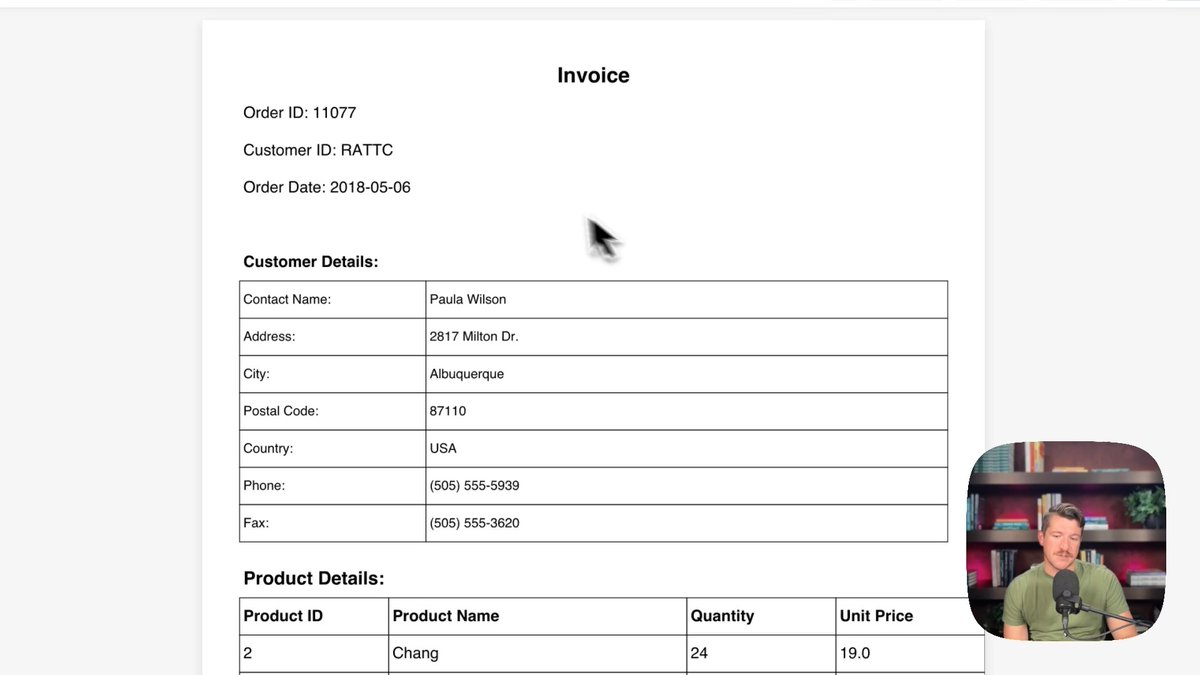
Automate Your Accounting: PDF Invoice to JSON with LangChain #python #coding #programming #ai Stop wasting time and money on expensive OCR software by building your own private invoice extraction tool with Python, LangChain, and Gemini 2.0 Flash. This Short shows you how to use PyPDF for text extraction and...

38,600 görüntüleme • 7 ay önce •via TikTok

0 Yorum

Yorum bulunmuyor

Orijinal gönderinin yorumları burada görünecek

Benzer Videolar

New Short Course: Getting Structured LLM Output! Learn how to get structured outputs from your LLM applications in this course, built in partnership with .txt, and taught by Will Kurt, a Founding Engineer, and , Developer Relations Engineer. It's challenging for software to automatically parse through an LLM's freeform text outputs. Structured outputs—like JSON—solve this by converting natural language into consistent, clear, data that a machine can read and process. This course teaches you how to generate structured outputs while building several use cases, including a social media analysis agent. You’ll learn about structured outputs and efficient ways to generate outputs in your defined schema or format. You’ll begin by using structured output APIs, then use re-prompting libraries like “instructor” to generate structured output. Finally, you’ll learn how constrained decoding works; this is a very clever technique in which constraints are applied on each subsequent token generated, blocking any tokens that don’t fit your defined schema. In detail, you’ll: - Learn why structured outputs are important, how they allow for scalable software development, and the different approaches to generate them, including vendor-provided APIs, re-prompting libraries, and structured generation. - Build a simple social media agent using OpenAI’s structured output API, learn how to define a model's desired structured output using Pydantic, and perform basic programming with your outputs, such as importing structured data into a data frame using pandas. - Learn how to use the open-source library "instructor," which checks the structured output of the model and re-prompts the model until it validates the desired output, and explore the limitations of this approach. - Understand how structured generation by the “outlines” library works by modifying LLM logits, on a per-generated-token basis based on the desired format, to give a particular output structure. - Learn how regular expressions, which outlines works with, are represented as finite-state machines, and how they can be used to develop a range of structured outputs beyond JSON. By the end of this course, you’ll have broadened your knowledge of the approaches you can use to get structured outputs from your LLM applications. Please sign up here:

Andrew Ng

89,792 görüntüleme • 1 yıl önce

JSON is just "Jason" — and he runs every automation you build* JSON is pronounced "Jason" — like the actor — and it's the single most useful thing to understand before you get into automation. Here's the plain-English version. Every time one app sends data to another — your signup form to your email tool, your store to your spreadsheet, your AI to your other tools — it doesn't send sentences. It sends JSON: a little labeled packet of information. It's the one language every app uses to talk to every other app. And it's simpler than it looks: 1. JSON is just labeled data inside curly braces { }. 2. Each piece is a label and a value — like "first_name": "Kim", "last_name": "Kardashian", "order": 3. 3. One app fills in the labels and ships it over; the other app reads the exact same labels and grabs the values — so two programs built by total strangers understand each other perfectly. 4. The moment you touch automation (Zapier, Make, n8n) and pull data from one app into another, it arrives as JSON — your contacts, orders, and leads, all as labeled packets. 5. Find the label you want, grab its value, and you can wire almost any app into any other app. The best part: you don't have to write or decode it by hand anymore. Paste any JSON into AI and it tells you exactly what's inside in plain English. Describe what you want and it writes the exact structure your tool needs. The scary syntax is the machine's job now — knowing what JSON is and what it's for is yours. You don't need to become a programmer. You need to know it's called JSON, know your automations run on it, and let AI handle the syntax. #aiautomation #automation #aiagents #aiskills

Professor Glitch

314,700 görüntüleme • 3 ay önce