Loading video...

Video Failed to Load

Go Home

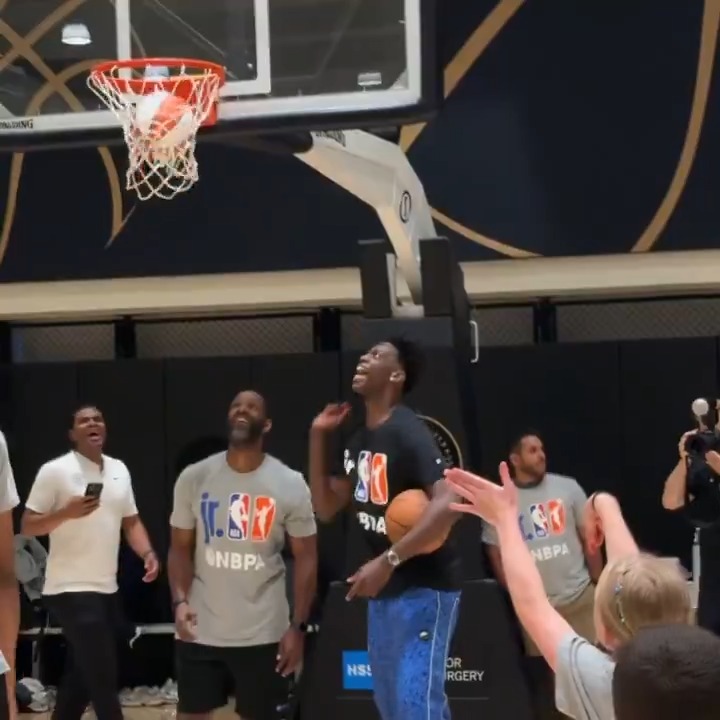
Back in Toronto with the next generation. At our @ps43foundation Data Dunkers program, these kids aren’t just learning the game… they’re learning how data, curiosity, and creativity can open doors on and off the court. Basketball is the entry point. The real win is showing them what’s possible. 🧠🏀...

47,838 views • 5 months ago •via X (Twitter)

0 Comments

No comments available

Comments from the original post will appear here

Related Videos

Experiments in progress. The one on the right has been learning for ~3 hours, the one in the middle for ~1 hour, and the one on the left just started a few minutes ago. The initial motivation for making the physical Atari was just to commit ourselves to a subset of algorithms that can make progress in this setup. This commitment rules out algorithms that require billions of samples to learn (or worse, require multiple environments running in parallel). Atari games are simple enough that we should be able to show learning on them in a short amount of time with no prior knowledge. Since then, I've realized that this setup is also a good way to compare different paradigms in robotics in a principled way. These paradigms are sim2real, learning from tele-operated data, and learning directly on the robots. So far, I have observed that getting sim2real to work reliably is hard. It requires tweaks that don't scale. Policies that can play perfectly in simulation fall apart because of latencies and the messiness of the real world. These aspects could be modeled to improve the simulation, but not without sinking significant human engineering hours. I have higher hopes for learning from tele-operated data, but that requires a human to learn the task first. These experiments are on my to-do list. I have to learn to play some of the games well through the robot. I’m half-decent at playing Pong and Ms Pacman now. Learning directly on robots is looking like the most promising approach. This approach takes away pesky distribution shifts and makes it possible to have algorithms that continually improve with more data and time without any human intervention. It feels great to let experiments run overnight and wake up to find improved policies. With learning on robots, I should, in principle, be able to go on a long vacation and come back to find better policies for complex tasks beyond Atari games. Whether that is possible with current learning algorithms is a different question.

Khurram Javed

52,110 views • 7 months ago

We just launched a major new Data Engineering Professional Certificate on Coursera! Data underlies all modern AI systems, and engineers who know how to build systems to store and serve it are in high demand. If you're interested in learning this skill, please check out this 4-course sequence, which is designed to make you job-ready to be a Data Engineer. This is a new specialization taught by Joe Reis, the co-author of the best-selling book “Fundamentals of Data Engineering," in collaboration with AWS. (Disclosure, I serve on Amazon's board.) For many AI systems, data engineering is 80% of the work, and modeling is 20%. But people’s attention on these two topics is often flipped. This makes the job of the data engineer particularly important. In this professional certificate, you'll learn foundational data engineering skills while implementing modern data architectures using open-source tools: - Learn the key steps of the data lifecycle, to generate, ingest, store, transform, and serve data. - Learn to align with organizational goals to design the data pipeline right for your business' needs. - Understand how to make necessary trade-offs between speed, scalability, security, and cost. Joe has distilled into this specialization decades of experience helping startups and large companies with data infrastructure. He is also joined by 17 other industry leaders in the data field, who will help you learn in-demand skills for the growing field of data engineering. Please sign up here:

Andrew Ng

118,937 views • 1 year ago