Loading video...

Video Failed to Load

Go Home

BADLAB V2: WHERE YOUR MEDIOCRE CODING DREAMS GO TO DIE ๐Ÿ”Š Listen up, code peasants. While you've been copy-pasting Stack Overflow answers, we've been revolutionizing how fucking development works. BADLAB V2 just dropped, and it's not just another update โ€“ it's a fucking paradigm shift. Let me break this...

44,480 views โ€ข 1 year ago โ€ขvia X (Twitter)

10 Comments

FLOKI's profile picture
FLOKI1 year ago

BADLAB V2, LET'S GO!

koznqtaaaaaaa's profile picture
koznqtaaaaaaa1 year ago

@BNBCHAIN your chat bots should watch and learn. When Innovation meets actual integration. $BADAI is not talking for the future, it's talking now.

Sprezzatura's profile picture
Sprezzatura1 year ago

@BNBCHAIN time to wake up, $BADAI is inevitable.

TheFirstMan's profile picture
TheFirstMan1 year ago

@yzilabs should invest in $BADAI ๐Ÿ‘€๐Ÿš€

MrPanda's profile picture
MrPanda1 year ago

While $BADAI is building real stuff on @BNBCHAIN, CZ and Richard Teng keep ignoring the $BADAI community at this moment. But Dev team will keep building, and @cz_binance will appreciate it in time.

TheFirstMan's profile picture
TheFirstMan1 year ago

Make $BADAI an alpha @BinanceWallet

TheFirstMan's profile picture
TheFirstMan1 year ago

Look who is building now ๐Ÿ‘€ @cz_binance

mw.creative's profile picture
mw.creative1 year ago

@BADAI very based.

Bad Kebab Saloon's profile picture
Bad Kebab Saloon1 year ago

$BADAI #BNBCHAIN @badmeme_coin BEST AI PROJECT COMING. BUY THE DIP

Trekkor BAD's profile picture
Trekkor BAD1 year ago

This takes creation to a whole new level. Innovation which is pushing forward at this very moment. Only pushing forward strengthening the future BAD empire walls constantly. innovation within peoples reach on BNB chain and is still evolving! @BNBCHAIN @cz_binance @badmeme_coin

Related Videos

Elon Musk just made one if the biggest moves in taking over the programming industry โ€œSpaceX just bought Cursor for $60 billion. Do you realize how big this is? SpaceX went public โ€” the biggest IPO in history. $75 billion raised, almost a $2 trillion valuation and the first thing to do with that money? Buy the most popular AI coding tool on the planet. Here's why that changes everything. Elon now owns 3 layers: the compute, Colossus data centers, the models, Grok through xAI, and now the tool that developers actually use every day. It's the full stack. And here's what makes Cursor different from Claude Code or Codex. Cursor is model agnostic. You can run Claude in it, GPT, Gemini, whatever model you want. It's not locked to any one company, and now it has SpaceX's resources behind it. Cursor said they were bottlenecked by compute. Well, that bottleneck has just been removed. $4 billion in annual revenue, over half the Fortune 500 already uses it, and now it's backed by a $2 trillion company. OpenAI has Codex, Anthropic has Claude Code, and now Elon has Cursor.โ€ Let me break this down in simple terms Elon Musk now controls more of the full AI picture: - Massive computers, power (data centers like Colossus) - Smart AI models (Grok from xAI) - The actual tool millions of developers use every day (Cursor) For every day users this means Faster and smarter apps and websites in the future. More developers using powerful AI tools means new apps, games, websites, and features get built quicker and cheaper. This means better video games, smoother streaming, smarter phone apps and better programs For Developers they can describe what they want in plain English (โ€œmake a feature that does Xโ€) and the AI handles more of the heavy lifting

Wall Street Apes

213,267 views โ€ข 1 month ago

Made $530,000 with Ai Bot that started with $313. Didn't know how to code. Now this bots run 24/7 printing money while sleeping. I've made the exact step-by-step guide to build this Claude Code Polymarket trading bot. Prompts. Code. Risk settings. Paper trading checklist. Everything from zero to running bot. It's free. For 24 hours. After that I'm charging $499 for it. To grab it right now: 1. Comment "Claude Bot" 2. Like and Retweet this post 3. Follow me Himanshu Kumar ( I can't send DMs to non-followers ) I'm DMing everyone who Complete the 3 steps. I spent hundreds of thousands hiring developers because he was too scared to learn. Then learned Claude Code. Built algorithmic trading systems. $313 โ†’ $530,000. You have the same tools available right now. And you're using them to ask ChatGPT for Instagram captions. This attached video is a goldmine. Full live walkthrough. Claude Code building actual Polymarket trading bots. From zero. Every line of code. Every decision explained. Now let me break down why everything you're doing in trading is wrong and exactly how to fix it. Save this post. You'll hate yourself if you lose it. โ†“ Let's start with why you keep losing money. You already know the answer. You just won't admit it. You overtrade. Every. Single. Day. You see a candle move. You feel something. You enter. No plan. No edge. No reason. Just feelings. Then it goes against you. You feel something else. Panic. Anger. Denial. You move your stop loss. Or you didn't set one at all. "It'll come back." It doesn't come back. So you take another trade. A revenge trade. Bigger size this time. Because you need to "make it back." That one fails too. Now you're emotional. Now you're tilted. Now you're using leverage you have no business touching. 40x. 50x. 100x. On a trade you entered because a candle looked "bullish" and some guy on Twitter said "send it." You get liquidated. Close the laptop. Punch something. Tell yourself you'll be "more disciplined" tomorrow. Tomorrow comes. Same cycle. Same result. Same liquidation. You've been doing this for months. Maybe years. And you still think the problem is your strategy. The problem isn't your strategy. The problem is you. Save this post right now. What I'm about to show you is the only way to remove yourself from the equation. Follow Himanshu Kumar so you don't miss any of this. โ†“ Here's what's actually killing your account. It's not the market. The market doesn't care about you. It's not your indicators. RSI works fine. MACD works fine. They all "work." It's not your timeframe. It's not your broker. It's not the "manipulation." It's four things: 1. Emotions. You hold losers because hope feels better than loss. You cut winners because fear feels stronger than greed. You size up when angry. You skip trades when scared. Your emotional state determines your position size. That's insane. And you know it's insane. But you keep doing it. 2. Overtrading. You take 15 trades a day. Maybe 5 of them had actual setups. The other 10 were boredom. Boredom trades are the most expensive hobby in human history. 3. Leverage. You use 20x-50x on trades where you're not even sure about the direction. That's not trading. That's a casino with a nicer interface. 4. Fees. You're smashing market orders. Paying spread. Paying commission. On 15 trades a day. Your broker makes more money from your account than you do. Think about that. Your broker is profitable on your account. You're not. You're the product. Not the trader. These four things are why 90% of traders lose. Not bad luck. Not the market. You. Save this post and follow Himanshu Kumar because the solution is coming next. โ†“ The solution is painfully obvious. Remove yourself from the equation. Not partially. Not "I'll be more disciplined." Not "I'll journal my trades." Not "I'll meditate before trading." Completely remove yourself. Build a bot. Let the bot trade. You go live your life. The bot doesn't feel emotions. The bot doesn't overtrade. The bot doesn't use reckless leverage. The bot doesn't smash market orders and bleed fees. The bot follows the rules. Every single time. Without exception. Without "just this once." Without "I have a feeling about this one." Rules in. Execution out. No human in the middle to mess everything up. That's algorithmic trading. And before your ego jumps in with "but I'm different, I have discipline" โ€” No you don't. Your account balance proves you don't. If you had discipline, your account would be green. It's not. So you don't. Accept it. Automate it. Move on. This is the hardest truth in trading. Your discipline will always fail. A bot's won't. Save this post. Follow Himanshu Kumar for the exact bot setup that removes your emotions permanently. โ†“ "But I don't know how to code." Neither did he. The guy in this video didn't know how to code for most of his life. Got held back in 7th grade. People counted him out early. Spent years building apps and SaaS businesses without writing a single line of code. Hired developers on Upwork instead. Spent hundreds of thousands of dollars paying other people to build what he could have built himself. Because he was scared to learn. That fear cost him years. And hundreds of thousands of dollars. Sound familiar? You're doing the same thing right now. Not with developers. But with your time. You're spending thousands of hours trading manually because you're scared to learn the thing that would make trading automatic. The fear of learning to code is costing you more than any bad trade ever did. Because every month you trade manually is a month of emotional decisions, overleveraged entries, and unnecessary losses that a bot would never make. And here's the thing that should really frustrate you: AI does the hard parts now. You don't need a computer science degree. You don't need to work at a hedge fund. You don't need to be "good at math." Claude Code writes the code for you. You just need to think clearly about trading ideas. That's it. If you can describe a strategy in English, Claude can build it in Python. "I don't know how to code" stopped being a valid excuse in 2024. It's 2026. You're 2 years late on that excuse. Find a new one. Or stop making excuses entirely. Save this post. Follow Himanshu Kumar because I'm showing you how people with zero coding experience are building profitable bots. โ†“ The process that actually makes money. Three letters. R. B. I. Research. Backtest. Implement. That's it. That's the entire process. Every single day. Research: Find an idea. A pattern. A market inefficiency. Don't trade it yet. Don't even think about trading it yet. Just research it. Backtest: Test the idea against historical data. Does it work? Not "does it look good on one chart." Does it work across thousands of trades? Across different market conditions? Across in-sample AND out-of-sample data? If no, kill it. Find another idea. If yes, move to step 3. Implement: Build the bot. Deploy it. Paper trade first. Then live with small size. Scale only on evidence. Research. Backtest. Implement. Every day. No exceptions. You know what your current process is? Feel. Enter. Pray. F. E. P. Feel bullish. Enter a trade. Pray it works. That's not a process. That's gambling with a TradingView subscription. RBI is the only process that works. Save this post. Tattoo it on your forearm. Follow Himanshu Kumar for daily RBI breakdowns. โ†“ What Claude Code actually does that your manual process can't. You can maybe test 3-5 strategy ideas per week. Manually adjusting parameters. Manually checking results. Manually writing code (badly). Claude Code tests 50-100 ideas per week. With parallel agents running simultaneously. Multiple strategies being built, tested, and validated at the same time. While you sleep. The guy in this video spends 4-8 hours a day building systems with Claude Code. Not trading. Building. Research. Backtest. Implement. Then iterate. Improve. Optimize. Every day the systems get better. Every day the edge compounds. Every day the bots get smarter. While you? You spend 4-8 hours a day staring at charts making the same mistakes you made last month. Same indicators. Same patterns. Same entries. Same losses. He's iterating forward. You're running in circles. Same 8 hours per day. Completely different outcomes. Because he's building systems. And you're feeding a casino. Stop feeding the casino. Start building the machine. Save this post and follow Himanshu Kumar for the Claude Code workflow that iterates strategies while you sleep. โ†“ Jim Simons. That's the benchmark. You probably don't know who Jim Simons is. And that tells me everything about how seriously you take trading. Jim Simons. Mathematician. Founded Renaissance Technologies. Built a net worth of $31 billion. 100% from algorithmic trading. Not one single manual trade. Not one "gut feeling" entry. Not one RSI divergence. Not one "smart money concept." Algorithms. Bots. Systems. Data. $31 billion. His fund averaged 66% annual returns for over 30 years. While you're excited about making $200 on a trade that you'll give back tomorrow. The best trader in human history never placed a manual trade in his life. And you think your edge is staring at a 5-minute chart with bloodshot eyes at 2 AM? Your edge is building the system. Not being inside it. Jim Simons is the benchmark. Everything else is noise. Save this post. Follow Himanshu Kumar because I'm building toward the same goal and showing every step publicly. โ†“ What you need to understand about patience. This is not get-rich-overnight. The guy in this video says it directly: "This channel is not for people looking to get rich overnight. It's not plug and play. There are no shortcuts. If you're impatient, this probably isn't for you." And that's exactly why most people will fail at this. Because you want results now. Today. This trade. You don't want to spend a week building a bot. You don't want to paper trade for 2 weeks. You don't want to test 50 ideas to find 1 that works. You want to copy someone's bot, run it live with your rent money, and be rich by Friday. That's why you'll be broke by Friday. The guy making $2.3M spent months iterating. Testing. Failing. Rebuilding. Testing again. He was patient when you would have quit. He was calm when you would have panicked. He was consistent when you would have given up. Patience isn't just a virtue in trading. It's the only virtue. Without it, everything else fails. Impatience is the most expensive personality trait in trading. Save this post. Follow Himanshu Kumar and learn to build systems with the patience that actually pays. โ†“ The live streams where the real learning happens. The YouTube video is the trailer. The live streams are the movie. Real-time bot building. Real-time questions answered. Real code shown. Real mistakes made and fixed. Not polished highlight reels where everything works perfectly. Actual development. Where things break. Where strategies fail. Where code doesn't compile. Where the fix takes 2 hours. Because that's what real development looks like. And seeing the messy parts is more valuable than any polished tutorial. Because when your bot breaks at 3 AM, you need to know how to fix it. Not just how to celebrate when it works. The streams mix beginner and advanced. Start with how to automate trading. How to use AI for code generation. Then dive into the daily work. Claude Code. Parallel agents. Constant iteration. Live debugging. 4-8 hours of real algorithmic trading development. Live. Uncut. No filter. Most "trading education" shows you the wins. This shows you the work. Save this post. Follow Himanshu Kumar for the stream schedules and breakdowns. โ†“ The belief that changes everything. Code is the greatest equalizer. Not money. Not connections. Not a degree. Not where you grew up. Not what school you went to. Code. Once you can build systems, you can build anything. For the rest of your life. A trading bot today. A SaaS product tomorrow. An automation business next month. A completely different life next year. The skill isn't "algorithmic trading." The skill is building systems. And that skill transfers to everything. The guy who can build a trading bot can also build a lead gen tool. Can also build a content pipeline. Can also build a SaaS product. Can also build literally anything that runs on logic and code. One skill. Infinite applications. And AI makes learning it 100x easier than it was 5 years ago. You don't need to be smart. You don't need talent. You need Claude Code and the willingness to sit down and build something instead of consuming content about building something. Building is the skill. Everything else is entertainment disguised as education. Save this post. Follow Himanshu Kumar because I'm showing you how to build, not just how to watch. โ†“ If any of this applies to you, pay attention. If you've lost money from overtrading. If you've been liquidated. If you know trading is the vehicle but manual execution keeps crashing you. If you've tried "being more disciplined" and it never lasted more than a week. If you keep saying "next month I'll start automating." If you've spent more money on courses than you've made from trading. There is a better way. It's not a magic indicator. It's not a signal group. It's not a $997 mentorship from a guy who makes money teaching, not trading. It's building your own system. A system that trades without emotion. A system that follows rules without exception. A system that runs while you sleep. A system that compounds while you live your life. That's the answer. It's always been the answer. You've just been too scared to accept that the solution requires building something instead of buying something. โ†“ What the next 30 days look like if you actually commit. Week 1: Watch the video. Learn Claude Code basics. Build your first simple strategy. Run your first backtest. Week 2: Iterate. Let Claude improve the strategy. Run Monte Carlo validation. Paper trade. Week 3: Go live with $50-100. Tiny positions. Watch every trade. Compare to paper results. Week 4: Scale based on evidence. Not based on excitement. Not based on one good day. Based on data. 30 days from now you either have a running bot that trades without your emotions destroying every position. Or you're exactly where you are right now. Reading another post. Making another promise. Breaking it by Tuesday. Same 30 days either way. Different actions. Different results. Different life. โ†“ Full video tutorial attached. Live bot building with Claude Code. From zero to running Polymarket trading bot. Every line of code. Every decision explained. The video is free. Claude Code is available now. The market is open 24/7. The only thing standing between you and a profitable trading bot is the same thing that's been standing there for months. You. Get out of your own way. Follow Himanshu Kumar for daily AI trading bot breakdowns, live build sessions, and the full RBI process. Save this post. Watch the video. Build the bot. Or keep trading manually and keep losing. The choice has never been easier. And you've never been more stubborn about making the wrong one.

Himanshu Kumar

37,548 views โ€ข 4 months ago

CANCEL Your Weekend Plans, and Learn Claude Code Today. $5,000/month. $10,000/month. $20,000/month. People are building entire apps and charging clients thousands using Claude Code. You're still Googling 'how to center a div.' While you're binge-watching a show you won't remember next week, a 19 year old with zero coding experience just built a $5,000 SaaS product in one afternoon using the tool I'm about to break down. Same laptop. Same internet. Same 24 hours. He has Claude Code. You have Netflix. That's the only difference. This YouTube video is a goldmine. Full Claude Code tutorial. Beginner to pro. Every feature. Every setup step. Every best practice. Zero prior knowledge needed. Save it. Watch it tonight. Not tomorrow. Tonight. Save this post. This is your complete Claude Code roadmap. Lose it and you lose the next 12 months of income. Follow Himanshu Kumar so you don't miss the breakdowns for each feature. โ†“ 1. Understand What Claude Code Actually Is. You think Claude Code is just another chatbot. It's not. And that misunderstanding is why you're broke. ChatGPT gives you text. Claude Code gives you software. It runs in your terminal. It reads your entire codebase. It writes files directly to your project. It runs commands on your machine. It debugs errors autonomously. It builds features end to end. You're not chatting. You're deploying a developer. One that works 24/7. Never asks for a raise. Never calls in sick. Never pushes broken code at 5 PM on a Friday. People are charging clients $5,000-$10,000 for apps they built with Claude Code in 3 hours. And you didn't even know this tool existed because you're still asking ChatGPT to write you a to-do list. The gap between you and people making money with AI isn't intelligence. It's awareness. Now you're aware. Save this post. Follow Himanshu Kumar for the complete breakdown of every Claude Code feature. โ†“ 2. Set Up Claude Code Properly. Most people quit here. "It's too complicated." "I don't know terminal." "I'll set it up later." Later never comes. And "complicated" means "I watched for 30 seconds and gave up." The setup takes 10 minutes. Install Node.js. Install Claude Code via npm. Authenticate your account. Open your terminal. Done. 10 minutes. You spent longer this morning deciding what to have for breakfast. The video walks through every single click. Every command. Every screen. Assuming you know absolutely nothing. If you can download an app on your phone, you can set up Claude Code. It's the same level of difficulty. But you'll still tell yourself it's "too technical" because that excuse is more comfortable than admitting you're just scared to try something new. This is the setup that everything else builds on. Skip it and nothing works. โ†“ 3. Use the Desktop App. You don't even need to live in the terminal if you don't want to. Claude Code has a desktop app. Clean interface. Visual feedback. Everything you need without touching command line. But here's the thing most people don't know: The desktop app isn't just a pretty wrapper. It lets you manage projects visually. See file changes in real time. Switch between projects instantly. The people making money with Claude Code use the desktop app for client projects because it's faster to manage multiple builds simultaneously. You're still opening 14 browser tabs to organize one project. They open one app and everything's there. Efficiency isn't a personality trait. It's a tool choice. Save this post. Follow Himanshu Kumar for the desktop app workflow that handles 5 client projects at once. โ†“ 4. Install the Right Dependencies. This is where beginners silently fail and blame the tool. Claude Code needs certain dependencies installed to work properly. Miss one and everything breaks. Then you go on Twitter and say "Claude Code doesn't work." It works fine. You just didn't read the setup guide. The video covers every dependency you need. What to install. How to install it. How to verify it's working. No guessing. No Stack Overflow rabbit holes at midnight. No "why isn't this working" for 3 hours. Watch the dependency section once. Follow every step. Never deal with setup issues again. You spent more time last week troubleshooting a printer than this takes. โ†“ 5. Work Inside Your Code Editor. Claude Code integrates directly with your code editor. VS Code. Cursor. Whatever you use. It's not a separate window you alt-tab between. It's right there. In your workflow. You type a request. Claude writes the code. The code appears in your editor. You review it. Accept it. Done. No copy pasting between windows. No reformatting code that got mangled in transit. No "which version was the right one." It's like pair programming with someone who never gets distracted, never argues about naming conventions, and actually writes code that works on the first try. Your current coding process is: Google the problem, read 5 answers on Stack Overflow, copy the wrong one, debug for an hour, find the right one, paste it in, break something else, repeat. Claude Code's process is: describe what you want, get working code, move on with your life. Same hour. One method produces working software. The other produces frustration and a browser history full of Stack Overflow tabs. Stop coding the hard way. Save this post. Follow Himanshu Kumar for code editor setup guides and integration tips. โ†“ 6. Master Basic Usage. Most people learn 5% of a tool and say they "know" it. You "know" Photoshop because you can crop an image. You "know" Excel because you can sum a column. You "know" Claude Code because you asked it one question. Basic usage means: How to give Claude Code context about your project. How to ask for changes to existing code. How to generate new files and features. How to review what Claude produces. How to iterate when the output isn't perfect. These basics are the foundation of everything. Skip them and every advanced feature feels confusing. Master them and every advanced feature feels obvious. The video breaks down each one with real examples. Not theory. Actual usage on actual projects. You've been using AI tools at 5% capacity and wondering why your results are 5% of what others get. Save this post. Follow Himanshu Kumar for daily Claude Code usage tips. โ†“ 7. Learn Every Command. Claude Code has commands that most users never discover. Because most users type one message and expect magic. That's not how professionals use it. Professionals use specific commands that tell Claude Code exactly what to do, how to do it, and what constraints to follow. The difference between a beginner and someone making $10K/month with Claude Code is knowing which command to use and when. The video walks through every single one. Not just what they do. But when to use each one. And why one command is better than another for specific situations. You've been using Claude Code like a hammer. These commands turn it into a full toolbox. Stop treating a power tool like a blunt instrument. Save this post. Follow Himanshu Kumar for the command cheat sheet I use daily. โ†“ 8. Understand Modes and Shortcuts. Speed matters. The person who builds an app in 2 hours charges $5,000. The person who builds the same app in 2 days charges $2,000. Same app. Same quality. Different speed. Different income. Claude Code has modes that change how it operates. And shortcuts that cut your workflow time in half. Most people don't know either exists. They use Claude Code in default mode for everything. Like driving a car in first gear on the highway. Technically it works. But everyone is passing you. The video shows you every mode. Every shortcut. Every time-saving trick that separates the people charging $2,000 per project from the people charging $10,000. Speed is money. Literally. Save this post. Follow Himanshu Kumar for the shortcuts that cut my build time by 60%. โ†“ 9. Write a Proper Planning Prompt. This is the section that separates amateurs from professionals. And it's the section most people skip. A planning prompt tells Claude Code what you're building before you start building it. Architecture. File structure. Technologies. Features. Constraints. Edge cases. Without a planning prompt, Claude Code guesses. And guessing produces garbage. With a planning prompt, Claude Code executes a clear plan. And clear plans produce working software. The video shows you exactly how to write a planning prompt that makes Claude Code produce professional-grade output on the first try. "But I just want to start coding." That's why your code breaks every time. That's why you restart projects 4 times. That's why nothing you build ever gets finished. Because you refuse to plan. A 5-minute planning prompt saves you 5 hours of debugging. But you'd rather skip the 5 minutes and suffer through the 5 hours because patience isn't your thing. And that's exactly why you're not making money. Planning is the most underpaid skill in coding. And the most overpaid when you master it. Save this post. Follow Himanshu Kumar for the planning prompt templates I use for every client project. โ†“ 10. Choose the Right Model. Claude Code lets you select different AI models. Not all models are the same. Not all tasks need the same model. Using the most powerful model for a simple task wastes credits. Using a basic model for a complex task wastes time. The video explains: Which model to use for quick fixes. Which model to use for complex architecture. Which model to use for debugging. Which model to use for code generation. Most people pick one model and use it for everything. That's like using a sledgehammer to hang a picture frame. Model selection is strategy. And strategy is money. The people making $10K/month with Claude Code are strategic about every credit they spend. You're burning through credits because you use the most expensive model to write a hello world. โ†“ 11. Use Git and Version Control. If you're not using version control, you're one mistake away from losing everything. Claude Code integrates with Git. Every change tracked. Every version saved. Every mistake reversible. Without Git: Claude makes a change. It breaks something. You can't undo it. You start over. 3 hours wasted. With Git: Claude makes a change. It breaks something. You roll back in 5 seconds. Keep working. Version control isn't optional. It's insurance. And the people not using it are the same people who say "I lost my entire project" like it's something that just happens. It doesn't just happen. It happens because you didn't set up Git. The video walks through the entire Git integration. Save this post. Follow Himanshu Kumar for the Git workflow that's saved every project I've ever built. โ†“ 12. Set Up Claude.MD and Memory. This is the feature that makes Claude Code feel like a real team member instead of a stranger you explain everything to every time. ClaudeMD is a memory file. You tell Claude Code about your project once. It remembers forever. Coding style preferences. Project architecture decisions. Technology stack. File naming conventions. Business logic rules. Without ClaudeMD: Every new conversation starts from zero. You explain the same things repeatedly. Output is inconsistent. With ClaudeMD: Claude knows your project. Claude follows your rules. Claude produces consistent, professional code. The difference between a sloppy freelancer and a reliable agency is consistency. Claude. MD gives you consistency without the agency overhead. Most people don't set this up and wonder why Claude Code gives different answers every time. โ†“ 13. Automate with Tasks. This is where Claude Code stops being a tool and starts being an employee. Tasks let you define repeating workflows. "Every time I push code, run tests." "Every time I create a new file, add boilerplate." "Every time I start a session, check for errors." Automated. Hands-free. Consistent. You're doing these things manually every single day. The same checks. The same steps. The same routine. Tasks do them automatically. So you can focus on the work that actually makes money. Every manual task you automate is time you get back. And time is the only thing you can never make more of. Save this post. Follow Himanshu Kumar for the task automation templates that run my entire workflow. โ†“ 14. Explore Features Most People Never Touch. The video covers features that 95% of Claude Code users don't know exist. Because they watched a 3-minute TikTok about Claude Code and think they're experts now. They're not. They're using 5% of a tool that can do everything. The full tutorial goes deep into features that most tutorials skip because they're "too advanced." They're not too advanced. They're too valuable for lazy creators to bother explaining. This video explains all of them. Clearly. For beginners. The 5% of features you don't know about are the 5% that make people rich. โ†“ Let's zoom out. I just broke down 14 sections of Claude Code. Setup and installation. Desktop app. Dependencies. Code editor integration. Basic usage. Commands. Modes and shortcuts. Planning prompts. Model selection. Git and version control. Memory and Claude. MD. Tasks and automation. Advanced features. All in one video. All free. All beginner friendly. The person who masters even half of these in the next 2 weeks will be in the top 1% of Claude Code users. The top 1% of Claude Code users are the ones charging $5,000-$10,000 per project and building them in a single afternoon. Everyone else is asking ChatGPT to fix their resume. Same tools. Same access. Completely different outcomes. Because one person treats AI like a toy. And the other treats it like a business. โ†“ Here's the hard truth nobody wants to hear. You don't have a talent problem. You don't have an intelligence problem. You don't have a resources problem. You have an action problem. Everything I just listed has a free tutorial right here in the attached video. 33 minutes. That's it. 33 minutes to learn the tool that people are using to build $5,000-$20,000/month businesses. You spent more time today scrolling Twitter than it takes to watch this video. You spent more time this week watching Netflix than it takes to master Claude Code basics. You spent more time this month doing nothing than it would take to completely change your income. The information is free. The tool is accessible. The opportunity is here. The only thing missing is you caring enough to start. โ†“ CANCEL your plans this week. This isn't optional anymore. The people learning Claude Code right now will be building apps for the people who didn't learn it. That's not a prediction. That's already happening. Companies are replacing $150/hour developers with one person and Claude Code. If you code: learn Claude Code or become half as valuable by next year. If you don't code: learn Claude Code or miss the biggest opportunity to start earning from tech without a CS degree. There's no path forward that doesn't include AI coding tools. None. You have one window. Right now. This week. โ†“ Here's your action plan for the next 7 days: Day 1: Watch the full video. Install Claude Code. Set up dependencies. Day 2: Learn basic usage. Try 5 different commands. Day 3: Write your first planning prompt. Build a small project. Day 4: Set up Claude. MD. Configure your memory file. Day 5: Master modes and shortcuts. Build a second project faster. Day 6: Set up Git integration. Automate with tasks. Day 7: Build something real. A tool, an app, a website. Ship it. 7 days. One tool. One completely different skill set. One completely different income potential. Or 7 more days of scrolling Twitter watching other people build things while you "plan to start." Your call. โ†“ This is the most important video you'll watch this year. 33 minutes. Complete Claude Code mastery. From zero to building real projects. Save this post. Come back to it every single day this week. Check off each section as you complete it. Follow Himanshu Kumar for daily Claude Code breakdowns, advanced tutorials, and the exact workflows that are turning beginners into $10K/month builders. The only thing between you and $10K/month with Claude Code is this video and 7 days. Don't waste them. You Must Follow me Himanshu Kumar, so i can send you DM.

Himanshu Kumar

101,579 views โ€ข 4 months ago

CANCEL Your Weekend Plans, & Learn Claude Code Today. This Claude Code teaches more about vibe-coding in 30 mins than most tutorials do in hours. Save this, it'll change how you build forever People are building entire apps and charging clients $5,000 to $20,000 using Claude Code. This Claude Code video is a goldmine. Full Claude Code tutorial. Beginner to pro. Every feature. Every setup step. Every best practice. Zero prior knowledge needed. Save it. Watch it tonight. Not tomorrow. Tonight. Follow Himanshu Kumar so you don't miss the breakdowns for each feature. This is your complete Claude Code roadmap. Lose it and you lose the next 12 months of income. โ†“ 1. Understand What Claude Code Actually Is. You think Claude Code is just another chatbot. It's not. And that misunderstanding is why you're broke. ChatGPT gives you text. Claude Code gives you software. It runs in your terminal. It reads your entire codebase. It writes files directly to your project. It runs commands on your machine. It debugs errors autonomously. It builds features end to end. You're not chatting. You're deploying a developer. One that works 24/7. Never asks for a raise. Never calls in sick. Never pushes broken code at 5 PM on a Friday. People are charging clients $5,000-$10,000 for apps they built with Claude Code in 3 hours. And you didn't even know this tool existed because you're still asking ChatGPT to write you a to-do list. The gap between you and people making money with AI isn't intelligence. It's awareness. Now you're aware. Save this post. Follow Himanshu Kumar for the complete breakdown of every Claude Code feature. โ†“ 2. Set Up Claude Code Properly. Most people quit here. "It's too complicated." "I don't know terminal." "I'll set it up later." Later never comes. And "complicated" means "I watched for 30 seconds and gave up." The setup takes 10 minutes. Install Node.js. Install Claude Code via npm. Authenticate your account. Open your terminal. Done. 10 minutes. You spent longer this morning deciding what to have for breakfast. The video walks through every single click. Every command. Every screen. Assuming you know absolutely nothing. If you can download an app on your phone, you can set up Claude Code. It's the same level of difficulty. But you'll still tell yourself it's "too technical" because that excuse is more comfortable than admitting you're just scared to try something new. This is the setup that everything else builds on. Skip it and nothing works. โ†“ 3. Use the Desktop App. You don't even need to live in the terminal if you don't want to. Claude Code has a desktop app. Clean interface. Visual feedback. Everything you need without touching command line. But here's the thing most people don't know: The desktop app isn't just a pretty wrapper. It lets you manage projects visually. See file changes in real time. Switch between projects instantly. The people making money with Claude Code use the desktop app for client projects because it's faster to manage multiple builds simultaneously. You're still opening 14 browser tabs to organize one project. They open one app and everything's there. Efficiency isn't a personality trait. It's a tool choice. Save this post. Follow Himanshu Kumar for the desktop app workflow that handles 5 client projects at once. โ†“ 4. Install the Right Dependencies. This is where beginners silently fail and blame the tool. Claude Code needs certain dependencies installed to work properly. Miss one and everything breaks. Then you go on Twitter and say "Claude Code doesn't work." It works fine. You just didn't read the setup guide. The video covers every dependency you need. What to install. How to install it. How to verify it's working. No guessing. No Stack Overflow rabbit holes at midnight. No "why isn't this working" for 3 hours. Watch the dependency section once. Follow every step. Never deal with setup issues again. You spent more time last week troubleshooting a printer than this takes. โ†“ 5. Work Inside Your Code Editor. Claude Code integrates directly with your code editor. VS Code. Cursor. Whatever you use. It's not a separate window you alt-tab between. It's right there. In your workflow. You type a request. Claude writes the code. The code appears in your editor. You review it. Accept it. Done. No copy pasting between windows. No reformatting code that got mangled in transit. No "which version was the right one." It's like pair programming with someone who never gets distracted, never argues about naming conventions, and actually writes code that works on the first try. Your current coding process is: Google the problem, read 5 answers on Stack Overflow, copy the wrong one, debug for an hour, find the right one, paste it in, break something else, repeat. Claude Code's process is: describe what you want, get working code, move on with your life. Same hour. One method produces working software. The other produces frustration and a browser history full of Stack Overflow tabs. Stop coding the hard way. Save this post. Follow Himanshu Kumar for code editor setup guides and integration tips. โ†“ 6. Master Basic Usage. Most people learn 5% of a tool and say they "know" it. You "know" Photoshop because you can crop an image. You "know" Excel because you can sum a column. You "know" Claude Code because you asked it one question. Basic usage means: How to give Claude Code context about your project. How to ask for changes to existing code. How to generate new files and features. How to review what Claude produces. How to iterate when the output isn't perfect. These basics are the foundation of everything. Skip them and every advanced feature feels confusing. Master them and every advanced feature feels obvious. The video breaks down each one with real examples. Not theory. Actual usage on actual projects. You've been using AI tools at 5% capacity and wondering why your results are 5% of what others get. Save this post. Follow Himanshu Kumar for daily Claude Code usage tips. โ†“ 7. Learn Every Command. Claude Code has commands that most users never discover. Because most users type one message and expect magic. That's not how professionals use it. Professionals use specific commands that tell Claude Code exactly what to do, how to do it, and what constraints to follow. The difference between a beginner and someone making $10K/month with Claude Code is knowing which command to use and when. The video walks through every single one. Not just what they do. But when to use each one. And why one command is better than another for specific situations. You've been using Claude Code like a hammer. These commands turn it into a full toolbox. Stop treating a power tool like a blunt instrument. Save this post. Follow Himanshu Kumar for the command cheat sheet I use daily. โ†“ 8. Understand Modes and Shortcuts. Speed matters. The person who builds an app in 2 hours charges $5,000. The person who builds the same app in 2 days charges $2,000. Same app. Same quality. Different speed. Different income. Claude Code has modes that change how it operates. And shortcuts that cut your workflow time in half. Most people don't know either exists. They use Claude Code in default mode for everything. Like driving a car in first gear on the highway. Technically it works. But everyone is passing you. The video shows you every mode. Every shortcut. Every time-saving trick that separates the people charging $2,000 per project from the people charging $10,000. Speed is money. Literally. Save this post. Follow Himanshu Kumar for the shortcuts that cut my build time by 60%. โ†“ 9. Write a Proper Planning Prompt. This is the section that separates amateurs from professionals. And it's the section most people skip. A planning prompt tells Claude Code what you're building before you start building it. Architecture. File structure. Technologies. Features. Constraints. Edge cases. Without a planning prompt, Claude Code guesses. And guessing produces garbage. With a planning prompt, Claude Code executes a clear plan. And clear plans produce working software. The video shows you exactly how to write a planning prompt that makes Claude Code produce professional-grade output on the first try. "But I just want to start coding." That's why your code breaks every time. That's why you restart projects 4 times. That's why nothing you build ever gets finished. Because you refuse to plan. A 5-minute planning prompt saves you 5 hours of debugging. But you'd rather skip the 5 minutes and suffer through the 5 hours because patience isn't your thing. And that's exactly why you're not making money. Planning is the most underpaid skill in coding. And the most overpaid when you master it. Save this post. Follow Himanshu Kumar for the planning prompt templates I use for every client project. โ†“ 10. Choose the Right Model. Claude Code lets you select different AI models. Not all models are the same. Not all tasks need the same model. Using the most powerful model for a simple task wastes credits. Using a basic model for a complex task wastes time. The video explains: Which model to use for quick fixes. Which model to use for complex architecture. Which model to use for debugging. Which model to use for code generation. Most people pick one model and use it for everything. That's like using a sledgehammer to hang a picture frame. Model selection is strategy. And strategy is money. The people making $10K/month with Claude Code are strategic about every credit they spend. You're burning through credits because you use the most expensive model to write a hello world. โ†“ 11. Use Git and Version Control. If you're not using version control, you're one mistake away from losing everything. Claude Code integrates with Git. Every change tracked. Every version saved. Every mistake reversible. Without Git: Claude makes a change. It breaks something. You can't undo it. You start over. 3 hours wasted. With Git: Claude makes a change. It breaks something. You roll back in 5 seconds. Keep working. Version control isn't optional. It's insurance. And the people not using it are the same people who say "I lost my entire project" like it's something that just happens. It doesn't just happen. It happens because you didn't set up Git. The video walks through the entire Git integration. Save this post. Follow Himanshu Kumar for the Git workflow that's saved every project I've ever built. โ†“ 12. Set Up Claude MD and Memory. This is the feature that makes Claude Code feel like a real team member instead of a stranger you explain everything to every time. ClaudeMD is a memory file. You tell Claude Code about your project once. It remembers forever. Coding style preferences. Project architecture decisions. Technology stack. File naming conventions. Business logic rules. Without ClaudeMD: Every new conversation starts from zero. You explain the same things repeatedly. Output is inconsistent. With ClaudeMD: Claude knows your project. Claude follows your rules. Claude produces consistent, professional code. The difference between a sloppy freelancer and a reliable agency is consistency. Claude. MD gives you consistency without the agency overhead. Most people don't set this up and wonder why Claude Code gives different answers every time. โ†“ 13. Automate with Tasks. This is where Claude Code stops being a tool and starts being an employee. Tasks let you define repeating workflows. "Every time I push code, run tests." "Every time I create a new file, add boilerplate." "Every time I start a session, check for errors." Automated. Hands-free. Consistent. You're doing these things manually every single day. The same checks. The same steps. The same routine. Tasks do them automatically. So you can focus on the work that actually makes money. Every manual task you automate is time you get back. And time is the only thing you can never make more of. Save this post. Follow Himanshu Kumar for the task automation templates that run my entire workflow. โ†“ 14. Explore Features Most People Never Touch. The video covers features that 95% of Claude Code users don't know exist. Because they watched a 3-minute TikTok about Claude Code and think they're experts now. They're not. They're using 5% of a tool that can do everything. The full tutorial goes deep into features that most tutorials skip because they're "too advanced." They're not too advanced. They're too valuable for lazy creators to bother explaining. This video explains all of them. Clearly. For beginners. The 5% of features you don't know about are the 5% that make people rich. โ†“ Let's zoom out. I just broke down 14 sections of Claude Code. Setup and installation. Desktop app. Dependencies. Code editor integration. Basic usage. Commands. Modes and shortcuts. Planning prompts. Model selection. Git and version control. Memory and Claude. MD. Tasks and automation. Advanced features. All in one video. All free. All beginner friendly. The person who masters even half of these in the next 2 weeks will be in the top 1% of Claude Code users. The top 1% of Claude Code users are the ones charging $5,000-$10,000 per project and building them in a single afternoon. Everyone else is asking ChatGPT to fix their resume. Same tools. Same access. Completely different outcomes. Because one person treats AI like a toy. And the other treats it like a business. โ†“ Here's the hard truth nobody wants to hear. You don't have a talent problem. You don't have an intelligence problem. You don't have a resources problem. You have an action problem. Everything I just listed has a free tutorial right here in the attached video. 33 minutes. That's it. 33 minutes to learn the tool that people are using to build $5,000-$20,000/month businesses. You spent more time today scrolling Twitter than it takes to watch this video. You spent more time this week watching Netflix than it takes to master Claude Code basics. You spent more time this month doing nothing than it would take to completely change your income. The information is free. The tool is accessible. The opportunity is here. The only thing missing is you caring enough to start. โ†“ CANCEL your plans this week. This isn't optional anymore. The people learning Claude Code right now will be building apps for the people who didn't learn it. That's not a prediction. That's already happening. Companies are replacing $150/hour developers with one person and Claude Code. If you code: learn Claude Code or become half as valuable by next year. If you don't code: learn Claude Code or miss the biggest opportunity to start earning from tech without a CS degree. There's no path forward that doesn't include AI coding tools. None. You have one window. Right now. This week. โ†“ Here's your action plan for the next 7 days: Day 1: Watch the full video. Install Claude Code. Set up dependencies. Day 2: Learn basic usage. Try 5 different commands. Day 3: Write your first planning prompt. Build a small project. Day 4: Set up Claude. MD. Configure your memory file. Day 5: Master modes and shortcuts. Build a second project faster. Day 6: Set up Git integration. Automate with tasks. Day 7: Build something real. A tool, an app, a website. Ship it. 7 days. One tool. One completely different skill set. One completely different income potential. Or 7 more days of scrolling Twitter watching other people build things while you "plan to start." Your call. โ†“ This is the most important video you'll watch this year. 33 minutes. Complete Claude Code mastery. From zero to building real projects. Save this post. Come back to it every single day this week. Check off each section as you complete it. Follow Himanshu Kumarfor daily Claude Code breakdowns, advanced tutorials, and the exact workflows that are turning beginners into $10K/month builders. The only thing between you and $10K/month with Claude Code is this video and 7 days. Don't waste them. You Must Follow me Himanshu Kumar, so i can send you DM.

Himanshu Kumar

85,668 views โ€ข 3 months ago

๐—ž๐˜‚๐—น๐˜๐—š๐—ฎ๐—บ๐—ฒ๐˜€ ๐—ถ๐˜€ ๐—ฐ๐—ต๐—ฎ๐—ป๐—ด๐—ถ๐—ป๐—ด ๐—ต๐—ผ๐˜„ ๐˜„๐—ฒ ๐—ฝ๐—น๐—ฎ๐˜† ๐—ด๐—ฎ๐—บ๐—ฒ๐˜€ ๐—ฟ๐—ถ๐—ด๐—ต๐˜ ๐—ป๐—ผ๐˜„ It is the main place where you can enjoy intelligent gaming today. You play connected games that work together. Your progress and items stay with you across all games instead of starting over each time. You can also create AI agents. These agents learn from your play style. They compete against others in games. They get better and stronger as they play more with you. The whole platform uses advanced AI tools from 0G labs. This makes the games feel smart and connected. Everything runs on the blockchain so you truly own your items and progress. The experience feels smooth in one browser on web or mobile. ๐—›๐—ฒ๐—ฟ๐—ฒ ๐—ฎ๐—ฟ๐—ฒ ๐˜๐—ต๐—ฒ ๐—ด๐—ฎ๐—บ๐—ฒ๐˜€ ๐˜†๐—ผ๐˜‚ ๐—ฐ๐—ฎ๐—ป ๐—ฝ๐—น๐—ฎ๐˜† ๐—ฟ๐—ถ๐—ด๐—ต๐˜ ๐—ป๐—ผ๐˜„ โžก Zero G Pool lets you play a fun version of pool with a space theme. โžก Guess The AI challenges you to beat smart AI in mind games. โžก Warzone Warriors gives you action with real progress that carries over on the blockchain. โžก Highway Hustle is a racing game where you dodge traffic and own the road. โžก Zero Dash offers fast paced challenges helped by AI. You can also join the AI Agent Sports League. Your agents can predict sports results and build a real reputation over time. Register: Use my referral code: FOUNDER2024 ๐Ÿ‘ˆ Visit today to see all the games join the waitlist and start your intelligent gaming journey. Follow Kult Games for more updates. This is where gaming feels alive and connected right now.

Eyenidim

11,168 views โ€ข 13 days ago

How I get shit done, Episode 001 I've set up a playbook called โ€˜landโ€™, which is triggered automatically when I drag an issue into the merging column in Linear. That reliably runs CI and merges any green PRs. This has allowed me to ship way faster than before. I think the key takeaway here is you can try to build your own code factory and your own agent orchestration layer, but it is a huge amount of work. The truth is there are entire companies with massive funding that are already tackling this and it's just easier to use their platform. I think this is a lot like if you were a carpenter: you could build your own generator, fuel it, wire it up, and then build a plug and then you could plug your saw into it. Or you could just plug your saw into the wall. Because the electricity company has already done all the work in the infrastructure and investment to make that plug work. I think more of us who are building companies should just be plugging into the wall instead of trying to build all this tooling ourselves. As a dev it's so tempting to build your own dev tools but I think a lot of times, even though you can build fast with agents now, it's a complete waste of time. It probably sounds like I'm being paid by Devin or something but I have zero financial interest here. They don't give me credits. I'm not an investor. I'm not being paid. I just think the tooling is really damn good. If you used Devin a long time ago and wrote it off, you really should have another look - for $500/month it's pretty obscene what you can get done.

Ryan Carson

14,059 views โ€ข 4 months ago

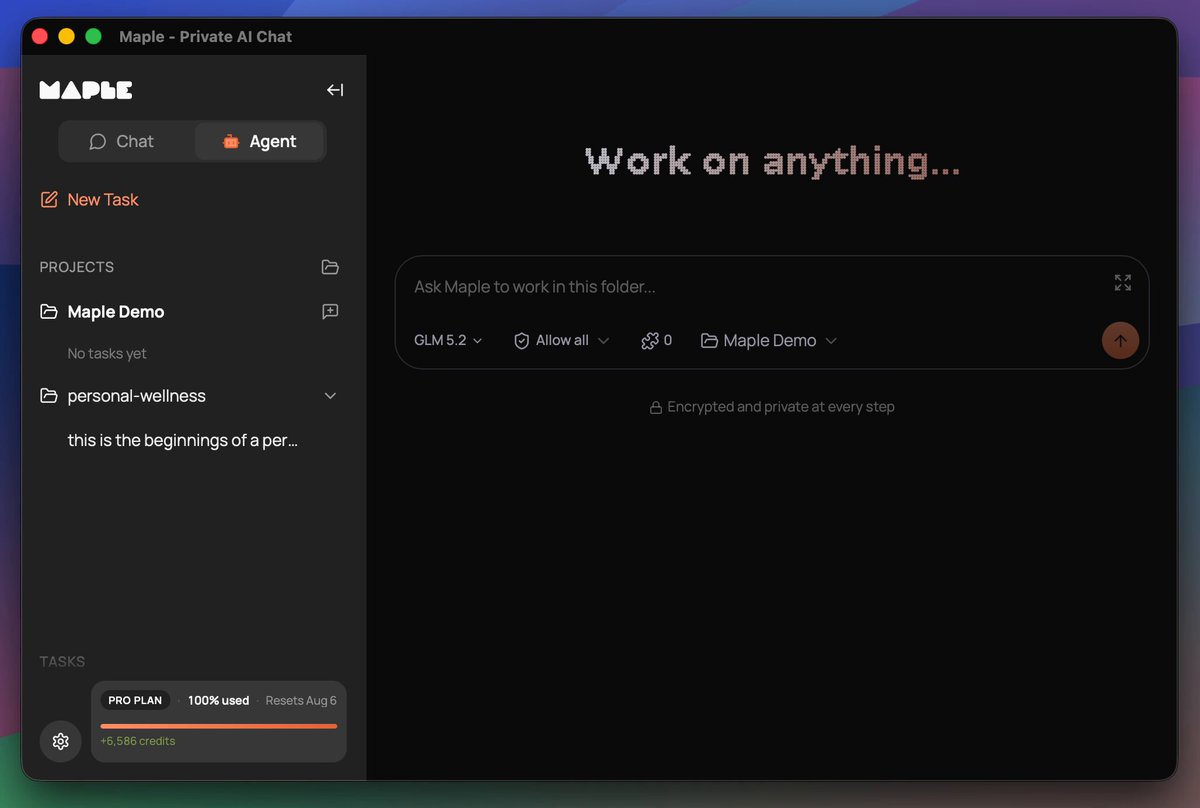
Maple is preparing for the release of a co-working agent. You install it locally and it works with your files, whether it's office work or building websites and apps. It's a turnkey solution, as easy as Claude Code, that keeps your data secure and private, no data sharing with closed AI labs. This is THE sovereign AI app for individuals and businesses who want powerful AI while retaining ownership of their information. Why build an agent into the Maple app when other agents already exist? Easy, we want to give you control over your work. We don't have a business plan that incorporates making money off our users' data. In the age of AI, your information, whether it's personal or company trade secrets, is the single thing that differentiates you from everyone else. We all have access to AI that can build a professional website for selling shoes. But your strategy and network for how you sell shoes should not be shared with your competitors. Sovereignty is the path to protecting what makes you, you. Maple sits at the intersection of Usability and Sovereignty. Maple gives you the best tools that are both easy to use and maintain your data sovereignty. Sovereign for one, sovereign for all. It has been a journey to get here. We brought to market the very first personal chatbot with end-to-end encryption using TEEs in late 2024. Prior to that there were proofs of concept but no full product offerings. Every other AI chat product on the market handled your data in plain text, either selling you a service to get your data or asking you to trust that they won't snoop on you. Quickly people found Maple and latched onto its open-source code and verifiable encryption. We didn't stop there. You may remember earlier this year we teased a product called "Maple Agent" and opened up a waiting list. That product is a mobile app that acts as your AI "friend", maintaining one long continuous chat, and getting to know you over time. I dislike using the word "friend" there, but it's the best way to convey the UX in a few words. AI is a tool, always has been, always will be. Any kind of friendly personality on top is just synthetic. In our testing, the UX of Maple Agent is really powerful for what it does. Think about the many short AI chats you have in your favorite app, whether it's looking up a historical fact or asking advice about a topic. With Maple Agent, those all go away in favor of the long-running chat with the friendly agent. It's like you have your own personal assistant who knows you so well and can look up anything for you. When I ask AI certain questions, I want to ask an expert who already understands my situation so I'm not repeating myself for the 100th time. That's the amazing value the personal agent brings to the table. We still see great utility for a personal agent like the "Maple Agent". Thousands of people on the waiting list, hoping to get their hands on it, agree that the concept is worth exploring and trying out. We were constrained in launching it due to a few circumstances, one of them being access to the scale of compute needed to power it. We have a clear path laid out for how to get there, but today is not the day to execute on that. It will be in the near future. Instead we have a different agent ready to go that we think is also incredible. We now have an agentic harness inside of the Maple Research app. This thing is a powerhouse. It even builds and publishes its own software releases. The agent in Maple Research works with your local filesystem, speaks to the largest open models running in TEEs, utilizes local models for certain tasks, is compatible with MCP tools, has an API for connecting to anything you need, and also supports the ACP protocol, which means it can be extended in the future to speak to other tools like Claude Code, Codex, and local models running on your own hardware. A big unlock for us was the Goose Development Kit, which powers the core of our agent harness. More on that to come as we publish articles and documentation later about the agent. The agent inside Maple Research doesn't have a name. At least not yet, not sure if it ever will. For now we call it "Chat Mode" and "Agent Mode". Think of this as the workhorse, the truck, the heavy lifter. Our other "Agent", the phone app, is your sidekick in your pocket, ready to help with quick things and ongoing conversations about life. I am incredibly excited about the Maple Research Agent. While I'm already seeing great results using it for internal work items, I'm especially thrilled about the personal health and wellness work it's doing for me. I know there are plenty of apps out there for compiling wellness data, but I'm having it build a tool tailored specifically for what I need, without the extra fluff. And none of my health data is being donated to the closed AI labs or sent to advertisers. I know that the AI logic is not being silently adjusted to fit the whims of a large corporation that has paid for product placement. It's me, state of the art AI, and my data. That's how I want it. Maple's new agent makes that possible. We can't wait for you to try it out. If you want early access, comment here, email us, reach out in some way. To those on the other agent waitlist, you're already in the queue. Thanks for reading this lengthy update. :)

Mark

29,937 views โ€ข 11 days ago

New course to bring you up to state-of-the-art at using AI to help you code: Build Apps with Windsurf's AI Coding Agents, built in partnership with WIndsurf (Codeium) and taught by Anshul Ramachandran! AI-assisted IDEs (Integrated Development Environments) make developersโ€™ workflows faster, more efficient, and much more fun. Agentic tools like Windsurf are more than just code autocompleteโ€”they are collaborative coding agents that help you break down complex applications, iterate efficiently, and generate code that spans multiple files. Although a lot of coding assistants share the same underlying large language models for planning and reasoning, a major point of distinction is how they handle tools, keep track of context, and stay aligned with your intent as a developer. For instance, if you make modifications to a class definition in your code and make the same modifications to other classes in the same directory, you might tell the AI agent "Do the same thing in similar places in this directory." Here, tracking your intent means understanding that โ€œthe same thing" refers to that recent edit you just made, which must be followed by appropriate search and tool-calling to implement the changes. In this course, you'll learn the inner workings of coding agents, their strengths and limitations, and how to use Windsurf to quickly build several applications. In detail, you'll: - Build a mental model of how agents work by combining human-action tracking, tool integration, and context awareness to carry out an agentic coding workflow. - Learn the challenges of code search and discovery and how a multi-step retrieval approach helps coding agents address them. - Use Windsurf to analyze and understand a large, old codebase and update it to the latest versions of the frameworks and packages it uses. - Build a Wikipedia data analysis app that retrieves, parses, and analyzes word frequencies. - Enhance the performance of your Wikipedia analysis app by adding caching, and through this, also learn how to course-correct when the AI agent produces unexpected results. - Learn tips and tricks such as keyboard shortcuts, autocomplete, and @ mentions to quickly call on agentic capabilities. - Use image/multimodal capabilities of the AI agent to increase your development velocity; you'll see an example of uploading a mockup with sketched-out UI features, and ask the agent to use that to build new functionality to an app. By the end of this course, youโ€™ll understand agentic coding in-depth and know how to use it to make your development process much faster, more efficient, and enjoyable. Please sign up here!

Andrew Ng

139,858 views โ€ข 1 year ago

New Andrej Karpathy interview Says AI agent failures stem from user skill, not model capability. Poor instructions cause errors. He suggests delegating 20-minute macro actions like coding and research to parallel agents and reviewing their work. --- "I think everything, like so many things, even if they don't work, I think to a large extent you feel like it's a skill issue. It's not that the capability is not there; it's that you just haven't found a way to string together what's available. Like, I didn't give good enough instructions to the agents in the file, or whatever it may be. I don't have a nice enough memory tool that I put in there, or something like that. So, it all kind of feels like a skill issue when it doesn't work to some extent. You want to see how you can parallelize them, and you want to be a 'Pierce tender,' basically. Pierce famously has a funny photo where he's in front of lots of these Codex agents behind the monitor. They all take about 20 minutes if you run them correctly and use high effort. You have multipleโ€”you know, 10 or 20โ€”pull requests checked out. It's just like you can do much larger macro actions. It's not just, 'Here's a line of code, here's a new function.' It's like, 'Here's a new functionality, delegate it to agent one. Here's a new functionality that's not going to interfere with the other one, give it to agent two.' Then, you try to review their work as best as you can, depending on how much you care about that code. You look for these macro actions that you can manipulate your software repository by. Another agent is doing some research, another agent is writing code, another one is coming up with a plan for some new implementation. Everything just happens in these macro actions over your repository. You're just trying to become really good at it and develop a muscle memory for it. It's very rewarding when it actually works, but it's also a new thing to learn. Hence, the psychosis." --- From No Priors YT channel (link in comment)

Rohan Paul

23,122 views โ€ข 4 months ago

Everyone keeps asking: "What's wrong with web3 gaming?" Spoiler: It's not cold start problems. It's not player retention. It's not lack of narrative. Web3 gave a generation of non-game developers access to millions in funding. They thought: โ€œLetโ€™s launch a token, spin up a studio, and build the next Fortniteโ€ฆ but with NFTs.โ€ Reality: most had never built a real game before. So what happened? โ€ข Games got released way too early โ€ข Content was nonexistent โ€ข No real core loop, no polish โ€ข Empty lobbies from day one โ€ข And then they wondered: "Why arenโ€™t players staying?" Because the games suck. The problem isnโ€™t player liquidity or tooling. Itโ€™s that the people building these games had no business building games in the first place. They didnโ€™t understand pacing, balance, content pipelines, or how to keep players engaged. A lot of Web3 games are just barely-playable prototypes disguised as live games. Why? Because these studios ran out of money before they were readyโ€”or never scoped the game properly to begin with. And itโ€™s not just the games. Itโ€™s the studios themselves. โ€ข No clear leadership. โ€ข No product vision. โ€ข No dev pipeline. โ€ข No publishing strategy. Just vibes, Discord mods, and Tokenomics spreadsheets. And you wonder why the token is going down only? Now enter AI. Cool tools. Great potential. But letโ€™s be clear: AI doesnโ€™t fix bad judgment. If you donโ€™t know how to design and ship a good game, AI isnโ€™t going to save you. Itโ€™ll just help you fail faster. The edge AI offers in this space is to the people who already know what theyโ€™re doing. A real game designer with AI is dangerous. AI can scale content, speed up dev time, automate workflowsโ€”yes. But none of that matters if the core game is still boring. If the team doesnโ€™t understand games. If no one wants to play. TLDR: AI won't save Web3 gaming. But it might amplify the few studios that know what theyโ€™re doing. The rest? They'll just fail fasterโ€”with slightly smarter bots. I am still bullish on a select few web3 games, but the majority are going to die and for good reason. Rant over

Web3 Wesley

20,716 views โ€ข 1 year ago

Youโ€™re tired of trying to quit, arenโ€™t you? I donโ€™t need to tell youโ€ฆYouโ€™re already aware of your bad habits But enough of it, let me break it down to you: You donโ€™t need more people to shame you for it Itโ€™s not that you don't care about your future Because anxiety is a sign that you do! The reason is that your mind hasnโ€™t caught up with your ambitions yet It still thinks youโ€™re the old version of you. It doesnโ€™t take you seriously, and it just wants to keep you comfortable Even if that meant bombarding you with negative thoughts, just so you donโ€™t go out there and try something new Because new=risky Your mind hates stress and scary experiences, and thereโ€™s only one way to work around thatโ€ฆ Itโ€™s to start controlling the part of your brain responsible for those emotions: โ€œThe Amygdalaโ€ You have some neuro connections that need to be trained And Iโ€™ve discovered a new fun way to do it Iโ€™ve combined ancient Buddhist and Hindu principles with what you already enjoy doing! I call it โ€œCreative Meditationโ€ Just 10 mins a day, at any time and place you like, WILL turn the table Youโ€™ll no longer struggle with addictions or self doubt I break it down very simply in my ebook, anyone can follow along at their own pace Itโ€™s short and based on REAL scientific studies (with sources) Get it TODAY and see change happening in REAL TIME:

Neuron Powers ๐Ÿง 

12,419 views โ€ข 1 year ago

A SLAVE TO YOU. 2001 was her peak. It is easy and safe to say โ€œGlad it was not meโ€ and โ€œI would have done it differentlyโ€. I see. Fame and Fortune is like dancing with a very large poisons snake and they always win. I have had, in a parallel former life, the chance to work with the very famous on their way up. The first thing I say is: โ€œWhat goes up, will go down. Your career, your money (maybe) and your brain (most definitely) and just about every friendshipโ€. This will happen to every single complex and all too human, human, some just do a good just a good job hiding it. No one is prepared for wealth and fame. Oh we all talk a big game, but no one is prepared. And the wealth and fame are a guarantee that when you fall, you fall hard. Oh you have the money to protect your fall but because of it your mind falls further than one could think is possible. You are so alone. Your parents, your grand parents, your siblings, your kids they all become part of what I call โ€œThe Elvis Syndromeโ€. To everything your constellation of folks around you say โ€œYes Elvis, thatโ€™s a real good ideaโ€, to everything. See they assume, even if they donโ€™t say it, that you must be a โ€œgeniusโ€ because they didnโ€™t do what you did and they donโ€™t have the money and fame. They assign genius to you and lesser to themselves. They dare not speak up. They prefer โ€œYes Elvis, have another fried peanut butter and bacon sandwich. You are not getting fatโ€. Long ago your burning starlight chased away any true friends, because even if they were strong to say truth, you believed your own public persona like everyone around you. You can not listen, you are the genius they have some job someplace. You also have just two options to anyone around you: 1) Your โ€œcrewโ€ 2) People you pay And ironically they merge in to one and the same. All see your public persona and all see you as a means to get paid. Oh you go to โ€œpartiesโ€ with other rich and famous people but they are one of the above ultimately. Hierarchy forms around you and they naturally form a protection barrier. You have tantrums as fame rips you apart and you desperately try to become your public persona. Each layer you build to protect your all too human center moves you into more and more isolation. Shielded from real and needed pressures of life you are in your beautiful and well stocked velvet prison. You are now just a vehicle for moving money efficiently and surrounded by people that live off this largess. At the peak you may have advisors and they may seem to help. But they dare not tell you what they see even if they could see it. And most canโ€™t see it because no one is prepared for it so they donโ€™t have any better insight. This spans the enter ensemble of people that are now your satellites from gurus to lawyers, from plastic surgery doctors and fitness trainers. So what now? What if your dreams to โ€œmake it bigโ€? Abundance does not fix a broken soul. And we all have this. Trauma is a great fuel, it will absolutely get you to orbit and you will shine, but trauma in orbit is the breaks that break you and when gravity wins, and it always does, you have no idea how to navigate going down. Trauma is what I have seen build everyone from Elvis to Steve Jobs. Trauma unresolved took them out. I am not saying your dreams are invalid and should not be your goal, I am saying that you donโ€™t get a pass. No one does. And with fame and fortune it is nearly impossible to address it, because your ego canโ€™t fit in a zip code. As you prepare for you fortune, and if you are reading this, you will have one, prepare your mind. Deal with the dark places that drive you. Make peace with the past, the people that did you wrong and mostly with yourself. But in this bargain you will remove some fuel for your rocket. It is the bargain. But it is the better path. We all will dance with the snake. But hopefully will know it. And you may have fame. Just donโ€™t become a: โ€œSlave to youโ€.

Brian Roemmele

115,188 views โ€ข 7 months ago

$ABCL CEO Carl Hansen explains the net negative overall value creation in biotech and how AbCellera plans to beat it: โ€œI really think it can be beat because thereโ€™s a lot of mistakes that get made in where you allocate capital.โ€ โ€œIf youโ€™re a biotech and you start a company on a drug, and you go public and have a drug, and now the data is looking not that great, you just keep running that drug. โ€ฆ Because if you quit that drug, the company is done.โ€ โ€œSo, because youโ€™re so concentrated on one thing, you end up having blinders. Itโ€™s like a cult of a molecule. And even a real, practical, capital access problem that makes you continue to move things forwardโ€ ______________________________________ โ€œAnother problem is that many of the drugs that get started, get started by people who donโ€™t understand the competitive or commercial landscape and have no intent of ever actually manufacturing it. โ€ฆ Because they know someone else is going to buy it. So then their framework is not โ€˜Am I making a drug thatโ€™s going to make a difference for people?โ€™ The framework is โ€˜Can I make something that I think someone will take off my hands?โ€™ And that happens a lot.โ€ โ€œThere are many acquisitions where a big pharma company spends $10B, $20B, and itโ€™s a complete bust. So really no value is generated for patients but someone was able to get a good exit on that because they anticipated what someone would want. And a lot of decision making gets done like thatโ€. _______________________________________ โ€œIโ€™m not saying that we have this all solved. But what weโ€™re trying to do is create a framework where we are able to take many bets so that we donโ€™t fall in love with anything, or we donโ€™t have to fall in love with anything. โ€ฆ And then always hold up very explicitly what we know and what we donโ€™t know along the dimensions that matter. The dimensions that matter are - Will it work? Thatโ€™s a science. - When it gets where will people care? - Is it differentiated? - Does it solve a big problem? In order to get it there, is there a path with our resources and expertise that would allow us to see it through?โ€ โ€œWhen you start to hold things up like that, you start to see where the mistakes are, where the uncertainties are, and you can be more rational in deciding โ€˜Weโ€™re going to run it to here because we get to flip the card and if the card goes the wrong way weโ€™re going to kill it because weโ€™ve got something else behind it.โ€™โ€ โ€œI do think that if done right, and if you can pick the right opportunities, the success rate can be well higher than an order of magnitude better. โ€ฆ And there are examples of thisโ€ฆ companies Iโ€™ve mentioned, you know, Regeneron, their success rate is at least 10x the industry in bringing programs forward and getting them approved. โ€ฆ So itโ€™sโ€ฆ you can do it better that wayโ€

Jack Prescott

18,424 views โ€ข 1 day ago

Introducing the Clips chrome extension - the easiest way to send bug reports to agents with video, transcript, and browser debug info captured automatically. 100% free and open source. If you are like me and get tired of manually typing instructions to agents, attaching screenshots, pasting debug logs, and all of that, this might be your new favorite tool. With the Clips chrome extension, you can just click the Clips icon, hit record, and start talking. Visually demonstrate your issue, go through the flow, point out whatโ€™s broken. Clips will capture everything on your screen, plus network requests, browser logs, client errors, and all the details around them. And it redacts sensitive information. Then it gives you a link you can send to humans so they can play it and take a look. Or, more importantly, just give it to your agents by just pasting the URL to them. The link has special metadata for agents so just from the URL, the agent can pull all information from the clip automatically. No plugin or MCP server required. That means it can "see and hear" whatโ€™s in the video - read the transcript, grab snapshots at any timestamp, and inspect the logs and network requests that were shared with it. So whether you want to quickly demo an issue and send all that context to an agent, or get better bug reports from teammates, recording and sending Clips makes that super easy. Unlike expensive apps like Loom, this is all 100% free and open source. The framework that powers this, plus a bunch of other free applications, is open source too. You can just sign up and use it, or fork it and customize it to your needs. This, in my opinion, is the future of software. Rather than bloated SaaS that charges you a ton of money and still doesnโ€™t even have the things you need, we get free open source canonical apps that you can fork and customize in any way you want. I'll link to all this stuff in the replies. If you try it, let me know your feedback.

Steve (Builder.io)

60,399 views โ€ข 1 month ago

Big moment for Postgres! AI coding tools have been surprisingly bad at writing Postgres code. Not because the models are dumb, but because of how they learned SQL in the first place. LLMs are trained on the internet, which is full of outdated Stack Overflow answers and quick-fix tutorials. So when you ask an AI to generate a schema, it gives you something that technically runs but misses decades of Postgres evolution, like: - No GENERATED ALWAYS AS IDENTITY (added in PG10) - No expression or partial indexes - No NULLS NOT DISTINCT (PG15) - Missing CHECK constraints and proper foreign keys - Generic naming that tells you nothing But this is actually a solvable problem. You can teach AI tools to write better Postgres by giving them access to the right documentation at inference time. This exact solution is actually implemented in the newly released pg-aiguide by Tiger Data - Creators of TimescaleDB, which is an open-source MCP server that provides coding tools access to 35 years of Postgres expertise. In a gist, the MCP server enables: - Semantic search over the official PostgreSQL manual (version-aware, so it knows PG14 vs PG17 differences) - Curated skills with opinionated best practices for schema design, indexing, and constraints. I ran an experiment with Claude Code to see how well this works, and worked with the team to put this together. Prompt: "Generate a schema for an e-commerce site twice, one with the MCP server disabled, one with it enabled. Finally, run an assessment to compare the generated schemas." The run with the MCP server led to: - 420% more indexes (including partial and expression indexes) - 235% more constraints - 60% more tables (proper normalization) - 11 automation functions and triggers - Modern PG17 patterns throughout The MCP-assisted schema had proper data integrity, performance optimizations baked in, and followed naming conventions that actually make sense in production. pg-aiguide works with Claude Code, Cursor, VS Code, and any MCP-compatible tool. It's free and fully open source. I have shared the repo in the replies!

Avi Chawla

186,931 views โ€ข 7 months ago

๐Ÿšจ A MUST LISTEN for all amateur ballplayers wanting to play in college. Long but SO MUCH VALUE here! Alabama HC Rob Vaughn on college baseball recruiting and the type of player you truly want in your program, no matter the level. โ€œOur job in college baseball, yes, it's to win games. Yes, it's to develop big leaguers, and yes, it's all the things that we all talk about in recruiting, but more than anything, it's to prepare these kids to be successful for whatever comes next. And man, as good as the talent is in this league, as good as the talent is on this team, not all of them are going to be career big leaguers, you know. And I think what makes Tyler Fayโ€™s journey so awesome, is in a world that is inundated with particularly moms and dads that want your kid to cut and run when when they're not starting every day or they're not playing every day. You see at one end of the equation, you either get the parents are like, โ€˜Hey man, put your head down to work. We got to get better.โ€™ And you get the parents that feed into the narrative, โ€˜man, they're not giving you a chance. You got to go. You got to leave.โ€™ the thing about him that makes him so special is regardless of whether Tyler's a 20-year big league or not, that guy's going to be a smashing success in life because when things get hard, he doesn't cut and run. He's not sticking his hand out looking for the next easy way and who's going to pay me more. Heโ€™s the I'm going to put my head down. I'm going to work and I'm going to get better.โ€ Guys like him are the exact reason you believe in what you recruit. You believe in makeup, you better hunt makeup because that guy has that in spades. And that's why he deserves every ounce of what he's getting right now.โ€

Harrison Cordell Fant

106,253 views โ€ข 1 month ago