Loading video...

Video Failed to Load

Go Home

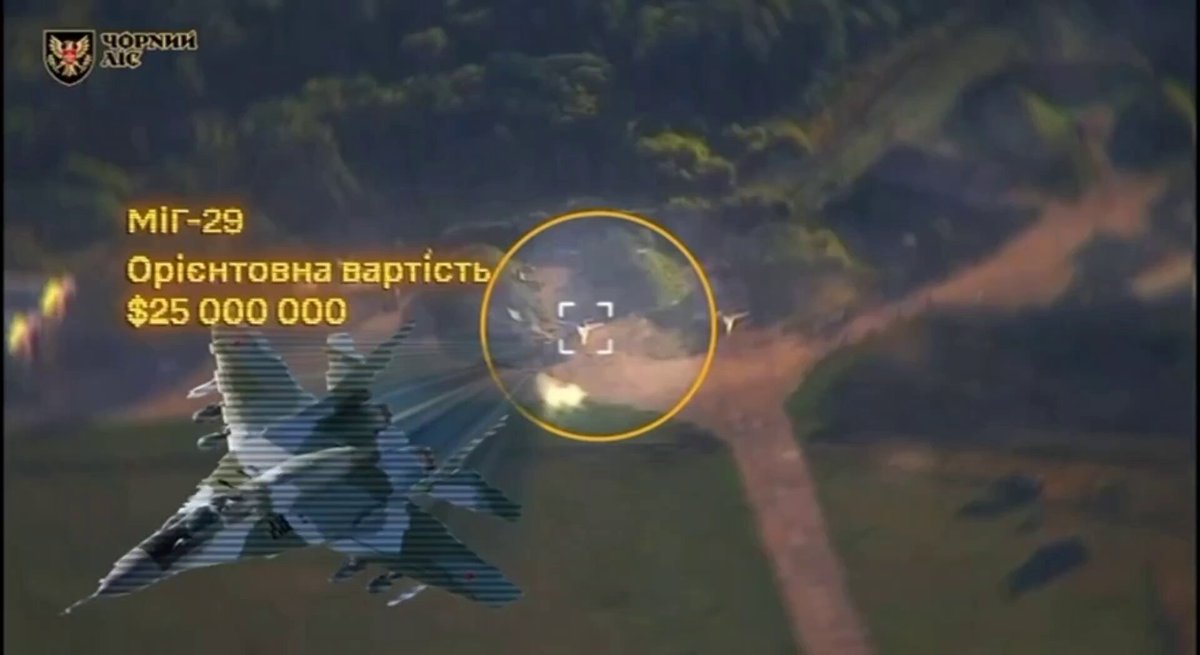
‼️‼️🇷🇺🇺🇦 BIG | Ukraine’s deep-strike capabilities have struck a humiliating blow deep inside Russian territory, proving that even heavy air defense coverage cannot protect Moscow's tactical airfields. The 15th Separate Artillery Reconnaissance Brigade "Chornyi Lis" executed a precision kamikaze drone strike targeting the Khalino Airfield in Russia's Kursk region,...

45,686 views • 2 days ago •via X (Twitter)

0 Comments

No comments available

Comments from the original post will appear here

Related Videos

Units of the Unmanned Systems Forces grouping carried out a series of strikes on key enemy targets, including an ST-68 radar, a "Pantsir-S1" anti-aircraft missile and gun system, logistical support and ammunition depots, railway tank cars with fuel and lubricants, mobile fire groups, and logistics facilities. Here are more details about the operations: 🎯In temporarily occupied Feodosia, operators of the 1st Separate USC destroyed a radome inside which an ST-68 radar was located. Immediately after that, the unit's operators struck the radar itself, which was designed to detect and track air targets and was an important element of the enemy's air defense system. 🎯The 1st Separate USC struck a "Pantsir-S1" anti-aircraft missile and gun system in temporarily occupied Crimea. The estimated cost of the struck complex is about 15 million US dollars. The "Pantsir-S1" is one of the key elements of the enemy's air defense. 🎯The 414 Magyar's Birds , the K-2 , the "Phoenix" border guard unit, and the 412th "Nemesis" Brigade struck enemy logistics targets in the Donetsk, Zaporizhzhia, and Luhansk regions. 🎯The 1st Separate USC struck railway tank cars with fuel and lubricants in the Donetsk region. 🎯The 412th "Nemesis" Brigade struck a logistical support depot in Mariupol. 🎯The 1st Separate USC struck an ammunition depot in the Luhansk region. 🎯The "Phoenix" border guard unit struck an enemy mobile fire group in the Luhansk region. The operations were conducted in coordination with the Deep Strike Center of the USF grouping. The Unmanned Systems Forces consistently dismantle the enemy's defense: destroying air target detection means, eliminating air defense systems, and disrupting the supply of ammunition, fuel, and logistical support. USF: One step ahead!

🇺🇦 Unmanned Systems Forces

49,980 views • 1 month ago

‼️‼️🇺🇦🇷🇺 BIG | A high-stakes air-to-air confrontation has culminated in the downing of a premier Russian Su-35S multirole fighter jet, triggering intense damage control across prominent Russian military propaganda channels. Prominent Russian military blogger Kirill Fedorov confirmed the destruction of the advanced air-superiority asset, revealing that the Russian aircraft was systematically hunted down in a coordinated engagement. According to Fedorov, the single Su-35S was targeted by a superior formation of three Ukrainian combat aircraft—including Western-supplied F-16 fighters—operating in tight tactical synchronization with a forward-deployed Patriot air defense radar station. While the Russian pilot reportedly managed to eject and survive, Fedorov conceded that the engagement likely marks a major milestone as one of Ukraine's first complex, multi-domain air-to-air victories involving newly integrated Western platforms. In an effort to downplay the tactical humiliation, the propagandist insisted that the loss of a single Su-35S is not structurally critical due to active production lines and low overall airframe attrition. However, he expressed profound alarm over the changing strategic balance in the skies, warning that Moscow's aviation dominance is rapidly eroding. Fedorov highlighted that the impending delivery of additional Western fighters and next-generation air-to-air ordnance—moving beyond standard AIM-120 AMRAAMs to include ultra-long-range European Meteor missiles capable of striking targets at distances exceeding 200 kilometers—poses an existential threat to Russian tactical aviation moving forward. See the latest updates with us: Visioner

Visioner

128,331 views • 15 days ago

According to military experts, Venezuela had the most powerful and multi-layered air defense network in Latin America. There are also reports that Russia has transferred its air defense systems to Venezuela in the fall of 2025. In this video, Maduro speaks about 5,000 Russian Igla MANPADS protecting Venezuela's borders. None of them did their job, it seems. The main tasks of protecting the country's airspace were carried out by the Bolivarian Military Aviation (Aviación Militar Bolivariana), which includes all branches of aviation, air defense forces, and other structures. There are six joint aerospace defense commands (Comando de Defensa Aeroespacial Integral) responsible for different areas. CODAI oversees surveillance units, combat aviation, and air defense systems. The Bolivarian Navy also had its own capabilities for protection against an air attack. According to publicly available data, a radar field has been established along Venezuela's borders for the rapid detection of an air attack. At the most critical areas, modern Chinese-made JYL-1 and JY-11B 3D radars are deployed (from 8 to 10 units). Bolivarian Military Aviation also has the following in service: 🔹 Russian S-300VM Antey-2500 system: two divisions, including radars, a command post, up to six launchers each, and anti-aircraft missiles, received by Caracas from Moscow in 2013; 🔹 Russian Buk-M2E surface-to-air missile system: according to open sources, nine combat vehicles; 🔹 S-125 Pechora-2M SAM system: outdated equipment that has been actively decommissioned, but around 24 launchers remain in service; 🔹 Tor-M1 SAM systems: between 10 and 12 units; 🔹 Small-caliber artillery systems of various types: at least 400 units, half of which are Soviet/Russian 23-mm ZU-23-2 autocannons; 🔹 Man-portable air-defense systems: Russian Igla systems and similar foreign-made MANPADS; 🔹 Anti-aircraft artillery: approximately 260 guns, including Swedish Bofors L70. And if we add fighter aircraft (at least 20 Russian Su-30MKVs and up to 10 operational American F-16s) and naval equipment to this, it becomes clear that Venezuela does have air defense capabilities. However, none of this did its job.

Anton Gerashchenko

244,043 views • 6 months ago

The Telegram channel “Byt Ili” conducted a detailed analysis of the performance of Russian air defense during yesterday’s Ukrainian drone raid on Moscow. It was the first time that the operation of Russian air defense could be observed almost in real time. Key conclusions from the analysis: “Perhaps the most surprising thing for me in today’s strike on the Moscow oil refinery is the number of missed interceptions by Russian air defense systems against Ukrainian UAVs. In this compilation, I’ve specifically cut together the misses by ‘Pantsirs’. The selection is not complete. For the first time, we were able to observe in real time how Russian air defense operates during large-scale drone raids. And I have no rational explanation for why it performs THIS poorly. Yan Matveev described it most succinctly: ‘Air defense systems were deployed right in the city, missiles are flying chaotically in all directions and missing their targets; the threat from them is no less (and perhaps even greater) than from the drones themselves.’ But this still doesn’t answer the question: why is it like this? After all, these are UAVs flying at low speed — not cruise missiles, and certainly not ballistic ones. This can hardly even be described as a combined strike designed to overwhelm air defenses. The only fast-moving targets here were a few jet-powered UAVs like “Bars,” and there were very few of them. This is nowhere near the level of overload seen in Ukrainian air defenses during Russian combined missile strikes. And yet, even a strike of this scale creates chaos and confusion for Russian air defenses. It also leads to the conclusion that ‘Pantsir’ systems perform rather poorly against UAVs. Now it becomes clear why there is such a shortage of Pantsir missiles — because even slow Ukrainian drones sometimes cannot be shot down with two missiles. This is shown in videos 1 and 2 — two misses by a Pantsir against a single UAV, which ultimately hits its target. In video 3, a Pantsir misses the first UAV, misses the second, and only the third missile manages to shoot down the second UAV.” 1/

𝔗𝔥𝔢 𝕯𝔢𝔞𝔡 𝕯𝔦𝔰𝔱𝔯𝔦𝔠𝔱△ 🇬🇪🇺🇦🇺🇲🇬🇷

67,005 views • 1 month ago