Video wird geladen...

Video konnte nicht geladen werden

Zur Startseite

BlackOpal isn't another fund tokenizing US Treasuries and calling it revolutionary. We're an onchain asset management and payments platform using onchain rails to access $100+ billion in emerging market credit card receivables, delivering investment-grade yield, asset liquidity, and built-in investor protection. Investment-Grade Yield • We partner with leading fintechs...

53,871 Aufrufe • vor 8 Monaten •via X (Twitter)

0 Kommentare

Keine Kommentare verfügbar

Kommentare vom Original-Post werden hier angezeigt

Ähnliche Videos

From Morgan Stanley to Ripple to Hedera: Building the Shopify of Institutional Asset Tokenization The world is moving toward a system where everyone, not just millionaires, can access high-quality real world assets. In our conversation with Anil, the founder of cSigma Finance, he explained how global investors and real businesses are being left out of traditional financial systems, and why DLT such as Hedera finally makes this possible. Anil spent nearly two decades in financial services, from Morgan Stanley to building institutional grade credit products Ripple, before launching cSigma in 2023. Today his team is building the full infrastructure layer for asset originators to bring institutional grade financial assets onchain. Here are the key insights straight from the interview: • Investors outside financial centers struggle to access high quality assets. • Even in developed countries, most people are shut out of institutional opportunities. • Mid-market businesses often pay extremely high APR because traditional lenders cannot efficiently serve smaller ticket credit. • cSigma connects these businesses directly with global stablecoin liquidity using a compliant, blockchain native process. • More than 80 million dollars in fully collateralized, legally enforceable real world assets have already been originated. • Higher yields are possible without speculative token incentives. • Asset originators are reducing their cost of capital by 20 to 30 percent. • cSigma built a complete stack: AI credit analysis, legal and compliance rails, risk monitoring, tokenization standards, and real settlement workflows. • Permissioned institutional capital and permissionless global liquidity now interact through one architecture designed for regulation and scale. Anil’s thoughts on 2026 were clear: Anyone with even 1000 dollars should be able to build a diversified portfolio of institutional grade assets. Tokenization makes this possible. Hedera makes this possible. This is what democratizing finance actually looks like. Podcast supported by HashPack Wallet Hedera Hashgraph Hedera Foundation

Generation Infinity

161,084 Aufrufe • vor 7 Monaten

OnRe turns one today. One year ago, OnRe was founded with a clear belief: the future of reinsurance capital would not stay offline forever. Today, that belief has grown into: • $178M+ AUM • 6,200 ONyc holders • $17.28M in gross written premium • $16.83M in yield distributed to ONyc holders • $250M+ total assets deployed across OnRe DeFi Markets • $100M+ of capital deployed into uncorrelated reinsurance opportunities Reinsurance is one of the world’s largest and most resilient yield markets, yet access remained limited to institutions and incumbent balance sheets. Meanwhile, onchain capital expanded rapidly in search of sustainable sources of real-world yield. The disconnect was clear: insurance needed new forms of capital, and digital asset markets needed more substance. So we built OnRe to connect them. A licensed collateralized reinsurer and onchain asset manager bringing reinsurance premiums onchain through ONyc, a Solana-native yield asset backed by real underwriting activity. Over the last year, ONyc integrated into Solana DeFi through Kamino, Loopscale, Exponent, Elemental ⬡, and others, helping bring institutional-grade yield into lending markets, vaults, and liquidity infrastructure. But the most important thing we built this year was conviction. Conviction that reinsurance can become programmable, transparent, and composable infrastructure for internet capital markets. To our team, partners, investors, users, and community: thank you for believing in this vision. We’re just getting started.

OnRe

100,819 Aufrufe • vor 1 Monat

The Arc Ecosystem is Taking Shape With today’s public testnet launch, we’re proud to share that leading companies across major sectors of the global financial system and onchain economy are already engaging in the early Arc ecosystem. Collectively, these organizations manage hundreds of trillions in assets, facilitate vast global payment flows, and power billions of transactions every day. Spanning the Americas, Asia, Europe, Africa, and the Middle East, the geographic diversity of testnet participants highlights a defining strength of Arc: it’s purpose-built to connect every local market to the global economy. As the Economic OS for the internet, Arc presents the opportunity for every type of company to build on enterprise-grade network infrastructure — advancing a shared vision that a more open, inclusive, and efficient global economic system can be built natively on the internet. Stablecoins and asset issuers: Arc is designed as a foundation for issuers of fiat stablecoins, along with tokenized equities, credit, money market funds, and more. Central to this is Arc’s roadmap for stablecoins as tokens for gas payments, as well as native infrastructure that will be deployed on Arc for core stablecoin swaps and FX liquidity. Currency issuers from key geographies — Australia, Brazil, Canada, Mexico, and the Philippines — who are joining for Arc Testnet include: AUDF issued by Forte Securities BRLA issued by Avenia JPYC issued by JPYC Inc. KRW1 issued by BDACS MXNB issued by Juno (a Bitso company) PHPC issued by CoinsPH QCAD issued by Stablecorp In addition to these global currency issuers, Circle is engaging with a wide range of stablecoin issuers and stakeholders — including issuers of dollar-, euro-, and other fiat-backed stablecoins — to bring their assets to Arc. Stay tuned for more details on upcoming Arc platform enhancements designed for stablecoin-based gas fees, FX, and cross-stablecoin liquidity and interoperability, which are key themes and focuses for the emerging internet financial system. Enabling developers The day-one experience for developers is essential, and we are pleased to have many leading ecosystem players that provide developer tools and blockchain infrastructure to help bring applications and solutions to Arc. Testnet participants include: AI: Anthropic enriching the developer experience on Arc with Claude Code-powered builder tools. Digital Wallets: Bron, Exodus, Fireblocks, Hecto Innovation, Ledger, MetaMask, Privy, Rainbow, Turnkey, and Vultisig connect Arc into desktop and mobile app experiences. Developer Tools: Alchemy, Chainlink, Crossmint, Dynamic, FunXyz, LayerZero, Pimlico, thirdweb, and ZeroDev support builders with frameworks and kits. Crosschain: Across, Stargate, and Wormhole connect Arc to other blockchain networks. Infrastructure: Blockdaemon, Blockscout, Bridge, Elliptic, Quicknode, Ramp Network, Tenderly, Transak, and TRM help keep Arc accessible, performant, compliant, and reliable. Digital asset markets and liquidity DEXs: Curve, Dromos Labs (Aerodrome, Velodrome), Euler Finance, Fluid, and Uniswap Labs provide decentralized trading and liquidity pools. CEXs: Bitvavo, ByBit, Coinbase, Coincheck, Hashkey, Kraken, and Robinhood expand access points into the Arc ecosystem. Market Makers and OTCs: Auros, B2C2, Cumberland, Galaxy Digital, GSR, IMC, Forte Securities, Keyrock, NONCO, Wintermute, and Zodia Markets provide efficient access to liquidity globally. Borrow/Lend: Aave, Maple, and Morpho enable credit and capital efficiency with stablecoins and tokenized assets. Yield: Centrifuge, Superform, and Securitize power stablecoin-native yield opportunities. Tokenized Fund Issuers: WTGXX and CRDT by WisdomTree provide access to yield-bearing tokenized investment funds. Custodians: BitGo, Copper, Taurus, and Zodia Custody provide digital asset storage for institutions. Global payments, technology, and fintechs: Amazon Web Services, Brex, Catena Labs, Careem, Cloudflare, Corpay, Dmall, Ebanx, FIS, Hecto Financial, LianLian Global, Mastercard, Mercoin, Nuvei, Noah, Pairpoint by Vodafone, Paysafe, PhotonPay, Ramp, Sasai Fintech — a business of Cassava Technologies, Sumitomo Corporation, Visa, WorldPay, and Yellow Card. Capital markets: Apollo, BNY, NYSE / ICE, and State Street. Banks, asset managers, and insurers: Absa, Bank Frick, BlackRock Inc, BTG Pactual, Clearbank, Commerzbank, Deutsche Bank, Emirates NBD, First Abu Dhabi Bank, FirstRand, Fiserv, Goldman Sachs, HSBC, Invesco, Kyobo Life, SBI Group, Standard Chartered, Société Générale, and WisdomTree.

Jeremy Allaire - jerallaire.arc

26,240 Aufrufe • vor 8 Monaten

Executive Thesis - Ripple Bank 2025 If Ripple secures bank-like permissions (U.S. national bank charter or state ILC plus key foreign licenses) and runs RL-stablecoins and XRPL rails under a Basel-caliber risk, capital, and compliance stack, it can become a regulated global settlement and asset-services platform. That platform could let central banks, sovereign treasuries, and regulated financial institutions issue, custody, trade, and settle stablecoins and tokenized RWAs (stocks, bonds, commodities, derivatives) with ISO 20022 native messaging, BSA/AML–FATF controls, and Basel III capital/liquidity governance—collapsing today’s slow correspondent chains into a single, high-compliance operating layer. The “Boom” Implications With the right charter(s), prudential regime, and partnerships, Ripple can become a compliance-first global neo-banking platform that (1) absorbs cross-border payment flows from correspondent networks, (2) powers CBDC and sovereign tokenized markets, and (3) monetizes issuance, custody, settlement, and compliance at scale—all inside Basel III, BSA/AML, FATF, and ISO 20022 guardrails. Impact on XRP If Ripple Bank were formally approved and XRP became the primary liquidity and settlement token across its’ regulated ecosystem, the economic demand for XRP would expand exponentially - transforming it from a speculative asset into regulated financial infrastructure. Structural Shift in XRP Demand From Speculative to Utility-backed Demand • XRP’s value today is primarily market-driven by speculation on future adoption. • Under a Ripple Bank framework, XRP becomes a mandatory utility asset — required for: • Settlement liquidity between all tokenized assets on XRPL (CBDCs, stablecoins, RWAs, derivatives). • Transaction fees and compliance verification across billions of high-value financial messages. • Collateral in interbank, treasury, and derivative clearing functions. This converts XRP from “optional” to “indispensable” in regulated settlement flows - similar to how SWIFT messaging depends on correspondent Nostro/Vostro liquidity BUT executed on a frictionless, tokenized rail. Volume & Velocity Effects Token velocity decreases, float demand increases • Basel III and liquidity regulations require prefunded, high-quality settlement collateral. • As banks, sovereigns, and institutions hold XRP as a liquidity reserve (like Tier-1 capital equivalents for tokenized payments), circulating supply falls while volume increases—driving scarcity-driven price appreciation. An Example of Flow Scale • Global wholesale payments ≈ $250T/year. • If 10% settles through Ripple’s bank-backed network using XRP at a 3-day velocity (roughly 120 settlement turns per year): • Required float ≈ $2.1T equivalent demand. • Even at $100/XRP, that implies 20B XRP locked in active liquidity operations. • At today’s 15B non-escrowed supply, value equilibrium could theoretically exceed $140–$200 per token, depending on velocity and collateral requirements. From today’s ~$3 price, this implies a 46x to 66x price surge. Are we ready? Ripple Treasury Department OCC Comptroller Jonathan Gould

Rob Cunningham

10,911 Aufrufe • vor 9 Monaten

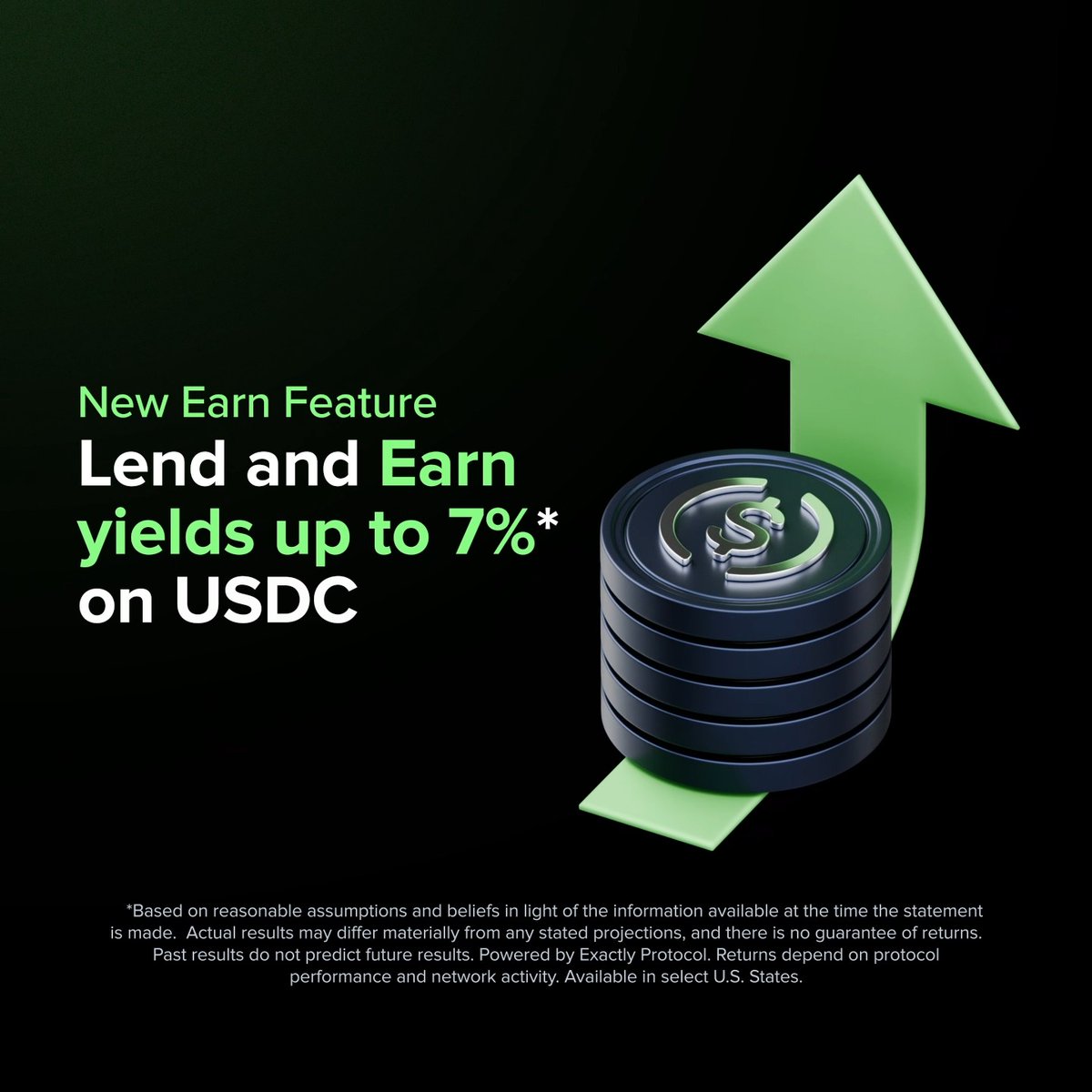
Earn yields up to 7%* on USDC 🔵 New Earn feature is live! Turn your $USDC into an active, yield-generating asset in just a few taps. → Earn yield through on-chain lending → Watch your balance grow live → Easy DeFi access Put your crypto to work 📲 *Based on reasonable assumptions and beliefs in light of the information available at the time the statement is made. Funds are deposited to, and yields are paid by, the Exactly Protocol, a decentralized protocol on the Base blockchain. Financial forecasts, even those presented with numerical specificity, are estimates based on subjective and variable assumptions that are inherently subject to material uncertainties, risks, and other changes in circumstances that are difficult to predict. Actual results may differ materially from any stated projections, and there is no guarantee of returns unless your funds are borrowed. Past results do not predict future results. Uphold cannot guarantee future performance and undertakes no obligation to assess the veracity of any stated projections. Users are cautioned not to rely on these projections when making a decision regarding Exa Earn. Available in select U.S. States. Powered by Exactly Protocol. Yield is variable and not guaranteed. Returns depend on protocol performance and network activity. Past performance does not guarantee future results. High credit demand means you may not be able to withdraw all your funds. You can withdraw your assets at any time as long as there is available (unborrowed) liquidity in the asset pool. Terms apply.

Uphold

23,791 Aufrufe • vor 2 Monaten

ADI Chain Mainnet and $ADI are now live. A new era of institutional blockchain starts today. From day one, $ADI is listed on Kraken, KuCoin, and Crypto.com, and soon on etoro, ensuring global accessibility and liquidity as the network scales. The token is also available through Wallet in Telegram, enabling users to manage $ADI directly within the Telegram app, as well as , the global banking and investment platform. $ADI is the native gas token powering all transactions across ADI Chain's L2 and customizable L3 domains, covering fees, smart-contract execution, and settlement across the network – enabling efficient, compliant infrastructure for stablecoins and real-world asset tokenization. Notably, ADI Chain will host the UAE's dirham-backed stablecoin being developed by First Abu Dhabi Bank and IHC, laying the foundation for a broader, multi-currency ecosystem of sovereign stablecoins. Built on ZKsync's Atlas and Airbender stack, ADI Chain delivers a compliance-ready framework for real-world, regulated digital infrastructure. It enables jurisdiction-specific L3 domains with optionally built-in KYC/AML, privacy controls, and programmable governance, all while remaining fully interoperable. Backed by 50+ government and enterprise projects across 20+ countries – including partnerships with Abu Dhabi Real Estate Centre - مركز أبوظبي العقاري for real-estate tokenization and Emirates Driving for blockchain-based solutions – the network launches with real-world adoption already in motion. With 500 million people already within its reach and a roadmap to bring 1 billion people onchain by 2030, ADI Chain is positioned for institutional-grade scale. That's Different.

ADI Chain

320,336 Aufrufe • vor 7 Monaten

I spent time on the ground in Jakarta over the last few days and came away more convinced that it will play a growing and significant role in the internet financial system In many ways it already is; Indonesia has extremely high crypto and stablecoin adoption. Hard to think otherwise after meeting so many leading entrepreneurs and innovators. William Sutanto of indodax has built Indonesia's largest crypto assets platform. Calvin Kizana and sndyc of Tokocrypto operate one of Indonesia’s leading platforms, focused on delivering simple, secure, and seamless crypto trading and transactions. The Mobee team is focused on providing seamless access to digital asset trading and liquidity through an easy-to-use platform for both individuals and businesses. It was so great to spend time again with Vince Iswara, founder and CEO of DANA.id, which continues to improve the financial wellbeing of so many through innovation, and is the largest digital wallet platform in Indonesia. Kai and his team ICEx Group have built an OJK-licensed bourse for digital assets, operating Indonesia’s integrated exchange alongside clearing and custody infrastructure. Archie Anugrah, Andy Putra, shabrina adani and the whole team Pintu have built a mobile-first digital asset platform that serves millions and has been innovating in the space from the early days. Natasha Ardiani and the team at Durianpay are laser focused on making payments seamless across the entire ecosystem. The Lippo Group and Nobu Bank are thinking deeply about the digital future at one of Asia’s largest diversified conglomerates and digital bank, clearly poised to continue the firm’s legacy as an industry pioneer in Indonesia and beyond. jeth_soetoyo of CFX and I first met in 2018 before Circle had even launched USDC! It’s impressive what he did with Pintu and is now doing with PT Central Finansial X (CFX), a licensed bourse that is on a mission to accelerate the adoption of digital assets. I got to meet with him and leaders from ICC, KKI and IKS. D3Labs.io is a secure and compliant asset tokenization infrastructure for asset issuance, management, and transactions. taking an innovative approach to tokenization and real world assets. It was great to meet Chung Ying Lai and Tigran Adiwirya. They have a deep commitment to the local crypto community! Very strong energy across the board, excited about what we can do together and the potential for growth in this highly dynamic market.

Jeremy Allaire - jerallaire.arc

118,195 Aufrufe • vor 3 Monaten

Know This With Full Conviction. In a post-Clarity Act world, Ripple becomes a monetary middleware giant - not the sovereign system itself, but the bridges between: banks → stablecoins → tokenized assets → custody → prime brokerage → global settlement → XRP/XRPL liquidity. Ripple now markets itself as financial infrastructure for payments, custody, stablecoins, and prime brokerage. Ripple Prime is the first global multi-asset prime broker owned by a crypto company, with 3T+ annual clearing and 300+ institutional customers. RLUSD is positioned as a regulated dollar stablecoin backed by cash, Treasuries, and cash equivalents, with NYDFS and DFSA approval. Ripple Custody is explicitly aimed at institutional tokenization, trading, stablecoin, and RWA infrastructure. The Clarity Act matters because it converts today’s regulatory fog into board-defensible adoption logic. The Senate Banking Committee is set to review the Clarity Act on May 14, 2026, with the bill focused on classifying digital assets and establishing regulatory guidelines. Ripple becomes one of the FEW “ready-now” institutional rails for compliant, global value movement. • RLUSD can serve the regulated dollar leg. • Ripple Custody can secure assets. • Ripple Prime can serve institutions. • RippleNet/Ripple Payments can move value. • XRPL can tokenize and settle. • XRP can serve as neutral bridge liquidity where dollar-to-dollar stablecoin rails are insufficient. Ripple makes large portions of correspondent banking, trapped liquidity, slow settlement, fragmented custody, and legacy FX plumbing ECONOMICALLY OBSOLETE where institutions are legally permitted to adopt faster rails. Ripple is today, the 6th largest, non-public company by market cap valuation, in America. And this is before open issues with China, Iran, Ukraine/Russia, Iraq and the Clarity Act are resolved. This is already world-realigning enough, and we still ain’t see nothing, yet. Two words: “Lock in.” America250 Ripple President Donald J. Trump

Rob Cunningham

11,904 Aufrufe • vor 2 Monaten

Joseph Chalom explains why BlackRock launched BUIDL on Ethereum “I’m not a spokesman for Larry Fink, but he really evolved his thinking on Bitcoin, and I give him a lot of credit because there’s very few people in their 60s or 70s who have the humility to continue to be a student of the market and a student of technology. And he learned that it’s an incredible store of value and has a role in a portfolio.” “I think BlackRock and others believe even more strongly that tokenization will essentially lead to the democratization and digitization of all of finance. Crypto is a $2.4 trillion market. Total financial assets are over $700 trillion. Our clients wanted to know where we were going, and we led them along.” “We launched a token called BUIDL, which was a yield-bearing security on mainnet Ethereum that was interchangeable 24/7 with stablecoins and could be used as collateral in on-chain transactions. That became the largest tokenized fund in history — not because it was BlackRock, but because we provided real utility. The industry was missing real examples and use cases of utility, and we wanted our first foray into tokenization to be something that would break barriers and give clients more utility than what they had, which was that stablecoins were not earning yield.” BUIDL has grown to $2.5 billion, and BlackRock has since filed to launch two new tokenized money market funds on Ethereum. BSTBL brings the nearly $7 billion Select Treasury Liquidity Fund on-chain, with BNY Melon keeping the official shareholder registry on Ethereum in ERC-20 tokens. BRSRV is a new fund built for stablecoin reserves and the GENIUS Act-driven institutional demand for tokenized Treasury yield. Source: Thinking Crypto Podcast (Mar 2026)

Etherealize

49,244 Aufrufe • vor 1 Monat

Elon wants Treasury Dept to run on Blockchain as we now find out career officials are breaking the law every hour of every day by approving payments that are fraudulent or match funding laws passed by Congress Great news Elon Musk because Treasury Department is already running on-onchain and here are some of the things they are testing ✅DLT for Transparent Ownership Records: Digital ledger technology provides a transparent and immutable record of ownership for tokenized assets. Each transaction involving tokenized assets is recorded on the blockchain, creating a tamper-proof audit trail of ownership transfers. DLT ensures transparency and trust in the ownership history of tokenized assets, mitigating the risk of fraud and disputes ✅AI-Powered Asset Valuation and Risk Assessment: AI algorithms can analyze vast amounts of data to assess the value and risk of tokenized assets. Machine learning models can incorporate financial data, market trends, and other relevant factors to provide accurate valuations and risk assessments in real-time. AI-powered analytics can help investors make informed decisions about buying, selling, or holding tokenized assets based on their risk appetite and investment objectives ✅Automated Compliance and Regulatory Reporting: AI can automate compliance processes and regulatory reporting requirements for tokenized financial products. Machine learning algorithms can monitor transactions for suspicious activities, detect potential compliance violations, and generate regulatory reports automatically. By integrating AI-powered compliance solutions with DLT-based platforms, financial institutions can ensure regulatory compliance while minimizing operational costs and risks. ✅Decentralized Governance and Decision-Making: DAOs enable decentralized governance structures where stakeholders collectively make decisions about the management and operation of tokenized financial products. Token holders within DAOs can vote on key governance issues, such as asset allocation, dividend distribution, and protocol upgrades. Decentralized governance ensures transparency, accountability, and community participation in the management of financial product ---------------------- All of this is running on the same DLT that is the number one data focused blockchain used by @DeptofDefense 🇺🇸IRON SPIDR Powered by Constellation² $DAG

Dagnum²

17,283 Aufrufe • vor 1 Jahr

🌐 2026 Digital Asset Outlook | Dawn of the Institutional Era In our latest Genfinity interview with Grayscale Head of Product and Research Rayhaneh Sharif-Askary, the discussion focused on how digital assets are entering a structurally different phase of adoption. A core theme was the weakening relevance of the four-year cycle narrative. Historically, crypto drawdowns were driven by macro shocks, not an internal clock. China’s banking restrictions in 2014. Global tightening and regulatory pressure in 2018. Liquidity reversal, inflation, and systemic deleveraging in 2022. Crypto traded like other risk assets because it is a risk asset. What has changed is the market foundation. ETF access has opened the advisory and wealth management channel. Institutional-grade custody exists. Regulatory clarity is improving rather than constricting. As a result, the conversation has shifted from whether digital assets belong in portfolios to how exposure should be constructed. Bitcoin is increasingly viewed as a macro asset and store of value within that framework. Infrastructure protocols such as Chainlink were highlighted for solving a fundamental constraint. Blockchains cannot access real-world data on their own. Chainlink provides that connectivity layer, with visible on-chain usage, interoperability across networks, and integration with traditional financial infrastructure. For institutions, that translates into picks-and-shovels exposure tied to real economic activity. Solana was discussed from a usage-first perspective. High throughput, low and predictable costs, strong developer activity, growing stablecoin flows, and real transaction volume. From Grayscale’s viewpoint, Solana’s relevance shows up in how people actually use the network and in the demand coming from retail, wealth, and institutional channels, including ETF and staking products. Another clear signal of maturity is the decline of tribalism. As access becomes standardized through ETFs, exposure management replaces ecosystem loyalty. Investors are no longer choosing a single chain. They are allocating across stores of value, infrastructure layers, and income-producing assets within one asset class. The outlook discussed was bullish, but not speculative. Improving regulation. Broader access. Institutional demand. Yield through staking. Tokenization and infrastructure moving from concept to execution. This interview was not about timing markets. It was about recognizing that digital assets are no longer operating outside the financial system. They are being integrated into it. The institutional era of digital assets is upon us. Grayscale rayhaneh Full Interview:

Generation Infinity

113,194 Aufrufe • vor 6 Monaten

SharpLink CEO and former BlackRock Exec Joseph Chalom on what the inflection point in tokenization will look like “We went through a period in tokenization where you had individual projects tokenized and everyone got excited. Franklin Templeton tokenized a money market fund called BENJI, then BlackRock did BUIDL, then our friends at Apollo did ACRED. So you’re going organically one fund or project at a time.” “What I’m looking for is some asset manager to wake up one day and not tokenize a fund but tokenize a fund complex measured in the hundreds of billions… When you see [massive one-time step functions], you know you’re at the right point of tokenization and it’s irreversible. So not individual projects, but entire complexes and asset classes. When that happens, there’s no going backwards.” Yesterday, BlackRock filed to launch two more tokenized money market funds. One is a newly created fund built specifically as a stablecoin reserve vehicle. As more stablecoins come to market, issuers are seeking reserve funds that are both Genius-compliant and tokenized to allow for 24/7 trading and near-instant settlement. The other is more interesting. And it's only on Ethereum. Unlike BUIDL, which was its own standalone fund, BlackRock added a tokenized share class to BlackRock Select Treasury Based Liquidity Fund (a $6.1B fund inside their institutional money market complex, BlackRock Liquidity Funds). The complex holds hundreds of billions across funds like FedFund, MuniCash, and T-Fund. The infrastructure is now built inside the complex. Extending it to FedFund or MuniCash next is a much smaller lift than what BlackRock just did. Chalom's step function isn't here yet, but the rails are - on Ethereum. Source: CoinDesk (Feb 2026)

Etherealize

18,395 Aufrufe • vor 2 Monaten