Video yükleniyor...
Video Yüklenemedi
BLOOD CLOTS? THERE’S A DRILL FOR THAT NOW Scientists have created a tiny tool called the “millspinner” that literally drills through arteries, spins around clots, and yanks them out. Old methods try to suck clots out like a smoothie; this one plays corkscrew and gets it done with way... show more

39,737 görüntüleme • 10 ay önce •via X (Twitter)
0 Yorum
Yorum bulunmuyor
Orijinal gönderinin yorumları burada görünecek
![Dr. McCullough: The COVID Vaccines Are Causing the ‘Largest Blood Clots We’ve Ever Seen’ “My experience with these blood clots are they’re enormously resistant to blood thinners,” disclosed Dr. Peter A. McCullough, MD, MPH®. “Wuhan spike protein is inside the blood clots, and it’s folding, forming what’s called amyloid structures.” “They [researchers] found astronomical rates of blood clots in the retinal arteries and retinal veins in those vaccinated compared to the unvaccinated. And that was only with two shots back in 2021,” he detailed. “Two years later ... the risk is there. So, what I’m telling you is these vaccines have a very long effect in the human body. And when we see blood clots in the arteries, small arteries, and veins of the eyes, they’re reflecting what’s going on in the body.”](https://image.24vids.com/tw-1668242537662803969/ext_tw_video_thumb/1668242046103048192/pu/img/QY2_TihqpDLgoXKm.jpg)

!["I didn't know it was possible for a human to die so horrifically, so quickly, before they rolled out the mRNA injections...[For] days, patients would be seizing, and no medications would stop it, and eventually they...kinda had to be put down." A hospital medical coder who goes only by "Zoe" for this interview describes for Children's Health Defense (Children’s Health Defense) the horrors she witnessed following the rollout of the COVID injections. Among the unthinkable, and deadly, illnesses were things like encephalitis, gangrene of the spine, blood clots, strokes, and multiple system organ failure. "I didn't know it was possible for a human to die so horrifically, so quickly, before they rolled out the mRNA injections...It was insane, I've never seen anything like that. The worst of them, they called it sepsis, but it was like instant multi-organ failure. Like, within hours patients would die of liver, lung, kidney... failure [all at once]..." Zoe tells CHD. She adds that "Some of the records...[from the] emergency crew that found them [the injection victims], it's like their body tried to reject everything and [in] some of these cases their family would be there 30 minutes before, and then within an hour they're dead." Zoe notes that "there were patients coming in with seizures like I'd never seen before," and that hospital staff "couldn't control some of them." The coder adds, "[For] days, patients would be seizing, and no medications would stop it, and eventually they...kinda had to be put down." "They called it encephalitis, or encephalopathy, and then later on, even the coding organization...[called it] COVID-19-associated encephalitis," Zoe says. "[T]he clots were insane," the coder notes. "Never seen clots like that before—even the interventional radiologists that were going in with...scopes where they can do heart interventions and do stents [a stent is a tube usually constructed of a metallic alloy or a polymer] in carotid artery (if you have a stroke going to your brain), normally it's rare to have more than one stent go in, and they were documenting...multiple locations all at once. They had heart attack cases that were like that where they needed massive amounts of stents that they never needed before." Zoe goes on to say that "There were people that were hiking in their 20s that were totally healthy, that had been running marathons, that suddenly needed a leg amputated because they had a massive blood clot going from their hip all the way down to their leg, and it couldn't be saved." "There were some cases of overnight spinal gangrene, which I'd never seen before," the coder adds. "And, you know, you can't amputate the spine when it goes gangrenous. Normally they cut out tissue that's dying like that so it prevents further infection and they didn't know what to do. The only thing they could do was...basically replace that part of [their] spine with an implant, that's the best they could do... It was really intense." As for doctors' responses to these horrors, Zoe says, "[they] were baffled, they weren't connecting the dots." However, she adds that "Knowing what the potential symptoms of a vaccine injury could be, we 100% had all the things I just described." Despite that knowledge, "doctors would never tell [patients] that. They would just say, 'It's a stroke. It's a heart attack. It's a blood clot.' And then they would never connect the two."](https://image.24vids.com/tw-1783325294415192511/ext_tw_video_thumb/1783325062134677504/pu/img/luH6kFi0ZFg4snI-.jpg)
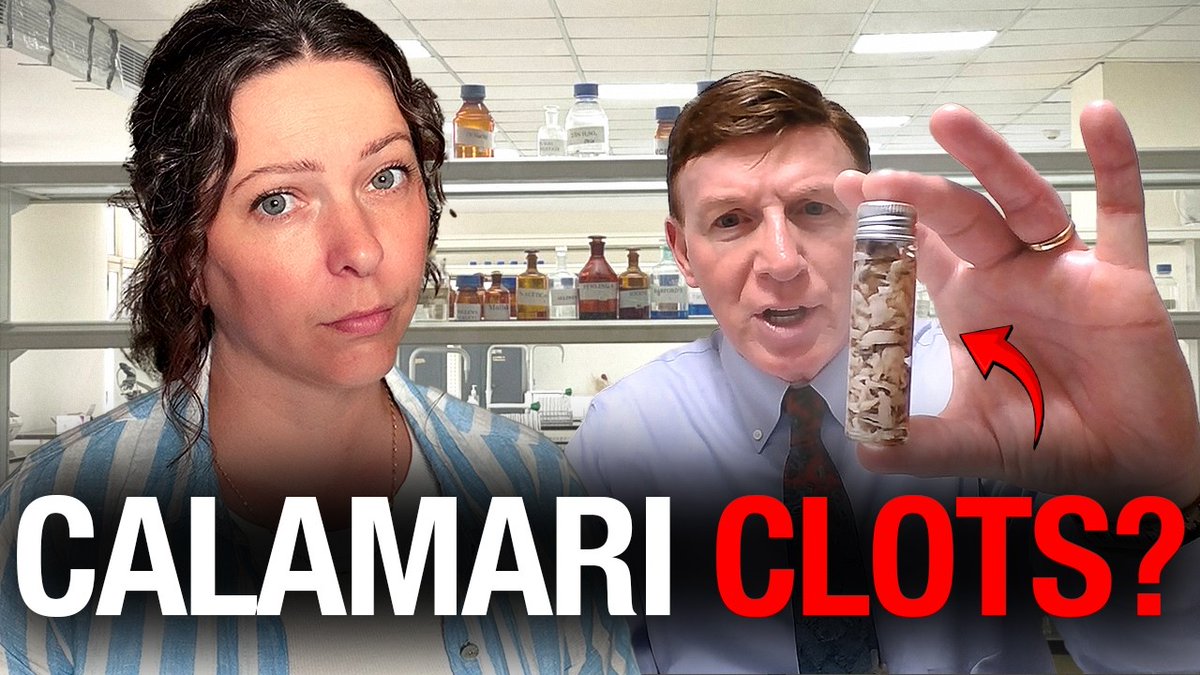


![Pharma insider explains how mRNA jabs cause "sludge" blood & clotting: "[Blood cells] have negative charges & that keeps them separate &...flowing. When you introduce these cationic [lipid nanoparticles], it's like throwing a toaster into a bathtub...[& the cells] all clump..." This clip of retired pharma R&D executive Sasha Latypova (sashalatypova.substack.com "Due Diligence and Art") is taken from an interview with Anita Krishna (Anita K) posted to Rumble on July 9, 2025. ---------------Partial transcription of clip---------------- "Yeah, so, so let me talk about cardiovascular first. Because actually this is something I'm currently researching and and going to write about. I'm drafting an article about this. "So the, the cardiovascular system is it's based on the blood flow. So it's, it's the organs that process the blood flow. You know, in, in the human body everything is completely integrated. There is no like separate systems. Everything is related to everything else. And it's very unique, it's individual. So you can't like we're not interchangeable, our parts not interchangeable. So there's like all kinds of nonsense in medicine and science today and I debunk it on my publication. "But with respect to the cardiovascular system, we're relying on blood flow. Blood flow is relying, blood flow is like traffic flow essentially. So if you think about a major highway going through a major city, you have like six lanes. Like in L.A., right? You have six lanes highway going through the city and you have traffic on it. If, if there is enough distance between the cars, the traffic will be flowing perfectly. There will be no like jams or anything. So the traffic will be flowing. It will be perfect if we have enough separation between the cars. When there is not enough separation between the cars. There are too many cars and the highway is not large enough anymore. Now you have traffic jams. You have stop and go traffic and they start and you even might even have pile-ups. You might have like, you know, somebody slams on the brakes and like three cars slam into them. This is what happens when these things get injected into the, into the bloodstream. "Because they are in those things, they formulated them with what's called cationic lipids. Cationic means it has positive charge. Positive electric charge on the surface. So in the blood flow, all the blood components, all the cars in the traffic are separated by, from each other by negative charge. They all have negative charge, negative ions on the surface and to the red blood cells and the white blood cells and other cells. And like things that are floating through, they all have negative charges and that keeps them separate and it keeps everything flowing. When you introduce these, these cationic lipids, it's like throwing toaster into a bathtub. "It strips that charge because now you have massive positive charge coming in for these particles. And they go. And they strip the negative charge from the normal particles that are there. Like red blood cells and other cells. And that's why we, we see immediate, you know, there were even videos people doing it, taking a drop of blood on the slide and, and putting a drop of thing on it and, and showing what happens. It immediately starts clumping and sep— Like where, where there was like normal cells. Now they all clump together. It's like the immediate reaction, just like as I said, it's like throwing toaster into a into a bathtub. "And the, the charge is now stripped and what's called zeta potential is collapsed. So your blood flow now starts sludging. It becomes sludge, it becomes like pieces. And, and that is the beginning of, of thrombosis. And then if that continues and then, and many people we've seen that the expression of the thing lasts years now so not in everybody but in some people, this lasts year for years. And if that continues for years, your system depletes itself from all sorts of defenses and it starts creating clots, various clots. "There are blood clots, but they're also non blood clots. There are fibrin clots, white. Rubbery kind of things...So you have now clots and, and you have. It just depends on where, where they go, which organs. But heart is obviously everything passes through the heart, you know."](https://image.24vids.com/tw-1943700643773890936/amplify_video_thumb/1943697117328850944/img/IpMWuGUdTYG7UWd7.jpg)


