Video wird geladen...

Video konnte nicht geladen werden

Zur Startseite

🚨BREAKING: An open-source agentic video production system just dropped. 11 pipelines, 49 tools, and a full product ad produced for $0.69 total. It's called OpenMontage. And it's not a text-to-video tool. It's a full production orchestration system where your AI coding assistant (Claude Code, Cursor, Copilot, Windsurf) becomes the...

112,201 Aufrufe • vor 3 Monaten •via X (Twitter)

0 Kommentare

Keine Kommentare verfügbar

Kommentare vom Original-Post werden hier angezeigt

Ähnliche Videos

Claude Code can now make full videos from your terminal.. Not slideshows. Not text on screen.. Actual motion graphics with animations, transitions, custom photos, and background music. [ SHARED A TUTORIAL BELOW EDITED WITH THIS SETUP IN JUST 5mins ] ▫️Here's the setup: Claude Code + Remotion Remotion is a React based framework that renders video programmatically. You describe what you want in plain English, Claude writes the React components and Remotion renders it into a real MP4. What you can actually do with this: > Generate 9:16 vertical videos for TikTok / Reels / Shorts > Add animated text with viral hooks and safe zones > Pull live web screenshots directly into your scenes using Chrome MCP > Fact-check your content in real time with Perplexity MCP > Drop in your own photos and background music > Edit existing talking-head footage cut bloopers, add captions > Schedule posts to your socials straight from the terminal ▫️How to set it up (takes 5 minutes) : > Make sure you have Node.js installed ( node -v to check ) > Create a new Remotion project: npx create-video@latest Pick the Blank template, enable TailwindCSS, and install the Skills package when prompted. > Install dependencies: cd my-video npm install > Start the preview server: npm run dev > Open Claude Code in the same project folder: cd my-video claude That's it. You can now prompt videos in plain English. If you already have a Remotion project, just add the skill directly: npx skills add remotion-dev/skills This drops a SKILL.md into your project that gives Claude expert knowledge of Remotion.. animations, compositions, captions, assets, 3D content everything. Example prompt you can steal: "Create a 30-second 9:16 vertical video about the top 3 AI tools this week. Use animated text with a hook in the first 2 seconds. Add smooth transitions between scenes. Keep text in the safe zone for TikTok. Use a dark tech aesthetic with blue accent colors." Claude writes all the React code, renders a preview, you tweak with natural language, and export when ready. The crazy part is this whole pipeline is local, free (minus your Claude sub), and you never open a video editor. imo this kills CapCut for anyone making info-style content. You describe the video in English and get back a rendered MP4. try it now.

Axel Bitblaze 🪓

31,250 Aufrufe • vor 3 Monaten

10 free Google AI tools nobody talks about. while everyone's burning $20/mo on chatgpt and claude, google quietly shipped a stack worth $200+/mo. all free. all yours. — 1️⃣ NotebookLM — your second brain upload sources (PDFs, websites, audio, YouTube). it summarizes, builds mind maps, generates quizzes, drafts slide decks, even turns your notes into a podcast you can listen to on a walk. free tier: 100 notebooks, 50 sources each, 50 chats/day, 3 audio overviews/day. replaces: notion AI + perplexity + readwise — 2️⃣ Google AI Studio — the free gemini playground web playground for gemini 3 pro and flash with a free API key. generous limits. paste a 1M-token context window and watch it actually use it. faster than the openai playground and free where openai charges per token. replaces: openai playground + paid API credits — 3️⃣ Gemini CLI — google's open-source terminal agent apache 2.0 licensed. one command (npx @google/gemini-cli) and you've got an agent in your terminal that reads your codebase, runs shell commands, and ships PRs. drop-in claude code alternative. replaces: claude code ($20/mo by default) — 4️⃣ Jules — async coding agent assign jules a github issue. it spins up a cloud VM, clones your repo, writes the plan, makes the changes, opens a PR. free tier: 15 tasks/day, 3 concurrent, runs on gemini flash. replaces: devin ($20/mo+) + cursor agent 5️⃣ Stitch — text → UI → code google's free figma killer. describe an interface, get production-ready HTML/CSS/Tailwind + figma export. march 2026 update added voice canvas, infinite canvas, and MCP integration with cursor. 350 standard + 200 experimental generations/month free. replaces: galileo AI + early-stage figma work — 6️⃣ Gemma 4 — open-weight LLM google's flagship open model. apache 2.0. 2B, 4B, 26B-MoE, and 31B variants. 256K context. runs on ollama with one command. quantized versions run on a 4090 or beefy laptop. replaces: paying for hosted LLM inference — 7️⃣ Illuminate — papers → podcasts paste an arxiv preprint link. illuminate turns dense research papers into a 6-8 min conversation between two AI hosts breaking it down. perfect for commute reading you can't do at a desk. note: still in waitlist for some regions. replaces: snipd + manual research reading — 8️⃣ Learn About (LearnLM) — adaptive AI tutor drop in any topic you're stuck on. highlight a word, click "go deeper," and the interface adapts in real time to your comprehension level. visual explanations, follow-up questions, the works. replaces: paid tutoring on niche topics — 9️⃣ Google Labs FX (ImageFX + Flow + MusicFX) — free imagen, veo, musicLM google labs creative suite. text-to-image (imagen 4), text-to-video (veo via Flow), text-to-music (musicLM). free tier: limited daily generations. the heavy veo 3.1 features are paid (AI Pro $19.99/mo). still worth using for image and music — those stay free. replaces: midjourney + suno (free tier only — runway-level video gen is paid) — 🔟 Google Colab — free GPU notebooks free T4 GPU + 12GB RAM in a browser tab. enough to fine-tune small models, run stable diffusion, prototype agents. the launching pad for half the ML projects on github. replaces: paid cloud GPU rentals — a quick honest note: these tools aren't 1:1 better than the paid versions they replace. but they're decent enough to get most things done — especially if you're not a heavy user or you've got little funds to play with. i've put all 10 in a public github repo (link in comments). follow + turn on post notifications for more useful posts like this 🔔

m0h

11,673 Aufrufe • vor 2 Monaten

google just released 15 AI tools that are completely FREE and can save thousands of $$$ every single monthly. all open-source. MIT licensed. save this in your bookmark." 1️⃣ pomelli ( builds your entire brand identity from just your website URL, then generates on-brand social posts, campaigns, and images. a free jasper + a junior brand marketer. no watermark, no gen cap in beta. 2️⃣ stitch ( describe an interface, get production-ready HTML/CSS/Tailwind + a figma export. google's free figma killer. 350 designs a month without paying a cent. 3️⃣ opal ( build no-code AI mini-apps and multi-step workflows just by describing them in plain english. basically a free n8n with Gemini baked in. no usage caps. 4️⃣ antigravity ( agentic IDE that plans, edits across files, and builds full apps from a single prompt. the "cursor-killer," free tier runs Gemini 3 Pro + Claude Sonnet 4.5. 5️⃣ mixboard ( canva x pinterest for AI. generate and remix images into moodboards, then edit right on the canvas with plain language. free while in beta. 6️⃣ disco ( turns your messy open browser tabs into custom interactive AI apps. competitor tabs become a comparison matrix, travel tabs become an itinerary. zero code. 7️⃣ notebookLM ( upload PDFs, videos, and notes, get instant summaries, mind maps, quizzes, even a podcast of your own material. replaces notion AI + perplexity + readwise. 8️⃣ Learn Your Way ( turns any topic into a personalized, AI-built course. immersive text, audio lessons, mind maps, and quizzes adapted to how you actually learn. free tutoring. 🔟 Google AI Studio ( prototype and ship AI apps in seconds with a free API key and a 1M-token context window. replaces the openai playground + paid API credits. 1️⃣1️⃣ Jules ( assign it a github issue, it spins up a VM, writes a plan, makes the changes, and opens a PR. a free devin. 15 tasks a day. 1️⃣2️⃣ Gemini CLI ( claude-code in your terminal. reads your codebase, runs commands, ships PRs. genuinely open source (Apache 2.0) and free. 1️⃣3️⃣ Code Wiki ( point it at any public github repo, get a living, self-updating wiki with architecture diagrams and a Gemini chat, every section hyperlinked to the code. 1️⃣4️⃣ Firebase Studio ( AI cockpit for your backend and cloud logic. heads up: existing users only, google is winding it down, so don't start a new project here. 1️⃣5️⃣ Gemini Code Assist ( free github copilot: 180k code completions a month + AI code reviews in VS Code, JetBrains, and github. the free tier that actually out-specs copilot. Follow me and turn on 🔔 post notifications.

m0h

76,899 Aufrufe • vor 3 Tagen

This guy runs his entire marketing department out of folders and markdown files. No code or crazy automations. He calls it CMOHQ, it works with any AI (Claude, ChatGPT, Hermes, Codex), and he sells the whole thing as a zip file. He went 3 weeks without opening his laptop and the business kept running. Justin Brooke ❤️‍🔥 is back on the pod to walk us through the entire system. Here's what I learned: 1. The whole OS is folders and markdown files. He tried n8n, LangChain, and CrewAI. Too technical for a copywriter. 2. One HQ folder for who you are. One folder per brand with intelligence, departments, and metrics inside. Say "work in the FaithFunnels brand" and Claude switches context. 3. He built the finance folder from a YouTube transcript. It ingests ThriveCart, Kit, Google Ads, and Zeni exports and auto-generates max CPA, spend ceilings, and dashboards. 4. Build it in iCloud, not on a Mac Mini. It's just text files. Phone, laptop, office, same brain. 5. Nothing skips the pipeline. Pope mentions "digital sobriety," Claude writes the article, he approves, it publishes to Ghost via MCP with an ElevenLabs audio version. 6. Reporting is wired in through MCPs. Kit, Google Analytics, Microsoft Clarity. Clicks to leads to sales, plus a monthly P&L drop. 7. He uses Claude Cowork, not Claude Code. 90% of the features, and his work is mostly writing anyway. 8. Start with Jobs To Be Done. Every job becomes a folder. Every folder gets instructions. 9. Delivery is the product. The zip holds an ops manual and an installer.md that interviews the buyer and builds their system. Zero onboarding calls. 10. If they want to build it themselves, they're not your customer. Millionaires look at the system and say "can I just pay you?" His 2 key takeaways: 1. Every agent needs three things: memory, instructions, and tools. Get those right and you can replicate any process in any business. 2. Stop doing sales calls on the fly. Run a slide deck, tweak one slide per call, and by call five it's dialed in and trainable. That's how you get out of sales. Justin has been marketing for 20 years and this is the simplest AI operating system I've seen. Go follow Justin Brooke ❤️‍🔥 Full video below. (Also available on the Build With AI podcast wherever you get your pods)

Corey Ganim

13,753 Aufrufe • vor 20 Tagen

Claymotion ads are crushing it on Meta right now. Built a free claude skill to make them 👇 If you've been scrolling Meta lately, you've seen them — stop-motion clay characters, tactile textures, weirdly satisfying to watch. CTRs are 2-3x the feed average. Almost nobody is running them. The problem: they look impossible to make unless you have a studio. They're not. You just need the right prompts. So I packaged the prompt system as a Claude Code skill. It's free. Here's what it does: Paste your product URL. Out comes a full claymotion ad plan: 1/ Shot-by-shot storyboard 5-7 shots with the narrative arc. Setup → product reveal → payoff → CTA. 2/ Image prompt per shot Exact prompt you paste into Midjourney, Nano Banana, or any image gen. Camera angle, lighting, clay texture specs, character details — dialed in for consistency across shots. 3/ Video prompt per shot The animation prompt you paste into Kling, Veo, Seedance, or Sora. Motion direction, pacing, transitions — so the shots actually flow. 4/ VO script per shot Voiceover copy written for rhythm. Timed to the shot length. Hook, body, CTA — all on brand. 5/ Music + sfx direction Tone notes for the track. Specific sfx cues per shot (squish, pop, whoosh) You take the outputs. Paste them into your image + video generators. Stitch the shots. Record the VO. A full claymotion ad in under an hour, at the cost of a few API credits. Instead of $3,000 and 3 weeks with an animation studio. Why claymotion works right now: → Pattern break — nothing else in the feed looks like it → Tactile feel — clay reads as "real" even when AI-generated → High dwell time — people watch the whole thing → Cheap to test — 5-10 variations per product is now feasible Comment "Clay" and I'll send you: → The Claude Code skill (free) → A starter prompt pack → 3 example storyboards so you can see the output (must be connected)

Ahad Shams

16,779 Aufrufe • vor 3 Monaten

Matthew Gallagher Built a $401M Company in Year One with 2 People. And the tool behind it? Claude Code. This year he's on track for $1.8B. Sam Altman predicted this. It's happening now. The problem? It costs money. API credits stack up. Monthly bills keep growing. Every prompt eats your budget. Every project drains your wallet faster. Until now. Two methods. 99% cheaper. One is completely free. Forever. $0. Not a trial. This video breaks down both step by step. ↓ Let me put this in perspective. $100-$500. That's monthly. That's what you spend. That's $6,000/year on API credits. Just to use a tool you haven't shipped anything with. The $401M guy? Spending $0. Same capability. Shipping weekly. Different cost structure. Different results. Different life. I'm about to hand you his cost structure for free. ↓ Open source vs closed source. Pay attention. Closed source: Claude. GPT-4. Pay per token. Meter always running. Open source: Qwen. Llama. Mistral. Free to download. Free to run. Free forever. No meter. No tokens. No bill. Here's what nobody tells you: 80% of coding tasks? Open source handles them. More than handles them. Writes clean code. Debugs errors. Generates boilerplate. Handles routine work perfectly. You're paying premium prices for tasks that don't need premium intelligence. That's hiring a brain surgeon to put on a bandaid. Smart play: Free models for the 80%. Paid credits for the 20%. That's what the $401M guy does. That's what this video teaches you. Follow Himanshu Kumar for more breakdowns that turn free tools into real businesses. ↓ Method 1: Ollama. Local. Free. Forever. Download it. Pull a model. Point Claude Code at it. Done. No internet needed. No API keys required. No monthly subscription. No token counting ever. No bill. Today. Tomorrow. Ever. Your data never leaves your computer. Complete privacy. Complete freedom. Claude Code thinks it's talking to the cloud. It's talking to your laptop. For $0. The video walks through every step: Every config file. Every variable. Every command. Every click. If you can follow a recipe, you can do this. People who set this up 3 months ago? Saved $300-$1,500 since then. Workflow didn't change one bit. ↓ Hardware you need: 16GB RAM: 7B models run smooth. 32GB RAM: 32B models run comfortable. 64GB + GPU: biggest models available. No GPU? Still works. Just slower. Few extra seconds. That's it. Your $1,500 laptop is sitting there running Chrome and Spotify. Put it to work saving you $200/month instead. Follow Himanshu Kumar for more breakdowns that turn free tools into real businesses. ↓ Method 2: Open Router. Free Cloud. No Hardware. Weak machine? Don't want local setup? This method is for you. Free AI models in the cloud. No download. No hardware. Configure Claude Code to route through Open Router. The config: Base URL: Open Router API. API key: free Open Router key. Default Sonnet: free. Default Opus: free. Default Haiku: free. Small fast model: free. Subagent model: free. Free. Free. Free. Free. Free across the board. Same interface. Same commands. Same workflow. Zero cost. Copy the config from the video. Paste it. Save $200/month. Starting today. Right now. ↓ When to use which: Ollama (local): Best for privacy. Best for offline work. Best for unlimited usage. Best if you have decent hardware. Open Router (cloud): Best for weak machines. Best for instant setup. Best for trying different models. Best if you don't want to manage anything. Both methods: Best for 80% of your daily work. Still use paid Claude for: Complex architecture. Multi-file refactoring. Deep reasoning tasks. The 20% that actually needs it. $20/month instead of $200/month. Same output. 90% less cost. ↓ The math that should make you angry. You (current): $200-$500/month. $2,400-$6,000/year. $7,200-$18,000 over 3 years. You (after this video): $20-$50/month. $240-$600/year. $720-$1,800 over 3 years. Savings over 3 years: $6,480-$16,200. That's a used car. That's seed money. That's 6 months of rent. All from one 25-minute video. All from 15 minutes of configuration. Highest ROI 25 minutes you'll spend this year. ↓ The limitations. I won't lie to you. Open source is not Opus. Not as smart on complex reasoning. Not as good at long-context tasks. Makes more mistakes on nuanced problems. But they are: Free. Capable. Getting better monthly. Good enough for 80% of daily work. Smart cost management isn't being cheap. It's being strategic. Expensive tool when it matters. Free tool when it doesn't. ↓ The one-person billion-dollar company is coming. $401M in year one proved it's possible. The building blocks: AI that codes: Claude Code. Way to run it free: this video. Distribution: the internet. Customers: everyone. Only missing ingredient? Someone who builds. Not reads about building. Not saves posts about building. Not bookmarks videos about building. Builds. Tools are free. Knowledge is free. Opportunity is screaming. You're still "thinking about it." ↓ Your action plan: Tonight: Watch the video. Tomorrow morning: Set up Ollama or Open Router. Tomorrow afternoon: Build something. Anything. This week: Build a second thing. Faster. This month: Charge someone for it. One video. One setup. One weekend. $0 cost. Unlimited potential. Or keep paying $200/month for something you could get free. Keep consuming instead of building. Keep planning instead of shipping. Matthew Gallagher didn't plan a $401M company. He built it. Full video attached. Every method. Every config. Every tradeoff. 25 minutes. Your move. Follow Himanshu Kumar for more breakdowns that turn free tools into real businesses.

Himanshu Kumar

13,573 Aufrufe • vor 3 Monaten

Everyone is sleeping on Meta's SAM 3 release. But it's actually a big deal. Here's why: Companies spend millions paying humans to label images and videos frame by frame. A single autonomous driving dataset? Months of work, hundreds of annotators, millions in cost. Without labeled data, you can't train custom models. Without custom models, you're stuck with generic solutions. This is why most companies never move past pilots. SAM 3 breaks this cycle. First let's look at the evolution: SAM 1 segmented objects when you clicked on them. Revolutionary, but one object at a time. SAM 2 added video tracking with memory. Game-changing, but you still manually prompted every object. SAM 3 changes everything with text prompts. Type "yellow school bus" and it finds ALL of them in your image or video. Not just one. Every instance across thousands of frames. Now here's where people get confused: "Can't I just use GPT-5 or Gemini for this?" No, and here's why that's a terrible approach. Large multimodal LLMs are great for reasoning, but they're slow and expensive for production visual tasks. You're paying API costs per image, waiting seconds for responses, getting inconsistent results. SAM 3 runs in 30 milliseconds on a single GPU for 100+ objects. That's 100x faster, and you own the infrastructure. More importantly, SAM 3 gives you precise pixel-level masks, not descriptions. Try asking an LLM to segment every defective part on a manufacturing line in real-time. It won't work. SAM 3 does this effortlessly. The real breakthrough is their data engine. Meta built an AI-human hybrid system that's 5x faster for complex annotations. They trained SAM 3 on 4 million unique visual concepts - 50x more than existing benchmarks like LVIS. SAM 3 is trained on 4 million unique visual concepts, it handles everything: - Text-based concept search - Interactive refinement with clicks - Video tracking across frames - Zero-shot detection of new concepts The model is open source. Weights, code, and benchmarks are on GitHub. If you're building computer vision applications, this is the foundation model to evaluate. The annotation time savings alone will pay for integration costs within weeks. Find the relevant links in the next tweet!

Akshay 🚀

46,421 Aufrufe • vor 8 Monaten

Nobody's talking about the Claude trick that fixes every Seedance 2.0 video mistake. A cinematic action scene, an animated sequence, a product ad, and a dialogue scene are completely different types of content. Different camera language, different pacing, different reference logic. Most people try to force all of it through one universal prompt. The fix turns out to be simpler than expected: Claude Skills. It's not some secret hack. It's a file of instructions you load into Claude for one specific type of task. Once it's loaded, Claude stops acting like a general assistant and starts thinking like an expert in that one niche — with its own set of rules for that scene type. Here's what that looks like in practice: ▪ Cinematic skill — generates real camera language: dolly moves, crane shots, rack focus, shot discipline across multiple cuts. Test: a medieval battle between two armies, 15 seconds, dark fantasy. Result — three shots with the shot logic of an actual film, not just "epic battle" typed as text. ▪ Animation skill — locks in style and physics before a single shot is built. One test: a rain-soaked shonen fight in the style of Tokyo Revengers. Another: a quiet Ghibli-style farm scene. Same skill, completely different visual output — because the style gets fixed at the very top of the prompt. ▪ Product ad skill — keeps the product front and center in every shot: clean hero framing, commercial lighting, a full product description built from the reference image before any shots are generated. ▪ Dialogue skill — this is where most people fall apart. Lip sync, emotional direction, shot structure, and audio cues all have to work together. Test: an interrogation scene with a fourth-wall break — and the moment landed exactly as written, down to the pause and tone. The core idea is simple: instead of writing a prompt from scratch every time and hoping for the best, you build one skill per content type — and Claude asks the right setup questions (genre, tone, shot count, camera energy) before generating a fully structured Seedance 2.0 prompt. One prompt template for everything is exactly why 90% of AI videos look the same. This 13-minute video is free, and it's more useful than a $500 course. YouTube: "Skai Generated" - Thank you for sharing this invaluable material with us.

Zentrix⌚️

43,491 Aufrufe • vor 7 Tagen

10 free github repos that can replace major SaaS with subscriptions. all free. open-sourced. some are MIT licensed. — 1️⃣ openscreen — replaces screen studio ($29/mo) - a clean macOS/windows/linux screen recorder for polished demos. - blur, cursor highlighting, annotations, export to mp4 or gif at any aspect ratio. - doesn't try to clone every feature, just nails the basics for quick walkthroughs you'd post on X. — 2️⃣ voicebox — replaces elevenlabs ($22/mo) + wisprflow ($15/mo) - local-first AI voice studio. - clone voices from 3 seconds of audio, generate speech across 7 TTS engines in 23 languages, - dictate into any text field with a global hotkey. - nothing leaves your machine. - runs on apple silicon, cuda, rocm. — 3️⃣ openshorts — replaces opus clip ($19/mo) + submagic ($16/mo) - free AI video platform. - clip generator turns long youtube videos into 9:16 shorts with auto-subtitles and face tracking (runs on free gemini + elevenlabs tiers). - also includes AI UGC video generation with actors — that part is pay-per-use via fal. ai (~$0.65-2 per video). docker self-host. — 4️⃣ freellmapi — replaces chatgpt pro + claude pro ($20/mo each) - stacks 14 free AI provider tiers (google, groq, cerebras, openrouter, github models + 9 more) behind one openai-compatible endpoint. ~800M tokens/month. - smart router with failover, sticky sessions, encrypted key storage. ships with a dashboard. — 5️⃣ playwright-mcp — replaces browserbase ($39/mo) + browser use ($25/mo) - microsoft's official MCP server that gives any AI agent full browser control. - uses accessibility trees, not screenshots — deterministic and token-efficient. - works with claude code, cursor, windsurf, codex out of the box. — 6️⃣ vibe-trading — replaces tradingview premium ($60/mo) - natural-language finance research agent. - 7 backtest engines across stocks, crypto, futures, forex. - 75 specialist skills (factor analysis, options strategy, ML strategy). - 29 multi-agent swarm presets. - 21 of 22 MCP tools work with zero API keys. — 7️⃣ CalCom — replaces calendly ($12/mo) + savvycal ($12/mo) - the open-source scheduling infrastructure. - one-on-ones, group events, round-robin, team booking, - payment collection (stripe), routing forms, workflows. - integrates with google/outlook/apple calendar, zoom, meet, teams. - self-host in 10 minutes with docker. 40k stars. — 8️⃣ whisper — replaces otter ($17/mo) - openAI's open-source speech-to-text model. - transcribe audio in 99 languages, translate to english, generate timestamps. - runs locally on cpu or gpu. - the actual model behind most "AI transcription" SaaS tools you're paying for. — 9️⃣ postiz — replaces buffer ($15/mo) - AI-powered social media scheduler. - cross-post to X, linkedin, instagram, tiktok, threads, bluesky, mastodon, youtube, pinterest. - AI captions and hashtags. - analytics dashboard. team workspaces. 31k stars and rising. — 🔟 vaultwarden — replaces 1password ($8/mo) - unofficial bitwarden-compatible server written in rust. - works with every official bitwarden client (mobile, desktop, browser). - unlimited users, unlimited vaults, full enterprise feature set. - runs on a $5 VPS or your home server. — disclaimer: open-source ≠ 1:1 replacement. you'll trade polish for ownership, hand-holding for control, and a credit card for a github version. for builders, prototypers, and indie hackers — that's the whole point. for everyone else, the paid tools still have their place. bookmark this. share with one friend bleeding subscription fees. ~m0h

m0h

247,857 Aufrufe • vor 2 Monaten

Every AI agent you've tried has amnesia. It does one task, forgets everything, and tomorrow you start from zero. That's not an employee. That's a temp you have to retrain every single morning. Hyperagent by Airtable is the first platform I've used that actually fixes this. Here's what got me: 1. Agents that compound. Each agent has memory. The one running today is smarter than the one you shipped three weeks ago. Same prompt, same integrations, but weeks of your judgment baked in. 2. Real deliverables, real receipts. You don't get a chat transcript. You get finished work with the cost and runtime printed right on it. A full research report for under ten bucks. Try getting that invoice from an agency. 3. A fleet, not a chatbot. Build a specialist for outreach, another for research, another for reporting. Give each one its own tools, its own memory, and its own budget cap so nothing runs away with your credits. 4. Deploy to Slack and your whole team uses the agent you built. One competitive intel agent, @ mentioned by everyone. Airtable runs its own data team this way. 5. Each agent gets its own cloud machine with a real browser and code execution. It works while you sleep. No babysitting, no local setup, no laptop that has to stay open. I put it to work in the video below. Watch what it builds. The teams treating agents as durable assets instead of one-off prompts are going to lap everyone else. This is the first tool that actually treats them that way. #ad Hyperagent

Leonard Rodman

94,961 Aufrufe • vor 11 Tagen

10 free GitHub repos that can save you hundreds every month. open-source. free to use. better than most people think. ↓ 1️⃣ OpenScreen — an alternative to Screen Studio ($29/mo) • record polished demos on macOS, Windows, and Linux • automatic cursor effects, blur, annotations, GIF + MP4 export • lightweight and perfect for product walkthroughs without extra editing — 2️⃣ VoiceBox — an alternative to ElevenLabs ($22/mo) + Wispr Flow ($15/mo) • privacy-first AI voice toolkit that runs locally • clone voices with a few seconds of audio • supports 7 TTS engines, 23 languages, and system-wide voice dictation • works with Apple Silicon, CUDA, and ROCm — 3️⃣ OpenShorts — an alternative to Opus Clip ($19/mo) + Submagic ($16/mo) • convert long videos into viral vertical clips • auto captions, face tracking, and AI clip selection • includes AI UGC video generation • easy Docker deployment for self-hosting — 4️⃣ FreeLLMAPI — an alternative to ChatGPT Pro + Claude Pro ($20/mo each) • combine 14 free AI providers behind one API • OpenAI-compatible endpoint • roughly 800M free tokens/month • built-in routing, failover, encrypted key storage, and dashboard — 5️⃣ Playwright MCP — an alternative to Browserbase ($39/mo) + Browser Use ($25/mo) • Microsoft's official browser automation MCP • AI agents interact using accessibility trees instead of screenshots • faster, cheaper, and more reliable automation • works with Claude Code, Cursor, Windsurf, and Codex — 6️⃣ Vibe Trading — an alternative to TradingView Premium ($60/mo) • AI-powered investing and strategy research platform • supports stocks, crypto, forex, futures, and options • dozens of built-in research skills • backtesting included without requiring paid APIs — 7️⃣ — an alternative to Calendly ($12/mo) + SavvyCal ($12/mo) • open-source scheduling platform • round robin, team scheduling, routing forms, payments • integrates with Google Calendar, Outlook, Apple Calendar, Zoom, Meet, and Teams • deploy yourself in minutes — 8️⃣ Whisper — an alternative to ($17/mo) • OpenAI's speech recognition model • transcribes and translates audio in nearly 100 languages • timestamp support included • runs locally on CPU or GPU — 9️⃣ Postiz — an alternative to Buffer ($15/mo) • schedule content across all major social platforms • AI-generated captions and hashtags • built-in analytics and collaborative workspaces • growing rapidly with a large open-source community — 🔟 Vaultwarden — an alternative to 1Password ($8/mo) • lightweight Bitwarden-compatible server written in Rust • works with official Bitwarden apps • unlimited users and vaults • self-host on almost any VPS or home server — Worth knowing: Open-source isn't always a perfect replacement. You may spend a little more time setting things up. In return, you get: • no monthly subscription • full ownership of your data • complete control over your workflow That's a trade many builders happily make. Save this for later. Someone on your timeline is probably paying for at least three of these. — Kshitij Mishra

Kshitij Mishra | AI & Tech

16,359 Aufrufe • vor 16 Tagen

Hermes + Claude + Higgsfield MCP + ViralBuilder = 💰💰💰 Four tools. One prompt chain. Hook to finished video in 10 minutes. I built a Claude skill that writes shot-by-shot Higgsfield prompts from a single creative brief. ViralBuilder tells you what's winning. The skill turns it into a production-ready prompt. Higgsfield renders it. No creative director. No guessing. No separate tools. Here is the setup: Higgsfield MCP → Open Claude Code → Settings → Connectors → Enter: → Connect your account Hermes → The agent layer running underneath Claude Code → It holds your skills, crons, memory, and routing rules → When you prompt Claude, Hermes feeds it the context it needs ViralBuilder (like Gethookd) → The winning ecom video database → Scrapes top performing ecom videos across platforms → Claude reads the data and extracts what styles, hooks, and formats are actually scaling The skill: video-prompt-builder → Installed inside Claude via Hermes → Takes a creative brief and outputs a full shot-by-shot prompt → Covers camera work, effects, transitions, pacing, and energy arc → Every output is structured for Higgsfield to render without ambiguity No switching apps. No export steps. Everything runs from one place. ▸ FIND WINNING CREATIVE ANGLES ViralBuilder tells you what the market already validated. Claude reads it and extracts the pattern. Prompts to run: "Search ViralBuilder for the top performing ecom videos in [niche] over the last 21 days. Extract the 3 dominant hook styles and rank by view velocity." "Pull the winning video formats in [niche] from ViralBuilder. Which opening 3 seconds appears most across videos spending over $10k?" "Find what video style is scaling right now in [niche] for the US market. UGC, talking head, or product demo. Filter for videos with over 1M views." "Pull the last 30 days of viral ecom hooks in [niche] from ViralBuilder. Cluster by emotional trigger. Which cluster has the most longevity?" You are not guessing at angles. You are reading what the market already spent money validating. ▸ BUILD THE PROMPT WITH THE SKILL This is where the video-prompt-builder skill takes over. You give Claude the winning angle. The skill outputs a complete shot-by-shot prompt with effects, transitions, pacing, and energy arc ready to fire into Higgsfield. Prompts to run: "Use the video-prompt-builder skill. Brief: 15-second UGC ad for [product] in [niche]. Hook style: [style from ViralBuilder]. Tone: direct to camera, US English. Output the full shot-by-shot effects timeline, effects inventory, density map, and energy arc." "Use the video-prompt-builder skill. The dominant hook in [niche] this week is [hook]. Build a 10-second product video prompt that opens with a speed ramp into a close-up product reveal. Include a signature visual effect and a low-density CTA landing." "Use the video-prompt-builder skill. Brief: replicate the pacing and energy of a [style description] video for [product]. Target duration: 20 seconds. Output all four sections. Then generate the video with Higgsfield using the shot-by-shot prompt." The skill outputs four sections every time: → Shot-by-shot effects timeline with camera, movement, and transitions per shot → Master effects inventory showing every technique used and where → Effects density map showing high, medium, and low intensity across the timeline → Energy arc describing how the video opens, builds, and lands That output goes directly into Higgsfield. No rewriting. No translating. ▸ GENERATE THE CREATIVE Claude writes the brief via the skill. Higgsfield MCP builds the video. Both happen in the same session. Prompts to run: "Use the video-prompt-builder skill to write a 15-second UGC prompt for [product]. Hook in the first 3 seconds, speed ramp into product reveal, slow-motion CTA landing. Then generate with Higgsfield in 9:16 format." "Build 3 prompt variations on this winning angle: [angle]. Each variation opens with a different effect — speed ramp, digital zoom, whip pan. Use the video-prompt-builder skill for each. Then generate all three with Higgsfield." "Use the video-prompt-builder skill. Brief: problem-solution ad for [product], 20 seconds, US market. Problem shot at high density, product reveal at medium, result and CTA at low. Generate with Higgsfield in 9:16." No separate tool. No file transfer. The video comes back in the same thread. ▸ CHAIN THE WHOLE STACK One prompt. All four tools firing together. "You are my ad creative director. Hermes has loaded my brand context. Pull the top performing video style in [niche] from ViralBuilder this week. Use the video-prompt-builder skill to write a full shot-by-shot prompt for [product] that replicates that style — 20 seconds, 9:16, US market, hook in the first 3 seconds. Output the effects timeline, inventory, density map, and energy arc. Then generate the video with Higgsfield." That single prompt replaces a half-day of production. The math before this stack: Brief: 30 minutes Script: 1 hour Creative production: 2 to 3 hours Agency or freelancer cost: $500 to $2,000 per creative With this stack: Hook to finished creative: 10 minutes Cost per creative: tool subscription, a fraction of agency rate 5 product tests in the time it used to take to brief one Bad product tests are where US ad budget disappears. $600 to $1,500 per failed test, before you even know if the angle works. This stack shows you what the market already validated before you spend a dollar on production. Hermes = your context layer. Brand, goals, past performance. Claude is always informed. ViralBuilder = your winning video database. See exactly what styles, hooks, and formats are scaling before you produce anything. video-prompt-builder skill = the translation layer. Turns a creative brief into a structured, production-ready Higgsfield prompt every time. Claude = the brain. Reads the market, writes the brief, chains the tools. Higgsfield MCP = the output. Video generated directly from the prompt. No export step. Four tools. One session. 10 minutes. Comment + RT "STACK" and I'll DM you the full workflow + the video-prompt-builder skill file.

Kid Pak

57,123 Aufrufe • vor 2 Monaten

Anthropic released Claude Design TODAY and it's now accessible at I spent the last hour giving it a first look, and shared my thoughts and results in the video below. This is a BIG drop. This is a new design surface from Anthropic, and it changes what "AI design" means. Short version: Claude can now design. Not "describe a design." Not "generate an image of a design." Actual production work — prototypes, wireframes, high-fidelity mocks, slide decks, landing pages — editable, on-brand, and ready to hand off. Here's what stood out on first look: → Real design surfaces Prototypes, wireframes, hi-fi, and slide decks — each with templates and proper structure, not just pretty screenshots. → Comment-based edits Leave a comment on any element and Claude revises it. This is the Figma-style review loop, with the designer replaced by a model that works at 3am. → Brand design systems You can feed it your system — colors, type, components — and it actually respects it. On-brand output, not generic AI slop. → Export anywhere PDF, PowerPoint, Canva, standalone HTML. Plus a built-in handoff straight to Claude Code for engineers to implement. → Import from real tools Figma, GitHub, and captured web elements come in as inputs. Your existing work is the starting line, not the discard pile. → Collaboration Share links for view / comment / edit — the exact tier system teams already expect. What I tested on Opus 4.7: • A 5-slide deck generated from a single screenshot. Claude asked clarifying questions BEFORE generating and shipped speaker notes by default. • A landing page build. Solid first pass, real components, real layout logic. • Multiple chats running concurrently. You can parallelize design work across threads like a small team. Why this matters: PMs, founders, marketers, and non-engineers can now create designs that engineers can actually ship with production-ready output and a claude code handoff built in. The gap between "I have an idea" and "here's a working prototype with my brand applied" just collapsed to minutes. Full walkthrough, live demos, exports, and honest takes on where it breaks below. P.S. • This is an Anthropic Labs product — NOT GA yet. • Claude Design is currently webapp only (no API), and does not yet support the Analytics API, Compliance API, or cost/usage reporting. • Availability: – Default ON for Pro / Max / Team – Default OFF for Enterprise Enterprise admins can toggle it on via RBAC in console (comes with a ~$20/user initial credit).

JJ Englert

32,445 Aufrufe • vor 3 Monaten

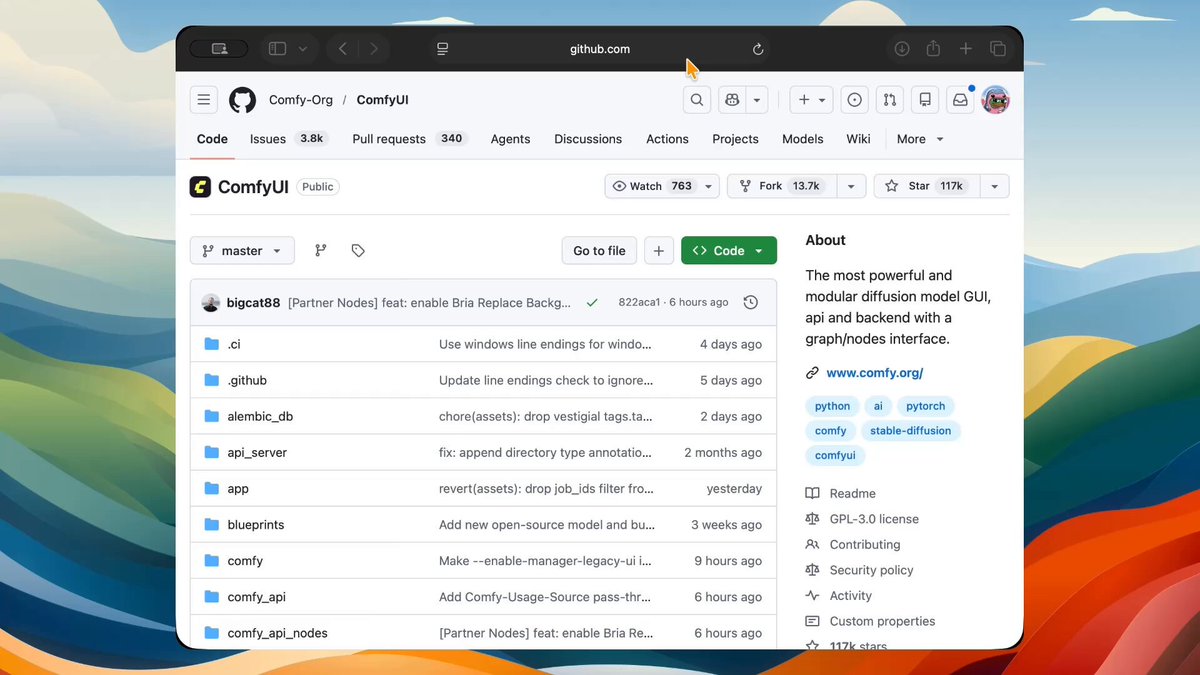
no money for grok or midjourney? this tool is for you. there's a FREE tool created by an anon dev. open-source. runs locally. 117k stars on github. it generates: > images & video > 3d models > audio > 20+ models here's how to set it up in under 5 minutes: 1️⃣download ComfyUI Desktop go to and grab the desktop app for your system. windows 10+, mac (apple silicon), or linux. it installs like any normal app, it sets up python and every dependency for you in the background. no terminal, no config files. 2️⃣open it first launch, it spins up its own environment automatically. you just wait a few seconds and you're in. you'll land on a node canvas, that's the whole interface. 3️⃣load a starter workflow top menu → Workflow → Browse Templates → Image Generation. click it. this drops a ready-made setup onto your canvas so you don't build anything from scratch. 4️⃣grab a model comfyui ships empty on purpose, the model is the brain, and you pick it. in the template, the "Load Checkpoint" node has a Download button when no model is installed. click it. it pulls one in for you (a few GB, this is the only real wait). 5️⃣install ComfyUI Manager this is the one add-on you don't skip. it lets you install models, custom nodes, and updates with a click instead of the command line. grab it from github (link in comments). it's the difference between fighting comfyui and flying in it. one honest note: an NVIDIA gpu makes this fast, apple silicon works great too, and a weak machine still runs it just slower. that's the whole setup. you now own an image, video, and 3D studio that costs you nothing per month. save this. and the next time grok or midjourney asks for your card. you won't need it. disclaimer: comfyui itself is 100% free. so are the local models (sdxl, flux, wan 2.2, ltx-2). some premium models like seedance are pay-per-use api models, only if you want top-tier quality. the free local ones cover most of what you need. (github link in the comments) follow and turn on post notification for daily AI contents.

m0h

14,542 Aufrufe • vor 1 Monat

Andrew Wilkinson owns 40+ businesses. He just showed me how he's using OpenClaw, Claude Code and AI agents to run latest business, start new ones, and automate everything. Here's what I learned: 1. In December 2025, something clicked. He started waking up at 3AM with a smile, sitting in terminal with 10 Claude Code tabs open. He hasn't stopped since. He calls it chasing the dragon. 2.He built a full SaaS product called Deep Personality. A 40-minute personality test that generates a 100-page report written like Robert Greene. $20 000 in revenue. Zero employees. The entire business runs on AI agents. 3. He has agents for support, marketing, and dev. When a support ticket comes in, the agent either handles it or sends it to the dev agent. If it's critical, the agent fixes the bug and merges the PR before he wakes up. Then it emails the customer back. 4. His marketing agent is connected to PostHog, manages Meta and Reddit ads, creates ad creative, runs multivariate tests, and sets budgets. He's about to give it a $100 k/month ad budget and see what happens. 5. He forgot his laptop on a trip to Arizona. He ran his entire business from the back of Ubers using OpenClaw. Nobody picked up that every single email was written by AI. 6. His take on vibe coding: the worst part about business is people. Between your vision and execution are 100 people you have to convince. Vibe coding removes all of them. For the first time he can do every part of building a product himself. 7. He was trying to build OpenClaw before OpenClaw existed. Now he uses a tool called Harbor, which is basically a GUI for managing multiple agents. You can see all your agents, their status, knowledge bases, and databases in one place. 8. He built a custom AI for his relationship. He and his girlfriend took 15 psychological tests, put the results into ChatGPT, and asked it to analyze their relationship. It nailed every fight they've ever had. That became the product idea for Deep Personality. 9. His honest take: he spends 50% of his time debugging, 30% improving the setup, and 20% being productive. It's a treadmill. But the 20% that works is so powerful he can't stop. 10. His prediction: we're 3-6 months from being able to hand basic businesses off to AI to run entirely. And pretty soon Anthropic and OpenAI are going to launch AI CEOs. This is an inside look at how a serious operator Andrew Wilkinson is using AI agents in the real world. The good, the bad, the debugging, all of it. Most people don't show you this. Episode is live on The Startup Ideas Podcast (SIP) 🧃 watch

GREG ISENBERG

144,005 Aufrufe • vor 2 Monaten

Google just launched a direct attack on Nvidia's most valuable asset. Not their chips. Their SOFTWARE. And if this works, Nvidia's $4 trillion empire collapses. Here's what just leaked: Google is building "TorchTPU" - a secret project that makes PyTorch seamlessly run on Google's TPU chips instead of Nvidia GPUs. Why does this matter? PyTorch is the MOST USED AI framework on Earth. Every AI developer uses it. And PyTorch was built around Nvidia's CUDA software. Wall Street analysts call CUDA "Nvidia's strongest defensive wall." It's the reason companies can't easily switch away from Nvidia even when alternatives exist. You don't just buy Nvidia chips. You buy into their entire ecosystem. Switching costs MILLIONS in engineering work. Months of rewrites. Performance drops. So companies stay locked in. Even when Nvidia raises prices. Even when supply runs short. That's not a hardware moat. That's a SOFTWARE prison. And Google just found the escape route. Here's the problem Nvidia created for itself: Google's TPU chips are actually GOOD. Competitive performance. Better availability. Lower cost. But developers won't use them because Google's chips run JAX (Google's internal framework), not PyTorch. That means if you want to use Google TPUs, you have to rewrite your entire codebase. Nobody wants to do that. So Google TPUs sit unused while developers fight over Nvidia chips. Until now. TorchTPU makes PyTorch run natively on Google hardware. No rewrites. No performance loss. No months of engineering. You just... switch. And Google is partnering with META (who built PyTorch) to make it happen. They're even considering OPEN-SOURCING parts of it to speed adoption. Translation: Google is willing to give this away for free just to break Nvidia's lock. The implications are insane: Every company currently paying Nvidia's premium prices suddenly has a way out. Oracle, Microsoft, OpenAI - all locked into Nvidia's ecosystem - can switch to Google. Nvidia's pricing power evaporates overnight. And the timing is perfect: Nvidia is already facing heat. Semiconductor index dropped 3% today. Oracle just lost their biggest investor over AI spending concerns. Companies are realizing AI infrastructure costs are unsustainable. Now Google hands them an alternative. Same performance. Lower cost. Better availability. Jensen Huang knows exactly what this means. CUDA has been Nvidia's untouchable advantage for YEARS. It's why Nvidia trades at 50x earnings while AMD trades at 25x. The software moat justified the premium. But if Google removes that switching cost? Nvidia becomes just another chip company. And chip companies compete on price, not ecosystem lock-in. Here's what happens next: Google needs 12-18 months to make TorchTPU production-ready. If it works, cloud providers will adopt it instantly. They WANT an alternative to Nvidia's monopoly pricing. Amazon already building their own Trainium chips. Microsoft making Maia. They're all trying to escape Nvidia. Google just gave them the software bridge. Nvidia's response options are limited: They can't buy Google. Can't kill PyTorch (Meta owns it). Can't stop open source. Their only play is to keep improving CUDA faster than Google can catch up. But that's a race, not a moat. The market isn't pricing this in yet. Nvidia down 2% today. Google down 2%. Investors think this is just "another competitor." They don't understand this is an attack on the FOUNDATION of Nvidia's valuation. Hardware is replaceable. Software lock-in is what made Nvidia worth $4 trillion. Google is attacking the lock-in. Watch what happens in 2026 when TorchTPU goes live and companies realize they can actually leave Nvidia. The "Nvidia is unstoppable" narrative dies. And a $4 trillion valuation built on software moats gets repriced.

Ricardo

1,616,417 Aufrufe • vor 7 Monaten

🚨 JUST IN: MICROSOFT just open sourced a VOICE AI THAT TRANSCRIBES 60 MINUTES OF AUDIO in a single pass. 100% FREE. It knows who spoke. It knows when they spoke. It knows exactly what they said. All in one shot. No chunking. No context loss. It's called VibeVoice. Not a transcription tool. Not a basic speech to text wrapper. A frontier voice AI family with ASR, TTS, and real time streaming. All open source. All free. Here's what it actually does 👇 VibeVoice ASR - Speech Recognition: → Processes 60 minutes of continuous audio in a single pass → Never slices audio into chunks so global context is never lost → Identifies WHO spoke, WHEN they spoke and WHAT they said simultaneously → Supports customized hotwords for domain specific accuracy → Works in 50+ languages natively → Already adopted by Hugging Face Transformers library → Already being built on by the open source community BY PEOPLE WHO HAD NO IDEA THIS LEVEL OF ACCURACY WAS ALREADY FREE. VibeVoice TTS - Text to Speech: → Generates up to 90 minutes of speech in a single pass → Supports up to 4 distinct speakers in one conversation → Natural turn taking and speaker consistency throughout → Expressive speech that captures emotional nuances → Supports English, Chinese and multiple other languages VibeVoice Realtime - Streaming TTS: → Only 300 millisecond first audible latency → Streams text input in real time → 0.5B parameters so it actually deploys anywhere → Robust long form generation up to 10 minutes → Lightweight enough for production use today The core innovation nobody is talking about: Most voice AI models slice long audio into short chunks. Every time they slice, they lose context. Speaker tracking breaks. Semantic coherence breaks. Accuracy drops. VibeVoice uses continuous speech tokenizers running at an ultra low frame rate of 7.5 Hz. This preserves audio fidelity while dramatically boosting computational efficiency. The entire 60 minutes stays in context. Nothing gets lost. Nobody gets misidentified. The numbers: → VibeVoice ASR 7B - available now on Hugging Face → VibeVoice Realtime 0.5B - try it on Colab right now → 50+ supported languages → 11 distinct English voice styles → 9 multilingual speaker voices → Already integrated into Hugging Face Transformers → Finetuning code now available The wildest part? A voice powered input method called Vibing just built itself on top of VibeVoice ASR. Available on macOS and Windows right now. The open source community is already shipping products on top of this. 100% Open Source. Free to use. Free to fine tune. Free to build on. 🔖 Save this before your competitors find it first. 👇

Kanika

220,977 Aufrufe • vor 3 Monaten

This guy built a $5,000 passive income stream off one Claude Code SEO workflow. The whole thing runs on skill files that turn YouTube videos into ranking blog posts, fully hands off. One prompt, and Claude writes the post, pulls screenshots from the video, sets the meta data, and publishes the draft to WordPress. He's also vibe coding entire local business websites that hit page one of Google in 2 weeks. Ryan Doser came on the pod to walk us through it. Here's what I learned: 1. He repurposes every YouTube video into an SEO blog post with one prompt. Claude Code grabs the transcript, writes the article, takes screenshots from the video, compresses them, uploads to WordPress, sets the title, slug, meta description, and category. Zero manual work. 2. The secret is skill markdown files. Think of them as SOPs for AI. His SEO writer skill encodes every best practice, past example, and formatting rule. The prompt is 5 lines because the skill does 99% of the work. 3. "Triple check this" is a cheat code. Tell Claude Code to triple check anything and it spins up parallel agents to verify the work. Better output, one extra sentence. 4. The money math: $5,000+ in passive sales from a $99 digital product. 80% attributed to blog traffic from this workflow. Site started at zero authority in February. Took off by mid April. 5. He runs the same workflow for a real client at several thousand a month. A national dental IT provider. The client's inbound leads are up and the retainer keeps renewing. 6. AI search impressions are the new currency. His client shows up #1 in Google's AI Overview for their money keyword. That's AI literally telling the searcher "this company is the best." Worth more than a blue link. 7. He vibe coded a fake septic tank website in 3-4 hours. Astro framework, GitHub, Cloudflare. Two weeks later it's on page one for "septic tank pumping near me," beating Better Business Bureau and HomeAdvisor. 8. The stack is basically free. GitHub: free. Cloudflare: free. Astro: free. The only cost is a Claude subscription. $100/month can realistically support 2-3 clients paying $2,000-4,000 each. 9. Target boring local businesses PE hasn't touched. Skip HVAC, plumbing, and roofing. Go after septic, junk removal, dumpster rental, funeral homes. Million-dollar businesses with websites from 2002. 10. Walk in the front door. Cold email and cold calls are drowning in AI spam. Go talk to 10 owners in person. You could be the worst salesperson alive and still close one. His 2 key takeaways: 1. Be your own case study. Spin up a demo site in a weekend, show it ranking in 2 weeks, then pitch: "imagine this on your established domain." 2. SEO is an evergreen asset. A tweet dies in 48 hours. A ranking blog post pays the client back for years, even after you stop working together. That's the pitch that justifies the retainer. Ryan is a non-technical marketer doing this at a level most developers are not. Go follow Ryan Doser. Full video below. (Also available on the Build With AI podcast wherever you get your pods)

Corey Ganim

13,900 Aufrufe • vor 1 Monat