Загрузка видео...

Не удалось загрузить видео

На главную

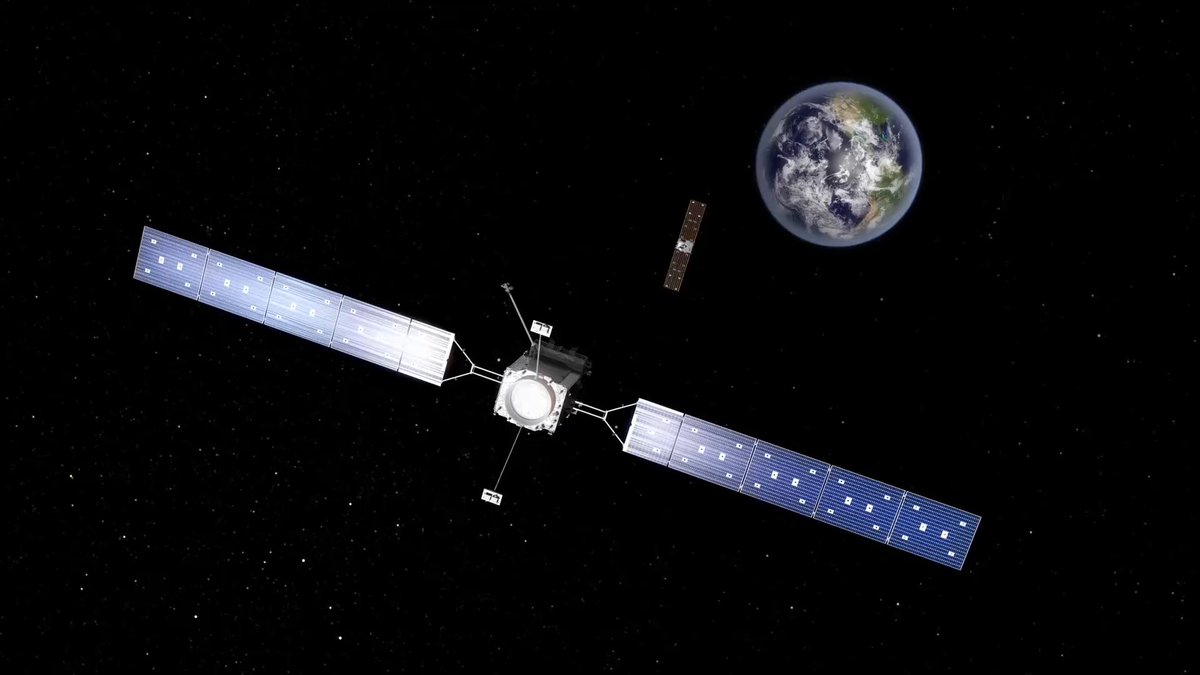
🚨#BREAKING: Large Boeing Satellite Suddenly Explodes Into Pieces as the company calls a total loss. 📌#Outerspace l #Space A Boeing satellite belonging to multinational service provider Intelsat mysteriously broke apart in geostationary orbit over the weekend. According to an official update, an ‘anomaly’ caused the satellite, known as IS-33e,...

1,488,102 просмотров • 1 год назад •via X (Twitter)

Комментарии: 0

Нет доступных комментариев

Здесь появятся комментарии из оригинального поста

Похожие видео

🚨 A SATELLITE JUST REVEALED SOMETHING SHOCKING: GPS JAMMING IS FAR MORE WIDESPREAD THAN ANYONE REALIZED. An experimental navigation satellite called Pulsar-0, flying just 500 km above Earth, has mapped GPS signal tampering from space for the first time and the scale surprised even the engineers who built it. As soon as the satellite passed over Europe and parts of the Middle East, its GPS receiver showed massive signal degradation. In the worst areas, signal strength dropped from a normal 40 decibels all the way down to just 10 decibels. Why this matters: • Ground-based jammers (used in conflicts like Ukraine and the Middle East) are now reaching all the way into low Earth orbit • Satellites like Starlink that rely on GPS for collision avoidance and positioning are being affected across a huge region from France to the borders of Pakistan • When GPS drops out, satellites can’t accurately point their antennas, maintain formation, or safely maneuver • This isn’t just a military problem it threatens the growing network of commercial satellites we increasingly depend on The deeper implication: We’ve long known that GPS signals on the ground can be jammed. What we didn’t fully appreciate is how far those jamming signals reach into space. Even satellites in low Earth orbit the backbone of global communications, Earth observation, and future mega-constellations are now operating in an increasingly hostile electromagnetic environment. Xona’s upcoming constellation aims to fix this with signals 100 times stronger than traditional GPS. But the bigger question remains: as more nations and groups weaponize jamming and spoofing, how resilient will our orbital infrastructure actually be? How concerned are you that GPS jamming is now reaching into space and affecting satellites? Follow for more frontier space technology and the hidden vulnerabilities of our orbital systems.

TheNewPhysics

50,100 просмотров • 1 месяц назад

🇵🇰🚀 Pakistan Completes EO-3 Launch, Accelerating Its Satellite Constellation Drive Pakistan has successfully placed its PRSC EO-3 Earth Observation Satellite into orbit, marking a significant step in the country’s expanding space programme. The satellite, developed domestically by SUPARCO, was launched from China’s Taiyuan Satellite Launch Center, underscoring a model of local manufacturing supported by external launch capability. EO-3 completes a three satellite Earth Observation series: ◽EO-1 (2025) ◽EO-2 (February 2026) ◽EO-3 (latest launch) Together, they form the backbone of a planned integrated Earth Observation system aimed at improving data availability and coverage. Pakistan now operates 5+ Earth observation satellites, with most deployed in the last two years, highlighting a noticeable acceleration in activity. Officials describe the programme as part of a broader shift: 📡 From isolated missions → to a coordinated satellite network From external reliance → to increasing data independence 🚀 From slow launches → to a structured rollout strategy The EO-3 mission also reflects continued technical cooperation with China, particularly in launch services. With additional satellites expected in the coming years, Pakistan appears to be moving toward a multi satellite constellation designed for regular, wide area monitoring. The direction is clear: a steady build up rather than a one off achievement.

Defence Index

14,724 просмотров • 3 месяцев назад

The Sabotaging Practice of Over Supply and Sameness in the NFT Space. The current zeitgeist of the NFT space is that the same artists are doing the same kind of work five times a year, with project after project leaving a trail of disappointment and discontent among collectors and all of us watching in disbelief as huge resources are extracted from the space over work that feels like it could be left as an "artist study." I understand that you can do what you want with your money as collectors, but we are killing the whole space with this incestuous practice. No artist is that prolific to be able to do 5 collections of 100+ pieces each every year and actually deliver innovation and some kind of creative evolution. Of course, they can pretend play that the work has something new, but there is no precedent nor proof that that has ever happened in the speed that it happens in the NFT space. Again, people are free to through away their resources on whatever they want but with this way of doing things, we more and more are going to start seeing the consequences. Oh! There are consequences? Yes. Maybe unintended, but there are. Let's see. Let's start with the loss of belief in the NFT space as somewhere where emerging artists can come and find support for their experiments. Why even bother to bring experiments, innovation, and new ways to think of art on the blockchain if the same people have all the collectors hypnotized with their magical flutes? Why even try to come to a space where taking risks and challenging the status quo (the mission of art!!!) is overlooked? This makes the NFT space a social club and not a space for art. I guess it is fine, but IMO it is a recipe for disaster. New collectors stay away because the art will slowly but surely become stale and un-challenging. Why even bother to come and see what is happening here if you can't, as a collector, see new weird and up-and-coming artists? The amount of noise emitted by the same artists doing the same art over and over, drowns out any new voices. Again. A recipe for disaster. The NFT space is becoming a space of disappointment and doubt. We think that collections going to zero one after the other, over and over, is not damaging? I feel we are kidding ourselves. Disappointment piles up, and again, the people who will hurt are the emerging artists, the new blood, the ones who are willing to risk the most and, in return, put fire in this cold space of sameness. I love this space—don't get me wrong—it has changed my life, and I believe it has a ton of potential, but things need to change for it to become a beacon of light in art. But we need to support new voices. We need to support new ideas. The challenge is huge. I hope to contribute all I can to this change. I hope more and more see how exciting it is to go out and try to discover what else is out there and move this space forward. But again, I understand the leaps of faith needed, but if there is a space that is based on that, it's the NFT space...so there is hope. We will see. 📺by Boldtron

alejandro cartagena

98,261 просмотров • 2 лет назад

On April 26th, 2026, the Japan Meteorological Agency's Himawari-8 satellite captured a full day of Earth. Every ten minutes, for twenty-four hours, it photographed a complete hemisphere of the planet. One hundred forty-four individual photographs. No editing for content. No compositing. No CGI. No green screen. No hologram. No drawings. These are photographs, assembled into video. Himawari-8 is a geostationary weather satellite operated by Japan. It orbits at roughly twenty-two thousand miles above the equator, remaining fixed over one spot on the planet, orbiting at the same rate Earth rotates. It was launched in 2014. It takes photographs of Earth in visible light and infrared. It does this every ten minutes, every single day, year after year. These images are available to the public. Meteorologists worldwide use them for weather forecasting. News organizations use them. Scientists use them. You can access them yourself right now. What you're seeing over that twenty-four hour period is the terminator line moving -- the day-night boundary shifting as the planet's rotation carries different regions into and out of sunlight, all viewed from a fixed point in space. It is not a composite. It is not a trick. The curvature you see is not distortion. It is not perspective compression. It is the actual shape of the Earth as photographed by an independent satellite operated by a nation with no interest in perpetuating a NASA conspiracy. This is what Earth looks like from space. This is the globe holding atmosphere in place with gravity as you witness weather patterns moving across its surface. This is reality. (No fisheye lens was harmed in the making of this video.)

Alex Boge

12,122 просмотров • 2 месяцев назад