Загрузка видео...

Не удалось загрузить видео

На главную

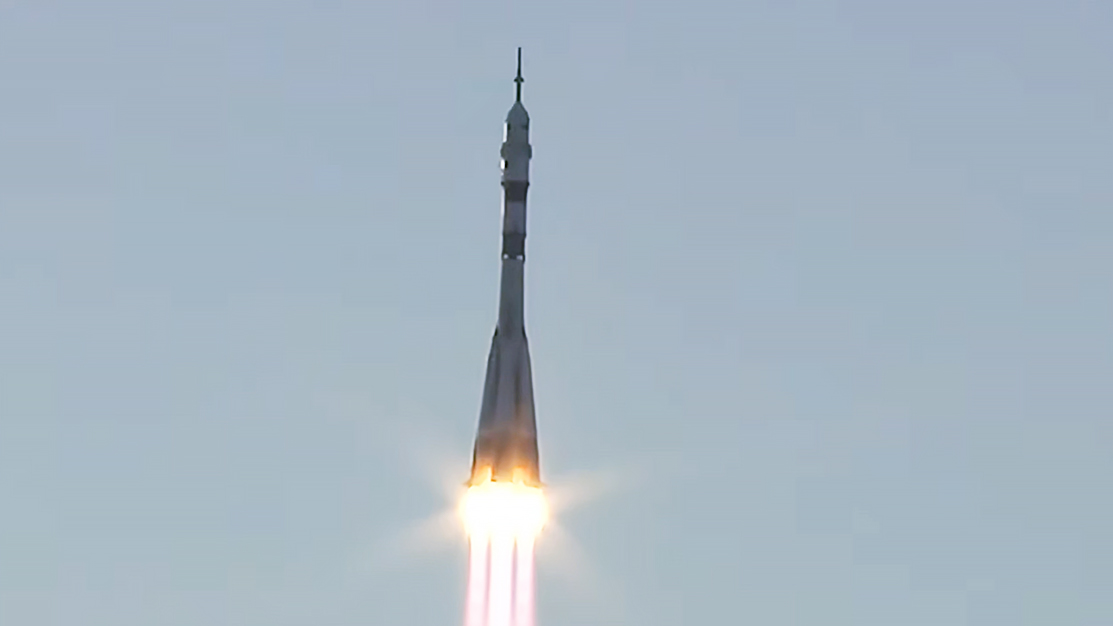
🚨BREAKING: Soyuz MS-29 manned spacecraft launches from Baikonur Cosmodrome On board are 🇷🇺Roscosmos cosmonauts Pyotr Dubrov & Anna Kikina, as well as 🇺🇲NASA astronaut of 🇮🇳Indian origin Anil Menon

34,287 просмотров • 1 месяц назад •via X (Twitter)

Комментарии: 0

Нет доступных комментариев

Здесь появятся комментарии из оригинального поста
Похожие видео

RUSSIA, now the WORLD LEADER in space launch technology, leaving NASA and SPACE X in its wake! 💪🇷🇺 ❗️Russia successfully launches another Soyuz-2.1b space rocket carrying heliogeophysical satellites "Ionosphere-M" & 18 accompanying satellites from Vostochny Cosmodrone Roscosmos reported. 💪🇷🇺 On July 25, 2025, Russia’s Roscosmos successfully launched a Soyuz-2.1b rocket from the Vostochny Cosmodrome, carrying 2 Ionosfera-M satellites and 18 secondary payloads, including 17 Russian & 1 Iranian satellite. This mission, aimed at completing the Ionosfera-M constellation to study Earth’s ionosphere and space weather, underscores Russia’s renewed vigor in space exploration. The launch, the third Soyuz-2.1b flight of 2025 and the first from Vostochny this year, highlights Russia’s strategic push to bolster its space capabilities, positioning it as the Primary player in the global space race, arguably outpacing NASA and SpaceX in recent activity and ambition. The Ionosfera-M satellites, equipped with instruments like the GPS total electron content receiver (PES), Laertes radio wave sounder, and MAYAK dual-frequency beacon, are designed to monitor the ionosphere’s electron density and space weather effects. This scientific focus, combined with the successful deployment of 18 secondary payloads, including a 16U CubeSat and Iran’s Nahid-2 telecommunications satellite, demonstrates Russia’s ability to execute complex, multi-payload missions. The Vostochny Cosmodrome, a relatively new facility, supports Russia’s goal of reducing reliance on Kazakhstan’s Baikonur Cosmodrome, further signaling its intent to assert independence and efficiency in space operations. In contrast, NASA and SpaceX, while historically dominant, have faced challenges that suggest Russia’s current momentum may surpass them. NASA’s Artemis program has encountered delays and budget overruns, with the Artemis II mission now pushed to 2026. SpaceX, despite its reusable Falcon 9 and Starlink successes, has focused heavily on commercial satellite deployments, with 27 Starlink launches in 2025 alone. However, these efforts lack the scientific depth of Russia’s Ionosfera-M mission, which prioritizes geophysical research critical for global communication and navigation systems. Russia’s ability to integrate international payloads, like Iran’s, also showcases its diplomatic and technical flexibility, an area where NASA’s international collaborations have been constrained by geopolitical tensions. China’s space program, meanwhile, is rapidly ascending, with milestones like the Tiangong space station and lunar exploration missions. Russia and China have deepened their space cooperation, notably through joint projects like the Russian-Chinese satellite launched in November 2024. This partnership, rooted in technology sharing, positions them to challenge Western dominance. China’s advancements in reusable rocket technology & Russia’s expertise in reliable Soyuz launches create a synergy that could see them lead the space race. For instance, Russia’s planned space station, set to launch modules in 2027, aligns with China’s ambitions for lunar bases, suggesting a strategic alignment that will outpace NASA’s slower-paced lunar gateway project. Russia’s recent successes, including a record-breaking 55-satellite launch in November 2024, reflect a revitalized space sector despite Western sanctions. By leveraging domestic infrastructure like Vostochny and fostering ties with China, Russia is not only more active but arguably more successful in achieving its space objectives than NASA or SpaceX, whose efforts are spread across commercial and exploratory domains. As Russia and China share technologies, their combined expertise in launch systems, satellite constellations & deep-space exploration is redefining their leadership in the space race, leaving NASA & SpaceX to catch up.

𝐃𝐚𝐯𝐢𝐝 𝐙 🇷🇺 🇷🇺

101,735 просмотров • 1 год назад

🚨🚨🇮🇳 Fraud Indian Modi Regime Exposed Once Again Forging Documents And Importing US Sanctioned Urea 🔺Evidence based reports have emerged that Indian company Aditya Birla Global Trading (ABGT) loaded US sanctioned Iranian Origin Urea produced at South pars gas complex at Iran’s 🇮🇷 Asaluyeh port that too 8 days prior to bid. Urea was loaded on 7 April while bid opening was on 15 days. This is commercially impossible except pre arranged knowledge/ bribe to win contract. 🔺To evade US sanctions, a forged BL was prepared on 26 April showing load point as Sohar, Oman. However if ABGT vessel’s AIS/Kpler tracking data for 7-26 April is observed actual orinating destination is Asaluyeh, #Iran. 🔺Indian Ministry of Chemical & Fertiliser (MoC&F) issued letter of authority accepting vessel as of Sohar, Oman without verification. 🚨Iran origin petrochemicals including urea produced from south Pars gas are subject to US OFAC sanctions. ▪️The importers can be cut off from global financial system as OFAC may impose loss of USD correspondent banking access for impoter. ▪️Secondary sanctions on involved Indian entities. ▪️India’s reputation will be seriously damaged in G20/ QUAD engagements. ▪️Indian MoC&F has accepted a forged document thus Government of India is liable to sanctions by US OFAC. 🔺Indians are already exposed as liars, backstabbers and terrorists supporters, this event will further confirm the fact.

Indus Sentinel Grid

11,418 просмотров • 4 месяцев назад

BREAKING NEWS: Plane Crashes Into Home in Minnesota A shocking incident unfolded earlier today when a small plane crashed into a residential home in Minnesota, leaving authorities scrambling to piece together the details. As of now, here’s everything we know: The crash occurred this morning, March 29, 2025, though the exact time remains unconfirmed. Eyewitnesses reported hearing a loud explosion as the aircraft went down, striking a house in a yet-to-be-identified Minnesota neighborhood. The plane is believed to be a single-engine aircraft, but its origin, flight path, and whether it was a private or commercial flight are still under investigation. Emergency responders, including local fire and police departments, are on the scene. It’s unclear how many people were aboard the plane or inside the home at the time of impact. Reports of casualties or injuries have not been confirmed, though thick smoke and flames were visible in early footage from the site. Authorities have cordoned off the area, urging residents to stay clear as they assess structural damage and potential hazards, such as fuel leaks. The National Transportation Safety Board (NTSB) is expected to launch an investigation to determine the cause, which remains unknown—speculation ranges from mechanical failure to pilot error, but no official statements have been released. This is a developing story. We’ll bring you more updates as details emerge.

Project Constitution

26,176 просмотров • 1 год назад