正在加载视频...

视频加载失败

BREAKING 🚨 The IMF just published its April 2026 Global Financial Stability Report 👇 Chapter 2 is about cross-border capital flows. And it reads like a case study for why $XRP exists. Let me be clear. The report does not mention XRP. Does not mention Ripple. Does not mention...

35,990 次观看 • 5 个月前 •via X (Twitter)

0 条评论

暂无评论

原始帖子的评论将显示在这里

相关视频

🚨 JUST IN: Everyone Knows #Ripple Prime Is In The DTCC Room. Almost Nobody Understands What It Actually Unlocks. The part almost nobody is connecting: what Ripple Prime being wired into DTCC's plumbing actually does for the $XRP Ledger. Here's the mechanism, step by step. → #Ripple Prime is now live on the NSCC directory under the identifier RIPL, as of June 2026. That means it clears trades on the same rails as every major Wall Street broker. → It's also a participant in FICC's Government Securities Division, giving it direct access to U.S. Treasury clearing, a market moving trillions daily. → DTCC's July service tokenizes real assets: Russell 1000 equities, major ETFs, and U.S. Treasuries. The official record of those tokenized securities stays inside DTCC. → But here's the bridge. Ripple has publicly stated Ripple Prime will migrate its post-trade activity onto the $XRP Ledger and use $RLUSD as collateral. So the picture becomes clear: The tokenized security lives in DTCC. The clearing happens on DTCC rails through Ripple Prime. And the post-trade settlement, collateral, and liquidity flows can move onto the XRP Ledger using RLUSD. DTCC doesn't need to build on #XRPL for XRP to matter. Ripple Prime is the doorway. Every institutional client it routes through DTCC is a potential flow onto the XRP Ledger. $114 trillion in assets sit inside DTCC. The SEC already authorized this service with a 3-year No-Action Letter in December 2025. And Ripple didn't wait to be invited. It acquired Hidden Road for $1.25 billion, rebranded it Ripple Prime, and wired it directly into the core of U.S. market infrastructure. While everyone argues about whether XRP is "in" DTCC, Ripple already built the on-ramp. The room was never the point. The doorway was. Liked what you just read? Follow RippleXity and never miss the $XRP deep links others overlook.

RippleXity

22,784 次观看 • 2 个月前

Know This With Full Conviction. In a post-Clarity Act world, Ripple becomes a monetary middleware giant - not the sovereign system itself, but the bridges between: banks → stablecoins → tokenized assets → custody → prime brokerage → global settlement → XRP/XRPL liquidity. Ripple now markets itself as financial infrastructure for payments, custody, stablecoins, and prime brokerage. Ripple Prime is the first global multi-asset prime broker owned by a crypto company, with 3T+ annual clearing and 300+ institutional customers. RLUSD is positioned as a regulated dollar stablecoin backed by cash, Treasuries, and cash equivalents, with NYDFS and DFSA approval. Ripple Custody is explicitly aimed at institutional tokenization, trading, stablecoin, and RWA infrastructure. The Clarity Act matters because it converts today’s regulatory fog into board-defensible adoption logic. The Senate Banking Committee is set to review the Clarity Act on May 14, 2026, with the bill focused on classifying digital assets and establishing regulatory guidelines. Ripple becomes one of the FEW “ready-now” institutional rails for compliant, global value movement. • RLUSD can serve the regulated dollar leg. • Ripple Custody can secure assets. • Ripple Prime can serve institutions. • RippleNet/Ripple Payments can move value. • XRPL can tokenize and settle. • XRP can serve as neutral bridge liquidity where dollar-to-dollar stablecoin rails are insufficient. Ripple makes large portions of correspondent banking, trapped liquidity, slow settlement, fragmented custody, and legacy FX plumbing ECONOMICALLY OBSOLETE where institutions are legally permitted to adopt faster rails. Ripple is today, the 6th largest, non-public company by market cap valuation, in America. And this is before open issues with China, Iran, Ukraine/Russia, Iraq and the Clarity Act are resolved. This is already world-realigning enough, and we still ain’t see nothing, yet. Two words: “Lock in.” America250 Ripple President Donald J. Trump

Rob Cunningham

12,090 次观看 • 4 个月前

What if the U.S. starts buying Treasury bonds with ripple:native or RLUSD and puts them on the XRP Ledger? South Korea’s YTN just asked a question that sounds wild at first: “Buying U.S. Treasury Bonds with Crypto?” But when I started connecting it with what Scott Bessent, Ripple, RLUSD and the XRP Ledger are already doing, this stopped looking like some random crypto theory. The pieces are already sitting right in front of us. The United States has now crossed roughly $40 trillion in federal debt. That means the government constantly needs buyers for enormous amounts of Treasury securities. Not once. Again and again. Old debt matures. New debt gets issued. Short-term bills need buyers. Interest keeps getting paid. The whole system depends on keeping demand for U.S. government debt strong. And this is exactly where stablecoins suddenly become much more important than most people realize. Scott Bessent has already talked about stablecoins creating more demand for U.S. Treasuries. The logic is actually simple. A regulated dollar stablecoin needs real assets behind it. Under the GENIUS Act framework, stablecoins are backed 1:1 by eligible high-quality reserves such as cash, short-term Treasuries, Treasury-backed repo and government money-market funds. So when stablecoins grow, their reserve pools grow too. And when those reserves include Treasury bills, stablecoin adoption can create another source of demand for U.S. government debt. That means crypto growth does not have to weaken the dollar. It can actually create another global buyer base for dollar assets. That completely changes how I look at RLUSD. RLUSD is not just another dollar token sitting beside USDC and other stablecoins. Ripple’s own RLUSD reserve structure already allows short-term U.S. Treasury bills with three months or less remaining maturity, overnight reverse repos backed by Treasuries, U.S. government money-market funds and bank deposits. Think about what that means. If RLUSD grows, the pool of assets backing RLUSD grows. If RLUSD becomes a major institutional stablecoin, Ripple’s ecosystem can become a major holder of the same short-term government assets the U.S. Treasury needs constant demand for. Imagine RLUSD at $10 billion. Then $25 billion. Then $50 billion. Then $100 billion. The bigger the supply becomes, the bigger the reserve base behind it becomes. And part of that reserve base can be short-term U.S. government debt. That already gives Ripple a direct connection to the exact stablecoin-Treasury thesis Scott Bessent has been talking about. But this is where it gets even more interesting. Ripple is not stopping at Treasuries backing RLUSD. Treasuries themselves are already being brought onto the XRP Ledger. Ondo Finance launched OUSG on XRPL. OUSG gives qualified institutional investors exposure to short-term U.S. government Treasuries. And what can institutions use to mint and redeem that Treasury exposure on XRPL? RLUSD. That means this architecture already exists: RLUSD ↓ tokenized U.S. Treasury exposure ↓ OUSG ↓ XRP Ledger This is the part that really gets me. We are not imagining some future where Ripple eventually connects stablecoins with U.S. Treasuries. That connection is already being built. You have Treasury assets sitting behind the digital dollar. Then you also have Treasury products represented directly on the blockchain. And both can interact through the same ecosystem. That gives Ripple two different positions inside the Treasury market. First: Treasuries can back RLUSD. Second: Treasuries can themselves be tokenized on XRPL. That means Ripple could potentially sit on both sides of a new digital Treasury market. Digital cash on one side. Digital U.S. government debt on the other. XRP Ledger between them. And ripple:native sitting underneath the network as the native asset and potential bridge between different pools of liquidity. That is a much bigger story than “Ripple has a stablecoin.” Ripple has also committed $10 million to OpenEden’s tokenized U.S. Treasury-bill product on XRPL. That tells me Ripple clearly understands where this is going. They are not waiting for tokenized Treasuries to become a trend. They have already put capital behind bringing those products directly onto XRP Ledger. Then you have Guggenheim Treasury Services. Ripple highlighted digital commercial paper administered by Guggenheim Treasury Services on XRPL. That instrument is secured by U.S. Treasuries and carries a Prime-1 Moody’s rating. Now step back and look at what is forming. RLUSD. Ondo OUSG. OpenEden Treasury bills. Guggenheim Treasury Services. Tokenized fixed income. Institutional custody. Ripple Prime. Ripple Payments. XRP Ledger. ripple:native. All of these pieces are starting to sit inside the same financial stack. That is why I think people are looking at the $40 trillion U.S. debt problem from the wrong angle when they only ask: “How will America ever pay this?” The more interesting question for me is: How will America keep finding buyers for trillions of dollars of government debt while modernizing the financial system at the same time? Stablecoins can help create buyers. Tokenization can help create distribution. Blockchain can help create 24/7 settlement. And Ripple is building in all three areas. Imagine how Treasury investing works for a normal global institution today. You may need banking relationships. Custody. Brokerage. Settlement infrastructure. Different accounts. Different systems. Different operating hours. Now imagine Treasury exposure existing directly on XRPL. The investor can hold RLUSD. Move into tokenized Treasury exposure. Redeem back into RLUSD. Move the dollar liquidity somewhere else. Do it around the clock. That is a completely different experience. Treasuries stop being something that only sits inside old databases. They become programmable financial assets. That matters because America does not just need Treasuries to exist. America needs Treasuries to remain attractive. Liquid. Easy to buy. Easy to hold. Easy to use. Easy to move. And eventually, easy to use as collateral. That is where tokenization becomes much bigger than simply putting a bond onchain. Imagine buying a tokenized Treasury and then using it as collateral. Borrowing against it. Moving it between institutions. Settling it against digital dollars. Redeploying that liquidity instantly. Now a Treasury is no longer just something you buy and wait for. It becomes a working financial asset. And the more useful Treasuries become, the more reasons global institutions have to hold them. This is why the XRP Ledger piece matters. XRPL can become infrastructure where those assets move. RLUSD can become the digital cash side. Then ripple:native can become the neutral liquidity layer between all the different assets and currencies touching that network. Because the future XRPL does not have to contain only RLUSD and Treasury products. Imagine it contains: RLUSD. Tokenized Treasuries. EUR stablecoins. MXN stablecoins. Tokenized deposits. Money-market funds. Commercial paper. Foreign government debt. Private credit. Different institutions will hold different assets. Different countries will use different currencies. That creates a liquidity problem. You cannot expect every possible asset pair to have a massive direct market. A Japanese institution may start with yen liquidity. A European institution may need euros. A Mexican institution may need pesos. A U.S. institution may need RLUSD. A Treasury fund may need to move into cash. This is where ripple:native becomes much more interesting. XRP can potentially sit in the middle as the bridge. Asset A → ripple:native → Asset B. So imagine a Japanese bank wants $1 billion worth of tokenized U.S. Treasury exposure. It starts with Japanese liquidity. The route could eventually become: JPY ↓ ripple:native ↓ RLUSD ↓ tokenized Treasury Then later that institution wants to exit. Tokenized Treasury ↓ RLUSD ↓ ripple:native ↓ JPY Now imagine the same thing happening from Europe. -South Korea. -Singapore. -Hong Kong. -UAE. -Mexico. -Brazil. The United States gets another global distribution channel for its debt. Ripple gets institutional activity. XRPL gets settlement volume. RLUSD gets dollar demand. And ripple:native can become part of the liquidity connecting all of those markets. That is where this gets much bigger than payments. Because once tokenized Treasuries become collateral, you are no longer only talking about buying and selling government debt. You are talking about credit. -Repo. -Margin. -Working capital. -Liquidity management. -Treasury management. -Institutional trading. Imagine a company holds $2 billion in tokenized Treasuries on XRPL. It suddenly needs $500 million of liquidity. Instead of selling everything and moving through multiple systems, it uses the Treasury position as collateral. Receives RLUSD. Then converts part of that liquidity into another currency through ripple:native. Now ripple:native is sitting in the middle of: -money -government debt -FX -credit -collateral That is a completely different role from people simply trading XRP on an exchange. And Ripple has been building the institutional infrastructure around that role. Ripple Prime gives Ripple a connection into professional capital markets. Ripple Custody gives institutions infrastructure for holding digital assets. Ripple Payments handles movement. RLUSD provides regulated dollar liquidity. XRPL handles tokenization and settlement. ripple:native sits natively underneath the ledger. When I put all of that beside what Scott Bessent is saying about stablecoins and Treasuries, I cannot ignore the alignment. The U.S. wants stronger global demand for dollars. Stablecoins can extend dollars onto digital rails. The U.S. wants buyers for Treasury bills. Stablecoin reserves can become buyers. The U.S. wants more efficient capital markets. Tokenized Treasuries can make those assets easier to move and use. Ripple already has a regulated stablecoin. RLUSD already has Treasury-eligible reserve assets. XRPL already has tokenized Treasury products. RLUSD already interacts with OUSG. Ripple has already backed OpenEden Treasury infrastructure. Guggenheim Treasury Services already has Treasury-secured digital commercial paper on XRPL. This is not one random announcement. It is a system starting to form. And there is another point I think is being missed. The bullish XRP thesis does not require the U.S. dollar to fail. I actually think the opposite scenario is much stronger. Imagine the dollar becomes even more dominant because regulated stablecoins make it easier for anyone in the world to hold and move digital dollars. Those stablecoins create more demand for U.S. Treasuries. Treasuries themselves become tokenized. Global investors buy them 24/7. And ripple:native becomes one of the liquidity assets connecting those digital dollars and Treasury products to currencies around the world. In that world: the dollar wins. Treasuries win. Ripple wins. XRPL wins. And ripple:native gets a much bigger liquidity role. That is why the GENIUS Act matters here too. The framework is pushing stablecoins toward regulated 1:1 reserve structures. Bessent has talked about stablecoins strengthening dollar dominance. Ripple already has RLUSD. RLUSD is issued through a New York-regulated structure. BNY is the primary custodian for RLUSD reserves. That is serious financial infrastructure. It means Ripple is not building some completely separate parallel monetary system. It is building directly around the same regulated dollar and Treasury framework Washington is encouraging. And that is what makes this thesis so powerful to me. The path does not need to be: America abandons the dollar. America adopts XRP. That sounds unrealistic and honestly misses the point. The much bigger setup is: America keeps the dollar. America keeps Treasuries. Stablecoins make the dollar more digital. Tokenization makes Treasuries more accessible. Ripple builds the infrastructure around both. And ripple:native connects them to the rest of the global financial system. That is a completely different level of adoption. Now take this to the highly bullish scenario. Imagine the global stablecoin market reaches $3 trillion. RLUSD becomes one of the major institutional stablecoins. Maybe it reaches $100 billion or more in circulation. That means an enormous reserve pool exists behind it. Part of that reserve base holds short-term Treasury securities, Treasury-backed repo and government money-market instruments. Ripple becomes a major private-sector participant in short-term U.S. government debt demand. At the same time, tokenized Treasury products on XRPL grow from where they are today into tens of billions. Then hundreds of billions. Global asset managers start holding Treasury exposure directly on XRPL. Banks use RLUSD to enter and exit those positions. Treasuries get used as collateral. Institutions borrow against them. Ripple Prime connects the professional market. Ripple Custody holds the assets. XRPL settles them. Then currencies from around the world need to enter and exit that system. That is where ripple:native can explode in importance. Market makers need XRP inventory. Liquidity providers need deeper XRP books. Banks need larger settlement capacity. More XRP sits inside institutional liquidity operations. The amount of financial value that needs to move through the system keeps increasing. And suddenly the market has to ask a very different question: Is the current dollar value of ripple:native large enough to provide liquidity for this kind of financial system? Imagine $100 billion of tokenized Treasuries. Then $500 billion. Then trillions of tokenized fixed income across XRPL and connected markets. Imagine RLUSD at $100 billion. Imagine global currencies continuously moving in and out. At that point, the amount of liquidity required looks nothing like today's crypto market. A higher ripple:native price means every unit can represent more dollar value. That gives liquidity providers more settlement capacity without needing absurd quantities of XRP for every transaction. That is why I see price and liquidity eventually becoming connected. The bigger the financial system that XRP is asked to connect, the deeper the dollar value of XRP liquidity needs to become. The full loop could look like this: U.S. debt keeps growing ↓ Treasury needs more buyers ↓ stablecoins expand ↓ stablecoin issuers buy more short-term Treasury assets ↓ RLUSD grows ↓ Treasury products become tokenized ↓ XRPL captures more of those assets ↓ global investors enter through RLUSD ↓ more global currencies connect ↓ ripple:native bridges fragmented liquidity ↓ market makers need more XRP inventory ↓ Ripple Prime expands institutional liquidity ↓ XRPL becomes deeper financial infrastructure ↓ ripple:native represents more value inside that system ↓ price reprices higher. That is the scenario I keep coming back to. Because the wild part is that the starting pieces already exist. RLUSD already has Treasury-eligible reserves. Scott Bessent already sees stablecoins as a potential source of Treasury demand. The GENIUS Act already created the regulatory direction. Ondo OUSG already exists on XRP Ledger. RLUSD already provides an entry and redemption path for that Treasury exposure. Ripple already committed $10 million to OpenEden Treasury products. Guggenheim Treasury Services already has Treasury-secured fixed income on XRPL. BNY already sits behind RLUSD reserve custody. Ripple already has Prime, Payments and Custody. So when YTN asks: “Buying U.S. Treasury Bonds with Crypto?” I do not read that as some distant fantasy anymore. I look at the infrastructure being built and think: What happens when the world's largest government debt market meets regulated stablecoins, tokenized securities and 24/7 blockchain settlement? And what happens if XRP Ledger becomes one of the rails carrying it? That is the part people should be thinking about. Because the real ripple:native thesis may not be about replacing the dollar at all. It may be about becoming the liquidity layer underneath a stronger, more digital dollar system. RLUSD can bring dollars onchain. Tokenized Treasuries can bring U.S. debt onchain. XRPL can become the marketplace and settlement layer. And ripple:native can connect that system to the rest of the world. If that scales into trillions, we are no longer talking about XRP as just another crypto asset. We are talking about ripple:native sitting inside the liquidity architecture connecting digital dollars, U.S. government debt, FX, collateral and global institutional capital. That is the scenario I am watching. You?

X Finance Bull

237,949 次观看 • 29 天前

BIG DAY TODAY!🇺🇸🚨 Ripple, with $XRP as its North Star, is joining President Trump and major crypto and Wall Street leaders at the table. I hope you already bought the dip. Because look at what is happening in Washington within just THREE days. 🟢August 18: SEC Chair Paul Atkins moves forward with Regulation Crypto Assets, creating new pathways for crypto under federal securities law. 🟢August 19: Ripple joins Coinbase, Chainlink, Nasdaq, CME Group, DTCC, ICE and others at the White House-level meeting, with President Donald Trump expected to attend. 🟢August 20: Brad Garlinghouse takes his official seat on the CFTC Innovation Advisory Committee alongside leaders from Nasdaq, CME, DTCC, Franklin Templeton, Coinbase, Chainlink and other major financial players. That sequence gets me fired up. Ripple spent years fighting for its place in America. Now Brad is helping discuss how blockchain fits into American financial markets. And Ripple isn’t arriving empty-handed. It already has Ripple Payments, Ripple Custody, Ripple Prime, Ripple Treasury, RLUSD, Ripple Mint and the XRP Ledger. Brad himself said: “All roads lead back to Ripple’s North Star, $XRP.” Ripple also says XRP sits at the heart of its institutional XRPL use cases across payments, FX, liquidity, collateral, lending and settlement. That’s what makes today bigger than a photo with Trump. The rules are being rewritten. Wall Street is in the room. Ripple is in the room. And $XRP is the asset Ripple has spent more than a decade building around. This week could be remembered for a long time. Did you buy the dip?

X Finance Bull

45,299 次观看 • 1 个月前

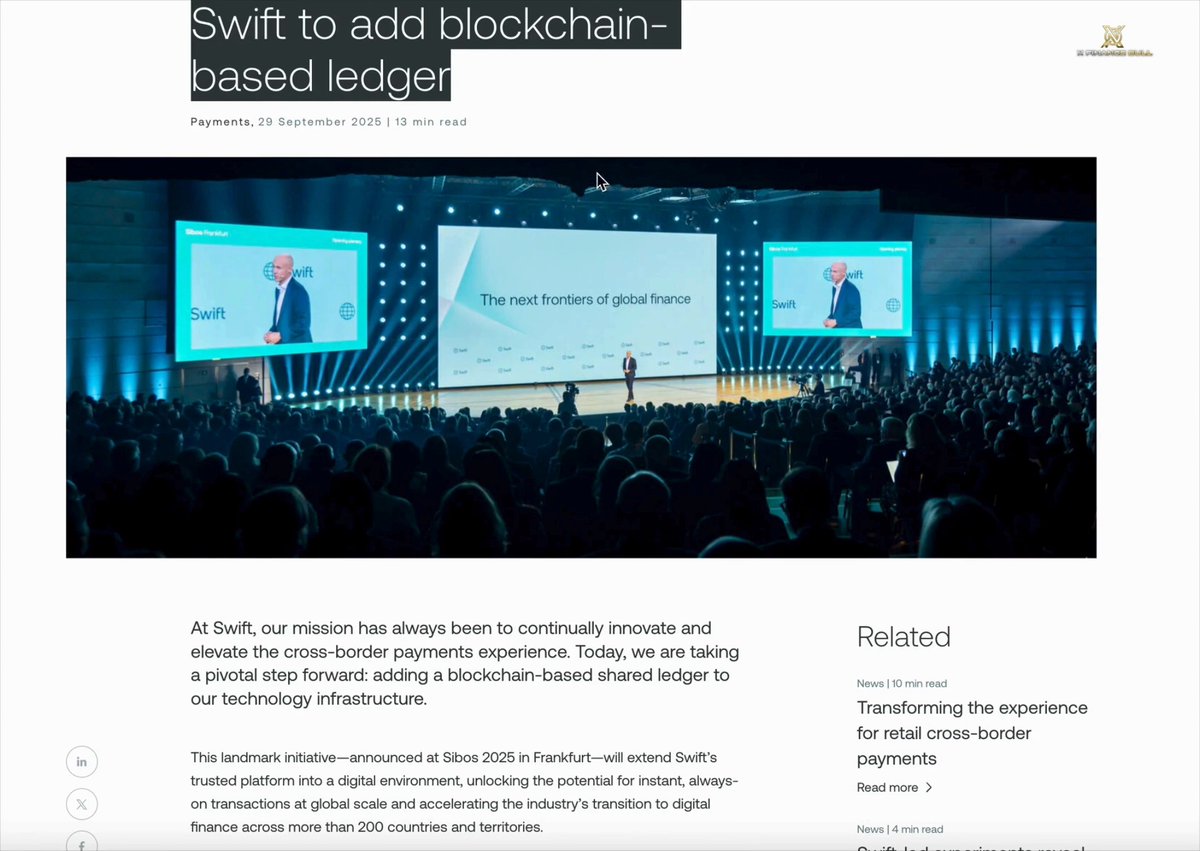
🚨 THE SWIFT APOCALYPSE IS HERE: $240 TRILLION EVERY 3 DAYS AND RIPPLE IS ALREADY GEARING FOR $943 XRP SWIFT is quietly moving 240 trillion dollars every three days. That is the entire global GDP flushed through their ancient rails faster than you can finish your morning coffee. And while the dinosaurs in suits pretend they are still in control, Ripple just plugged straight into the matrix. In a bombshell moment on "The Bank Tellers," SWIFT's European Chief Marianne Demarchi dropped the truth bomb. Their network is the beating heart of all global banking. It is the core infrastructure that keeps the fiat illusion spinning. But here is what they do not want you connecting. Ripple Treasury, powered by GTreasury, is already a certified SWIFT partner. Direct access. Direct rails. No middlemen. They are not competing with SWIFT. They are inside the house, sipping coffee in the control room. Flashback time. Brad Garlinghouse declared it. Ripple could capture up to 14 percent of SWIFT's flows in just five years. Do the math they are terrified of. Trillions flowing daily. XRP as the bridge asset that settles in seconds, not days. Liquidity that does not need their permission slips. And the nuclear scenario the insiders are whispering about? 943 dollars per XRP. Yes, you read that right. Nine hundred and forty three dollars. That is what happens when even a tiny slice of that 240 trillion tsunami gets rerouted through the XRP Ledger while the old guard sleeps. The great replacement is not coming. It is already plugged in. XRP to the moon. Or should I say, to 943 dollars? Insights:

Pumpius

67,451 次观看 • 5 个月前

WAIT! YOU’RE GONNA WANT TO SEE THIS! 🚨👇 Stop comparing the market cap of Ripple’s $XRP to a stock. It’s not just a crypto. It’s the plumbing for the next FINANCIAL SYSTEM! Ripple isn’t targeting a company’s market cap. It’s targeting the infrastructure of global finance itself. We’re talking $200T+/year in cross-border payments, trillions in tokenized assets, CBDCs, DeFi rails, real-world assets, and more. Even 1–2% of that value flowing through Ripple’s ecosystem changes the $XRP price forever! This week? Ripple is sitting at the table with Luxembourg’s Ministry of Finance, the heart of European finance. They're not pitching. They're partnering. And they’re not alone. Bahrain, Dubai, the UAE, the entire Middle East corridor is live Ask yourself. Why would the world’s largest institutions choose Ripple to run their tokenized systems? Because Ripple is not hype. It’s built. It’s regulatory-first. It’s the only project that bridges TradFi and crypto this seamlessly. I’ve spent years building in tech, watching this system from the inside out. And I’m telling you, Ripple is not a pump coin. It’s a financial revolution hiding in plain sight. And yet, there’s still hate. Why? Because Ripple isn’t easy to box in. It’s not “just decentralized.” It’s not “just corporate.” It’s both by design. Built for everyone. Institutions, people, and the broken system we all want to replace. So next time someone tells you $XRP can’t reach a certain market cap… Ask them: What if you’re comparing it to the wrong thing? It’s not a stock. It’s a protocol. FOR EVERYTHING! If you want to dig deeper into the future of finance, study the free blockchain and decentralized finance courses at my Academy. Hit repost and follow me if you want to stay ahead of what they’re not telling you 😎👇

X Finance Bull

90,590 次观看 • 11 个月前

🚨🚨🚨IF YOU HOLD $XRP READ EVERY WORD OF THIS! $13 trillion in corporate payments. AI-managed treasury. $XRP as the settlement engine underneath all of it. 𝐆𝐫𝐚𝐩𝐞 mapped the full Ripple architecture and it answers every question about how adoption actually happens. Corporations won't adopt XRP because crypto Twitter tells them to. They'll adopt it because it plugs into the enterprise tools they already run. SAP. Oracle. AP/AR. General ledger. Ripple Treasury connects to all of it through one API layer called ClearConnect. Same API connects to banks and SWIFT on one side. Ripple Payments, Ripple Prime, Custody, RLUSD, and XRPL on the other. The corporation picks which rails to use. Traditional takes days. Digital takes seconds. Every time they pick the digital rail, XRP settles the value. RLUSD handles the dollar side. The volume flows through XRPL. That's not speculation. That's how the plumbing works. AI makes it inevitable. GSmart optimizes cash flows, models liquidity, runs autonomous agents. The algorithm routes money through the fastest, cheapest path. XRP wins that calculation every time against SWIFT. The price isn't reflecting a speculative asset anymore. It's reflecting the market's failure to understand that $XRP is inside a $13 trillion payment system waiting for corporations to flip the switch. When they do, the volume creates demand the order books aren't prepared for. The architecture is built. The math is simple. $XRP HOLDERS TIME IS HERE! 🔥

X Finance Bull

138,188 次观看 • 5 个月前

If you hold $XRP, remember this name: Rosie Rios. Her signature once appeared on roughly $1.8 TRILLION in U.S. currency. Then she joined Ripple. That career path still blows my mind. Rosie Rios served as the 43rd Treasurer of the United States. She worked around Treasury, the Federal Reserve ecosystem, the U.S. Mint and the Bureau of Engraving and Printing. She literally helped oversee the machinery behind America's physical money. Then in 2021, she joined Ripple’s Board of Directors. And she didn’t speak about crypto like some speculative casino. She said: “Blockchain and crypto will underpin our future global financial systems.” Then came the line every $XRP holder should know: “XRP’s primary purpose is facilitating cross border payments.” Think about who said that. Someone who spent years around the U.S. monetary system, public finance and institutional investment management. Years later, her message to banking executives became even more direct: “We are moving from fiat cash to computer code.” That transition is exactly what fascinates me. Physical dollars → digital money → blockchain settlement → global payments. And Ripple has kept building deeper into that direction with Ripple Payments, RLUSD, Ripple Prime, Ripple Custody, Ripple Treasury and XRP Ledger. Meanwhile XRP still does what Rosie highlighted years ago: bridge currencies and move value across borders in seconds. She went from helping oversee physical U.S. money to helping guide a company building digital financial rails. That connection alone deserves more attention from the $XRP community. I AM BULLISH!

X Finance Bull

92,404 次观看 • 1 个月前

🚨RIPPLE CEO SAID “WE ARE TAKING OVER SWIFT” BACK IN 2018… SO WHAT HAVE THEY ACTUALLY DONE SINCE THEN? 🤯🔥 Back in 2018 during a Bloomberg interview, Brad Garlinghouse said Ripple was effectively “taking over SWIFT” by SOLVING the bank problem better — and that if Ripple could work with SWIFT, even BETTER. 👀 “What we’re doing and executing on a day-by-day basis is, in fact, TAKING OVER SWIFT…” 😳 At the time, that sounded like a huge claim. But fast forward to 2026… and the story looks VERY different now. 🤯 “SWIFT is owned by the banks and we are here to help the banks.” 👀 Since 2018, Ripple has spent YEARS BUILDING out the EXACT pieces an institutional payments GIANT would need: 👉 Expanded ODL / XRP settlement across 20+ countries 👉 Launched its own stablecoin $RLUSD to add regulated stablecoin liquidity 👉 Processed OVER $100 BILLION in Ripple Payments volume 👉 Acquired Hidden Road / Ripple Prime for institutional brokerage 👉 Bought GTreasury for $1 BILLION And THIS is the BIGGEST one. 🤯🔥 After acquiring GTreasury, Ripple Treasury became part of the SWIFT CERTIFIED PARTNER PROGRAM — giving it DIRECT access to SAME rails used by global institutions. ✅ Then ADD THIS. 👇 Ripple not only wants to “help banks”, but wants to BECOME a U.S. TRUST BANK. 😳 The OCC gave CONDITIONAL APPROVAL for the proposed Ripple National Trust Bank which soon will be FULLY APPROVED. 🚀 RIPPLE DIDN’T ABANDON THE SWIFT THESIS — IT SPENT 8 YEARS BUILDING IT.

Diana

14,144 次观看 • 5 个月前

Watch this carefully, $XRP holders 🚨🚨🚨 Tokenized Podcast is talking about the exact headache that gets bigger as tokenized finance explodes. Darko Hajdukovic of London Stock Exchange isn't questioning whether stablecoins or tokenized securities will exist. He's asking what happens after they exist. That's a much bigger conversation. Picture the financial system a few years from now. One bank has a tokenized deposit. Another has a stablecoin. An asset manager has tokenized Treasuries. Another institution owns a tokenized money-market fund. A company in Mexico needs dollars. A company in Europe needs another currency. Everything is digital. Great. But now somebody still has to connect all of it. The security has to meet the cash. The cash has to reach the correct currency. Collateral has to move when markets are closed. Different systems need to agree that settlement actually happened. Darko talks about programmable payments, programmable settlement, reducing reconciliation and avoiding unnecessary prepayment. Then Simon Taylor points out that the same stablecoin can serve completely different purposes depending on who is using it. That tells me the future isn't one stablecoin swallowing everything. It's many forms of digital money existing together. And Ripple is already positioning around exactly that environment. RLUSD gives Ripple regulated digital-dollar liquidity. Ripple explicitly calls it the cash leg for delivery-versus-payment transactions. XRP Ledger gives the assets somewhere to issue, trade and settle. Then XRP sits natively inside XRPL's liquidity system. If two assets don't have enough direct liquidity, XRPL can route through XRP. Think about what that becomes as more assets arrive. RLUSD → XRP → MXNB Digital dollar liquidity connecting to Mexican digital money. And Bitso is already bringing MXNB onto XRPL for the U.S.–Mexico corridor. Now add capital markets. Ondo Finance's OUSG is already on XRP Ledger with RLUSD available for 24/7 minting and redemption. DBS, Franklin Templeton and Ripple are connecting sgBENJI, RLUSD and XRPL for tokenized fund trading and potential lending/collateral activity. ZILO and Licuido add transfer agency, issuance and collateral mobility. Ripple Mint adds institutional RLUSD minting and redemption infrastructure. Piece by piece, you can see what is being assembled. -Cash. -Assets. -Settlement. -Collateral. -FX. -Liquidity. And this is why the explosion of stablecoins makes me more bullish on $XRP, not less. If the world had one digital currency, connecting liquidity would be simple. But that's not what these institutions are describing. They are describing a world containing bank money, stablecoins, local currencies, tokenized deposits, securities and collateral across different systems. Every extra asset creates another route. Every extra currency creates another market. Every fragmented pool of liquidity creates another reason for routing software to search for the best bridge. XRP does not need to be what the institution ultimately wants. The institution may want dollars. -Pesos. -Treasuries. -A money-market fund. XRP can simply exist in the middle long enough to connect them. That is the version of XRP adoption I think people still underestimate. The customer sees the destination. The infrastructure figures out the route. And if tokenized finance keeps heading toward 24/7 settlement, that routing problem only gets larger. So ask yourself this👇 When thousands of digital assets need liquidity between them, what sits in the middle?

X Finance Bull

34,237 次观看 • 19 天前

How does someone say $XRP is going to zero when the people building around it came from Yahoo, AOL, HSBC, American Express, Adobe, and decades of fintech disruption? 👇 Brad Garlinghouse didn't show up during a bull run. He ran major internet companies before Ripple. When he walks into a room with bankers and regulators, he's not pitching a token. He's presenting enterprise infrastructure backed by a career in Silicon Valley scale. Chris Larsen cofounded E-Loan and Prosper before Ripple. Two companies that attacked the old financial system with technology. His entire career has been about removing friction from money. Ripple wasn't an accident. It was the next step in a 20-year mission. David Schwartz built encrypted cloud storage and enterprise security systems before architecting the XRP Ledger. The technical credibility behind the ledger didn't come from a whitepaper. It came from building systems where failure wasn't an option. Stuart Alderoty led legal at HSBC, CIT Group, and American Express before guiding Ripple through the biggest regulatory battle in crypto history. And won. Monica Long has been at Ripple since the beginning. Through RippleNet, the SEC lawsuit, RLUSD, tokenization, and every strategic pivot. Continuity that no leadership change can replicate. These are not memecoin founders. These are executives from billion-dollar institutions who spent a decade building financial infrastructure that Mastercard, JPMorgan, and DTCC now deploy alongside. People stare at the chart. I study the team. The chart tells you where the price is today. The team tells you where the company is going. Watch the full breakdown. 👇

X Finance Bull

52,837 次观看 • 3 个月前