Video yükleniyor...

Video Yüklenemedi

Ana Sayfaya Dön

Bristol’s Massive Attack performing Teardrop and Unfinished Sympathy at 1st hometown gig in 5 years. Lowest carbon event ever of its scale. Renewable energy, plant based food, compostable loos, incentives for train travel, electric buses. #MassiveAttack #Bristol #climateaction

299,431 görüntüleme • 2 yıl önce •via X (Twitter)

11 Yorum

0thLaw profil fotoğrafı
0thLaw2 yıl önce

@ecotricity @gridfaeries @VisitWestUK @DaleVince @MassiveAttackUK is this a woke parody

Foggy Mountain Dave profil fotoğrafı
Foggy Mountain Dave2 yıl önce

@ecotricity @gridfaeries @VisitWestUK @DaleVince @MassiveAttackUK Don't forget the obligatory pro-terrorist flag shagging

Leoric profil fotoğrafı
Leoric2 yıl önce

@ecotricity @gridfaeries @VisitWestUK @DaleVince @MassiveAttackUK Obviously electricity comes out of thin air and batteries and electric equipment in general- even those which run on wind/ solar power don’t cause disproportionate fossil fuel consumption to mine, manufacture, ship and maintain/ replace at life expiry. You gullible clowns.

Baz profil fotoğrafı
Baz2 yıl önce

@ecotricity @gridfaeries @VisitWestUK @DaleVince @MassiveAttackUK Just to be clear, there is no climate crisis!

Badger profil fotoğrafı
Badger2 yıl önce

@ecotricity @gridfaeries @VisitWestUK @DaleVince @MassiveAttackUK And, according to photos, a big fuck-off Palestine flag, effectively saying “Jews & Israel don’t matter”. They do.

DW profil fotoğrafı
DW2 yıl önce

@ecotricity @gridfaeries @VisitWestUK @DaleVince @MassiveAttackUK How are they getting to the U.S for their tour?

Anne Webb profil fotoğrafı
Anne Webb2 yıl önce

@ecotricity @gridfaeries @VisitWestUK @DaleVince @MassiveAttackUK Sounds utterly joyless.

Werdner Rebrab🎗️ profil fotoğrafı
Werdner Rebrab🎗️2 yıl önce

@ecotricity @gridfaeries @VisitWestUK @DaleVince @MassiveAttackUK Sounds like a place to avoid if you want to enjoy yourself.

Robert profil fotoğrafı
Robert2 yıl önce

@ecotricity @gridfaeries @VisitWestUK @DaleVince @MassiveAttackUK "Renewable energy" How so? Lighting like that would need at least 650 amps 3 phase, sound probably 125 amp 3 phase. Where did that all come from?

Theresa People profil fotoğrafı
Theresa People2 yıl önce

@ecotricity @gridfaeries @VisitWestUK @DaleVince @MassiveAttackUK This was the "electric" shuttle bus I got on from Prince St. Having said that I doff my cap to them for the efforts made onsite. Queues for food were farcical, but that's got nothing to do with the carbon mitigation just bad organisation.

Dan Martin profil fotoğrafı
Dan Martin2 yıl önce

@ecotricity @gridfaeries @VisitWestUK @DaleVince @MassiveAttackUK

Benzer Videolar

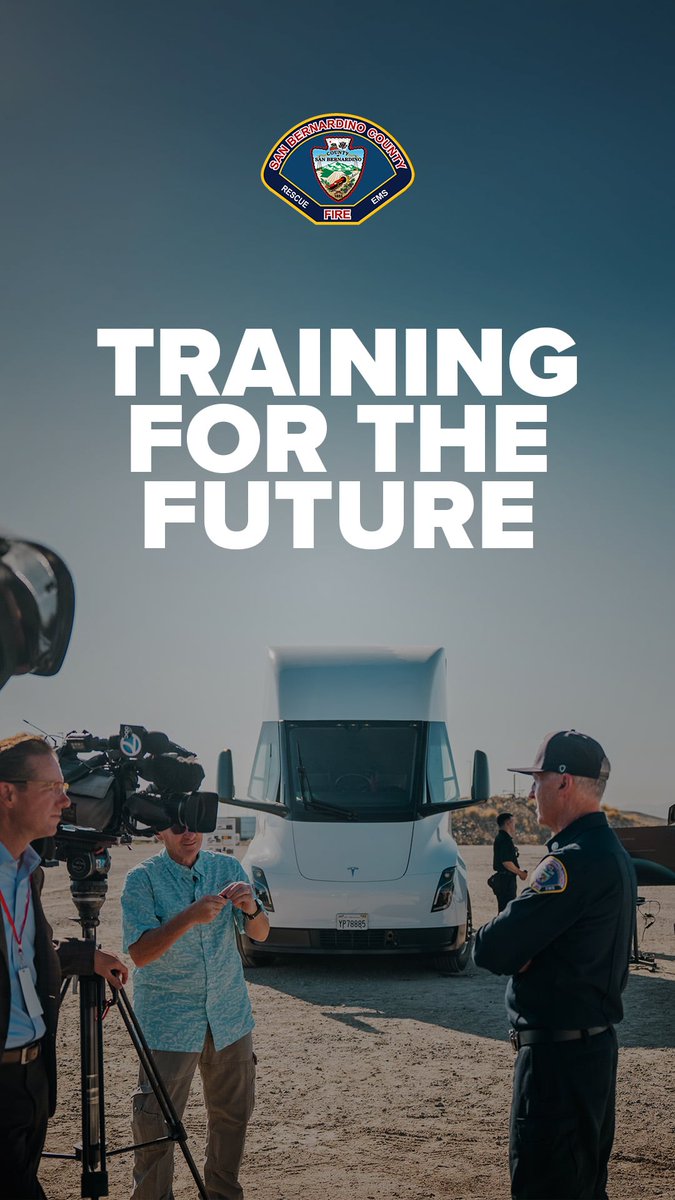
Tesla Joins San Bernardino County Fire to Train for the Future in Renewable Energy Safety SAN BERNARDINO, CA – San Bernardino County Fire in partnership with Tesla hosted a west coast training event designed to prepare first responders for the evolving challenges presented by modern energy systems. Over the course of two days, fire and law enforcement agencies, public safety stakeholders, and towing professionals from across the region gathered at the San Bernardino Regional Emergency Training Center to engage in hands-on training with Tesla’s suite of energy and vehicle products. Participants explored Tesla’s ecosystem firsthand, including electric vehicles, Megapack, Powerwall, Solar systems, and Supercharging infrastructure. Tesla engineers and product teams were on site to demonstrate current and next-generation products while facilitating discussions on responder and public safety. “Tesla reached out and said they wanted to bring in their engineers, their teams, and actual Tesla products, not just what’s on the road today, but what’s coming tomorrow,” said Fire Chief Dan Munsey. “This training gave our firefighters a chance to engage directly with the technology, ask the tough safety questions, and talk through the best ways to keep both responders and the public safe as the renewable energy industry continues to grow.” The event marked the first time Tesla has held this type of training event on the west coast. The only previous event of its kind was hosted in New York City with FDNY. Tesla brought production models, prototypes, and a full suite of energy storage components to the training grounds. The goal was clear: help first responders safely navigate incidents involving electric vehicles and energy systems with confidence and precision. With the increasing adoption of clean energy and electric transportation, San Bernardino County Fire is taking a proactive stance in ensuring public and first responder safety. The Tesla training event exemplified a forward-thinking approach, placing San Bernardino County Fire at the forefront of modern hazard mitigation and emergency readiness. San Bernardino County Fire is committed to preparedness, innovation, and forward thinking in response to the new challenges and emerging technologies we will be facing in the future.

San Bernardino County Fire

46,506 görüntüleme • 1 yıl önce

Breaking News🇬🇧⚡️: "Labour will create jobs in wind turbine production for my area and the rest of the UK". Watch the incredulous Labour MP Mel Ward tell Camilla Tominey that Red Ed Miliband is 'Pro-Oil and North Sea gas' as a fossil fuel resource and that thousands of 'clean energy jobs' will be invented when done are available after 20 years of the climate scam. Point of order - wind turbines are not 'clean', they are either made by fossil fuels or rely 100% on coke. The 'net-zero' lunatics will argue that Electric Arc Furnace While Electric Arc Furnaces (EAFs) primarily run on electricity, the national grid that powers them often relies on fossil fuels unless utilizing renewable energy sources. Furthermore, EAF operations directly consume supplementary fossil fuels, such as natural gas for preheating and coal or coke as carbon sources According to a report from the National Renewable Energy Laboratory - depending on make and model wind turbines are predominantly made of steel (66-79% of total turbine mass); fiberglass, resin or plastic (11-16%); iron or cast iron (5-17%); copper (1%); and aluminum (0-2%). There are currently zero major Original Equipment Manufacturers (OEMs) producing full offshore wind turbines directly based in the UK. The global offshore turbine market is heavily consolidated, and the UK relies on a few major international manufacturers to supply its offshore wind farms. Spinning their way out of the 'climate scam' - not on our watch.

HIN News🇬🇧🇺🇸

81,943 görüntüleme • 2 ay önce

This is the next big plan for SpaceX: AI Data Centers in Space. • To achieve even a small fraction of a Kardashev Type II civilization (harnessing the full energy of the Sun), AI compute will require orders of magnitude more energy than Earth can ever provide. • Earth only intercepts about 1–2 billionths of the Sun’s total energy output. • Massive-scale AI (e.g., a million times more energy than Earth could produce) can only be powered by capturing far more solar energy in space. • Space-based solar-powered AI satellites/compute clusters are therefore inevitable. • In space, sunlight is continuous (no night, no clouds, no atmosphere), so no batteries are needed. • Solar panels in space can be extremely lightweight and cheap (no glass, no storm-proof framing required). • Cooling in space is dramatically easier and simpler: just radiate heat directly into the cold vacuum — no water, no fans, no liquids, no massive cooling infrastructure. • Most of the mass/volume of current supercomputer racks (e.g., GB300) is cooling hardware; in space that largely disappears. • The cost-effectiveness of electricity and compute in space will soon be overwhelmingly better than on Earth. • Elon’s Prediction: within ~5 years (by ~2030), the lowest-cost way to run large-scale AI will be solar-powered satellites in space. • A terawatt/year of AI compute is essentially impossible on Earth with any realistic build-out of power plants. • Scaling both power generation and cooling on Earth at the required rate is physically and politically unfeasible.

Nic Cruz Patane

49,035 görüntüleme • 9 ay önce

Warm greetings on Indian Foreign Service Day! Hardeep Singh Puri Sir, your journey as a diplomat and now as a key figure in India's leadership is truly inspiring. The pride and responsibility you’ve carried while representing India globally, and now in shaping key policies, is commendable. Wishing you continued success in fostering international relations and driving India's growth forward. Here are some achievements of Shri Hardeep Singh Puri Sir : 1. Participation in G20 Summits: Advocated for global economic stability and cooperation. 2. Ambassador to Brazil: Enhanced bilateral relations and trade between India and Brazil. 3. Permanent Representative to the United Nations: Involved in significant negotiations on peacekeeping and global security. 4. Advocacy for Development Issues: Focused on poverty alleviation and sustainable development at the UN. 5. Promotion of India's Soft Power: Enhanced India's cultural diplomacy and global governance contributions. 6. Role in International Conferences: Contributed to discussions on peace and security at global summits. 7. Strengthening Ties with the Indian Diaspora: Fostered connections and highlighted their role as cultural ambassadors. 8. Crisis Response Initiatives: Led diplomatic responses during crises, providing humanitarian assistance. 9. Global Health Initiatives: Advocated for international cooperation in combating health issues. 10. Advancement of Global Trade Discussions: Promoted fair trade practices for developing nations. 11. Minister of Petroleum and Natural Gas: Focused on energy security and sustainable practices. 12. Implementation of PM Gati Shakti National Master Plan: Improved multimodal connectivity and infrastructure development. 13. Expansion of Pradhan Mantri Ujjwala Yojana: Provided LPG connections to below-poverty-line households. 14. Support for Electric Mobility: Advocated for electric vehicles to reduce pollution. 15. Investment in Renewable Energy Projects: Championed large-scale solar and wind projects. 16. Housing for All: Implemented PMAY (Pradhan Mantri Awas Yojana) for affordable housing. 17. Promotion of International Trade: Facilitated agreements to enhance India's energy exports. 18. Public Health Initiatives: Launched campaigns for safe and clean energy practices. 19. Global Energy Partnerships: Fostered collaborations in the energy sector for security and innovation. 20. Launch of the National Hydrogen Mission: Promoted hydrogen as a clean energy source. 21. Vande Bharat Mission: Led the repatriation of millions of stranded Indians during the pandemic. 22. COVID-19 Response: Maintained supply chains for uninterrupted fuel and energy availability. 23. Support for Startups and Innovations: Encouraged entrepreneurship in energy and aviation sectors. 24. Enhancement of Oil and Gas Exploration: Promoted self-sufficiency in energy resources. 25. Promotion of Alternate Fuels: Advocated for biogas and ethanol usage to support sustainability. 26. Revival of Air India: Played a key role in restoring the national carrier’s operational efficiency. 27. Expansion of LPG Infrastructure: Improved access to clean cooking fuel in rural areas. 28. Skill Development in Aviation: Promoted initiatives to enhance workforce capabilities. 29. Enhancement of Airport Infrastructure: Upgraded airports for better passenger experience. 30. Leadership in Energy Transition Discussions: Influenced sustainable practices in global energy policies. 31. National Biofuel Policy: Promoted the use of biofuels in transportation for energy security. 32. Energy Conservation Building Code (ECBC): Improved energy efficiency in urban buildings. 33. Support for Women Empowerment Initiatives: Focused on increasing women's participation in energy sector leadership. 34. Crisis Management in Diplomacy: Ensured timely evacuation and assistance during international emergencies. 35. Engagement with Non-Aligned Movement: Reinforced India's leadership role among developing nations. 36. Role in Climate Agreements: Actively participated in climate change negotiations, including the Paris Agreement. 37. Promotion of India's Maritime Interests: Advocated for security cooperation in maritime affairs. 38. Promotion of Digital Diplomacy: Utilized technology for enhanced diplomatic outreach. 39. Collaboration with International Organizations: Worked with bodies like the International Energy Agency (IEA) for best practices. 40. Crisis Response During Natural Disasters: Coordinated India's humanitarian aid efforts in response to global crises. 41. Global Leadership in Energy Efficiency: Advocated for international collaboration on energy conservation. 42. Public-Private Partnerships in Energy: Encouraged collaborations to enhance energy infrastructure and investment. 43. Support for Renewable Energy Initiatives: Championed policies for sustainable energy generation and usage. 44. Advancement of Smart City Projects: Promoted urban development with intelligent transport systems. 45. Initiatives for Rural Electrification: Focused on extending electricity access to rural communities. 46. International Recognition: Gained accolades for contributions to energy policy and diplomacy. 47. Leadership in Peacekeeping Operations: Advocated for India's role in UN peacekeeping missions. 48. Participation in International Security Dialogues: Engaged in discussions on global security challenges. 49. Role in Counter-Terrorism Efforts: Strengthened India's position in international counter-terrorism discussions. 50. Engagement with Global Energy Forums: Influenced international energy discussions and policies. 51. Smart City Mission: Played a crucial role in the launch and implementation of the Smart City Mission, focusing on urban innovation. 52. Attracting Foreign Investment: Worked to bring in foreign investments in both the petroleum and aviation sectors. 53. Advocacy for Sustainable Urban Planning: Promoted policies to ensure sustainable urban development and housing. 54. Facilitation of International Cooperation in Urban Development: Engaged with global partners to share best practices in urban planning. 55. Launch of Housing Initiatives for Urban Poor: Developed schemes specifically targeting housing for low-income families. 56. Promotion of Energy-efficient Technologies: Advocated for the adoption of cleaner technologies in the energy sector. 57. Support for Women’s Health Initiatives: Focused on energy access and its impact on women’s health and well-being. 58. Enhancement of India’s Energy Diplomacy: Strengthened relationships with energy-producing nations. 59. Promotion of Research and Development in Energy: Encouraged innovation in energy technology and research. 60. Implementation of Smart Grids: Promoted the development of smart grids for efficient energy distribution. 61. Role in Enhancing Regional Cooperation: Advocated for regional energy cooperation in South Asia. 62. Promoting India’s Energy Security Agenda: Focused on securing India’s energy needs through diverse sources. 63. Collaboration with Industry Leaders: Worked with industry stakeholders to promote sustainable practices. 64. Global Advocacy for Clean Energy Solutions: Represented India’s interests in global clean energy discussions. 65. Promotion of Corporate Responsibility in Energy: Encouraged corporations to adopt sustainable energy practices. 66. Leadership in Urban Mobility Initiatives: Promoted policies to improve public transport and reduce urban congestion. 67. Development of Integrated Transport Systems: Advocated for a multimodal approach to transportation planning. 68. Promotion of Decentralized Energy Solutions: Supported renewable energy projects at the community level. 69. Encouragement of Local Manufacturing in Energy Sector: Advocated for indigenous production of energy technologies. 70. Promotion of Innovative Financing Mechanisms: Supported new financing models for energy projects. 71. Enhancement of Air Safety Standards: Focused on improving safety measures in civil aviation. 72. Promotion of Cargo and Logistics Services: Advocated for the growth of air cargo services to boost trade. 73. Support for Regional Air Connectivity: Strengthened initiatives for connecting underserved regions. 74. Leadership in Aviation Policy Reforms: Worked towards comprehensive reforms in the aviation sector. 75. Development of Aviation Infrastructure: Facilitated investments in airports and aviation facilities. 76. Community Engagement in Energy Projects: Promoted community involvement in renewable energy projects. 77. Support for Energy Access Initiatives: Advocated for projects that increase energy access for marginalized communities. 78. Promoting Sustainable Agriculture Practices: Focused on the role of clean energy in enhancing agricultural productivity. 79. Engagement with Youth on Energy Issues: Promoted awareness among youth regarding energy conservation and sustainability. 80. Support for Skill Development Programs: Encouraged training programs in renewable energy technologies. 81. Advocacy for Climate Action: Continued efforts in addressing climate change and promoting sustainable practices. 82. Promotion of India as an Energy Hub: Positioned India as a central player in the global energy market. 83. Leadership in Global Energy Transitions: Influenced discussions on transitioning to renewable energy sources. 84. Engagement with Multilateral Organizations: Strengthened India’s position in international organizations related to energy. 85. Commitment to National Development Goals: Aligned energy policies with national development objectives. 86. Promotion of Environmental Sustainability: Advocated for policies that balance development with environmental conservation. 87. Support for Technology Transfer: Encouraged collaboration for the transfer of clean technologies to India. 88. Participation in International Forums on Energy: Actively engaged in global dialogues on energy security and sustainability. 89. Role in Disaster Management Initiatives: Contributed to policies that integrate energy management in disaster response. 90. Implementation of Smart Energy Solutions: Advocated for the adoption of smart meters and energy-efficient appliances to enhance energy management. 91. Promotion of Clean Cooking Solutions: Launched initiatives to provide access to clean cooking fuels to reduce health hazards in rural areas. 92. Strengthening of Regulatory Frameworks: Worked on reforms to streamline regulations in the oil and gas sector, enhancing transparency and efficiency. 93. International Collaborations for Renewable Energy: Established partnerships with countries for joint research and development in renewable energy technologies. 94. Advocacy for Energy Efficiency Labels: Promoted the labeling of appliances to encourage consumers to choose energy-efficient products. 95. Engagement in International Climate Finance Discussions: Represented India in dialogues aimed at securing funding for climate change mitigation projects. 96. Promotion of Urban Sustainability Initiatives: Advocated for integrated urban development strategies that focus on sustainability and livability. 97. Support for the Production of Biofuels: Encouraged initiatives to enhance the domestic production of biofuels to achieve energy security. 98. Advancement of Women’s Leadership in Energy: Launched programs to promote women's leadership in the energy 99. Fostering Innovation in Energy Startups: Supported initiatives aimed at nurturing startups in the energy sector through mentorship and funding. 100. Commitment to India’s Energy Independence: Continually worked towards policies that enhance India’s energy independence and reduce reliance on imports and 100+ more. Narendra Modi Amit Shah Office of Hardeep Singh Puri Lakshmi M Puri Ministry of Petroleum and Natural Gas #MoPNG Bharat Petroleum Hindustan Petroleum Corporation Limited GAIL (India) Limited Indian Foreign Service Association BJP गृहमंत्री कार्यालय, HMO India PMO India rasaal dwivedi BJP Delhi Manohar Lal Parshottam Rupala Indian Oil Corp Ltd ChairmanIOC Indian Diplomacy Ministry of Housing and Urban Affairs

Rajashekhar Masna

50,836 görüntüleme • 1 yıl önce

The experiment is over – we know what does and doesn’t work to address climate If we look at what has been proposed to address global warming, air pollution, and energy security during the past 25 years, only one solution – electrification of all energy sectors and generation of the electricity with wind, solar, geothermal, and hydro sources -- has made an impact. This solution has reduced enough world emissions and technology costs for the IPCC, to eliminate its worst-case climate scenario. What are the proposed climate solutions that never worked? (1) Fossil gas replacing coal, (2) ethanol replacing gasoline, (3) carbon capture, (4) direct removal of CO2 from the air by equipment, (5) blue hydrogen, 6) nuclear, and (7) geoengineering. We knew these were poor solutions back in 2009, when they were first evaluated. But, it has taken 17 years to overcome lobbyists pushing these techs. On the other hand, electrification of world transport, buildings, and industry and using clean renewables to provide the electricity while growing energy efficiency, also proposed in 2009, has worked, as evidenced by the world growth in electric vehicles, heat pumps, electric furnaces, and clean, renewable electricity generators. All-of-the-above policies, or let’s try everything and hope something works policies, have failed. Given the short time we have, we should never see another IPCC scenario that includes biofuels, carbon capture, direct air capture, nuclear, geoengineering or their derivatives, blue hydrogen, electo-fuels, or sustainable aviation fuels. We know what works. Let's focus on that going forward. References Elimination of most extreme IPCC scenario Components of a WindWaterSolar system 2009 paper evaluating energy technologies 2009 paper proposing to transition the world to 100% WWS More details here: "Still No Miracles Needed" Video

Mark Z. Jacobson

12,285 görüntüleme • 3 ay önce

Inaugurated the new administrative building of Maharashtra Energy Development Agency (MEDA) at Aundh, Pune—based on eco-friendly (green building), Super E.C.B.C. and Net Zero concept. It reflects the commitment to clean energy and decarbonisation, meeting every green building benchmark. Congratulated the MEDA team for this exemplary achievement. Over the years, MEDA has shown outstanding performance in the renewable energy sector. Maharashtra now leads the country in solar energy generation, especially through distributed power models. Under the PM-KUSUM scheme, we have installed 5 lakh solar pumps—more than the combined 4 lakh installed in the rest of the country. Maharashtra have set an ambitious target: to meet 100% of agriculture power demand through solar energy by December 2026, bringing significant cost savings. Two core objectives guide our path forward: ✅ The first objective is to solarise all Government offices. In the 1st phase, consumers using up to 100 units of electricity will be brought to solar energy. ✅ The second objective is to prepare a separate scheme for the State similar to the PM Surya Ghar Yojana. In the 2nd phase, consumers using up to 300 units of electricity will be brought to solar energy. We’ve also signed an MoU with a Russian Government company for thorium-based power generation. It will be a game-changer for India and a boost to environmental protection. Hon PM Narendra Modi Ji has set a national goal of 50% electricity from renewable sources by 2030. Maharashtra will surely exceed this and achieve at least 52%. Deputy Chairman of Maharashtra Legislative Council Dr Neelamtai Gorhe, Deputy Speaker of the Maharashtra Legislative Assembly Anna Bansode, Minister Atul Save, MP Shrirang Appa Barne, MP Dr Medhatai Kulkarni, MLA Uma Khapre, MLA Bhimrao (Anna) Tapkir and other dignitaries were present. Dr Neelam Latika Diwakar Gorhe Anna Bansode Atul Save Shrirang Appa Barne Dr. Medha Kulkarni Uma Khapre( Modi Ka Parivar) Bhimrao Tapkir Maharashtra Energy Development Agency #Maharashtra #Pune #MahaUrja

Devendra Fadnavis

95,376 görüntüleme • 1 yıl önce

Impressive exhibition of “Made in Ethiopia” manufactured products (video) at the very beautiful new Addis Abeba International Convention Center (AICC). Ethiopia’s manufacturing capacity has grown steadily in the past few years. It now produces wide variety quality products including: Trucks Buses Electric Vehicles (EV) Solar panels Drones Electronics Tractors Boats Furniture Food & beverages Manufacturing is one of the 5 key pillars of Ethiopia’s home grown economic reform program. With the world’s 3rd cheapest energy per kwh, 47+ million young, trainable, deployable work force (2nd largest in Africa), abundant natural resources, close proximity to global export markets, and access to the 1.2 billion African market via the AfCFTA, Ethiopia is well positioned to be the “China of Africa” manufacturing hub. The country has been amongst the 5 largest recipients of FDI in Africa for the last 5 years in a row (Number 2 in 2025) and most of the FDI has been in the manufacturing sector. Domestic investors too have been actively investing in the manufacturing sector including the investment by one of the country largest local companies (East Africa Holdings) which recently inaugurated Africa’s largest cement factory (Lemi). Another large local company (BKG) produces electric buses, vehicles and charging stations. Drones too are now produced locally. I was glad to meet at the exhibition two women who lead two very successful furniture manufacturers—Technostyle (Amelework) and Waryt (Tihitina). Very impressive high quality furniture locally manufactured for export and the domestic market. We at CBE Capital Investment Bank CBE Capital are already working with many Ethiopian manufacturers in capital raising (IPOs, Private Placements), M&A, JVs with international investors, etc. and look forward to supporting them in their future growth. Nigeria Kenya South Africa Tanzania Uganda Rwanda Melaku Alebel Addis Office of the Prime Minister - Ethiopia kassahun gofe Ethiopian Investment Commission (EIC) Eyob Tekalign Tolina(PhD) Fitsum Assefa Adela Ministry of Finance - Ethiopia 🇪🇹 Adanech Abiebie ብሩክ ታዬ Brook Taye Ethiopian Investment Holdings Abie Sano

Zemedeneh Negatu

510,992 görüntüleme • 4 ay önce

Marc Andreessen just explained how the United States assassinated its own future. In the 1970s, the Nixon administration launched something called Project Independence. The mandate was absolute. Andreessen: “Build a thousand new civilian nuclear power plants in the US by the year 2000.” One thousand reactors. Unlimited, carbon-free baseload power. Enough electricity to move the entire country to electric vehicles four decades ahead of everyone else. But it went further than energy. Andreessen: “It’s called Project Independence because it means the US won’t have to be involved in the Middle East anymore, because we won’t need the oil.” No oil dependence. No Gulf Wars. No generations of soldiers stationed in deserts protecting supply chains that never needed to exist. A complete strategic withdrawal from the Middle East. Permanent. And none of this was hypothetical. Andreessen: “France ran for a long time almost entirely on nuclear power. Japan ran for a long time almost entirely on nuclear power.” Other nations proved it worked at scale. America had more capital, more engineers, and more ambition than all of them. Andreessen: “How many nuclear power plants were built out of the thousand? Rounds to zero.” Zero. Not because the physics failed. Not because something superior replaced it. Because the same administration that drafted the blueprint for unlimited energy also created the institution that killed it. Andreessen: “They never got built because the Nixon administration also created the Nuclear Regulatory Commission, which made it its purpose in life is to stop nuclear power plants from getting built.” Same government. Same decade. Same pen. One directive launching the most ambitious energy program in American history. Another creating the bureaucracy that would quietly dismantle it from the inside. Andreessen: “The Nuclear Regulatory Commission did not approve a new nuclear plant design for 40 years.” Forty years of zero approved designs. Not because no one submitted them. Because the institution built to regulate nuclear energy became the institution built to prevent it. That’s not oversight. That’s abolition dressed as due diligence. We spent the next fifty years fighting wars in the desert for a resource we never needed. Choked the atmosphere with carbon we didn’t have to burn. Terrified an entire generation with the illusion of scarcity. And the entire time, the physics already worked. The government didn’t fail to navigate the energy crisis. They took the densest source of energy in the universe and drowned it in paperwork. Every war fought for oil. Every carbon debate. Every geopolitical crisis of the last half century. All of it was a policy choice. We didn’t lack the technology to power the future. We let a committee outlaw the math.

Dustin

112,565 görüntüleme • 3 ay önce

NEWS: Ford has officially unveiled its new electric vehicle platform and its next-generation vehicle production system. Ford Universal EV Platform Details: • Reduces parts by 20% versus a typical vehicle, with 25% fewer fasteners, 40% fewer workstations dock-to-dock in the plant and 15% faster assembly time. • Ford says "Lower cost of ownership over five years than a three-year-old used Tesla Model Y." • Wiring harness in the new midsize truck; more than 4,000 feet (1.3 kilometers) shorter and 10 kilograms lighter than the one used in our first-gen electric SUV • Lithium iron phosphate (LFP) prismatic batteries enable space and weight and cost savings. It's a structural sub-assembly that also serves as the vehicle’s floor • The new midsize truck is forecasted to have more passenger room than the latest Toyota RAV4, even before you include the frunk and the truck bed. You can lock your surfboards or other gear in that bed – no roof rack or trailer hitch racks required • The new midsize truck will have a targeted 0-60 time as fast as a Mustang EcoBoost, with more downforce. Ford Universal EV Production System Details: • Transforming the traditional assembly line into an “assembly tree”. Instead of one long conveyor, three sub-assemblies run down their own lines simultaneously and then join together • Large single-piece aluminum unicastings replace dozens of smaller parts, enabling the front and rear of the vehicle to be assembled separately. • The front and rear are then combined with the third sub-assembly, the structural battery, which is independently assembled with seats, consoles and carpeting, to form the vehicle. • Parts travel down the assembly tree to operators in a kit. Within that kit, all fasteners, scanners and power tools required for the job are included. • Assembly of the new midsize electric truck could be up to 40% faster than Louisville Assembly Plant’s current vehicles. Some of that time will be reinvested into insourcing and automation to improve quality and cost, ultimately netting a 15% speed improvement. Ford: "A simple, efficient, flexible ecosystem to deliver a family of affordable, electric, software-defined vehicles – the first of which is a midsize, four-door electric pickup that will be assembled at Ford’s Louisville Assembly Plant for U.S. and export markets. Its launch is scheduled for 2027. It will have a target starting MSRP at about $30,000 USD." Ford says it is going to deliver a family of affordable, adaptable electric vehicles that offer multiple body styles for work and play — including for export — and whose LFP batteries will be assembled in America, not imported from China. Additional specifications for the midsize electric truck – including reveal date, starting price, EPA-estimated battery range, battery sizes and charge times – will be communicated later. Ford’s $2B investment in their Louisville Assembly Plant is in addition to its previously announced $3 billion investment in BlueOval Battery Park Michigan, which will build the prismatic LFP batteries for the midsize electric truck starting next year. Together, the investments total approximately $5 billion, and between the two plants, Ford expects to create or secure nearly 4,000 direct jobs.

Sawyer Merritt

202,060 görüntüleme • 1 yıl önce

🚨 Australia’s fuel crisis isn’t “just bad luck, or “due to the Iran conflict”, it’s the direct result of net zero climate policies. The media in Australia are quick to blame the Iran war for empty diesel pumps and soaring prices. But that’s only the spark. The real fire was lit years ago by climate policies that made domestic refining unviable. Australia once had 8 oil refineries. Thanks to the Paris Agreement, net zero targets, the Safeguard Mechanism (their carbon tax/credit system), and tightening emissions rules, most shut down. Now they have just 2 left — both needing subsidies to survive. Australia imports ~90% of its fuel and sits on only ~39 days of petrol, ~29-31 days of diesel, and ~30 days of jet fuel. A huge, car-and-truck-dependent country with fragile supply chains. The same mechanism is at work here in Britain. Our North Sea oil and gas producers face 78% effective taxation through the windfall/energy profits levy , explicitly designed to disincentivise carbon-intensive activity. Investment has collapsed, companies have left, and we’re more exposed than ever. We still need diesel for tractors, trucks, mining, and freight. Without it, food doesn’t get to shelves, supermarkets empty, and economies grind to a halt. This isn’t abstract “climate action”, it’s self-inflicted vulnerability in energy security and food security. Australia is the warning light flashing for the UK and Europe. The war made it urgent, but the weakness was baked in by net zero ideology that prioritises carbon credits and emissions targets over keeping the lights on and the wheels turning. The smart move? REPEAL the damaging targets. EXIT or renegotiate the Paris Agreement. Prioritise domestic energy production and realistic reserves. Put affordability and security first, before shortages become the new normal here too. Australia is living the future net zero is building for all of us. We should be paying attention, not just blaming foreign conflicts. What do you think? Is it time to put reality before ideology? #NetZeroReality #EnergySecurity #AustraliaWarning #UKFuelCrisis

Anika

41,432 görüntüleme • 5 ay önce

No, this is not a video game; it's all thanks to Newsoms policies and distain for his own people living in his state. Lets list some of Newsom accomplishments: - California’s highest-in-the-country gas prices - California is home to nearly 1/2 of the country’s homeless drug addicted vagrants - California is home to 1/3 of the country’s welfare recipients - California public school children are exposed and indoctrinated to dangerous sexualized curriculum - Water rationing - Ever growing homeless population - Reparations for descendants of slaves - $7.00-per-gallon-gas - Newsom signed AB 5, killing gig economy - COVID mandatory vaccine bills - Single Payer health coverage - Public school teachers strikes - Government created energy shortage, rolling blackouts - Huge crime wave, thanks to Proposition 47 - Gov. Newsom allocated $200M for abortion travel and care, and legalized infanticide - Newsom’s COVID State of Emergency order from March 2020 until the end of February 2023 - Newsom’s Vaccine mandates for school children, days after opposing one for prison guards - Gov. Newsom’s shakedown of the oil and gas industry, blaming “Big Oil” for California’s highest-in-the-nation gas prices, ignoring the package of “sweeping legislation” signed last September to achieve statewide carbon neutrality as soon as possible, and no later than 2045, by establishing an 85% emissions reduction target, capping oil wells, slowing oil and gas permitting, making it impossible to increase refining capacity, and entirely phasing out oil and gas starting in two years.

AlphaFox

2,408,585 görüntüleme • 3 yıl önce

$TE T1 Energy Energy is the new currency. AI deals are now measured in GWs. Without power, the AI revolution stalls. Data centers are being booted from cities due to energy concerns. Nat gas buildouts? 3-5 years out. Nuclear? A decade away. But data centers are building NOW. Solar is the only large-scale, rapidly deployable energy source ready today. China has a stranglehold. Even $TSLA doesn't make its own solar panels/cells. Enter FEOC rules (Foreign Entity of Concern): Only modules using U.S.-made cells qualify for the 10% domestic content bonus on top of the 30% ITC through 2029. Imported cells? Disqualifies the whole system. US based and large scale fully integrated publicly traded solar cell producers are very few. Actually there's really just two... 🔸First Solar $FSLR ($25B mkt cap) 🔸T1 Energy $TE ($700M mkt cap) T1 Energy $TE -One of the most vertically integrated solar makers in the U.S. -Texas based -Snagged a Texas solar plant dirt cheap post-Trump election from a Chinese firm. -Rated as having one of the most advanced solar manufacturing facilities in the world. -Another Texas plant online next year -Targeting 10 GW solar production capacity. A nuclear reactor makes ~5GW equivalent. That's two nuclear reactors per year. (there is currently only 13GW solar production capacity in the entire US) -Landmark Corning deal (Aug 2025) locks in U.S.-made polysilicon/wafers from Michigan for a full domestic chain: polysilicon → wafers → cells → panels -Zero China-sourced components in disclosures -It's competitor First Solar $FSLR is 36x the market cap. - $TE revenue surged from $3M (24Q4) to $54M (25Q1) to $133M (25Q2). Q3 estimate is $300M. -Turned positive gross profit this year -Poised for a major lift from Section 45X Production Tax Credits under the One Big Beautiful Bill Act -Cash projection: >$100M by year-end -P/S (TTM): 3.87 vs. $FSLR's 5.75 -Stock breaking out of multi-year consolidation -Down ~20% in recent pullback $FSLR is the safe pick. $TE? High risk, high reward. As energy desperation ramps up the move on $TE could be eye watering.

YeahDave

146,661 görüntüleme • 11 ay önce

Elon Musk just explained why the SpaceX IPO is an energy story and the energy constraint is why he believes space becomes the only viable path for AI to scale (Save this). The argument he is making is one of the most important and least understood things happening in technology right now. The United States currently consumes roughly 500 gigawatts of electricity on average. To double that capacity which is what continued AI expansion on the current terrestrial trajectory would eventually require would mean building as many power plants as currently exist in the entire country. He is not arguing that this is technically impossible, just that communities are not willing to accept it, that permitting timelines make it unrealistic, and that the hard ceiling on Earth based power generation means the expansion of AI compute will eventually hit a wall that no amount of capital can overcome on the ground. His observation is that in space, that wall does not exist. A solar panel in orbit produces roughly five times more power than the same panel on Earth, operates in continuous sunlight uninterrupted by weather or nighttime, and benefits from the vacuum of space as a completely passive cooling system meaning the two largest operating costs of any terrestrial data center, energy and cooling, are effectively eliminated. He then said that you could theoretically increase harnessed energy by a factor of one million and still be using less than a millionth of the sun's total energy output. This is the underlying physics of why SpaceX filed with the FCC to launch up to one million solar powered AI satellites, and why they described that constellation in their own filing as a first step toward becoming a Kardashev Type II civilization capable of harnessing the full power of the sun. To understand what makes this credible rather than visionary, you need to understand what SpaceX already controls that no other company on earth possesses. Starship, once operating at full cadence, can deliver 100 to 150 tons of payload to orbit per launch, at a target cost per kilogram that is an order of magnitude lower than any existing vehicle. Musk's stated ambition is to scale Starship to 10,000 to 30,000 launches per year, a frequency that would allow the deployment of orbital compute infrastructure at a pace that is currently unimaginable with any existing rocket. He told xAI staff earlier this year that achieving space-based AI at scale will eventually require manufacturing facilities on the moon, building solar panels and heat dissipation structures from lunar silicon and aluminum, and launching them into orbit from there rather than from Earth's surface because the moon's lower gravity makes the economics of launch dramatically more favorable. SpaceX's S-1 filing explicitly states that its launch capabilities could enable massive AI compute satellite constellations with the potential for millions of satellites for orbital data centers, with the first launch potentially occurring as soon as 2028. Google and Alphabet are already in advanced talks with SpaceX about deploying space-based data centers. Starcloud, a startup running Nvidia H100 GPUs in orbit, has already validated that high-performance AI inference workloads can operate in space, with plans to scale to five gigawatts of orbital compute power by 2035. This is why Musk believes the cost crossover happens in two to three years because SpaceX's launch cost trajectory intersects with the accelerating energy constraint on the ground in a way that makes space genuinely cheaper, faster, and less regulated at exactly the moment AI demand is hitting its hardest physical limits.

Milk Road AI

12,738 görüntüleme • 3 ay önce

Elon Musk just scored human civilization on the only scale the universe keeps. Zero. Musk: “We’re practically nowhere on the Kardashev scale. Not registering.” The Kardashev scale measures one thing. How much energy a civilization captures from its star. Type 1 harnesses its planet. Type 2 harnesses its star. Humanity is not Type 1. We are so far below it the math rounds to nothing. A trillion is a million times a million. That is the gap. Every reactor ever built. Every barrel of oil ever burned. Every grid on every continent. Rounding error. Three centuries of industrial progress. Not a flicker on the only scale that tracks whether a civilization is real. Oil is just old sunlight. We killed each other for the crumbs. The sun throws 3.8 × 10²⁶ watts into empty space. Earth intercepts one two-billionth of that. We harness a fraction of even that. The rest hits nothing. Warms nothing. Powers nothing. The offer has stood for four billion years. Musk: “Even one millionth of what the sun outputs. Extremely kickass civilization.” One millionth would make us gods by current standards. We are not at one millionth. We are fighting over condensation on a fire hose. And that is the most hopeful fact about our species. We mistook the floor for the ceiling. Musk: “Launch satellites to orbit Earth and capture solar power. Avoids the need to build massive power plants on Earth.” This is not a policy position. It is a coordinate change. Institutions don’t scale. Physics does. Bureaucracies were designed to manage scarcity. They have no operating manual for abundance. So they fight it. Because abundance makes gatekeepers unemployed. Everything we call history happened in the dark. Every atom in your body was forged inside a star. You are not reaching for something foreign. You are the sun’s output reaching back for the sun. It poured out an empire for four billion years. No one showed up to claim it. Until now.

Dustin

33,751 görüntüleme • 3 ay önce

WHILE YOU SLEPT – Dec 29, 2025 Here are the top stories you missed, While You Slept (If you like this content and our work, help it grow by subscribing for $5/month to Mossad Commentary) 1️⃣ IRAN DECLARES “TOTAL WAR” Iran’s president says the regime is now in “total war” with the US, Israel, and Europe, claiming the pressure is worse than the Iran–Iraq War. He insists Iran’s military is stronger after the June conflict, even as he admits the economy is under severe strain. 2️⃣ IRAN DEVELOPING NON-CONVENTIONAL WARHEADS A report by Iran International says military sources claim Iran’s Revolutionary Guard is developing chemical and biological warheads for ballistic missiles, while upgrading launch systems and command-and-control infrastructure after losses in the June war. 3️⃣ HOUTHIS THREATEN ISRAEL OVER SOMALILAND Yemen’s Houthi leader warns that any Israeli presence in Somaliland will be considered a legitimate military target, framing Israel’s recognition of Somaliland as a regional threat and tying it to the Palestinian issue. 4️⃣ SOMALILAND RECOGNITION SHAKES THE REGION Israel’s recognition of Somaliland is triggering diplomatic backlash from Somalia and threats from hostile actors, while Somaliland sees it as a breakthrough that could unlock wider international recognition and economic access. 5️⃣ ISRAELI RENEWABLE ENERGY STOCKS SURGE Israeli renewable energy companies tied to the US market are soaring as AI data centers drive massive electricity demand. Even Trump has delayed rolling back incentives, recognizing the tech race depends on power at scale. 6️⃣ TEMPLE ERA DISCOVERY IN JERUSALEM Israeli archaeologists have uncovered a rock-hewn ritual bath dating to the final days of the Second Temple period beneath the Western Wall Plaza. Sealed beneath a destruction layer from 70 CE, the mikveh provides a rare physical link to daily Jewish life in Jerusalem just before the Temple’s destruction. Stay connected, follow and subscribe. Mossad Commentary

Mossad Commentary

39,394 görüntüleme • 9 ay önce

Follow the money. If you want to know why the Australian Labor Party is indulging in a childish scare campaign against nuclear energy, follow the money. This pathetic Labor scare campaign is an insult to the intelligence of every Australian. If Labor was truly against nuclear energy on principle, it would cancel any arrangements to purchase nuclear-powered submarines and it would dismantle the nuclear reactor at Lucas Heights in Sydney. However, we know Labor has no principles other than doing the bidding of the union thugs who fund them. This appears to be the ultimate reason behind Labor’s anti-nuclear scare campaign. Labor provides billions of dollars of grants, subsidies and incentives to support renewable energy investments. Between them and the Coalition, this has cost taxpayers $29 billion in the past 10 years. Labor enforces regulations and mandates which enforce a guaranteed market for renewable energy. Industry superannuation funds controlled by Labor’s union bosses invest heavily in these renewables projects, and why not? It’s underwritten by taxpayers thanks to Labor, guaranteeing a lucrative return for these union-controlled super funds. These lucrative returns are then used to support the Labor Party with large donations. It was no coincidence that in December 2023, union-controlled industry super funds demanded even more “favourable investment conditions” underwritten by taxpayers for the transition to net zero. These funds included CBUS, chaired by former Labor treasurer Wayne Swan, and AustralianSuper, with close ties to former Labor prime minister Paul Keating. I’ll highlight a few more union affiliations among the current Labor cabinet: • Bill Shorten and the AWU • Tony Burke and the SDA in New South Wales • Don Farrell and the SDA in South Australia • Katy Gallagher and the CPSU • Pat Conroy – the CFMEU and the AMWU • Richard Marles and the ACTU It’s insidious how much unions have infiltrated this Parliament, and how it compromises good government. This is a scam paid for by the Australian taxpayer with subsidies, and by Australian consumers with their record high energy bills. Labor and its union masters don’t want this corrupt gravy train derailed by nuclear energy. That’s why they’ve come out swinging against it, while once again showing their absolute contempt for the intelligence of the Australian people. Fortunately, Australians are smart enough not to fall for Labor’s pathetic scare campaign of three-eyed fish memes. Australians understand that nuclear power is safely used at 450 sites around the world in 32 countries. Australia is the only advanced economy in the world which doesn’t make use of this proven technology, despite having at least a quarter of the planet’s proven uranium reserves. This important natural advantage to Australia is being squandered. It makes absolutely no sense that Australia – one of the world’s most energy-rich countries – is facing energy shortages this winter and has some of the highest energy prices in the world. That is, unless you follow the money trail. Labor and the unions are orchestrating a massive scam on the Australian people, and the price of it will be our economy and our standard of living. This scam and the destruction it is causing must be exposed and stopped. Nuclear energy is a beginning, but uranium is just one of Australia’s natural advantages. We also have abundant reserves of coal and natural gas. All of these natural advantages should be utilised in an independent energy policy that prioritises affordability and reliability over climate change ideology. The Prime Minister’s inability to stand up to unions has been exposed by thugs like John Setka. The Prime Minister’s weakness has been further exposed by Senator Payman, who has escaped any serious sanction for crossing the floor against Labor policy last week. Why are we allowing this union-Labor renewables scam to happen? Is it to arrest climate change by reducing carbon dioxide emissions? Because if it is, that’s not working. Global emissions continue to rise, another indicator of the union-Labor renewables scam. They will rise no matter what Australia does, no matter how many coal mines and power stations we close, no matter how many wind turbines and solar panels pollute the Australian landscape.

Pauline Hanson 🇦🇺

189,773 görüntüleme • 2 yıl önce