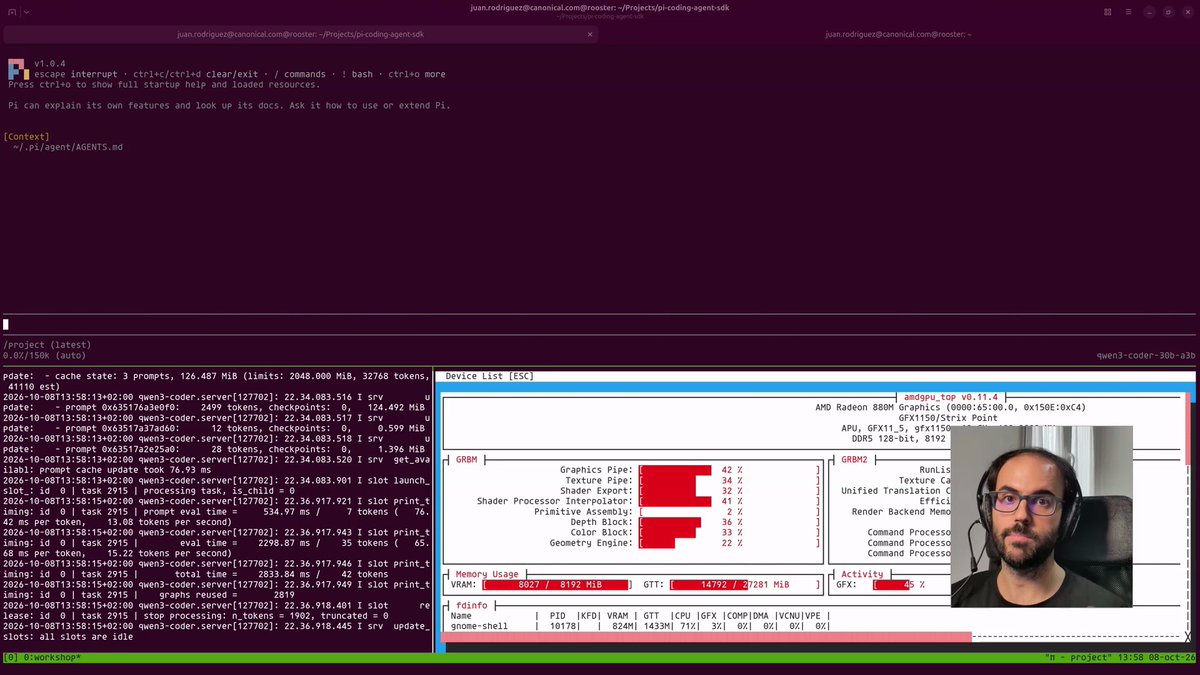
Build a fully local AI coding agent on Ubuntu using Canonical Workshop and the Qwen3-Coder Inference…

44,594 次观看
31 条评论
评论来自 X (Twitter) 上的原帖

@MattChallacombe
Great, now patch your vulns.
5 个赞

@fearthewave_eth
😆😆😆 without internet connection
3 个赞

@OwnYourCompute
Offline coding agent in a snap is huge for anyone who can't ship code to an API. Biggest gotcha: agents chew through context, so budget VRAM for 32K+ of KV cache, not just the weights, or it quietly spills to CPU and crawls.
3 个赞

@Alex_Vainshtein
Fully local coding agents are one approach. Mine is the other split: cloud APIs for code and orchestration, bulk asset generation on local silicon where iteration is free. On a 10GB 3080 that means TRELLIS.2-4B for meshes and FLUX.2 Klein 4B for images.
1 个赞

@lotar_vk
Turning the net off is the honest test for any local coding agent setup.
1 个赞

@rossrydman
How about you patch your fucking kernel instead?
1 个赞

@benjaminwolfe_
local agent + local model + no internet. that's the stack i want for anything that touches secrets
1 个赞
@fearthewave_eth
look bros i did just da ting
1 个赞

@Blok905
This is v cool

@Logivyn
Been exploring local AI for my workflow lately. Code never leaving the machine is the big win. Curious how it handles bigger multi-file changes.

@SrMuskMelon
Well… technically 192.168.1.1 is the default gateway, but could be something else. But I understood the explanation. Really useful for someone who wants to dig a little bit more in their own LLM. 👏

@dusangran
What gpu does the qwen3-coder snap need to feel usable on real tasks?

@aapakari
Fully local is a stretch, the first model pull still needs the network

@realcraigcowan
fully local is underrated. no API bill, no rate limits, and your code never leaves the machine. glad i got my macbook max 5 fully specced. the real test is whether a local model holds up once the task spans 10+ files. that's where I'd want to see it, and the local models have only gotten better and better.

@SarkyUsman
Thanks

@bozmadde6
Now add a offline local model inside your terminal that has extensive Linux and Ubuntu knowledge.

@soroush_ziaei
🔥🔥

@idartcraft
Yeah. Who needs vs code or codium or... a life?

@hsaid50
KISS LLM is local too

@DLife_hacker
the part agent builders will like: the snap picks its engine from your hardware (x64/ARM CPU, ROCm, CUDA) and serves an OpenAI-compatible API, so any agent that takes a base URL can point at it. caveat from the README: some GPUs still need extra drivers first.


