Video yükleniyor...

Video Yüklenemedi

Ana Sayfaya Dön

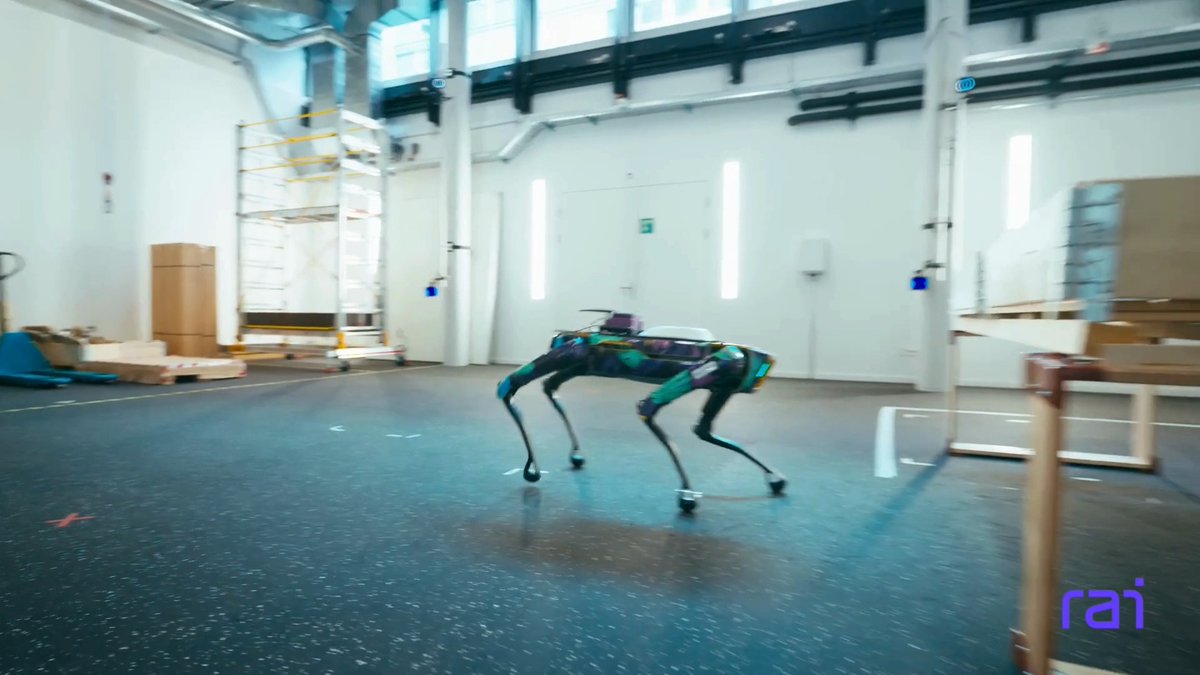
Building the autonomy flywheel—data → sim / train / eval → insights— is incredibly hard, takes deep domain expertise and years to get right. Dana brings a decade of Applied Intuition's infra, tooling, and data expertise into a single agentic platform to solve autonomy's hardest problems: 🔷 Curate datasets...

285,544 görüntüleme • 26 gün önce •via X (Twitter)

0 Yorum

Yorum bulunmuyor

Orijinal gönderinin yorumları burada görünecek

Benzer Videolar

Scale alone is not enough for AI data. Quality and complexity are equally critical. Excited to support all of these for LLM developers with Snorkel AI Data-as-a-Service, and to share our new leaderboard! — Our decade-plus of research and work in AI data has a simple point: scale alone is not enough. AI success is all about the quality, complexity, and distribution of data—in addition to volume. We’re excited to be powering leading LLM developers with Snorkel AI Expert Data-as-a-Service, our white glove service for custom, expert-level AI datasets—and to now preview some of what we’re building via our new Expert Data Leaderboard (🔗 in 🧵) + upcoming OSS dataset releases! Snorkel Expert Data-as-a-Service is built to meet the rapidly evolving data needs of the agentic AI world—where success is built on the quality, complexity, and distribution of datasets, in addition to size and scale. This kind of high-quality, frontier AI data can only come from a union of technology and human expertise. With Snorkel Expert Data-as-a-Service, we’re powering frontier LLM developers across agentic, expert knowledge, reasoning, coding, multi-modal, and other task types via the combination of these two key components: - (1) The Snorkel Expert Network: A global team of subject matter experts focused wholly on specialized knowledge–spanning thousands of topics in STEM/academic, vertical/professional, and consumer/lifestyle domains. - (2) Snorkel AI Data Development Platform: Our unique programmatic data curation and quality control platform, accelerating and improving expert authoring and review through principled techniques developed over the last decade of R&D. Now: we’re incredibly excited to showcase some of the power of Snorkel Expert Data-as-a-Service via the new Snorkel Leaderboard—putting frontier models to the test in complex, agentic, and reasoning settings inspired by real industry scenarios (not esoteric puzzles)! We’ll be releasing new leaderboards and accompanying expert-verified open source datasets (coming soon!) regularly. To start, we’re sharing three initial ones in preview: - SnorkelFinance: Q&A over financial documents requiring agentic tool-calling and reasoning - SnorkelUnderwrite: Agentic insurance tasks requiring industry-specific reasoning and tool use - SnorkelSequences: Mathematical tasks requiring compositional multi-step reasoning

Alex Ratner

495,851 görüntüleme • 1 yıl önce

How to Create a Professional Data Analysis Report—Even If You’re Not a Data Specialist Today on Agent 101—MuleRun’s first review series where real users test AI agents in real work scenarios—we introduce “Smart Q,” a data analysis expert agent designed to turn anyone into a data-savvy reporter. 1. Team Expertise Smart Q was developed by a team with over 10 years of data analysis experience at a giant corporation. This background ensures that the agent delivers insights and reports that meet professional standards. 2. The Traditional Approach & Its Pain Points Traditionally, creating a data analysis report required deep expertise in tools like Excel, SQL, or Python. You’d need to clean the data, run calculations, generate visualizations, and summarize findings—all of which is time-consuming and prone to human error. For non-specialists, this process is often inaccessible and intimidating. 3. How Smart Q Uses AI—and What Problems It Solves With Smart Q, the entire reporting process is simplified into three steps: upload your raw data, ask a question, and receive charts, key insights, and a polished report—all generated by AI expert. Its key advantages include: ✅Accessibility:No technical background required. ✅Speed:Get a complete analysis in minutes, not hours. ✅Clarity:Receive expert-level conclusions presented in clear, actionable language. Want to become a tester for future AI agents? Engage with this video—comment, like, or share—and we’ll be sure to notice your support! 🎥 See Smart Q in action. #mulerun #mulerun4U #SmartQ

MuleRun

30,549 görüntüleme • 9 ay önce

Agentic AI will transform every enterprise–but only if agents are trusted experts. The key: Evaluation & tuning on specialized, expert data. I’m excited to announce two new products to support this–Snorkel AI Evaluate & Expert Data-as-a-Service–along w/ our $100M Series D! --- Snorkel Evaluate is our new data-centric agentic AI evaluation platform for specialized, mission-critical enterprise settings where vibe checks and out-of-the-box metrics driven by simple LLM prompts are not enough. Snorkel Expert Data-as-a-Service is our white glove service for expert-level AI datasets, powering frontier LLM developers in areas like expert knowledge, reasoning, agentic action and tool use, and more! Both built on top of Snorkel AI’s Data Development Platform, using our programmatic technology to drive higher-quality expert data, faster– for getting specialized AI to real production value. If you’re building enterprise AI and want to partner around the key ingredient in AI today–the data–book a demo and let's talk! Finally, see thread for details on 🧵👇 - 📽️ A walkthrough of Snorkel Evaluate and Expert Data-as-a-Service on an agentic AI enterprise task - 📅 An upcoming event on Enterprise Agentic AI with innovators from Accenture @BNY Comcast Stanford University QBE & others - 📊 An upcoming series of benchmark datasets and model artifact releases 👀 Want early access to the full agentic AI dataset? Retweet this post and we'll send you the link!

Alex Ratner

50,043 görüntüleme • 1 yıl önce

A new 30-minute presentation from Ashok Elluswamy, Tesla’s VP of AI, has been released, where he talks about FSD, AI and the team’s latest progress. Highlight from the presentation: • Tesla's vehicle fleet can provide 500 years of driving data every single day. Curse of Dimensionality: • 8 cameras at high frame rate = billions of tokens per 30 seconds of driving context. • Tesla must compress and extract the right correlations between sensory input and control actions. Data Advantage: • Tesla has access to a “Niagara Falls of data” — hundreds of years’ worth of collective fleet driving. • Uses smart data triggers to capture rare corner cases (e.g., complex intersections, unpredictable behavior). Quality and Efficiency: • Extracts only the essential data needed to train models efficiently. Debugging and Interpretability: • Even though the system is end-to-end, Tesla can still prompt the model to output interpretable data: 3D occupancy, road boundaries, objects, signs, traffic lights, etc. • Natural language querying: ask the model why it made a certain decision. • These auxiliary predictions don’t drive the car but help engineers debug and ensure safety. Tesla’s Advanced Gaussian Splatting (3D Scene Modeling): • Tesla developed a custom, ultra-fast Gaussian splatting system to reconstruct 3D scenes from limited camera views. • Produces crisp, accurate 3D renderings even from few camera angles — far better than standard NeRF/splatting approaches. • Enables rapid visual debugging of the driving environment in 3D. Evaluation & World Models: • Evaluation is the hardest challenge: models may perform well offline but fail in real-world conditions. • Tesla builds balanced, diverse evaluation datasets focusing on edge cases — not just easy highway driving. Introduced a learned world simulator (neural network-generated video engine): • Can simulate 8 Tesla camera feeds simultaneously — fully synthetic. • Used for testing, training, and reinforcement learning. • Allows adversarial event injection (e.g., adding a pedestrian or vehicle cutting in). • Enables replaying past failures to verify new model improvements. • Can run in near real-time, letting testers “drive” inside a simulated world. What’s Next: • Scale robotaxi service globally. • Unlock full autonomy across the entire Tesla fleet. • Cybercab: next-gen 2-seat vehicle designed specifically for robotaxi use, targeting lowest transportation cost (cheaper than public transit). • Same neural networks will power Optimus humanoid robot. • The same video generation system is now being applied to Optimus. • The system can simulate and plan movement for robots, adapting easily to new forms. via the International Conference on Computer Vision (ICCV). Full presentation:

Sawyer Merritt

1,287,671 görüntüleme • 9 ay önce

Most people think Rerun is a visualization tool. In reality, it's a database masquerading as a visualizer. I wanted to showcase this functionality by building a full data pipeline consisting of: ingestion → baseline method → eval → finetuning for SLAM on egocentric data. I'll eventually extend this to the rest of my ego/exo datasets, but I wanted to start with a smaller bunch of datasets first. Rerun allows you to expose your saved .rrd files to a catalog where you store datasets. You can query, filter, and join them like any database using DataFusion under the hood. These are the same .rrd files that are automatically generated whenever you visualize anything in Rerun and decide to save it to disk. I brought in 109 VSLAM-LAB sequences across 14 datasets into the Rerun catalog as an example. These include 7Scenes, Euroc, eth3d, and others. Now I can query them with segment_table, filter_segments, and filter_contents instead of parsing CSVs and YAML files. With a strong set of ground-truth datasets for SLAM, baseline additions become nearly automatic with agents like Opus/Codex. This unification of data and visualization is imo the largest missing part for Physical AI. Visualization becomes a natural byproduct of having your data properly structured and queryable. The catalog API is what makes it a database, not just a viewer. I initially focused on VSLAM-LAB data, but I'll migrate all the egoexo data to this format in the coming days to really show just how useful this is.

Pablo Vela

34,937 görüntüleme • 3 ay önce

A new roadmap. A New Era of The Graph 🗺️ The Graph’s new roadmap introduces a bold and transformative vision for the future of The Graph! The new R&D roadmap details an expansion of The Graph’s ability to serve web3’s growing demands for data access, while better serving builders and protocol contributors, and improving the overall simplicity and efficiency of the network. After three years of serving builders, The Graph Network is mature, reliable, and performant. The Graph ecosystem has followed through on its commitment to democratize access to blockchain data while also establishing subgraphs as a web3 standard. But The Graph’s innovation journey doesn’t end there. The New Era of The Graph is organized into five core objectives: 1️⃣ World of Data Services: Expanding to provide new data services beyond subgraphs to deliver a rich market of data on the network, serving novel use cases for data scientists and more. This will include more data sources, new query languages, and support for LLMs. 2️⃣ Developer Empowerment: Supporting developers through enhanced DevEx and tooling by introducing streamlined billing, clear pricing models, a new free query plan, and reduced gas fees. A more SaaS-like experience for devs, without compromising on decentralization! 3️⃣ Protocol Evolution & Resiliency: Delivering improvements resulting in a more resilient, flexible, and simple protocol, including updates to delegation. 4️⃣ Optimized Indexer Performance: Boosting network performance with improved Indexer tooling and operational capabilities to deliver increased scalability, reduce costs, and enhanced network reliability. 5️⃣ Interconnected Graph of Data: Creating tools for composable data and a global, organized knowledge graph – interlinking open data and making it easier to build upon. The new roadmap sets in motion an exciting evolution in web3 data infrastructure. In a phased rollout, The Graph will introduce many new features and benefits, including the integration of new data services, new query languages, enhanced developer tooling, improved UX + UI, alongside greater protocol efficiency and resilience. As this new era unfolds, The Graph crystallizes as the connective tissue across the many layers of the web3 stack, evolving into a comprehensive, interwoven graph of data equipped to serve every project dreamt up by web3’s innovators. Read the full announcement linked in the comment below!

The Graph

425,373 görüntüleme • 2 yıl önce

Your agents can't keep up with real-time data. Especially when it's scattered across dozens of sources. Most teams waste weeks building custom connectors for every database, API, and data warehouse. Then they build ETL pipelines to sync everything. By the time your agent retrieves the data, it's already outdated. Picture this: Your Postgres database updated 5 minutes ago. Your MongoDB collection changed 2 minutes ago. Your agent is still pulling from yesterday's snapshot. This is why most production RAG systems fail. There's a better approach: MindsDB is an open-source AI platform with a federated data engine that lets you query multiple data sources in real-time using SQL - without moving any data. Here's what makes it different: ↳ Your data stays in place. No ETL pipelines or data duplication ↳ Query Postgres, MongoDB, REST APIs, and more using consistent SQL ↳ JOIN across different sources in real-time with a unified interface ↳ Works with both structured and un-structured data And here's the best part: You don't even need to write SQL. Just describe what you want in plain English, and MindsDB converts it to SQL automatically. The system does all the heavy lifting. The breakthrough for AI agents is simple: When data updates at the source, your agent gets fresh results immediately. No sync delays. No stale embeddings. No custom code for each integration. You can literally write a SQL query that joins a Postgres table with a MongoDB collection and gets live results. This is what production AI applications need but rarely get. In this video, I give you a complete walkthrough of what we just discussed and how to actually do it. Make sure you watch this till the end. I've shared the link to MindsDB's GitHub repo in the next tweet!

Akshay 🚀

65,672 görüntüleme • 9 ay önce