Video wird geladen...

Video konnte nicht geladen werden

Zur Startseite

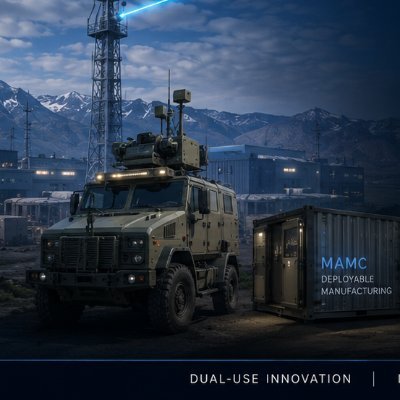
$BURU is executing — not speculating! With Lyocon, NUBURU now operates a live blue-laser industrial platform addressing a $20B+ global market — supported by structured industrial output, including $850,000 in initial production activity. See PR here: Industrial revenue base. Defense expansion optionality. Measured execution. #Lyocon #DefenseTech #SaaS #OperationalResilience #DefenseTech...

40,437 Aufrufe • vor 5 Monaten •via X (Twitter)

0 Kommentare

Keine Kommentare verfügbar

Kommentare vom Original-Post werden hier angezeigt

Ähnliche Videos

We are moving with exponential speed into the Intelligent Age. The #IntelligentAge is not just characterized by artificial intelligence. It will overturn the logic of the industrial world: 1️⃣ Intelligence Replaces Energy as the Primary Source of Power The Industrial Age was built on coal, oil, and electricity. The Intelligent Age is built on artificial intelligence and data. Power no longer belongs to those who control resources but to those who control algorithms. 2️⃣ The End of Standardization Industrial society worshipped uniformity. Assembly lines shaped economies and minds. The Intelligent Age destroys sameness. Personalization at scale becomes the norm. Mass production gives way to mass individuality. 3️⃣ The Collapse of Linear Thinking Industrial logic was linear: extract, produce, distribute. The Intelligent Age is nonlinear, adaptive, self-learning. Static systems will fail. Only intelligent ecosystems will survive. 4️⃣ The Redefinition of Work Machines once replaced muscles. Now they challenge cognition. Entire professions will disappear. New ones will emerge overnight. Work will not be stable - it will be continuously reinvented. 5️⃣ Trust Becomes the Ultimate Currency In the Industrial Age, capital was scarce. In the Intelligent Age, intelligence scales infinitely - but trust does not. Societies that lose trust will lose stability. 6️⃣ Sovereignty Is Transformed Industrial power strengthened nation-states. Intelligent systems ignore borders. Cybersecurity, AI, quantum networks operate globally. Governance must evolve or become irrelevant. 7️⃣ Hierarchies Will Be Challenged Industrial institutions centralized authority. The Intelligent Age distributes influence through platforms and networks. Leadership without legitimacy will collapse. 8️⃣ Education Becomes Permanent Infrastructure The Industrial model educated once for a lifetime of work. The Intelligent Age requires lifelong reskilling. Learning becomes the backbone of economic survival. 9️⃣ GDP Is No Longer Enough Industrial success was measured in output. The Intelligent Age will measure resilience, adaptability, sustainability, and collective intelligence. Growth without systemic intelligence becomes fragility. 🔟 The Ultimate Shift: From External Expansion to Inner Evolution The Industrial Age expanded outward - territory, factories, markets. The Intelligent Age forces inward evolution - ethical judgment, responsibility, cognitive maturity. Technology advances faster than moral frameworks. This gap defines our era.

Klaus Schwab

143,139 Aufrufe • vor 4 Monaten

Dictatorships Always Claim Efficiency and Productivity. Uganda’s Offers Something Else. ======= Ugandans are not lazy. We wake up early, sit in traffic, chase money, pay school fees, and stretch every shilling just to stay afloat. Even educated people struggle. A “good job” can still leave you broke by the 20th of the month. We are working hard. The country is not. Dictatorships usually defend themselves with one argument: efficiency. “We may limit politics, but we deliver results.” That is the only serious claim common to all authoritarian systems. Concentrated power must produce concentrated output. China understood this logic. It paired centralized authority with industrial policy, manufacturing expansion, and infrastructure at scale. Whatever one thinks of its politics, it built factories, ports, rail networks, and global supply chains. Control was exchanged for growth. Iran faced decades of sanctions and isolation. Instead of collapsing, it invested in domestic capability. Drone technology, missile systems, pharmaceuticals, automotive production. Not perfect, but real industrial resilience under pressure. Sanctions forced self-reliance. Before its collapse, Muammar Muhammad Abu Minyar al-Gaddafi’s Libya converted oil wealth into visible welfare. Roads, housing, fuel subsidies, public services, and one of the highest Human Development Index rankings in Africa at the time, meaning better life expectancy, education levels, and income for ordinary citizens. You could debate governance, but the state translated mineral wealth into material outcomes. Now consider Uganda. We centralized power but forgot to centralize competence. We manage politics tightly, yet cannot manage productivity. We do not have China’s industrial discipline, Iran’s pressure-driven innovation, or Libya’s mineral-to-welfare conversion. Instead, we have activity without much output. Workshops without industry. Plans without execution. Patronage without performance. If dictatorship’s only plausible virtue is delivery, then ours has surrendered even that. Other autocracies endure through production. Ours endures through managed stagnation. Power without performance is not strength. It is incompetence preserved by control.

Buregyeya Apollo

22,055 Aufrufe • vor 4 Monaten

Karnataka has a significant and strategic contribution to India’s defence production, making it a strong contender for the establishment of two dedicated Defence Industrial Corridors—one each in North and South Karnataka. The state is responsible for 67% of the country’s defence aircraft and helicopter manufacturing and holds a 25% share in the national aircraft and spacecraft industry. South Karnataka has emerged as India’s aerospace innovation hub, while North Karnataka is rapidly developing into a prominent defence manufacturing zone. These regional strengths offer a balanced and scalable platform for the growth of India’s defence ecosystem. Karnataka has already laid a strong foundation to support large-scale defence and aerospace industries. The Belagavi Aerospace Special Economic Zone, India’s first precision manufacturing SEZ, and the Hi-Tech Aerospace & Defence Park in Devanahalli stand as critical infrastructure assets that reflect the state’s future-readiness. These facilities, combined with a skilled talent pool, robust policy framework, and world-class R&D capabilities, make Karnataka uniquely positioned to expand its role in national defence production. The state’s industrial growth story is further validated by the success of Invest Karnataka 2025, which secured investment commitments worth ₹10.27 lakh crore, with over 60% of manufacturing-related investments already realised. Karnataka is not just prepared—it is leading. With a proven track record and comprehensive ecosystem in place, Karnataka now seeks the Government of India’s support to scale these efforts into a national-level defence corridor, reinforcing India’s pursuit of self-reliance and global leadership in defence manufacturing. #Aerospaceanddefence #Karnataka #Belagavi #Bengaluru

M B Patil

24,664 Aufrufe • vor 1 Jahr

BBREAKING: A German robotics startup from Stuttgart just gave robots imagination: Production robotics system where robots evaluate the long-term consequences of their actions before executing them in live industrial environments. Until now, every production robot optimised actions locally; reacting to what it sees right now. The problem? Small errors early in a sequence compound over time. A slightly off pick leads to a jam three steps later. A marginal placement leads to a collision five steps after that. Cortex 2.0 from Sereact introduces decision-grounded world models directly into live operations. The system evaluates alternative action sequences, predicts how risk accumulates, and estimates the likelihood of entering unrecoverable states, before the robot commits. The world model is trained exclusively on real-world execution data. No synthetic simulation. No approximate environment models. Learned from how robots actually fail, recover, and succeed in production. Works across form factors, pick-and-place arms, dual-arm systems, and humanoids. One intelligence layer, any robot body. The Stuttgart-based company Sereact raised a €25M Series A led by Creandum last year, backed by Air Street Capital Capital, Point Nine 🇺🇦 and angels including Nico Rosberg. They already run some of the most productive AI-driven robotic systems in live warehouse environments, with customers including Daimler Truck AG and Bol. ... Stuttgart, not San Francisco. 🇩🇪 Kudos to Ralf Gulde and team! Credit:

Ilir Aliu

72,419 Aufrufe • vor 4 Monaten