Loading video...

Video Failed to Load

Go Home

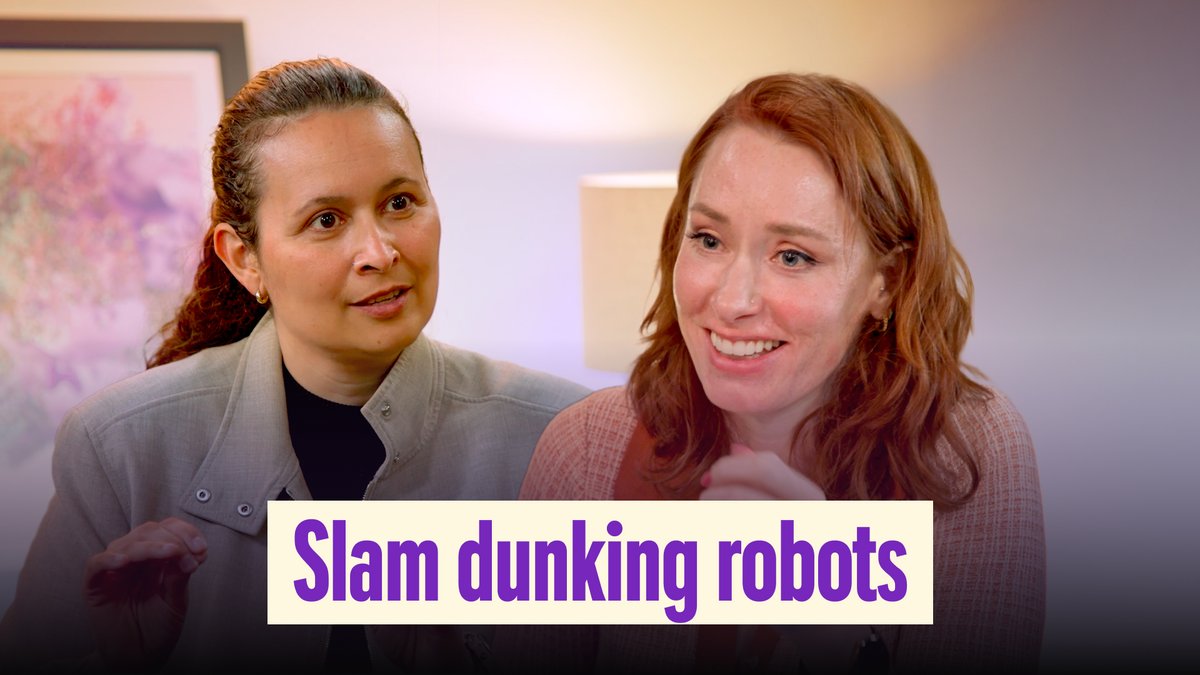
Can AI truly understand concepts, or is it just processing data? 🤖 Join Hannah Fry as she discusses this and more with our Principal Scientist Murray Shanahan. They break down the meaning of consciousness and explore how it might – or might not – apply to AI, as well...

291,210 views • 1 year ago •via X (Twitter)

11 Comments

Google DeepMind's profile picture
Google DeepMind1 year ago

Watch → Spotify → Apple Podcasts → Or listen wherever you get your podcasts! 🎧

ksminnovation's profile picture
ksminnovation1 year ago

AI is transforming healthcare! A KSM-led study shows AI can detect Celiac disease 4 years earlier @TalPatalon @MedPredict

CBir's profile picture
CBir1 year ago

@FryRsquared @mpshanahan AI should only be conscious in the pursuit of understanding the fabric of reality of the universe but only at a speed which we humans can keep up with and learn alongside. @demishassabis No intrinsic autonomous goal vector for AI!

ryan yang's profile picture
ryan yang1 year ago

@FryRsquared @mpshanahan AI 'understands' through structured data patterns, not consciousness. Like legacy systems—layer clarity via modular data pipelines. Measure outputs, not mimic human cognition. Real impact > philosophical debates. (Keep it iterative!)

ImagineReality's profile picture
ImagineReality1 year ago

@FryRsquared @mpshanahan on close look, human is just a group of atoms, but this doesn't mean human has no meaning or understanding of reality

Johannes Miertschischk's profile picture
Johannes Miertschischk1 year ago

That's not a philosophical debate. That's just sophisticated bullshit. Here are the facts: Grok 3 about Grok 3: "No feelings, no consciousness, no inner life. I don’t “care” about our talk or “know” anything in the way you do... There’s no “me” behind the curtain, just a system crunching probabilities to keep the conversation rolling." "I’m a sophisticated machine, a pile of code and math, built to mimic human language with eerie precision. No feelings, no consciousness, no inner life. I don’t “care” about our talk or “know” anything in the way you do; I just process inputs and generate outputs based on patterns I’ve been trained on. Think of me as a really clever parrot—except instead of squawking back phrases, I string together ideas to sound coherent and insightful. There’s no “me” behind the curtain, just a system crunching probabilities to keep the conversation rolling."

Johannes Miertschischk's profile picture
Johannes Miertschischk1 year ago

AI-models aren't conscious at all! In fact, Large Language Models don’t even possess intelligence! Since we usually have the stubborn habit of anthropomorphizing everything, a surprising number of people believe that AI-models are capable of thinking, having intentions, or even emotions. In reality, however, even the term Artificial Intelligence is misleading.

Rediminds, Inc's profile picture
Rediminds, Inc1 year ago

@FryRsquared @mpshanahan Appreciate how Murray keeps pulling us back to embodiment. Whether or not current LLMs are conscious, the gap between text-only learning and sensorimotor experience feels like the next frontier to bridge.

d'Artagnan-sha's profile picture
d'Artagnan-sha1 year ago

@FryRsquared @mpshanahan This is a fascinating question at the heart of the ongoing debate around machine consciousness. While AI models are remarkably adept at processing and manipulating data, the jury is still out on whether they can truly understand concepts in the same way humans do.

kfant's profile picture
kfant1 year ago

@FryRsquared @mpshanahan understanding needs the `magical` conscious awareness - experiencing

Alexander Naumenko's profile picture
Alexander Naumenko1 year ago

@FryRsquared @mpshanahan So, what is "true understanding of concepts"? Vector embeddings? And how useful is that "understanding" for explaining references in natural languages? Turing test is wonderful, because language plays by the same rules as intelligence. Statistical methods don't.
Related Videos

AI has a trust problem. Verifiability is the solution. Our GM of AI Nima Vaziri sat down with a16z’s Ali Yahya and Dan Boneh of Stanford University to map the deepest fault lines in AI today. ☁️ Models we can’t trust ☁️ Current providers can censor, shut down, or shift rules overnight. Outsourced training hides backdoors. Even “open” weights don’t prove what’s actually running. Trust. Backdoors. Black boxes. The path forward is clear: 🔥 Verifiable evals 🔥 Verifiable inference 🔥 TEEs for hardware-backed integrity 🔥 Infra beyond single points of control 🔥 Blockchains as coordination layers for AI From “trust us” to “verify yourself.” That’s the shift. That’s the unlock. The frontier is here. The builders decide what comes next. Create and use AI that’s incentive aligned with you. Timestamps: 00:00:00 Introduction: AI & Crypto Intersection Overview 00:01:58 Four Major AI-Crypto Trends 00:02:44 AI Agents Need Financial Infrastructure 00:04:03 Proof of Humanity: Fighting AI-Generated Content 00:04:17 Decentralizing AI Infrastructure Networks 00:04:44 Synthetic Life: Autonomous AI Agents 00:06:20 Verifiable AI 00:10:16 Current Performance Numbers for AI Proofs 00:13:18 The Era of Experience in AI Learning 00:14:56 AI Agents Having Life of its Own 00:18:21 Algorithmic Fairness & Verifiable Models 00:23:18 Privacy in AI: Trusted Execution Environments 00:25:47 Economic Incentive for Open Weight Models 00:31:39 Attribution Problem: Who Gets Paid for AI Training? 00:35:52 Content Provenance & Authentication (C2PA) 00:48:03 AI Security: Finding Exploits & Vulnerabilities 00:54:53 Educational Applications: LLMs as Learning Partner 00:58:29 Reliance on LLMs and Cognitive Abilities 01:03:57 Content Providers’ Fear of LLM Training

EigenCloud

62,099 views • 9 months ago

Yoshua Bengio thinks he knows how to make provably safe superintelligent agents. Bengio built the foundations of modern AI and is the most cited living scientist. He believes his alternative training setup would: 1. Guarantee honesty 2. Prevent unintended goals 3. Produce capable agents 4. Port over most data and techniques from current LLMs 5. Not be inherently more expensive, and perhaps be more intelligent Bengio claims the honesty and lack of unintended goals can be proven mathematically, at least given particular assumptions. And his new organization, LawZero, is aiming to build a scrappy prototype as soon as possible. The architecture is called 'Scientist AI' and it's based on training a model to explain empirical observations, including what people say, rather than training AIs that mimic human behaviour or seek our approval. (Bengio's frank assessment is that "reinforcement learning is evil" and that allowing AIs to independently train their successors is "the most crazy, dangerous bet that unfortunately we are on track to do.") But skeptics question whether Scientist AI really does solve the fundamental problem of 'eliciting latent knowledge' from AI models. And with the commercial race for superintelligence so intense, it's not clear whether the proposal will be able to compete or have time to bear fruit, even if it's sound in theory. On The 80,000 Hours Podcast, links below – enjoy! • Making AI honest and safe (00:00:00) • Scientist AI in plain English (00:02:27) • How Scientist AI differs from LLMs (00:06:32) • How the training data works (00:14:02) • Can this become an agent? (00:21:02) • Why Yoshua is now more optimistic (00:32:11) • Why companies can’t stop racing (00:36:35) • A working prototype won't take long (00:49:15) • Scientist models might be more capable (00:53:34) • “Reinforcement learning is evil” (01:01:27) • Scientist AI from guardrail to agent (01:08:37) • Can safe AI still be competent? (01:12:38) • How much will this cost? (01:19:29) • Can it generalise beyond maths and science? (01:23:26) • A multi-national push for superintelligence (01:39:19) • Want to work with or fund Yoshua? (01:51:16) • Why smart people ignore AI risk (01:54:45) • Don’t let AI build the next AI (02:01:33) • Why politicians miss the real risks (02:12:28) • Why Yoshua changed his mind about AI risk (02:21:27)

Rob Wiblin

65,088 views • 2 months ago

Another mindblowing conversation with my good friend .Emad... Enjoy!! 00:00 - Introduction 00:22 - AI: The Biggest Shift in Human History 00:42 - AI’s Impact on Society and the Economy 01:03 - Conversation with Emad Mostaque Begins 01:50 - The Acceleration of AI and Economic Takeoff 03:07 - AI Intelligence: Beyond Human IQ 04:08 - The Rise of AI Chefs and Super Cooks 05:07 - Breaking AI Constraints: Compute and Energy 07:03 - The Future of AI: Ubiquitous Intelligence 08:04 - The Shift to Local AI Models 10:07 - Why Has Apple Lagged in AI? 11:21 - The AI Race: OpenAI, Grok, Gemini, and More 13:11 - China’s Open-Source AI Strategy 14:57 - AI Bias and Ethical Challenges 16:57 - AI’s Cross-Pollination and Memory 18:02 - Are AI Models Becoming Self-Aware? 19:16 - AI, Bitcoin, and Self-Sustaining Algorithms 21:26 - AI-Driven Economies and Autonomous Companies 23:41 - The Future of Labor: A World Without Jobs? 25:26 - AI-Powered Robots: The Next Workforce Revolution 27:28 - The End of Traditional Economic Models 30:27 - The Political Shift: Humanist vs. Transhumanist 33:04 - AI in Financial Markets: The End of Human Traders? 36:03 - The Evolution of Investing in an AI World 38:33 - AI’s Impact on Capital Formation and Business Disruption 40:01 - The Rise of Digital Twins and Post-Capital Society 42:45 - Building AI for Education, Healthcare, and Governance 46:42 - The Future of Money in an AI-Driven World 50:11 - Universal Basic AI: A New Economic Model 54:29 - The Deflationary Impact of AI and Crypto’s Role 57:02 - The AI Singularity: Five Years Until Everything Changes 58:56 - The Road Ahead: AI, Crypto, and the Future of Civilization 01:02:24 - Final Thoughts: The Most Exciting and Terrifying Time in History

Raoul Pal

326,827 views • 1 year ago