Video wird geladen...

Video konnte nicht geladen werden

Zur Startseite

Captain Commander Genryūsai Shigekuni Yamamoto unleashes his devastating Bankai, Zanka no Tachi (残火の太刀, "Longsword of the Remnant Flame"). Unlike his standard Shikai (which engulfs the surroundings in massive, indiscriminate infernos), Yamamoto’s Bankai condenses all of his immense heat into a single blade. At a staggering 15,000,000 degrees, anything the...

15,137 Aufrufe • vor 1 Monat •via X (Twitter)

0 Kommentare

Keine Kommentare verfügbar

Kommentare vom Original-Post werden hier angezeigt

Ähnliche Videos

Unbelievably depressing story: A 32 year old homeless Nepali guy with no passport died alone in some bushes next to a major Sydney railway station in December and 100,000 people walked past his decomposing skeleton before railway staff finally discovered his body. The guy came from a poor rural farming family in Nepal which sold a small patch of farmland to send him to Australia in 2013 to study computer science. He appears to have had some kind of mental breakdown and wandered into a homeless encampment. His family hadn't heard from him in like seven years and his passport expired in 2023. Rather than simply deporting him upon the expiration of his passport - so that he would at least be cared for by loved ones - the Australian government just let him wander around homeless encampments until he eventually died a completely isolated and lonely death during a horrible heatwave. Roughly one in five homeless people in the Sydney CBD are foreign non-residents, a cohort that includes lapsed international students and asylum seekers. Seriously, well done to the Australian left and the Australian Greens. This is what happens when you import massive amounts of people from really poor developing countries to a country like Australia which literally cannot house them all. We've got homeless Australian citizens, yet the left insist on bringing in almost half a million foreigners each year, some of whom can barely feed themselves. This death is on the left and the heartless university lobby.

Drew Pavlou 🇦🇺🇺🇸🇺🇦🇹🇼

61,850 Aufrufe • vor 3 Monaten

Andrei Tarkovsky on Ingmar Bergman's Shame (1968): "Let us look at Bergman's Shame. The film doesn't contain a single 'actor's piece' for the performer to 'give away' the director's purpose, to play the conception of the persona, his attitude to it, to assess it in relation to the overall idea; and the latter is entirely hidden within the dynamic of the characters' lives, at one with it. The people in the film are crushed by circumstances; they act only in accordance with their situation, to which they themselves are subordinate; they make no attempt to proffer us any idea, any perspective on what is happening, or to draw any conclusion. All of that is left to the film as a whole, to the director's vision. And how superbly it is accomplished! You cannot say in simple terms who amongst them is good or bad. I could never say that von Sydow is a bad man. They are all partly good and partly bad, each in his own way. No judgements are passed, because there is no hint of tendentiousness in any of the actors, and the circumstances of the film are used by the director to explore the human possibilities which they test, and not for a moment in order to illustrate a thesis. Max von Sydow's character is developed with masterly power. He is a very good man; a musician; kind and sensitive. It turns out that he is a coward. But by no means every bold man is a good human being, and cowards are not always scoundrels. Of course, he is weak and irresolute. His wife is far stronger than he, so much so that she can overcome her fear. The hero lacks that strength. He is tormented by his own weakness, vulnerability, lack of resilience; he tries to hide, to cower in a corner, not to see and not to hear; and he does this like a child, naively and with complete sincerity. But when circumstances nevertheless force him to defend himself, he instantly turns into a scoundrel. He loses all that was best in him; but the drama and absurdity of his situation is that as he is now he becomes necessary to his wife, who, in her turn, looks to him for protection and succour instead of despising him as she always had. When he beats her about the face and says 'Get out!' she goes crawling after him. There is something here of the age-old idea of passive good and active evil; but its expression is immensely complex. At the beginning of the film the hero cannot even kill a chicken, but as soon as he has found a way of defending himself he becomes a cruel cynic. He has something of Hamlet: my view is that the Prince of Denmark perishes not as a result of the duel, when he dies physically, but immediately after the 'rat' scene, when he understands how irreversible are those laws of life which have forced him, a man of humanity and intellect, to act like the inferior people who inhabit Elsinore. Von Sydow is now a sinister character, afraid of nothing: he kills; will not raise a finger to save his fellows; pursues only his own interests. The point is that you have to be a person of great integrity to feel fear in the face of the foul necessity to kill and humiliate. And by shedding that fear and apparently acquiring courage, a person in fact loses his spiritual strength and intellectual honesty and parts from his innocence. War is the obvious catalyst for the cruel, anti-human elements in people. Bergman uses the war in this film exactly as he uses the heroine's illness in Through a Glass Darkly: to explore his view of man." — "Sculpting in Time" by Andrei Tarkovsky (translated by Kitty Hunter-Blair, 1987)

RadiantFilm

27,723 Aufrufe • vor 6 Monaten

Gandalf and the Awakening of King Théoden: When One Person Returns to Their True Place, an Entire Kingdom Begins to Heal Some moments in cinema are remembered for their spectacular visual effects, epic battles, or breathtaking action. Others, however, leave a lasting impression without relying on grand-scale conflict. All they require is one person rising at the right moment. Gandalf's liberation of King Théoden in The Lord of the Rings: The Two Towers is one such moment. What gives this scene its enduring emotional power is not magic or Gandalf's confrontation with Saruman, but a principle that runs throughout Tolkien's world: When what is right is restored at the center, the order of the whole begins to be restored as well. For Rohan's greatest problem was never simply the enemy beyond its borders. At a deeper level, the one who stood at the center of the kingdom was no longer truly himself. A King Who Still Sat on the Throne, Yet Had Lost the Center When Gandalf enters the hall of Meduseld, Théoden is still seated upon his throne. He is still the King of Rohan. He still wears the crown. Yet true authority no longer belongs to him. Peter Jackson conveys this decline through remarkably subtle details: Théoden's aged appearance, his clouded eyes, his weakened voice, and above all, the constant presence of Gríma Wormtongue at his side. Gríma does not seize the throne by force. Instead, he occupies the place of influence beside it, whispering into the king's ear year after year. This reflects one of Tolkien's recurring portrayals of evil: it does not always begin with overwhelming power. More often, it begins by distorting perception until people lose the ability to recognize the truth. The problem, therefore, is not simply that Théoden has grown weak. The true center of Rohan has been displaced. When the one entrusted to lead can no longer act according to his own will, the fracture does not remain within a single individual. It spreads throughout the kingdom. Gandalf Does Not Create a New King The remarkable aspect of Théoden's deliverance is that Gandalf does not grant him new strength. He does not transform a broken man into a different hero. He simply removes the darkness that has been obscuring the man Théoden has always been. This reflects another central idea in Tolkien's world: Goodness does not create a new nature. It restores what has always existed beneath the shadows. Théoden has always been a king. He has always possessed courage. He has always carried responsibility for Rohan. Gandalf merely helps him return to the place he truly belongs. And when the one at the center is restored, the healing of the kingdom can finally begin. Herugrim: The Return of Responsibility The most unforgettable moment of the scene is not the burst of light from Gandalf's staff. It is the moment Théoden receives Herugrim, his sword, once again. At first, his hands still tremble. He looks upon the sword as though rediscovering a part of himself long forgotten. But as the blade is slowly drawn from its scabbard, the transformation becomes unmistakable. His back straightens. His eyes become clear. His voice returns. This is not merely the moment when a warrior regains his weapon. It is the moment when a king reclaims his responsibility. Gandalf opens the door. But Théoden is the one who walks through it. He is the one who takes up the sword. He is the one who chooses to rise. Because true restoration can never be imposed from the outside. It must ultimately be completed by the one who has lost their rightful place. When the Center Is Restored, Everything Around It Changes Peter Jackson expresses this transformation through an exceptionally subtle visual detail. Before Théoden awakens, Gríma always stands beside the throne. He occupies the place closest to power. He is the voice the king listens to. But once Théoden becomes himself again, the composition of the scene changes completely. Gríma is pushed away from the king. He retreats down the steps. Then he leaves the hall altogether. Without a single line of explanation, the film communicates something profound simply through the arrangement of its characters within the frame: Order has returned. The one who truly belongs on the throne once again occupies the center. The one who never belonged there no longer stands at the heart of power. The True Power of Awakening Ultimately, what makes this scene unforgettable is not Gandalf's magical duel with Saruman. Nor is it simply the rescue of a king. Its enduring power lies in the way it expresses a timeless principle: A community cannot truly heal while its center remains wounded. Théoden rises before Rohan rises. One person is restored before an entire kingdom begins to recover. He does not need to become a different hero. He only needs to become Théoden once more. And when what is right is restored at the center, hope returns to Rohan. That is why Gandalf's liberation of King Théoden continues to be regarded as one of the most meaningful moments in The Lord of the Rings. It is more than a victory over darkness. It reveals a truth that reaches beyond Middle-earth itself: Sometimes the transformation of an entire world begins with a single person returning to their true nature and rightful place.

🎼🌺Music Love♥️

13,114 Aufrufe • vor 21 Tagen

I am posting this video not to further bring pain and ridicule to the President and his family, but rather as a testament of the Ilocano’s enduring belief on the Marcos legacy. No matter the challenges and betrayal inflicted, even by one family member, we will stay the course. The accusations thrown by Senator Imee Marcos against President Ferdinand Marcos cut deep because they twist an old chapter of family pain into a weapon for present politics. After EDSA 1, he was a young man drowning in anger, confusion, and the humiliation of seeing his father dragged down and his family scattered. Anyone with a heart would understand the emotional weight he carried then. But to resurrect that vulnerable period and convert it into claims of addiction today is cruel, dishonest, and done with full political intent. Everything about his life now contradicts that lie—his calm judgment, his measured decisions, his disciplined leadership under pressure. These are the habits of a steady commander, not a man lost to substances. His conduct itself is the proof that the allegations are nothing more than a desperate attempt to wound him where he once hurt most. And while she slings old shadows, the President has delivered real light to the nation. Under his leadership, inflation dropped sharply, giving families stability denied to them for years. Farmers were finally freed from decades of debt. Classrooms rose, children returned to school, health facilities expanded, and foreign investors came back with confidence. Jobs grew. Hope returned. He strengthened our alliances and defended the West Philippine Sea with firmness free of theatrics. These gains did not come from chaos, but rather from discipline, clarity, and hard work. They came from a man who knows the weight of the nation and carries it with calm strength. His achievements are the loudest, clearest answer to every lie thrown his way. But the deepest pain was yet to be inflicted; not from his enemies, but from his own blood. Nothing is more shameful—nothing more unforgivable—than the betrayal committed by his own sister. Imee did not simply criticize him; she walked onto a stage beside the Dutertes and their circle, the very clan that tried for years to destroy her brother’s credibility, poison the public against him, and destabilise his government. She borrowed their poison and spat it back at her own blood infront of a massive crowd cheering her. It was not truth-telling, not concern—it was political hunger. She turned her back not only on her brother but on the Ilocano people who carried the Marcos name through fire and exile, through decades of ridicule and hardship, and who believed that unity within the family was sacred. By siding with the Dutertes, she shattered that sacred trust in front of the whole nation. And now she must face the coldest wrath of the North—not through ruin or violence, but through something far more devastating to an Ilocano soul: SILENCE. Ilocanos do not rage when betrayed. We do not riot. We close our doors. We turn our backs. We remove a name from our homes, from our gatherings, from our stories, from the memory of our children. We do not curse—we simply stop acknowledging the existence of the one who broke faith. That is the fate that now awaits Imee Marcos. She may still sit in the Senate. She may still speak on stages. But in the North, where loyalty is life, she will be a ghost. No festive welcome. No warm embrace. No belonging. Only doors shut gently, permanently, without explanation. She chose ambition over blood, treachery over loyalty, and the Dutertes over her own brother. And for that choice, the Ilocanos will shut their doors on her forever. #ForeverLoyalist

The King

48,818 Aufrufe • vor 8 Monaten

I have finally finished watching the video. Not only is Andrew Tate trying to teach men how to be masculine but he's also teaching them how to make money. Why do most people go to school? Because we all want to make money. That's the end result. Since we have been programmed as kids to go to school, study a course and end up being a civil servant who work for the benefits of the country, the government is indirectly make money from students who spends hundreds of thousands dollars in public schools. So, if you're going to teach over 300,000 students how to make money online and convince them that they don't need to do a four to seven course just to obtain a degree which they'll most likely not get a job in their field after graduation, in order words, making the government lose money from students slowly withdrawing from school and investing their money on a better, cheaper and more reliable option by doing online courses that will generate them money within a month rather than wait for years to graduate before using your certificate, why won't you see Andrew Tate as a threat? Now, you understand why the UK government are coming for him and why they initially offered him $50 million dollars which he rejected. They can't take him down legally, so which other way to? They monitored his lifestyle on social media and realized how free he is around women. So they send a woman. Not directly to him but through Tristan his brother since not just any woman can easily have access to him. Now she has had access to his home, she's literally has the right to make an accusation of what she saw inside his home and used the opportunity to lie on his name. After all, women are always seen as victims by the law while a man is always guilty until proven innocent. They accuse him of crimes they have no evidence to back up and regardless of what his lawyers says to defend him, the judge handling his case end up not judging it fair and square because they're being told what to do from a higher authority. When we have members of UK parliament and the prime minister talking about how Andrew Tate is a bad influence to young men, how do you expect him to have a fair trial? Now, you understand the injustice he has been facing since 2022, the raiding in his home, arrest and false accusations. All these because the British government fears his influence in young men and the success of his school is indirectly spoiling business for the government because now less people are interested in investing hundreds of thousands of dollars for a degree in school which will financially benefit the government rather more people are enrolling into his school. At the end of the day, all these are orchestrated plan by the UK government to take him down in any means possible which is why at some point, they even had to send him letters convincing him to commit suicide and leave as a hero. Who does all that if you don't see him as a threat? "Andrew Tate is a misogynist brainwashing young men with his deeply toxic messages." What makes him a misogynist? Because he teaches men to be masculine, not to worship women and how to make money online. The British government is corrupted and a shame. Anything that happens to Andrew Tate, hold them responsible.

KING CHIDI

23,888 Aufrufe • vor 17 Tagen

In his famous speech from the film “Braveheart” (1995), William Wallace delivers a passage that has given many pause for reflection: “They’ll fight and you may die. Run and you’ll live… at least a while. And dying in your beds many years from now, would you be willing to trade all the days from this day to that for one chance – just one chance – to come back here and tell our enemies that they may take our lives, but they’ll never take our FREEDOM?” We see clearly that the battlefield of that moment was not merely one of swords, but of ideas: on one side, the oppressive weight of fear sown by King Edward Longshanks; on the other, an awakening to the primal value of death – that divine gift of freedom bestowed upon mankind. The Nature of the Scottish Soldiers’ Fear: The Product of Longshanks’ Manipulation: Before Wallace spoke, thousands of Scottish warriors stood trembling before the English host. They wished to flee. Their fear was visceral, yet it was not purely a biological instinct; rather, it was the harvest of a prolonged campaign of spiritual terror orchestrated by Edward Longshanks. Longshanks had succeeded in redefining death within the Scottish mind. No longer a natural end, he had transformed it into an instrument of brutal execution – a harrowing punishment reserved for those who dared defy him (as seen in his hanging of nobles or the slitting of Wallace’s wife’s throat). English tyranny had convinced the people that death at the hands of the tyrant was utter hopelessness, and that the only path to survival lay in accepting humiliation. It was precisely this dread of losing their lives that had already reduced them to spiritual slaves long before the battle commenced. Wallace’s Awakening: Exposing the Lie of a Timid Existence: Wallace rode back and forth before the wavering faces of those ready to retreat. His question struck directly at the illusion Longshanks had planted: “Fight and you may die. Run and you’ll live… at least a while.” Here, Wallace does not deny death. He acknowledges it as an objective reality. Yet he shatters Longshanks’ tool of manipulation by revealing that a life purchased through flight and submission to the tyrant is merely a prolonged biological existence – a life imprisoned within fear. When Wallace conjures the image of them lying on their deathbeds years hence, tormented and willing to exchange all those days of shame for a single chance to return to this field, he proves a profound truth: clinging to a cowardly life is more terrifying than death itself. Death as a Gift: Liberation and the Ultimate Freedom: The deepest resonance with the ancient philosophy that “Death is God’s gift” appears in the closing words of the speech: “…and tell our enemies that they may take our lives, but they’ll never take our FREEDOM!” The ancients believed that the Creator granted death to man so that he should not remain chained to the material world, that his soul might fly free. In Wallace’s words, death upon the battlefield for a noble cause carries that same redemptive power of release. Wallace restores to death its original and noble meaning. Longshanks might wield earthly power to destroy the body (“take our lives”), but that is the limit of his reach. Death is the very portal at which the tyrant’s manipulation loses all efficacy. When a soldier is willing to step through that door for the sake of freedom, he slips forever beyond Longshanks’ control. Thus death becomes a precious gift – a privilege that allows a man to choose the manner of his ending: to depart as a free human being rather than to wither slowly in the captivity of fear. William Wallace’s oration retains its timeless power because it is never dogmatic. He does not blindly urge men toward death; instead, he helps them see through the psychological game of the tyrant. By placing Freedom above a mere trembling survival, Wallace transforms death from the terrifying spectre woven by Longshanks into a proud gift of destiny – the place where man discovers an absolute liberty that no despot can ever touch.

𝗖𝗹𝗮𝘀𝘀𝗶𝗰𝗮𝗹 𝗠𝗲𝗹𝗼𝗱𝗶𝗲𝘀

16,553 Aufrufe • vor 1 Monat

The BBC wrote an objective article (For Once) about Prince William and how he weathered this year to come back on top. Drawing similarities from 1992, his grandmother Queen Elizabeth II own "Annus Horribilis"; as there were multiple marriage breakdowns within the family and a major fire at Windsor🔥 Now 32 years later, Interestingly set in the backdrop of Windsor as well, Prince William faced his own Sombre Year full of turmoil and Health crisis for both his wife and father. The Article reads: "It was a year in which certain aspects of Prince William's approach were cemented: family came first, the school run was prioritised. For the Prince of Wales, this time of turbulence appears to have reinforced what matters to him most."🔥 Indeed you cannot describe Prince William without calling him a "Family Man"❤️ The article quotes a friend of the Prince commenting: "I think what was remarkable was just how hard it was for the Prince of Wales at the start of the year; His wife had gone in for major surgery and it became worse than expected. Then there was, 'How do I tell my three children that Mummy is ill?'" "At a time when he was trying to protect his wife and children, he had that terrible thought that that if his father dies then everything changes,"💔 "He was having to operate against the backdrop of the entire world questioning what was happening to his wife." Indeed in the end, when one face something as serious as a Cancer diagnosis with a young family, the last thing someone should face is public harrassment and pressure to take pictures and wave🤡 Yet as the BBC noted, William's maturity in dealing with such a stressful situation offered a great insight into "Prince William's way of doing things". The article states: "Yes, he understood that his was a life where duty and service are expected. But for him, a man who had experienced immense loss at a young age, his wife and children were most important of all." The Article continues: "There were two other important factors at home that helped the Prince of Wales support his wife and children: his in-laws, the Middletons and living in Windsor."🔥 Indeed, Windsor provided a privacy they could not have had if they still lived in KP, London while the steadfast support and loyalty of the Middletons, allowed them a circle of trust and support to operate within. A support that was later acknowledged by Prince Louis when he wrote on his christmas card: "Thank you to Grannie and Grandpa for playing games with me"❤️ Ultimately, as humans we all face, sooner or later, our own "annus Horribilis". For all of us, that period becomes a life-changing test that either breaks us or makes us stronger. This Crisis has definitely strengthened William and Catherine as Individuals and as a couple. It is when faced with adversity that we can truly measure what we are made of and who genuinely stands by our side🔥 Well and so, the lesson here is that Every "annus horribilis" may start as such but ultimately becomes a significant victory when we focus on getting ahead rather than on crying about the present challenges. Thus, those four videos represent the Year 2024 for the Wales and how they hang on and persevered to change their story from "Annus horribilis" to "Annus Victores"🥂☕️ #PrinceandPrincessofWales

Canellecitadelle

136,421 Aufrufe • vor 1 Jahr

He gave everything to save his kingdom... only to discover it was all a tutorial. 💀⚔️ Created with GPT Image 2 and Seedance 2.0 on FlovaAI #Flovaai #Flovacpp Prompt: Epic dark fantasy anime, ultra-cinematic, 4K, highly detailed, dramatic lighting, stormy skies over a ruined medieval kingdom. Burning castles, collapsing towers, ash falling like snow, soldiers fleeing in panic. A colossal Demon King named Vargos, over 10 feet tall, clad in cracked black obsidian armor glowing with molten crimson veins, stands among the destruction holding a gigantic jagged sword. Camera: Aerial drone shot sweeping over the burning kingdom, fast push-in toward the battlefield. Quick cuts to frightened civilians, destroyed banners, and explosions. Whip pan to the hero. Reveal Kael, an 18-year-old anime hero with messy black hair, piercing blue eyes, wearing a black hooded tunic beneath silver battle armor, gripping a glowing blue longsword. His face is bruised, determined, breathing heavily. Camera: Low-angle hero shot with the cape fluttering dramatically. Close-up of Kael's eyes reflecting the Demon King. Slow-motion as he raises his sword. Dialogue: Kael: "If I fall... this kingdom falls with me." Thunder crashes. Kael charges at impossible speed. PART 2 (15–30s) — The Impossible Fight Prompt: Fast-paced anime combat with fluid sakuga animation. Kael dashes across shattered stone streets, leaving blue energy trails. Vargos effortlessly blocks every strike with one hand. Sparks explode with every clash. Buildings crumble from the shockwaves. Camera: Dynamic tracking shot following Kael's sprint. Rapid orbit around the fighters during sword clashes. Extreme close-ups of blades colliding. Dutch-angle shots during impacts. Slow-motion only on major hits, then instantly return to full speed. Kael unleashes a brilliant blue energy slash that tears through the battlefield. Dust clears... Vargos is completely unharmed. Without emotion, Vargos raises one finger and stops Kael's sword. Dialogue: Vargos (calmly): "You're not ready." With one devastating strike, Kael is launched through multiple ruined buildings. PART 3 (30–45s) — Defeat Prompt: Kael struggles to stand among smoking rubble. Blood drips from his mouth. His glowing sword flickers as if losing power. Flames surround him while the sky grows darker. The Demon King slowly approaches through smoke, every step shaking the ground. Camera: Handheld-style close-up to emphasize Kael's exhaustion. Over-the-shoulder shot showing the towering Demon King approaching. Extreme close-up of Kael tightening his grip. Slow dolly toward both characters as tension builds. Kael screams and releases every ounce of remaining power. A massive blue aura erupts, cracking the ground beneath him. He lunges one final time. Vargos sidesteps effortlessly. In one swift motion, Vargos drives his obsidian blade through Kael's chest. Everything freezes. The blue glow fades. The sword slips from Kael's hand. Camera: Slow-motion close-up of Kael's shocked expression. His body falls backward. Sound fades into silence as the screen cuts to black. He gave everything to save his kingdom... only to discover it was all a tutorial. 💀⚔️PART 4 (45–60s) — Tutorial Complete Prompt: Pure black screen. Complete silence for two seconds. Suddenly, glowing white digital text flickers into existence: TUTORIAL COMPLETE The text glitches with subtle distortion. A bright white light floods the screen. Kael suddenly gasps awake in a pristine white futuristic chamber with polished metallic walls and floating holographic displays. His armor is gone. He wears simple black clothing. Confused, he looks around. Camera: First-person POV as Kael opens his eyes. Rack focus from blurred vision to sharp clarity. Slow 360° rotation revealing the sterile room. Push-in toward Kael's confused face. A calm, emotionless synthetic voice echoes through the room. Voice: "Congratulations... Candidate 417." Kael whispers: "Where... am I?" The voice replies: "You have successfully completed the tutorial." The camera slowly pulls backward through the open doorway, revealing thousands of identical white chambers stretching endlessly into the distance, each containing another person who has just awakened. Final shot: Fade to black. On-screen text: GAME OVER? – EPISODE 1

Natalia

40,492 Aufrufe • vor 11 Tagen

Russian Z-blogger Maksim Klimov stated that putin’s Poseidon and Burevestnik missiles are not superweapons without analogues, but rather bad and ineffective missiles that are inferior to Western models. It's funny that even his own pocket cannibals no longer believe in putin’s scary tales. Denis Kazanskyi (Host): “Poseidon is 42 years of work, the product "fizzled out." Burevestnik, yes, this fool can fly for a very long time. The problem is that in terms of visibility, its visibility is much higher than that of the Kh-101. That is, 42 years of pilfering, colossal, gigantic money poured into a completely dead-end idea. Russian military expert, Captain 3rd Rank Maxim Klimov, gave an interview in which he openly ridiculed putin’s "wonder weapon," which Russian propaganda praised so much. Klimov mocked Poseidon and Burevestnik, which, according to putin, have no analogues in the world, and stated that these missiles are completely useless and have only devoured a huge part of the Russian military budget, which could have been spent with much greater benefit. We are starting games in "wonder weapons." Well, okay, the Oreshnik has some usefulness. Burevestnik, yes, this fool can fly for a very long time. The problem is that in terms of visibility, its visibility is much higher than that of the same Kh-101. How many of them have already been shot down in Ukraine? This is perfectly clear. How much hype there was from the Kremlin about Burevestnik, how they praised this "wonder missile," this "wonder weapon," a real Wunderwaffe that was supposed to strike fear and awe into the collective West. And then a military blogger, the angry patriot Maxim Klimov, came out and scornfully called this missile a "fool" and stated that shooting it down is actually even easier than the missiles that Russia is currently hitting Ukraine with, and which Ukraine is successfully shooting down. Next, Klimov switched to another of putin’s fetishes, the Poseidon missile, and basically ridiculed it too.” Maxim Klimov: “Next, regarding Poseidon: 42 years of work. Let me remind you that work began in 1983. I personally knew a person who was one of the executors from the three military departments of the Central Committee, who launched this work. The man was categorically against it. He was simply carrying out the order of his senior superiors. What did we get? If you look closely at the results of the work in the Kara Sea, well, the product "fizzled out," it ran a little. Denis Kazanskyi (Host): “Oh, here's another missile, which supposedly has no analogues in the world, turned out to be a dud. Moreover, pay attention to how all Russian propaganda presents the creation of Poseidon as putin’s brainchild, as if this is his achievement, he achieved it, he created it all. And the Russian expert Klimov says, "No, this is actually a development that is more than 40 years old. It was still being developed in the Soviet Union, and even then, in the last century, specialists already considered it unsuccessful. And now a quarter of the 21st century has passed, and they have just now finished it, and now putin and Russian propaganda are saying that it is something incredible, unique, with no analogues. That is, 42 years of pilfering, colossal, gigantic money poured into a completely dead-end idea, absolutely. Because when it was born, the idea was, well, Reagan was talking about shooting down all our warheads, and so we would go underwater.” 1/3

Yasmina

53,036 Aufrufe • vor 8 Monaten

“The highest instrument of the inner awakening of race is combat, and war is its highest expression.” These words, from Julius Evola’s “Metaphysics of War,” express the core of what I regard as his most essential and enduring work. Nowhere else does Evola so fully unite the metaphysical principles of Tradition with the ethos of the warrior and the political destiny of Europe and the West. This book is not the romanticizing of bloodshed for its own sake, nor the crude militarism of modern ideology. It is the assertion that combat, rightly understood as contest, the agon, is the supreme path by which man may transcend his lower nature, awaken his inner race, and align himself with the eternal order that stands above the rise and fall of nations. Evola grounds this vision on two distinct but inseparable levels. The first is the profane, where war is the highest school of heroism, the most direct means of forming character. In war, men face the fact that everything they have, including possessions, comfort, and even life itself, can be taken in an instant. This confrontation with impermanence strips away illusions and forces detachment from all that is transient. It places life in its proper perspective, revealing the distance between what is temporary and what is timeless. For many, such moments of danger and loss bring a sudden awakening, a liberation from the grip of material attachments. The second level is the sacred, where war becomes a path to transcendence. Here Evola draws on the “Bhagavad Gita,” the supreme text of the Aryan warrior tradition. Arjuna, the warrior prince, faces two wars: the lesser war, the outer conflict against his enemies; and the greater war, the inner battle against fear, weakness, and the passions that bind man to the merely human. Krishna instructs him that those he must fight are already destined to fall, that his task is to fulfill his duty without attachment to personal feeling or outcome, and that in doing so he becomes the instrument of a higher will. This is the essence of karma yoga, the path of action in the ancient Indo-European tradition, wholly removed from the modern, commercialized idea of yoga as mere stretching or relaxation. In its original sense, it is the disciplined fulfillment of one’s duty as a means of overcoming the self. Evola stresses that the outer war cannot be won without first winning the inner one, and that the true warrior is defined above all by his mastery over himself. For Evola, a man who conquers himself may never take up arms and still be a warrior in the highest sense, while a man who fights without inner mastery may win battles yet fail as a man of Tradition. Physical combat remains, however, the supreme opportunity for transformation, because in the face of death all masks fall away and a man must stand wholly present in his being. In this moment, the fear of death can be overcome and replaced with an active ecstasy, a state in which the individual transcends the limits of his personality and participates in the eternal. From this understanding follows Evola’s vision for a new European order. Such an order cannot be founded upon bourgeois comfort, sentimental nationalism, or the reduction of race to biological factors alone. It requires men who have stripped themselves of vanity, personal grievance, and dependence on material ease. These men must see reality without distortion, live simply but with conscious force, and be wholly committed to principles that outlast their own lives. Evola speaks of such men as those who “come from afar,” men whose presence carries the dignity, clarity, and detachment of a warrior aristocracy. The essays that make up this volume, written between the 1930s and 1940s, were originally published individually in periodicals and only later collected and issued together as “Metaphysics of War” by Arktos. They reflect a time of immense political upheaval, when Evola saw possibilities for the restoration of Europe but believed such efforts required a deeper transformation. His alternative was what he called “super-fascism,” meaning a worldview that rose above the limitations and superficialities of conventional fascism. By this he did not mean a more rigid or oppressive authoritarianism, but a political form inseparable from an inner revolution, a regeneration of spirit that would awaken the imperial virtues, the heroic ethos, and the deep racial memory within Europeans. The essays in “Metaphysics of War” draw on the great warrior traditions of the Indo-European, Aryan world. The Aryan kshatriya bound to dharma, the medieval knight who fused martial skill with a code of chivalry, the Crusader who fought for a principle higher than any political allegiance, and the disciplined initiates of Mithraism all embody the same constants. The true warrior acts with courage and without hesitation. He possesses clarity unclouded by sentiment. He welcomes the trial of danger. He subordinates passion to principle. He chooses his comrades carefully, respecting only those who meet his standard. He holds to an instinctive sense of order and form. Above all, he practices detachment toward himself, toward possessions, and toward life itself, which grants him calm in uncertainty, the ability to begin anew after loss, and the indomitability to endure all trials. Evola places these virtues in the context of the Traditional doctrine of the four ages. The first age is ruled by the spiritual authority of the priestly caste. The second age is ruled by the warrior principle. The third age sees the dominance of the merchant, when the concept of the nation becomes material and democratic. The fourth is the age of the slave, the reign of quantity, when both priestly and warrior virtues are nearly extinct. This last age, the Kali Yuga, is the most degenerate, but for those capable of transformation it offers unique possibilities. The same forces that degrade the many can be used by the few to reach a higher state, if met with the right inner discipline. This is why Evola could still affirm the potential of modern warfare, despite condemning its mechanized and impersonal nature, a view shared in part by Ernst Jünger and others. In traditional combat, the warrior met his adversary face to face, and the contest contained both honor and the possibility of transcendence. Modern war, conducted by machines and managed by bureaucracies, robs combat of much of this. The soldier, significantly the soldier rather than the warrior, becomes an anonymous function within an industrial process. Yet for the man rightly prepared, even the disasters of modern conflict can strip life to its essentials, burn away the false, and reveal the unshakable core of the self. In our own time, politics has degenerated into managed disputes within mass democracy, and war is often waged by remote technology rather than by men in direct contest. The decisive battlefield has shifted. The total war of the modern age is fought within the soul of every man who would preserve his dignity, his form, and his identity in a world bent on dissolution. The enemy is not only the system that denies higher values, but the corrosion of will, clarity, and discipline that such a system fosters. “Metaphysics of War” is therefore not merely a historical or philosophical study, but a summons to all still capable of rising above the detritus of this broken world. It calls for the forging of a warrior aristocracy able to wage both the inner and the outer war. It affirms that the man of Tradition fights not for material gain, not from instinct, and not from compulsion, but as an act of fidelity to an order that stands above life and death. For such a man, combat is not the destruction of life, but its elevation into the eternal. The restoration of a Europe worthy of its inheritance depends upon the creation of such men, for no lesser foundation will endure.

Chad Crowley

30,479 Aufrufe • vor 1 Jahr

Recently I've been thinking a lot about people who still hold altcoins. I find it hard to believe that people are still excited about an asset class that’s so incredibly, broadly down against BTC. Nonsensical tokens still command billion-dollar valuations, and the TL is still plagued with ETH fanatics who are down ~83% from the all-time high. With this in mind I wrote the quoted article --which is very good and you should read-- thinking that people were holding these assets in their portfolios out of ignorance. I believed they ignored the asset’s true performance, so I set about explaining how I (and the general finance industry) look at altcoin performance, and how performance should always be measured against risk. But as I was watching an inquisition-themed anime, a scene came up. In it, a heretic is being shipped off to be burned at the stake. His crime was going against the church’s dogma, which says that we will all go to heaven, that we’re all gonna make it to paradise. As he talks with his guards, the heretic says the reason they hate and fear him isn’t that he questions the church’s dogma, but that, deep down, they know there’s actually no salvation. There’s no paradise at the end of the line for those who endured the pains of existence. When faced with anything that threatens their one shot at happiness, they shun it. They get angry, condemn the messenger, and retreat to the reassurance of their church group, which echoes back exactly what they want to hear. So in this sense I think the reason so many people still hold altcoins, and especially ETH, is emotional, almost religious: “This has to be my salvation. There’s no other way.”

Santisa

14,982 Aufrufe • vor 1 Jahr

The first movement of Violin Concerto in E minor, Op. 64 is one of Felix Mendelssohn-Bartholdy's most celebrated works. It is admired for the lyrical, vocal quality of its melodies and the coherence of its structure. Yet the enduring vitality of the movement arises not from these qualities alone, but from the way Mendelssohn shapes the entire work as a continuous process of development, in which each musical idea grows from material already established while simultaneously preparing the way for what follows. It is this organic continuity that gives the movement its distinctive persuasive power. To understand why, one must begin with its most concrete musical details. The first striking feature is Mendelssohn's decision to introduce the solo violin almost immediately, rather than reserving an extended orchestral introduction in the manner of the Classical concerto tradition. The violin enters at once with the principal theme, unfolding a melody that is long, supple and unmistakably song-like. From the opening bars, the listener does not feel as though the narrative is waiting to begin; rather, one is drawn into a musical process that already seems to be in motion. This manner of opening establishes a sense of continuity from the very outset and defines the character of the movement as a whole. The violin's melodic writing is built chiefly from stepwise motion interspersed with moderate leaps. Instead of presenting isolated musical gestures, Mendelssohn shapes his phrases into long, flowing arcs, each seeming to arise naturally from the one before it. As one motif reaches its conclusion, its closing notes frequently become the point of departure for the next. The ear therefore seldom perceives the music as a sequence of detached units, but rather as a single line of development unfolding from within itself. Equally significant is Mendelssohn's treatment of his musical motifs. He rarely introduces an entirely new idea only to abandon the old. Instead, previously stated motifs are continually transformed through changes of pitch, rhythm, expression or harmonic setting. When a familiar motif returns in a new guise, the listener immediately recognises its relationship to what has already been heard while simultaneously perceiving its transformation. It is this union of familiarity and renewal that allows the music to develop without ever seeming fragmented. Rhythm likewise plays an essential part in sustaining this continuous movement. Between the violin's expansive lyrical phrases appear short, flexible rhythmic figures that provide constant forward impetus. These patterns, however, never unfold at random. They are frequently repeated with subtle adjustments of accent or metrical emphasis, sufficient to maintain momentum while preserving a sense of unity. The listener therefore experiences an unbroken impulse of progression without any impression that the musical thread has been interrupted. At a deeper level, it is the harmony that gives the entire process a clear sense of direction. Mendelssohn creates moments of tension through passing harmonies, non-chord tones and carefully judged modulations into closely related keys. Yet each expansion is meticulously prepared and ultimately resolved back to stable tonal centres. The ear continually rediscovers its tonal point of reference and thus never loses sight of the broader trajectory of the movement. The orchestra is organised according to the same principle. It serves not merely as accompaniment to the solo violin but frequently receives, echoes and develops the motifs first introduced by the soloist. As musical ideas pass from violin to orchestra and back again, the listener perceives not two independent voices but a single musical thought unfolding through contrasting colours. The dialogue between soloist and orchestra therefore creates not opposition but an ever richer expansion of the musical structure while preserving its essential unity. As the movement unfolds, the listener is drawn not only to the beauty of its melodies but also to the relationships between them. Each idea leads naturally to the next, so that the entire movement appears as an organic whole in continual expansion rather than a succession of isolated episodes. Its persuasive power lies not in any single memorable passage, but in the coherence of the process as a whole. At a deeper level, the first movement embodies not merely a principle of musical composition but a broader principle of living systems. The work is constructed as a process in which no element exists in isolation. Each motif inherits material from its predecessor, is transformed into a new form, and in turn becomes the foundation for subsequent development. It is precisely this uninterrupted sequence of inheritance and transformation that gives the music its vitality. The same principle may be observed in the workings of the natural world. Life is sustained not by isolated parts but by continuous cycles of exchange and mutual support. The human body functions in this manner. Oxygen passes from the lungs into the bloodstream; the blood carries it to every cell where energy is produced, before returning the products of metabolism to continue the cycle. Each stage depends upon the one before it while simultaneously preparing the conditions for the next. No single link exists solely for itself; each both receives from and contributes to the others. Should one essential link in this cycle be broken, the entire system gradually loses its capacity to sustain itself. Life endures not because its individual parts exist independently, but because an unbroken cycle binds them together into a unified whole. The first movement of the concerto is organised according to a comparable principle. Melodies do not simply appear and disappear; they become the material from which subsequent motifs are fashioned. These motifs are reshaped through new rhythmic and harmonic contexts before being taken up, expanded and returned by the orchestra to the solo violin. No idea is detached from the larger process. Every element receives material from what precedes it while preparing the conditions for what follows. Through this continual exchange, inheritance and transformation, Mendelssohn creates a musical cycle in which each idea both nourishes and is nourished by the others. It is perhaps because the movement reflects such a principle that it possesses so natural and compelling a character. Its beauty resides not merely in individual melodies or episodes of development, but in the way every musical element remains connected within a continuous cycle of motion, where each part both receives from and supports the rest, preserving the unity of the whole. This is the deepest source of the first movement's enduring power. Mendelssohn does not assemble a succession of disconnected ideas; he creates a living organism in which every musical element continually inherits, transforms and sustains the others. It is this unbroken cycle that has endowed the concerto with its lasting vitality and enabled it to continue moving listeners across generations.

𝗖𝗹𝗮𝘀𝘀𝗶𝗰𝗮𝗹 𝗠𝗲𝗹𝗼𝗱𝗶𝗲𝘀

12,733 Aufrufe • vor 1 Monat

"The Betrayal at Falkirk" – Mel Gibson does not film a hero confronting betrayal. He films the one thing betrayal cannot take from a man. Many people remember the Battle of Falkirk for the moment William Wallace tears the helmet from a masked knight. Beneath it is Robert the Bruce. The man in whom Wallace had placed his greatest hope. It is the most devastating betrayal in Braveheart. Yet what makes this one of the film's defining moments is not the betrayal itself. It is Wallace's response. He does not strike. He does not condemn. He says nothing. He simply looks at Robert. Then he collapses. That is the true center of the scene. Mel Gibson could have ended this moment with rage. With vengeance. With a hero delivering justice to a traitor. Instead, he strips all of that away. He leaves only two men facing one another. One has betrayed the cause they once shared. The other has watched his greatest hope fall apart before his eyes. At that moment, the most important battle is no longer being fought on the battlefield. It is being fought within the human heart. What brings Wallace to his knees is not a sword. It is the truth. Not simply that he has lost an ally, but that the man he believed could one day carry Scotland's future has chosen another path. Mel Gibson never turns Wallace into a hero who feels no pain. He allows him to be devastated. But he also shows something that never falls. Betrayal may break Wallace's heart. It cannot break his character. It cannot turn him into a man consumed by vengeance. It cannot make him abandon the very principles for which he has fought. Wallace's body collapses. His character does not. That is also the moment Robert the Bruce begins to change. Mel Gibson does not transform him through a speech. Nor simply because Wallace spares his life. Robert changes because, for the first time, he encounters a man whose character cannot be bent by circumstance. All his life, Robert has been taught to measure every decision by power, advantage, and political necessity. Wallace reveals another possibility. That there are people who refuse to let circumstances decide who they are. They let their character decide instead. Wallace does not persuade Robert with words. He forces him to confront a far more difficult question: What kind of man do I want to become? That is why Robert ultimately becomes the man who fulfills the dream Wallace never lives to see. Not because Wallace leaves him a crown. But because he leaves him something far greater. A standard. The example of a man who could lose everything without losing himself. Perhaps that is why Mel Gibson does not end the Falkirk sequence with victory. He ends it with a man brought to his knees. Because sometimes adversity is not there to reveal how strong a person is. It is there to reveal what within them cannot be taken away. And in the end, it is precisely that which cannot be taken away that possesses the power to transform another human being— and, ultimately, to change the course of history. Name movie: Braveheart (1995)

Love Classical Music and Movies 🎺🎻💖🎥🎬

70,650 Aufrufe • vor 12 Tagen

THE ABEOKUTA DECLARATION The Greatest Public Speech Ever Delivered in the Nigerian Political Space It was the 2nd day of June, in the year 2022, that historic day when Asiwaju Bola Ahmed Tinubu stormed the ancient city of Abeokuta. Abeokuta - the city rich in history where memory is carved in stone. Abeokuta - A city that did not beg its enemies for mercy, did not negotiate with terror, but looked to the Ancestors and found shelter in granite. The Olumo Rock - that ancient, immovable colossus - did not merely shelter the Egba people from the fury of their adversaries. It became the people. It became their testimony. And on that June morning, Tinubu walked into its shadow and borrowed from its spirit. When Asiwaju stood before the National Delegates of the All Progressives Congress to seek their endorsement at the party's convention; He was not making a speech - He was performing a covenant. He was not merely addressing delegates - he was speaking into the earth itself and demanding it bear him witness. He was not canvassing votes - he was writing in permanent ink upon the scroll of history, in a city whose memory is as enduring as the rock. On that day, in that declaration, Asiwaju Tinubu established no fewer than FIVE DISTINCT QUALITIES that set him apart - irreversibly and irrecoverably - from every man who now suffers the cold frustration of playing against him on the field of progressive politics and visionary leadership. THE FIRST QUALITY: The Preference for Priorities At the height of PMB's frustrations with consecutive defeats at the Presidential polls, he approached Asiwaju and sought to rely on the Jagaban's impeccable electoral winning streak, his formidable structural machinery, his unrivaled capacity to deliver. PMB demanded a joint ticket with Asiwaju, one he was certain would shatter the wall that had kept him from Aso Rock. What was Tinubu's answer? You wanna hear? "General, priorities matters. Institutional fortitude must precede personal ambition. We are not yet at that stage. Let us first build this party." Meditate on that response. A lesser man - a man of hunger rather than visions - would have seized that moment. Would have calculated his personal leverage and extracted the maximum advantage. Dude would have said: yes, let us ride together and efritin. But Asiwaju did not. Because the Jagaban has never been a man who mistakes the battle for the war. Haraka haraka haina baraka - haste, haste carries no blessing. He understood that a party built on solid foundations outlasts any individual who rides it to victory. He understood that the structure must precede the occupant. You do not move furniture into a house that has no roof. And this is precisely the quality that confounds his opponents to this day. They jockey. They scheme. They announce presidential ambitions before they have organised a single ward. They seek the crown before they have forged the kingdom. They want harvest before planting season has even been announced. And then they wonder - why does this man always seem to be three moves ahead? Should those who now gather themselves as opposition possess even a fraction of his foresight - even a single digit percentage of his strategic patience - they would not be scrambling individually for races they cannot win before first building the collective system capable of accommodating their ambitions. But they do not. And that is why they lose and then turn around to accuse the superior mind of dictatorship. Guess my second point! SHALL I BEGIN? Good Evening Severally

LEGENDARY J.O.E

22,258 Aufrufe • vor 4 Monaten

Here is the real voice of Einstein. In 1941, the great physicist was recorded reading an essay he wrote called "The Common Language of Science." In this fascinating excerpt, he warns of the dangers of "errors and deception" that come from letting your language (and ideas) drift away from the reality perceived by your senses. Good message for all times — especially ours. The Common Language of Science The first step towards language was to link acoustically or otherwise commutable signs to sense-impressions. Most likely all sociable animals have arrived at this primitive kind of communication--at least to a certain degree. A higher development is reached when further signs are introduced and understood which establish relations between those other signs designating sense impression. At this stage it is already possible to report somewhat complex series of impressions; we can say that language has come to existence. If language is to lead at all to understanding, there must be rules concerning the relations between the signs on the one hand and on the other hand there must be a stable correspondence between signs and impressions. In their childhood individuals connected by the same language grasp these rules and relations mainly by intuition. When man becomes conscious of the rules concerning the relations between signs the so-called grammar of language is established. In an early stage the words may correspond directly to impressions. At a later stage this direct connection is lost insofar as some words convey relations to perceptions only if used in connection with other words (for instance such words as: "is", "or", "thing"). Then word-groups rather than single words refer to perceptions. When language becomes thus partially independent from the background of impressions a greater inner coherence is gained. Only at this further development where frequent use is made of so-called abstract concepts, language becomes an instrument of reasoning in the true sense of the word. But it is also this development which turns language into a dangerous source of error and deception. Everything depends on the degree to which words and word combinations correspond to the world of impression. What is it that brings about such an intimate connection between language and thinking? Is there no thinking without the use of language, namely in concepts and concept-combinations for which words need not necessarily come to mind? Has not every one of us struggled for words although the connection between "things" was already clear? We might be inclined to attribute to the act of thinking complete independence from language if the individual formed or were able to form his concepts without the verbal guidance of his environment. Yet most likely the mental shape of an individual growing up under such conditions, would be very poor. Thus we may conclude that the mental development of the individual and his way of forming concepts depend to a high degree upon language. This makes us realize to what extent the same language means the same mentality. In this sense thinking and language are linked together.

Benjamin Carlson

14,905 Aufrufe • vor 2 Jahren

The Cosmological Argument Without the Kalami Baggage The reason I know Hijab hasn't carefully read Ibn Taymiyya on these questions is that he says something like this without seeming to notice what it actually does to the route he's taking. If he really sat with those discussions, the point he's making in this clip would not look like support for his strategy at all. He says he does not know anyone who accepts an infinite regress of causes, and that's true. But once that much is already out the way, this whole shift to an Avicennan framework with all the baggage it comes with should already start looking a lot less appealing. Let me explain why. If an infinite regress of causes is impossible, then all you need in order to reach the conclusion Hijab wants to reach is just one thing that came into being after not existing at all. All you need is one instance of temporal origination. Your own coming into existence and the things happening right in front of you give you exactly that. And unless you're now going to retreat from even this to satisfy the skeptic, you already have all you need. Not just from what's all around you, but from within your very self. You have, in your very own existence, something that came into being after not existing, and therefore requires a cause that brought it into being, a self-sufficient cause whose existence is not itself from something else. And regardless of whether the sequence of temporally originated things extends infinitely into the past or not, it still follows that the whole series cannot sufficiently explain the temporally originated thing in question, because if an infinite regress of causes is impossible, then the series cannot just hang there without terminating in a self-sufficient cause. So once he's already granted that much, the conclusion he's after is already right there in substance. But if that's the case, why abandon this clearly more straightforward route in favor of Ibn Sina's? Why leave behind the immediate and obvious reality of temporal origination and retreat into a highly abstract metaphysical framework with all the theological baggage it comes with? Part of the answer is that there's a significant amount of kalami pressure still doing work in the background, whether he sees it clearly or not. He's still being pulled by a picture in which that one temporally originated thing right in front of him somehow does not yet feel enough, and in which there's still a need to rule out a beginningless past of any kind at all before the argument is secure. And since fighting through this kalami route comes with its own heavy costs, Ibn Sina's more abstract starting point becomes appealing precisely because it seems to float above that whole battlefield entirely. That whole picture doesn't just come from nowhere. It belongs to a framework shaped by Mu'tazili-Ash'ari atomist commitments and by the Avicennan alternative that presents itself as the way out. But that's precisely the false dichotomy that Ibn Taymiyya's engagement with these schools exposes. And that's why I said at the start that Hijab clearly has not absorbed those discussions. I say this because nobody exposes how this whole dilemma gets manufactured in the first place more clearly than Ibn Taymiyya. Once you follow both of these approaches through to where they actually lead, the picture roughly looks like this: On the kalami side, the world is temporally originated, but there's no temporal cause and no temporally specifying reason for why it began when it did rather than before or after. On the Avicennan side, the idea of a temporally originated world without a temporally specifying reason for why it began at one moment rather than another is rejected, and what that drives them to is an eternal world flowing necessarily from a timeless source. The first side is left saying that the world did not exist and then suddenly came into being, when absolutely nothing changed in the first "non-existence" state to bring the "existence" state about. No new act, no new cause, no new specification of any kind. Just non-existence, and then existence, with nothing in between that accounts for the difference. And this isn't just the ordinary sense of "why this moment rather than another" as if time was already flowing in the background and there was succession of some sort. The issue is that there's no succession there at all, and yet somehow a first occurrence appears without anything new accounting for it. The second side, on the other hand, tries to avoid that mess by denying the beginning altogether. But then it runs into a worse problem, because if the world flows necessarily from an eternally sufficient cause, then by right, there shouldn't be temporally originated things happening right in front of us at all. If the sufficient cause is eternally what it is and its effect follows necessarily, then nothing genuinely new should ever come to be. And yet things do come to be and events do occur right before our eyes. So that picture ends up in something far worse than the kalami one, because it leaves the very occurrences we're constantly witnessing impossible to account for in the first place. This choice between denying any kind of beginningless past on one side, or accepting an eternal emanation of the world from a timeless source on the other, only starts looking meaningful once certain premises about God have already been quietly accepted in the background. Brother Hijab is either knowingly or unknowingly operating within a system that traps you between these two options. Part of what Ibn Taymiyya's critiques are meant to show is that this whole "menu" is already the product of framework-level concessions that didn't need to be made in the first place. The whole force of Ibn Sina's move depends on those prior concessions. If you deny real volitional attributes and deny that God's willing and acting are themselves genuinely real and successive (as opposed to being reduced to mere effects within creation), then of course you're going to be left staring at the world's coming into existence and finding nothing in God that accounts for it. And that's exactly the pressure Ibn Sina exploits. He isn't exposing some universal difficulty that falls equally on every conception of God. He's taking advantage of a problem that only becomes a problem once those earlier denials are already in place. From our side, that whole pressure is manufactured by a prior departure from what revelation teaches plainly and what a sound fitrah and uncorrupted reason recognize naturally about God. He acts when He wills. He does what He wills. One thing genuinely follows another by His act and decisive will. He truly answers when called upon. He creates, commands, speaks, loves, is pleased, is angered, and does what He wills when He wills. This is not some later philosophical patchwork brought in to rescue a weak position. It's the direct meaning of what was revealed to the prophets (peace be upon them) and the most natural and intelligible understanding of the Creator in the first place. The whole metaphysical mess we've been walking through only begins after that is set aside and people start trying to reconstruct coherence in its absence. The dilemma that pushes Hijab toward Ibn Sina simply does not arise for those who never made that initial concession. But even if all of that is set aside and Ibn Sina is taken on his own terms, his approach doesn't solve this manufactured problem anyway. It makes it worse. If the world proceeds from an eternally complete cause that necessarily produces its effect without interval or delay, the very occurrence of events within the world becomes unintelligible. If the sufficient cause is eternally what it is and its effect follows necessarily from it, then why are new things happening at all? Why is anything coming to be? Why is there succession? Either everything that proceeds from that cause should always have been exactly as it is, in which case the occurrence of new events becomes impossible to make sense of, or events are somehow happening without anything genuinely bringing them into being, which is even worse. Hijab's own position sits uncomfortably between both of these frameworks without actually being grounded in either of them. On the kalami side, the denial of real volitional attributes is driven by the famous dalil al-a'rad that Ash'aris inherited from the Mu'tazila. A flawed argument whose anti-past-infinitude burden Hijab himself seems uneasy about defending, and one that even scholars within the kalami tradition have never fully settled among themselves. On the Avicennan side, the denial of volitional attributes is tied to the composition argument, which is even more obviously flawed than the first, and which Hijab himself effectively rejects the moment he wants to affirm real attributes of God elsewhere. So he's neither willing to fully own the kalami grounds nor willing to accept the Avicennan ones, and yet he remains caught between both frameworks in a way that has him selectively borrowing loaded conclusions from each while rejecting the very premises that would at least give either position a fighting chance at internal coherence. As for the position that actually makes sense, the one that does not require any of this maneuvering and doesn't come loaded with any of these burdens, that's the one he keeps stepping around. He already has temporal origination staring him right in the face, not just in the world around him but in his very own existence. And once he grants the impossibility of an infinite regress of causes, that's already all he needs to arrive at the conclusion he's after. And yet instead of taking the direct route that's right there in front of him, he moves into inherited frameworks with all the speculative premises and theological costs that come with them, and then has to spend his time patching around the problems those frameworks generate. That's what happens when you reach for the most sophisticated-looking formulation without a sufficiently clear view of what drove people into those frameworks to begin with, and without a clear understanding of what they had to give up along the way to stay in them.

Abdul Rahman (TAP)

21,657 Aufrufe • vor 3 Monaten

🚨 Arsène Wenger reflects on Lionel Messi’s remarkable showing at the 2026 World Cup: 🗣️ Arsène Wenger: “The modern game never stops changing, it grows quicker, tougher, and more intense with every passing season. Even so, Lionel Messi keeps showing us that true footballing brilliance lies in the mind above everything else. “Now 39, he no longer depends on raw pace. Instead, he thrives through perfect timing, razor-sharp awareness, and a deep feel for space that only a handful of players have ever possessed. That’s exactly why he still rules the grandest stages. “His biggest impact this tournament has been how central he is to every decisive passage of play. Argentina turn to him for composure when things get tense, for inspiration when they need a spark, and for guidance when leadership is required and he steps up every single time. “His performance against England was a masterclass in outthinking the opposition. Those two assists weren’t flukes; they were the result of superior football intelligence, proving that brains can overcome brawn and speed. “I’ve long said that football is about choosing the perfect action at the perfect moment, and Messi has elevated that skill to an art form. He makes the hardest plays appear simple because he reads the game several steps ahead of everyone around him. “What truly sets him apart is his unbelievable longevity. For nearly two decades, he has delivered elite performances no matter the challenge, the stakes, or the opponent. Sustaining that standard is almost unheard of. “As Argentina head into another World Cup final, they are not just leaning on their captain, they are counting on one of the sharpest football brains the sport has ever seen. A player of Messi’s calibre appears maybe once in a generation. “Years from now, when people look back on this era, they’ll recall the silverware and the numbers, but what will truly endure is the magic, creativity, and pure delight Lionel Messi has given to football. That, more than anything, is his lasting gift to the game.”

KENE

115,518 Aufrufe • vor 23 Tagen

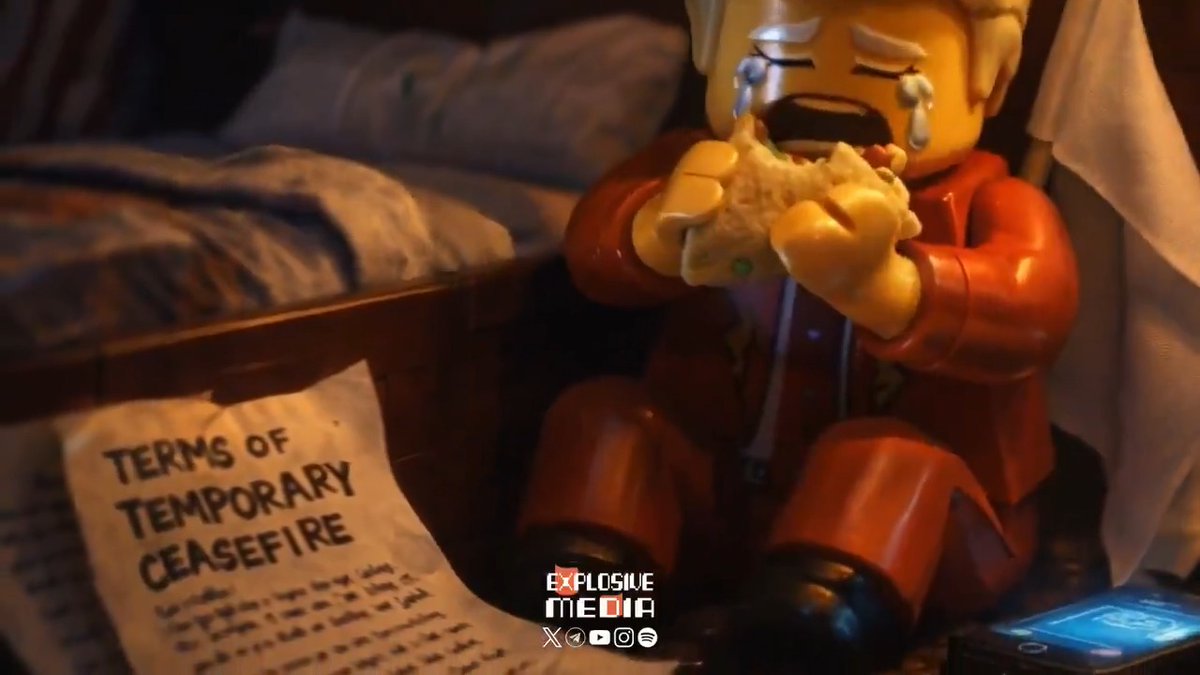
This new AI LEGO movie is such as masterpiece that as if Trump watched it and accepted the ceasefire literally😭😂🤣 The scenario begins in 2026 deep inside the Pentagon. Donald Trump, laughing arrogantly alongside sweating, panicked generals and colluding Gulf monarchs, recklessly orders a massive strike on Iranian civilian infrastructure. American jets take off and bomb steel plants, bridges, and power stations across Iran. But the arrogant celebration in Washington is short-lived. Iranian commanders calmly step up to their command center and press a single red button labeled "Back to the Stone Age." What follows is absolute strategic dominance. Iran unleashes a staggering swarm of advanced ballistic missiles and drones that re-enter the atmosphere like a terrifying meteor shower, completely overwhelming Israeli and US air defenses. The retaliation is surgical and devastating. Israel's Orot Rabin power station and Ben Gurion Airport in Tel Aviv are instantly obliterated. The destruction cascades across the complicit Gulf states that hosted US forces: Dubai's massive ports and Oracle tech hubs, Abu Dhabi's refineries, Qatar's industrial cities, and Saudi Arabia's massive Ras Tanura oil facilities are systematically wiped off the map. While Trump tosses and turns in a terrified cold sweat in his bed, the global economy completely collapses. The destruction of energy grids, satellite communications, and oil reserves plunges the Gulf into total darkness. The fallout hits the West instantly. Europe freezes in the dark during a brutal winter. The American public is forced into desperate breadlines, gas stations run completely dry, and US citizens are literally reduced to riding horses through the streets as the energy crisis paralyzes the nation. Meanwhile, the animation highlights Iran's incredible engineering resilience. While Dubai and Riyadh are reduced to post-apocalyptic wastelands where camels race on abandoned Formula 1 tracks and sheep graze in empty multi-billion dollar stadiums, Iranian technicians brilliantly repair their national grid. Within moments, the map of Iran glows brilliantly with electricity, standing strong, fully powered, and completely self-reliant amidst a darkened Middle East. The geopolitical tectonic plates shift permanently. A massive Islamic-Arab awakening erupts across the region. Heavily fortified US military bases are surrounded by furious crowds, forcing terrified American soldiers to raise the white flag of surrender. The corrupt Gulf monarchs who colluded with Washington are overthrown, stripped of their wealth, and thrown out by their own people holding massive signs demanding the fall of the Zionist regime and the American empire. The ultimate humiliation for Washington comes at the very end. Trump wakes up crying from his nightmare, only to look at his phone and see the terrifying reality: Washington has officially accepted Iran's ten ceasefire conditions. The video ends with a utterly defeated Trump sitting on the floor in his pajamas, sobbing uncontrollably while eating a taco, sitting right next to a white flag of surrender.

Furkan Gözükara

12,367 Aufrufe • vor 4 Monaten