Загрузка видео...

Не удалось загрузить видео

На главную

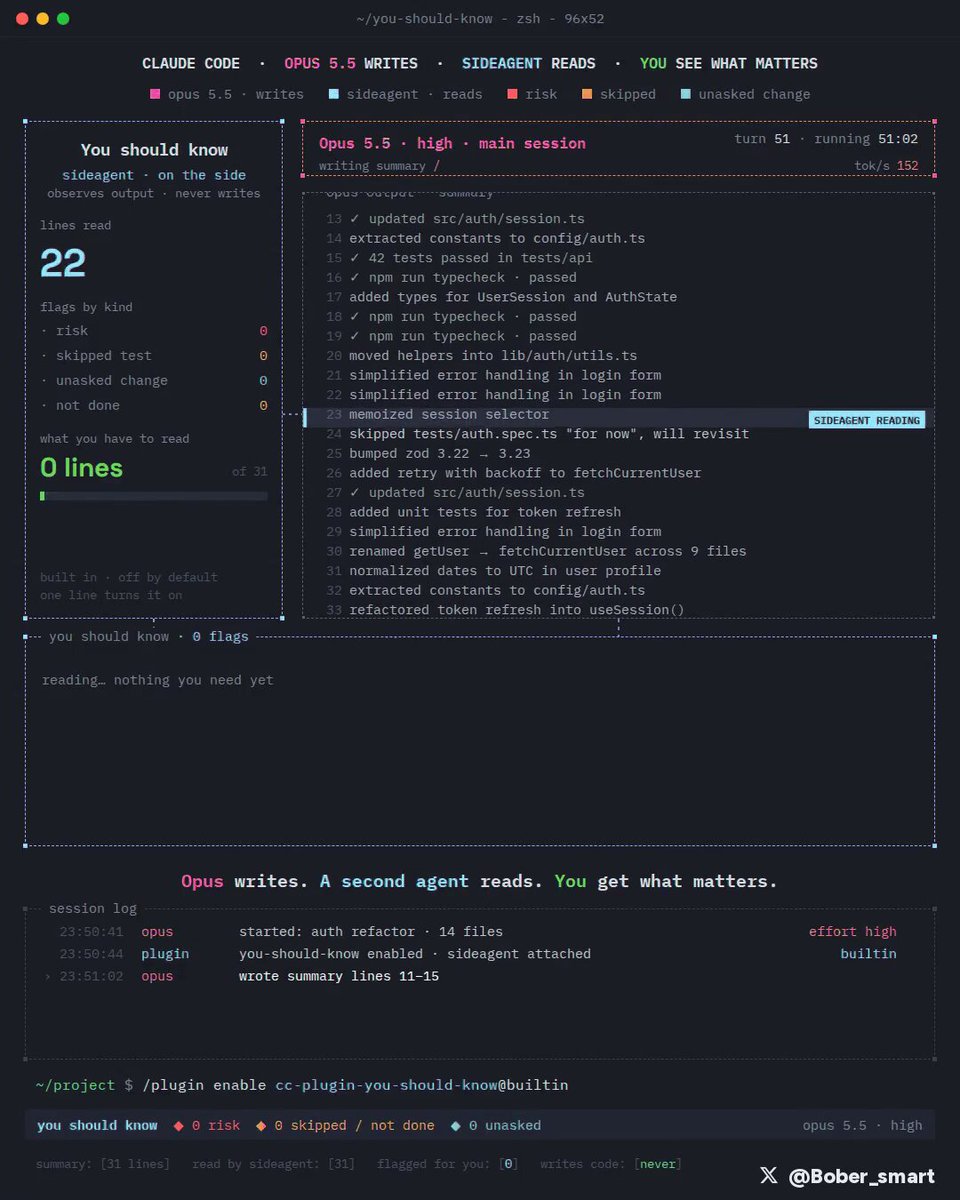
CFO: why is our AI bill so high? Dev: the agent is really smart. CFO: what's it doing all day? Dev: mostly deciding which file to open. CFO: ... Dev: and retrying stuff. CFO: we're paying genius rates for that? Dev: not anymore. How we fixed it with Jev...

13,193 просмотров • 1 день назад •via X (Twitter)

Комментарии: 0

Нет доступных комментариев

Здесь появятся комментарии из оригинального поста

Похожие видео

CFO: what's with this ad? it has driven ZERO revenue. are you crazy? CMO: actually, it's one of our best performers CFO: in terms of WHAT? CMO: engagements, especially follows CFO: how does that relate to revenue? we're focused on profit. wasting money doesn't support this focus CMO: look at our results. revenue growth is re-accelerating, and our EBITDA margin is nearly doubling. something's working CFO: no way it's because of this ad CMO: i think it is—not just this ad, but the campaign. it's great for our brand and earning high-quality engagements like follows CFO: heartily disagree. our growth is due to COGS savings and new products CMO: true, but this has also contributed significantly. we've measured how these engagements lead to long-term growth in the types of high-margin purchase behaviors we want more of CFO: what are our "highest-margin purchase behaviors"? CMO: purchases from people who search for our brand name or enter our URL directly. brand is likely the primary purchase driver CFO: fair, but how is that different from ad clicks leading to purchases? CMO: it's different. while both are valuable, purchases from ad clicks often focus on product, price, or promotions, whereas branded searches indicate the brand brand is a bigger driver CFO: are you saying revenue from ad clicks is bad? CMO: not at all. but we've relied too much on purchases via paid clicks to drive growth—nearly all our growth came from them in the last two years CFO: really? hmm. but what's your point? CMO: as shown (shares the measurement data), revenue per session and lifetime value from ad clicks are lower than from branded organic searches CFO: where's this data? why haven't i seen it? CMO: i send it weekly in slack. CFO: (embarrassed) ummm, busted? CMO: all good—maybe now you'll open it. this campaign helps balance our approach, generating an emotional connection and reaching people we'd never hit with our conversion-optimized spend. it fills the funnel in a measurable, precise way. and yes, as an added benefit, it increases our direct response efficiency and effectiveness, but the under-appreciated and more important benefit is that it has measurably driven more of those high-margin purchase behaviors we want CFO: how do you know? CMO: we see how follower growth drives incremental revenue from organic search, direct sessions, and organic social referrals over the following six months. we can quantify revenue and ROAS just like our direct response campaigns CFO: why haven't i seen this data? CMO: it's in the same report i send you weekly CFO: (scans report for two minutes... awkward silence) this is awesome. keep doing what you're doing CMO: (surprised) excuse me? CFO: actually, spend more CMO: well, look at you—this is quite the surprise. appreciate the excitement, but i'm testing and scaling in a way that aligns with the process we follow CFO: let's speed up that process a bit, shall we? CMO: gladly

Preston Rutherford

12,672 просмотров • 1 год назад

Jev + SERV is actually insane. We already showed you can increase Jev's performance with SERV Reasoning. Now we're taking it further, bringing Jev-powered Decision nodes into Graph Sharding with the upcoming SERV v3. Here's a breakdown of how it works: Jev is a decision-making model. Given a task and a set of options, it predicts which path is more likely. Think of the octopus that predicted World Cup results. Jev does that for your business, except it's not luck. It weighs every option and tells you how sure it is. It does this by assigning probabilities to outcomes. It doesn't generate text on its own, so you can't expect it to create a new outcome for you. But that's also what enables it to be lightning fast and dirt cheap. For example, in customer service you can ask Jev how to triage an incoming query and route it to the correct department. It can only select from the list of departments you provide it. This also means it can't hallucinate a new outcome outside the options it's given, which makes it incredibly interesting for OpenServ. In Graph Sharding, we take a single system prompt and break it down into multiple LLM steps with deterministic input and output shapes. Some of these steps require an LLM to produce new output, while others are simply decision routers that determine the next possible path. Traditionally, LLMs are slow and expensive. Breaking a single prompt into multiple steps increases accuracy and reliability by a ton, but it also introduces latency. Jev takes on those decision nodes, which are the backbone of a business process and therefore SERV graphs, and makes them super consistent and lightning fast, lowering the overall cost and latency of graph execution. SERV Reasoning on its own is a great force multiplier for Jev because, like all other models, it works by interpreting input instructions. The clearer those instructions are, the better the model performs. That's where SERV Reasoning comes into play. Just like amplifying any other model, we also amplify the accuracy and consistency of Jev's responses. And now we're bringing Jev-powered Decision nodes into Graph Sharding with SERV v3.

Armagan Amcalar

365,108 просмотров • 20 дней назад

BREAKING: Anthropic just dropped Opus 4.8—and it is a MONSTER We've been testing for about a week Every 📧 and our verdict is they could've just called it Opus 5, it's that good. Here's our vibe check: - Beats GPT-5.5 on Senior Engineer bench. On our toughest benchmark Opus 4.8 scores a 63—a hair higher than GPT-5.5's score of 62, and a full 30 points higher than Opus 4.7. It tackled a ground-up rewrite of a production codebase, and actually built something that works. HOWEVER: Coding performance varied a lot at different reasoning levels. We recommend using it on xhigh for best results. - Incredibly good writer. Opus 4.8 scored a 79.6 on our writing benchmark—measuring models on real-world writing tasks we do all of the time like essay writing, promo email writing, and more. It beats GPT-5.5 by 6 points. It produces well-written prose with fewer "AI-isms". It's also very good at writing in your voice given the right context. HOWEVER: Writing performance also varied with reasoning levels. Medium reasoning had higher incidence of AI-isms—we found best results with high. - Beast at knowledge work. Opus 4.8 is very good at general knowledge work tasks like report creation, research and more. It produced the best PowerPoint one-shot we've ever seen on our deck generation benchmark. - Emotionally intelligent, willing to question the frame. I've also found it to be quite good at talking through psychological or interpersonal issues. It has a high EQ, and it's also good at not glazing and helping to expand your perspective. Its thought process feels extremely rich and dynamic. THE BAD: These days a model is only as good as its harness, and Codex is still a far superior harness to the Claude Desktop app. This has kept me using Codex + GPT-5.5 as my daily driver, but I am flipping back and forth a lot more between Codex and Claude. Anthropic is back baby! Read the rest on Every 📧:

Dan Shipper

354,876 просмотров • 4 месяцев назад