Loading video...

Video Failed to Load

Go Home

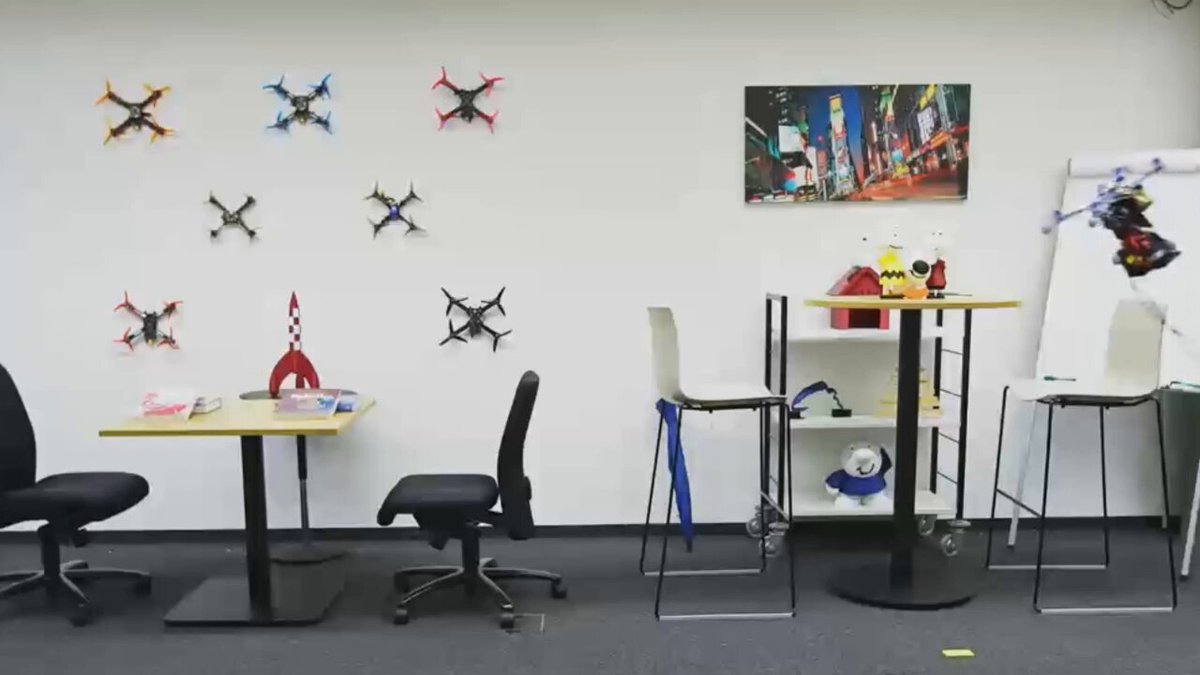
Check out our #ECCV2026 paper "Low-latency Event-based Object Detection with Spatially-Sparse Linear Attention", where we make linear attention sparse in space, recurrent in time, and parallel in training, enabling the first purely-linear-attention-based neural network for asynchronous object detection with #EventCameras, outperforming the previous best asynchronous method with 20x less...

52,916 views • 1 month ago •via X (Twitter)

3 Comments

emilio's profile picture
emilio1 month ago

Nice results! Any suggestions on how to deal with an event camera on a moving support (agv, drone)?

Ben Harper's profile picture
Ben Harper1 month ago

Incredible!

Forlais Research's profile picture
Forlais Research1 month ago

Latency is a property of the whole loop, not just the sensor. Holding the network to the same clock as the camera is the right framing. Event by event on CPU is the bit worth repeating.

Related Videos

Check out our #PAMI paper with code "Dense Continuous-Time Optical Flow from Event Cameras," where we show how to regress *continuous-time* trajectories of every pixel from event cameras alone or events plus frames! The key idea is to iteratively estimate per-pixel polynomials using a recurrent lookup and update scheme. Paper: Code: DOI: We present a method for estimating dense continuous-time optical flow from event data. Traditional dense optical flow methods compute the pixel displacement between two images. Due to missing information, these approaches cannot recover the pixel trajectories in the blind time between two images. We show that it is possible to compute per-pixel, continuous-time optical flow using events from an event camera. Events provide temporally fine-grained information about movement in pixel space due to their asynchronous nature and microsecond response time. We leverage these benefits to predict pixel trajectories densely in continuous time via parameterized Bézier curves. To achieve this, we build a neural network with strong inductive biases for this task: First, we build multiple sequential correlation volumes in time using event data. Second, we use Bézier curves to index these correlation volumes at multiple timestamps along the trajectory. Third, we use the retrieved correlation to update the Bézier curve representations iteratively. Our method can optionally include image pairs to boost performance further. To train and evaluate our model, we introduce a synthetic dataset (MultiFlow) that features moving objects and ground truth trajectories for every pixel. Our quantitative experiments suggest that our method successfully predicts pixel trajectories in continuous time and is competitive in the traditional two-view pixel displacement metric on MultiFlow and DSEC-Flow. Open source code and datasets are released to the public. Kudos to Mathias Gehrig Manasi Muglikar

Davide Scaramuzza

12,692 views • 2 years ago

We are excited to share our work “Event-Aided Sharp Radiance Field Reconstruction for Fast-Flying Drones” published in IEEE Transactions on Robotics IEEE Transactions on Robotics (T-RO), which tackles sharp radiance field reconstruction under agile drone motion, where RGB frames are heavily motion-blurred and pose priors become unreliable! 4 years in the making! Code & dataset released! PDF: Code & Dataset: Full Narrated Video: High-speed flight is essential for time- and battery-constrained missions (e.g., inspection, exploration, search & rescue). However, fast motion corrupts visual data with severe motion blur and introduces drift/noise in visual-inertial odometry, making NeRF-based 3D reconstruction particularly brittle. We propose a unified framework that leverages asynchronous #EventCamera streams together with motion-blurred frames to reconstruct high-fidelity radiance fields from agile drone flights. Our key idea is to embed event-image fusion directly into radiance field optimization while jointly refining a shared, continuous-time camera trajectory initialized from event-based VIO. This enables us to recover sharp radiance fields and accurate trajectories without ground-truth supervision during training. We validate our method on synthetic data and on real sequences captured by a drone flying up to 2 m/s. Despite severe blur and noisy pose priors, our method preserves fine scene details and achieves a performance gain of over 50% on real-world data compared to state-of-the-art methods. Kudos to Rong Zou and Marco Cannici! Marco Cannici Reference: Rong Zou*, Marco Cannici*, Davide Scaramuzza Event-Aided Sharp Radiance Field Reconstruction for Fast-Flying Drones IEEE Transactions on Robotics (T-RO), 2026 NCCR Robotics European Research Council (ERC) AUTOASSESS UZH IfI University of Zurich UZH Science Prophesee SynSense UZH Space Hub

Davide Scaramuzza

12,028 views • 7 months ago