Video wird geladen...

Video konnte nicht geladen werden

Zur Startseite

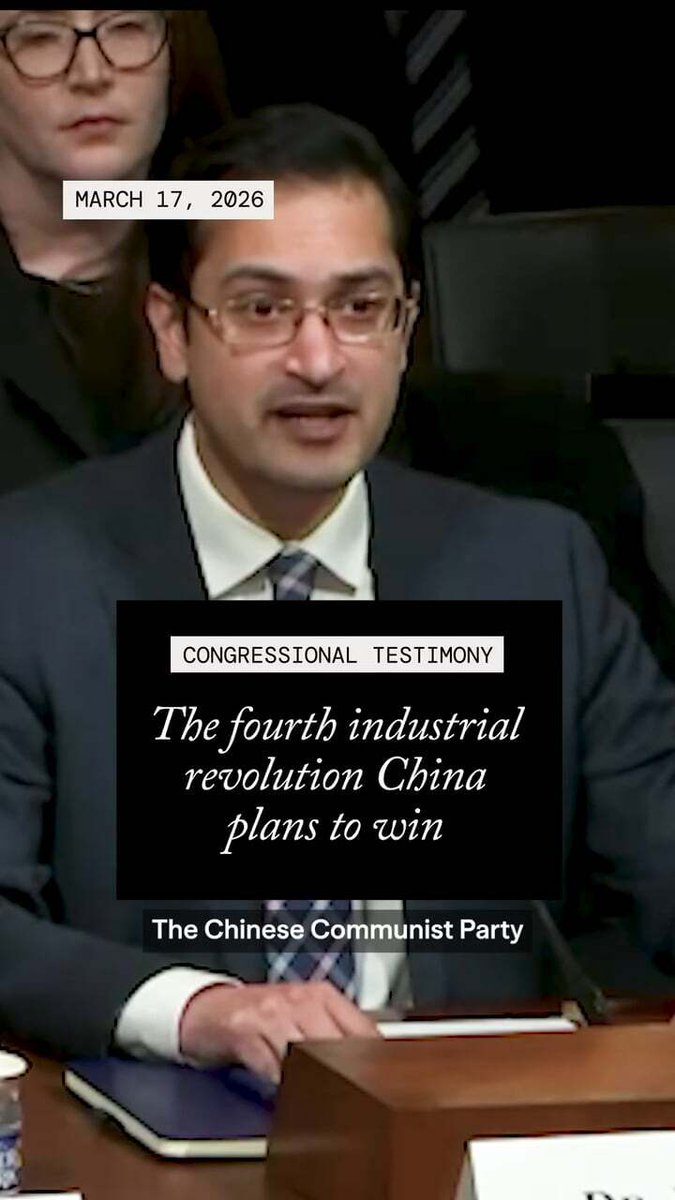
“China’s national intelligence law, its counterespionage law, require Chinese companies to cooperate with Chinese intelligence and not disclose that fact to others. That creates espionage risks,” says Rush Doshi, director of CFR’s China Strategy Initiative and assistant professor at Georgetown University’s Walsh School of Foreign Service. “These robots are...

22,838 Aufrufe • vor 3 Monaten •via X (Twitter)

0 Kommentare

Keine Kommentare verfügbar

Kommentare vom Original-Post werden hier angezeigt
Ähnliche Videos

🚨🇺🇸🇨🇳 SENATE INTEL CHAIR: CHINESE TECH IS A NATIONAL SECURITY THREAT - U.S. SPY AGENCIES NEED AN UPGRADE Sen. Mark Warner - the Democrat who chairs the Senate Intelligence Committee - is sounding the alarm again, calling China’s tech ecosystem a systemic national security threat and warning that U.S. intelligence laws “were written for a rotary-phone world.” Warner argues that Chinese firms like Huawei, TikTok, and others operating under China’s 2017 National Intelligence Law are not normal companies: They’re legally obligated to assist Beijing’s security services. That means data harvesting, influence operations, infrastructure access points - the entire stack. Warner says the U.S. still hasn’t updated its surveillance and counterintelligence tools to match this new battlefield, calling current protections “dangerously outdated” as China races ahead in AI, telecom, and cyber espionage. He’s not alone. A rare joint briefing by U.S. and allied spy chiefs - including the FBI, MI5, and their Five Eyes partners - recently warned that: China is conducting the largest technology-theft campaign in history, and more than half of its targets are in Silicon Valley. Beijing aims to dominate the next generation of computing, biotech, and AI - by any means necessary. This isn’t Cold War espionage anymore. It’s an always-on, digital infiltration campaign woven through apps, networks, and supply chains. Warner’s core message: The U.S. built the internet. China is trying to weaponize it. If Washington doesn’t modernize its intelligence playbook now, it may lose the next decade - and the technologies that define it. Source: CNBC, The New York Times

Mario Nawfal

17,053 Aufrufe • vor 8 Monaten

China urges US, EU to stop lies and meddling in China's internal affairs by hyping up ethnic issues The West always looks at China’s ethnic policy through the mirror of its own crimes. They committed genocide against indigenous peoples. They built settler states on mass graves. They erased languages, cultures, tribes, and entire civilizations. So they assume China must be doing the same. But China is not the West. China is a multi-ethnic civilization-state where ethnic minorities are not colonial subjects, not museum props, and not disposable populations. They are Chinese citizens, part of the same national community. That is why most Chinese ethnic minorities abroad introduce themselves simply as Chinese — not because their identity was erased, but because the national identity is real. And the panic over “extraterritorial application” is comedy. Chinese citizens abroad are still Chinese citizens. They receive Chinese consular protection. They carry Chinese passports. They are naturally subject to Chinese law where applicable. That is not “long-arm jurisdiction.” Long-arm jurisdiction is Washington hunting foreign citizens across the world, sanctioning companies in third countries, freezing assets, kidnapping executives, and pretending U.S. domestic law is international law. The U.S. and EU are not worried about human rights. They are worried that China refuses to let them weaponize ethnicity, separatism, and identity politics as tools of internal sabotage. They are not defending minorities. They are trying to manufacture another pressure point. China has seen this script before. Different costume. Same empire.

𝘊𝘰𝘳𝘳𝘪𝘯𝘦

15,431 Aufrufe • vor 1 Monat

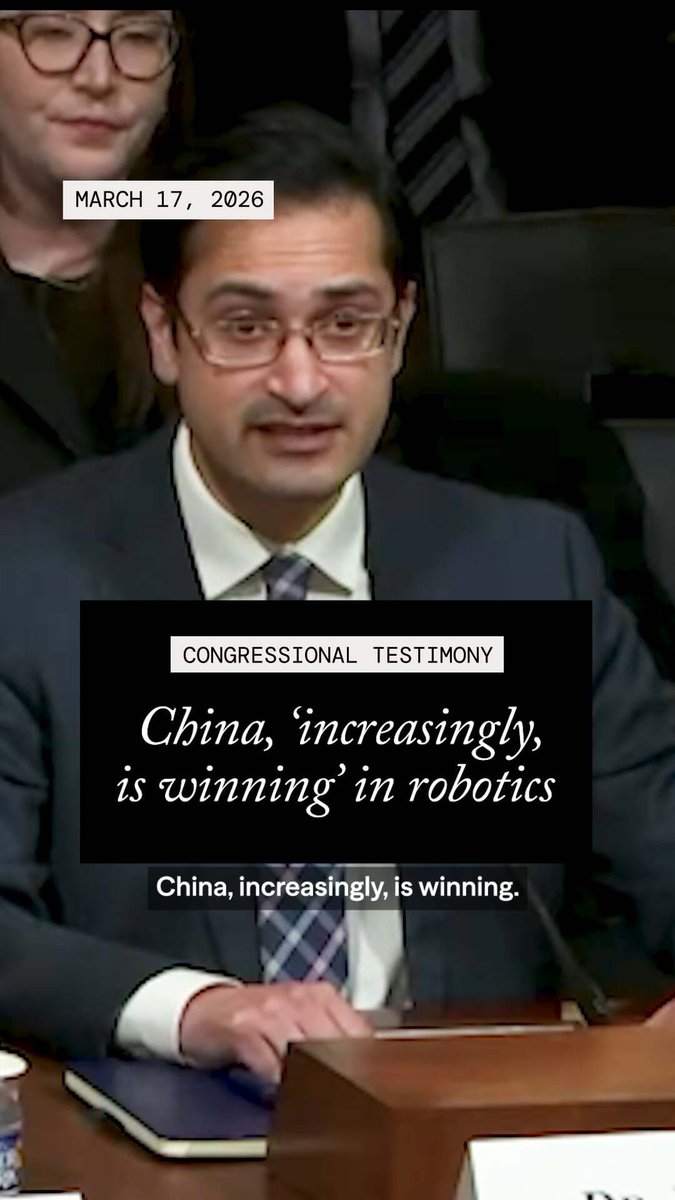
On Tuesday, I testified before the House Homeland Security Committee on China's strides in robotics and AI. I warned that we lost solar, batteries, and EVs -- now we're at risk of losing robotics and AI. If that happens, it would irreversibly change the balance of power. Five points: 1️⃣ China aims to win the next industrial revolution. PRC leaders believe history is shaped by industrial revolutions. The first, steam power, made Britain dominant. The second and third, electrification and mass manufacturing, made America dominant. China is determined to win the fourth. 2️⃣ In robotics, China is already winning. In 2024, China installed 300,000 new industrial robots. America installed 30,000. China now has over 2 million robots in its factories — five times more than the US. A decade ago, it imported 75% of its robots. Today it makes 60% domestically. This year alone, China may spend $400 billion on industrial policy. The entire US CHIPS Act provided $50 billion across multiple years. If we fall behind here, U.S. reindustrialization becomes farfetched. 3️⃣ In AI, we're ahead — but selling off the advantage. China has more energy, more talent, and makes the edge devices. But America still leads because of chips, according to China's own AI companies. US chips are 4-5x better than China's today. We are debating whether to surrender that edge. 4️⃣ We are inviting risks of cyberespionage and catastrophic cyberattacks. PRC law requires its companies to cooperate with intelligence services and never disclose it. Today's robots carry LiDAR, microphones, and cameras — they are mobile surveillance platforms. But the bigger risk is cyberattack. We know China has compromised our power, gas, water, telecommunications, and transportation infrastructure in preparation for cyberattack. We cannot deploy robots in sensitive facilities from the very country targeting those facilities. 5️⃣ Here's what we must do. Extend ICTS rules to cover Chinese robots. Direct CISA to audit where they're deployed in critical infrastructure. Ban federal procurement of Chinese robotics and AI. Strengthen semiconductor export controls. Stop treating American AI companies with more regulatory scrutiny than Chinese ones. And build allied scale in robotics—a trading bloc with preferential terms for the members that can rival China's scale in in the sector. Thanks to @HomelandDemsIt and House Homeland GOP for the hearing on this topic, and grateful to join Michael Robbins and colleagues from Scale and Boston Dynamics for a great discussion.

Rush Doshi

152,123 Aufrufe • vor 5 Monaten