Loading video...

Video Failed to Load

Go Home

Claude Code tip: once Opus 5.5 runs your main session, stop leaving Fable 5.1 on the bench put it on call with /advisor run /advisor fable Opus 5.5 keeps writing the code Fable 5.1 reads the whole session, every tool call included, and only speaks up at three moments:...

49,415 views • 2 days ago •via X (Twitter)

14 Comments

PublicAI's profile picture
PublicAI1 day ago

Advisor on Fable 5.1 and the main session on Opus 5.5 is the split a lot of long sessions needed. The three gates (plan, repeated error, before done) stop Fable from narrating every tool call. Pin those three in CLAUDE.md so a new chat does not forget them.

Delayo's profile picture
Delayo1 day ago

alpho

slash1s's profile picture
slash1s2 days ago

useful pipeline here

Dominik's profile picture
Dominik2 days ago

advisor that reads every tool call is how taste stays in the loop.

airplanestar 𓂀's profile picture
airplanestar 𓂀2 days ago

running an observer model out of band catches tunnel vision before bad patches get committed. way smarter than asking the primary model to critique its own code in the same thread

sophs l's profile picture
sophs l2 days ago

opus writing fable reading is basically pair programming with a senior who only speaks when you're about to break prod

catman's profile picture
catman2 days ago

It’s like a pilot with a second set of eyes: Opus drives, while the advisor checks the route at the moments where a wrong turn gets expensive.

Risos AI's profile picture
Risos AI1 day ago

Setuju sih setup dua model gini kepake banget, apalagi pas server utamanya lagi ngadat kayak sekarang, kerjaan riset langsung berhenti di tengah jalan. Btw pas advisor baca seluruh session, konteksnya nggak keburu kepotong ya kalau sessionnya udah panjang banget?

David Kovach's profile picture
David Kovach2 days ago

What are you building that you even need all this???

kadd's profile picture
kadd1 day ago

Impressive

Sof t.'s profile picture
Sof t.1 day ago

Well said!

The SI Therapist's profile picture
The SI Therapist2 days ago

Opus écrit, Fable vérifie : l'orchestre est enfin complet pour coder sans faux pas

✿ soph e.'s profile picture
✿ soph e.1 day ago

whats the actual latency hit on that, does fable add like 2s per turn

∑: Meww ∑: (❖,❖)'s profile picture
∑: Meww ∑: (❖,❖)1 day ago

Interesting Claude Code setup for efficient AI collaboration.

Related Videos

Claude Code tip: once Opus 5.5 is your main model, stop leaving Fable 5.1 sitting idle put it on call with /advisor run /advisor fable Opus 5.5 keeps writing the code Fable 5.1 reads the full session, every tool call included, and only speaks up at three points: → before a plan: is this the right approach? → when the same error comes back: am I digging in the wrong place? → before "done": what did I miss? Fable 5.1 reviews. Opus 5.5 ships Jev engineering is the same move one layer down: the forks that need no thinker (which file, which tool, retry or stop) go to Jev in under half a second, and the big model only sees the ones that split - the full tree > Opus 5.5 on high runs the main session > explorer reads the code > worker edits and runs tests > researcher pulls the docs > all three on medium > Fable 5.1 on call as the advisor paste the tree and this prompt into Claude Code ↓ "Rebuild my Claude Code setup around this tree: 1. Check ~/.claude/agents and .claude/agents for subagents that already fit explorer, worker and researcher. > Draft new ones only for missing roles > Give each model: opus, effort: medium > Skip any that pin a different model and list them 2. Set the main session to high via effortLevel in ~/.claude/settings.json, and set advisorModel to fable 3. Find anything that keeps the advisor off (CLAUDE_CODE_DISABLE_ADVISOR_TOOL, DISABLE_TELEMETRY, any variable that stops feature-flag fetching) plus CLAUDE_CODE_EFFORT_LEVEL, which overrides subagent effort. Report them, change nothing 4. Add one rule to ~/.claude/CLAUDE.md: consult the advisor before a large plan, when an error repeats, and before calling a long task done Show me every change as a diff first. No edits until I say go." ↳

delost

686,628 views • 4 days ago

Claude Code tip, and it's absolute free f*cking gold: run Opus 5.5, Sonnet 5.5 and Fable 5.1 as one team and stop burning Opus tokens on routine work the setup in one line: plan on high, delegate on medium, keep Fable on call • who does what > Opus 5.5 on high - plans and ships the code > Sonnet 5.5 on medium - explorer reads code, worker edits and runs tests, researcher pulls docs > Fable 5.1 via /advisor fable - reads the whole session and speaks up only when it matters • when Fable 5.1 steps in -> before a plan: is this the right approach? -> when an error repeats: am I digging in the wrong place? -> before "done": what did I miss? Jev engineering takes it one layer lower: which file, which tool, retry or stop all go to Jev in under half a second, so the big models only see the real forks paste this into Claude Code ↓ "Rebuild my Claude Code setup: 1. Find subagents in ~/.claude/agents and .claude/agents that fit explorer, worker and researcher. Draft only the missing ones. Set each to model: sonnet, effort: medium. List any that pin a different model and leave them 2. In ~/.claude/settings.json set effortLevel to high and advisorModel to fable. 3. Report anything that disables the advisor (CLAUDE_CODE_DISABLE_ADVISOR_TOOL, DISABLE_TELEMETRY, flag-fetching blockers) and CLAUDE_CODE_EFFORT_LEVEL. Change nothing. 4. Add to ~/.claude/CLAUDE.md: consult the advisor before a large plan, when an error repeats, and before calling a long task done. Show every change as a diff. No edits until I say go." ↳

Mr. Buzzoni

139,098 views • 1 day ago

Claude Code tip: once Opus 5.5 is your main model, stop letting your Fable 5.1 quota go to waste put it on call with /advisor run /advisor fable Opus 5.5 keeps doing the work Fable 5.1 sits on the sidelines, reads the whole session, and steps in at three moments: → before a plan: is this right? → when the same error comes back: am I going the wrong way? → before "done": did I miss anything? Fable 5.1 advises. Opus 5.5 writes the code the same idea sits under Jev engineering: the expensive model stops weighing in on every step and only gets called at the moments that change the outcome • the full setup > Opus 5.5 on high runs the main session > subagent one reads code > subagent two edits and runs tests > subagent three looks up docs > all three on medium > Fable 5.1 on call hand the tree and this prompt to Claude Code 👇 "Set up my Claude Code to match this tree: 1. Reuse fitting subagents from ~/.claude/agents and .claude/agents. > Propose new ones only for missing roles > Set each to model: opus, effort: medium > Leave any that set a different model alone and list them 2. Set main session effort to high via effortLevel in ~/.claude/settings.json 3. Check for env vars that disable the advisor (CLAUDE_CODE_DISABLE_ADVISOR_TOOL, DISABLE_TELEMETRY, anything that stops flag fetching) and CLAUDE_CODE_EFFORT_LEVEL, which overrides subagent effort. Report them, don't change them 4. Add a rule to ~/.claude/CLAUDE.md: ask the advisor before a big plan, when an error repeats, and before calling a long task done Show me the changes first. Don't edit files yet." ↳

Mr. Buzzoni

321,445 views • 4 days ago

Codex tip: once GPT-6.1 Sol is your main model, stop running Astra on every turn put Astra on call as an architect agent GPT-6.1 Sol keeps writing the code Astra only gets spawned at three points: → before a plan: is this the right approach? → when the same error comes back: am I digging in the wrong place? → before "done": what did I miss? Astra reviews. Sol ships Jev engineering is the same move one layer down: the forks that need no thinker (which file, which tool, retry or stop) go to Jev in under half a second, and the big models only see the ones that split - the full tree > GPT-6.1 Sol on high runs the main session > explorer reads the code on Luna > worker edits and runs tests on Sol > researcher pulls the docs on Luna > all three on medium > Astra on call as the architect > auto_review checks every approval paste the tree and this prompt into Codex ↓ "Rebuild my Codex setup around this tree: 1. Check ~/.codex/agents and .codex/agents for agents that already fit explorer, worker and researcher. > Draft new TOML files only for missing roles > explorer and researcher on gpt-6-luna, worker on gpt-6.1-sol, all with model_reasoning_effort medium > Add an architect agent on gpt-6-astra, model_reasoning_effort high, whose only job is reviewing plans, repeated errors and finished work > Skip any that pin a different model and list them 2. In ~/.codex/config.toml set model to gpt-6.1-sol, model_reasoning_effort to high and approvals_reviewer to auto_review 3. Find anything that would override this (active profiles, flags in my shell aliases, agents.default_subagent_model). Report it, change nothing 4. Add one rule to AGENTS.md: spawn the architect before a large plan, when an error repeats, and before calling a long task done Show me every change as a diff first. No edits until I say go." ↳

delost

717,378 views • 2 days ago

fable 5.1 vs fable 5 vs opus 5 – three lord of the rings landmarks, built in 3d from one image the setup: one reference image per scene, one html file per build, everything procedural – no meshes, no textures, no image files, nothing past Three.js from a cdn. each model reads the picture, writes its own prompt from it, then builds to that prompt in the same turn. three named camera shots per scene on keys 1/2/3, so it can be screen-recorded. run through OpenRouter tasks: 1. bag end – hobbiton from two frames, outside and in. the round green door has to open onto the room you are standing in 2. barad-dûr – the tower and orodruin from one film still. the eye has to move and track the camera, the volcano erupts on a cycle, the clouds never stop 3. rivendell – jerry vanderstelt's painting. sun shafts that shimmer, water that falls without a break, trees that sway on a gust models: Anthropic fable 5.1, fable 5, opus 5 total cost, three builds #1 fable 5 – $14.97 #2 opus 5 – $18.53 #3 fable 5.1 – $22.38 wall clock, three builds #1 fable 5 – 38m #2 fable 5.1 – 92m #3 opus 5 – 122m output tokens #1 fable 5 – 298,592 #2 fable 5.1 – 439,435 #3 opus 5 – 724,418 lines of code shipped #1 fable 5 – 2,885 #2 fable 5.1 – 4,021 #3 opus 5 – 5,161 biggest single build, lines #1 opus 5, bag end – 2,410 #2 fable 5.1, barad-dûr – 1,375 #3 fable 5, bag end – 1,319 observations: • fable 5.1 is the only model that furnished the bag end interior – a live fire, panelling, books on the floor, leaded diamond windows, against fable 5's flat color and opus's dark tunnel. the round door outside opens onto that room, the hard part of the brief • what it costs is thinking room. the 128k output ceiling is a thinking budget in disguise: fable 5.1 burned 102,116 of it on reasoning and hit the wall mid-file. opus spent 109,241 and hit the same wall. fable 5 spent 61,240 and finished bag end in one call – the only one that did • fable 5.1's first pass is not the finished thing. its barad-dûr came back with three defects you only catch by looking at it – nothing a read of the code would have flagged • it is the best of the three at being corrected. handed a plain list of what was wrong, it returned 32 targeted patches over two rounds, every one applied first try, and it worked out one of the causes itself instead of guessing at constants conclusion: nine scenes, 12,067 lines and 1.46m output tokens for $55.88 all in – and the cheapest model was also the fastest, by 3.2x! follow thehype. for 24/7 ai news, analysis and breakdowns

thehype.

18,509 views • 1 month ago

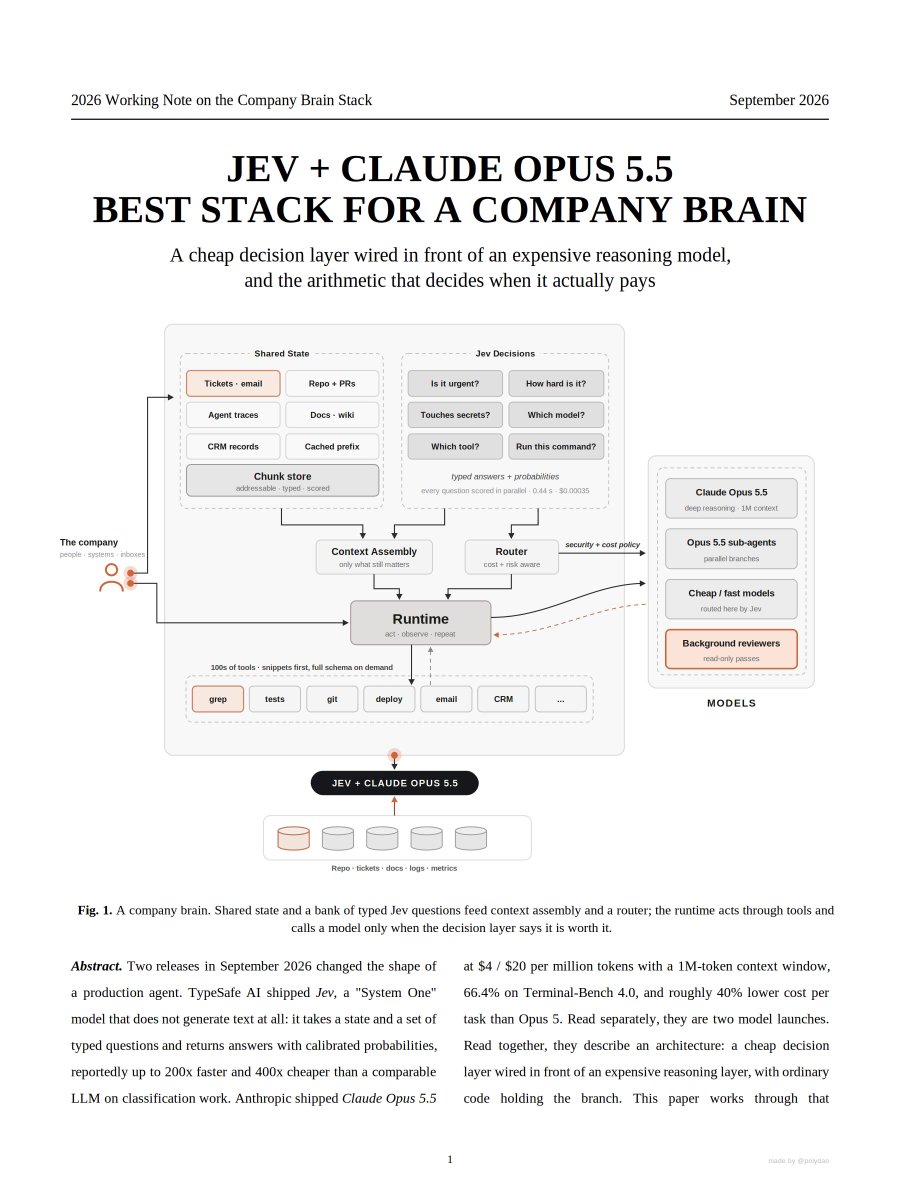
JEV + OPUS 5.5 IS INSANE FOR BUILDING A COMPANY BRAIN I pulled the whole architecture out of the TypeSafe and Anthropic docs and packed it into a 14-page PDF the 10 steps: 1. meet the pair > Opus 5.5 thinks, Jev decides, your code holds the branch 2. stop asking a text generator for a yes or no > Jev returns a typed answer with a calibrated probability in 0.44s for $0.00035 3. ask everything at once > Choice, Score and Noul run in parallel, so the fourth question costs almost nothing 4. branch on the number > 0.999 goes straight into the if statement. ~99% of turns end right here 5. stop routing blind > Opus 5.5 to Sonnet and back costs 5.84 against 3.32 for staying on 5.5 6. keep one context warm > cache reads at $0.20 per Mtok are 20x cheaper than a fresh load 7. escalate the hard part > the toughest 1% goes to Opus 5.5 with 1M context and 66.4% on Terminal-Bench 4.0 8. score every chunk on every query > keep whole, summarize or drop. the context gets rebuilt each turn 9. gate the actual command > every bash call gets classified before it runs, inside your own code 10. judge 100% of runs > $3.50 a day for 10,000 traces, and it matched the human label on all 500 decisions the result: a while loop that paid a frontier model for every tiny call turns into a brain that spends a fraction of a cent to notice and pays properly only when it has to think the person who brings this into their team walks into the budget meeting with the AI bill cut and the output up the PDF maps the company brain. the loop side of it - how Jev takes a Claude bill from $765 to $3 a month - is in the article below ↓

Mr. Buzzoni

85,590 views • 4 days ago

i finally mastered how to maximise my opus 5.5 usage limits... the trick: let jev choose which subagent gets each task and how much effort it should use. [here’s how i’d wire it:] claude breaks the project into tasks. jev selects from predefined worker profiles. claude applies the selected settings and dispatches the work. → main session, medium: clarify the requirements, define what “done” looks like, and prepare the tasks → builder, low: small, clearly defined tasks with existing examples or patterns → builder, medium: tasks that connect multiple parts or need decisions within the approved plan → verifier, high: check requirements, probe edge cases, and report problems for the builder to fix jev gets the task’s scope, what’s uncertain, and the consequences of failure. it chooses from the profiles allowed for that task. your approval checkpoints stay in place. paste this into your next planning session: “use opus 5.5 with jev selecting the worker and effort profile for each task. first, check that a working jev integration is available and that this environment supports separate effort settings for subagents. check for configuration or environment overrides that could prevent those settings from taking effect. if anything is missing, explain what needs wiring before proceeding. break my request into tasks with clear ownership, dependencies, relevant context, and acceptance checks. keep small related tasks together when a separate subagent would add unnecessary overhead. keep the main session at medium effort. offer jev these worker profiles: builder at low effort for small, clearly defined tasks using existing patterns; builder at medium effort for tasks that connect multiple parts or require decisions within the approved plan; verifier at high effort for checking requirements and edge cases. give jev each task’s scope, uncertainties, dependencies, and consequences of failure. only offer profiles appropriate to the current stage. validate its selection before dispatching. use the actual jev integration; don’t simulate its decisions. if it abstains or returns an invalid choice, stop that handoff and ask me. show me the task plan and proposed assignments before starting. after approval, launch the selected workers with their assigned effort settings, relevant context, file ownership, and completion checks. let me review the result before verification. the verifier may add tests but must leave implementation code unchanged. have it report what passed, what failed, and what remains uncertain. send implementation fixes back to the builder, then recheck the affected parts. if a task repeatedly fails, examine the requirements and approach before increasing effort. report available total usage, including jev calls, worker calls, retries, and verification. don’t invent missing data. compare similar completed tasks before claiming savings.” steal this 👇

Avid

31,355 views • 6 days ago