正在加载视频...

视频加载失败

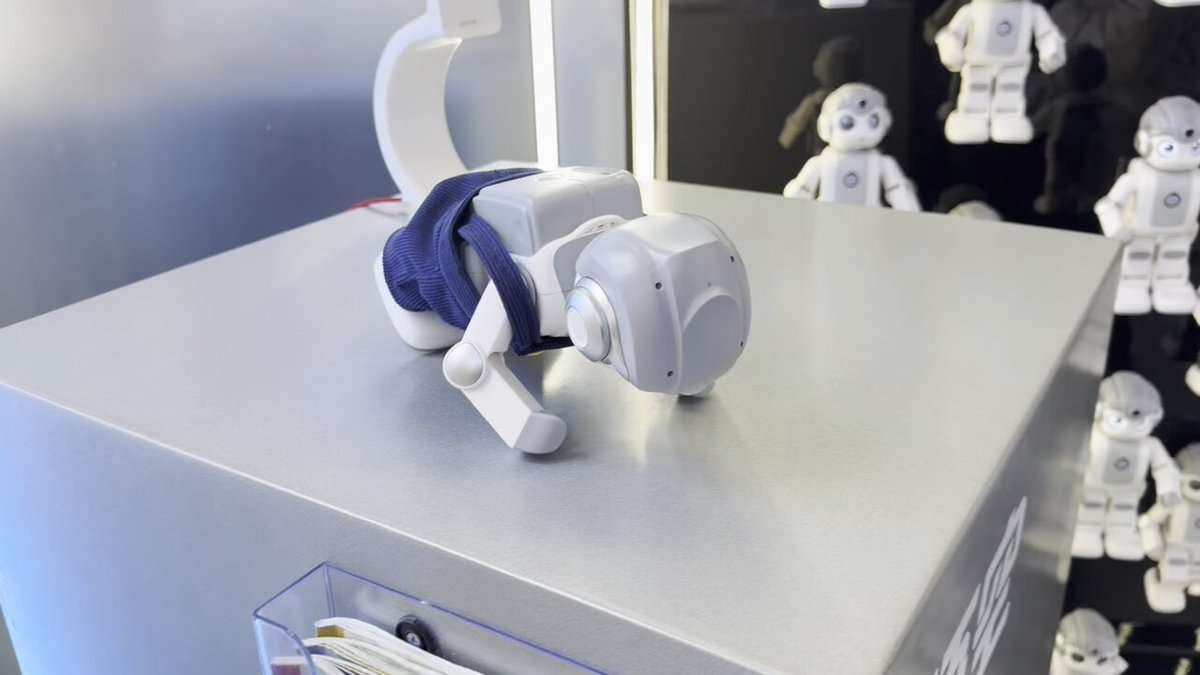
Contemporary discussion (hype?) about LLMs and “pausing AGI development” seems oblivious of Moravec’s paradox. We’ve hypothesized since the 80s — that the hardest problems in AI involve sensorimotor control, not abstract thought or reasoning. It explains why AI is mastering games, dialogue, and scene generation. But robots are conspicuously...

322,691 次观看 • 3 年前 •via X (Twitter)

0 条评论

暂无评论

原始帖子的评论将显示在这里

相关视频

WHY AI NEEDS ROBOTS TO BE THE ECONOMY We keep hearing about the rise of AI - in finance, in art, in code. But here’s the part Elon said out loud: AI doesn’t scale the economy without a body. Right now, AI lives in data centers. It writes essays, diagnoses symptoms, maybe even talks you through a breakup. But it doesn’t fix the plumbing. It doesn’t pick fruit. That’s the missing link: robots. Real-world productivity - the kind that moves GDP - still runs on physical labor. You can automate all the spreadsheets you want, but if strawberries rot in the field or a construction site goes unmanned, you’re not growing the economy. You’re just writing better emails about the shrinkage. AI alone is smart. But AI with wheels, arms, and joints? That’s transformative. Think warehouses where bots stock shelves without lunch breaks. Think 3D-printed houses built in days, not months. Think carebots helping aging populations bathe, cook, and live with dignity. That’s not sci-fi - it’s the only way economies with shrinking workforces and ballooning eldercare costs survive. China’s already there. Japan’s aging crisis is pushing robotic adoption into every corner of daily life. And yet, the conversation stays stuck on chatbots and copyright lawsuits. Because here’s the catch: merging AI with robotics doesn’t just replace jobs - it reshapes civilization. The shift is seismic. It means redefining what “employment” means when machines can work 24/7 and never strike. It’s an economic revolution that doesn’t just disrupt - it displaces. But the choice isn’t between utopia or dystopia. It’s between preparing or pretending. If we want AI to boost productivity, solve labor shortages, and pay off its hype, it needs more than brains. It needs bodies.

Mario Nawfal

141,937 次观看 • 9 个月前

Why Hyderabad Drowns After A 20min Rain? I may not have a simple answer to this complex question but was in Raidurgam area yesterday and this what I saw. This is right next to the Raidurgam metro. It is like the IT hub of Hyderabad and look at the state of things here. Roads are being dug to lay drainage pipes. Locals told me it has been close to a year since they started digging. The debris is just lying on the road, existing drainage seems to be damaged and all the sewer is flowing on to the main road. To make things worse, many are parking right on the road making the congested area much more difficult to commute. There is no parking space at Raidurgam Metro. If someone wants to take the metro, they have to arrive on a separate vehicle to reach. Plus there are a million autos lined up on the road. Traffic police who hide behind trees or corner you in some random street won’t regulate traffic on the main roads. They won’t show a solution to park vehicles but will collect challans. Why are you collecting challans without any space being earmarked for parking? Do you expect people to jump off a parachute and get into a metro? We look at China, Japan with their advanced technology of laying roads in a day and will be wowed. Here governments talk about AI city, Future City and such money minting projects for the government and still get wowed. Why isn’t AI or advanced technology being used to repair roads, drainages or maintain infrastructure in the existing city??? Why this craze to call the existing city a dump and then pumping huge public money into a nonexistent Future City? Why is governance driven by real estate ambitions of a few politicians?

Revathi

19,667 次观看 • 2 个月前

Your twin flame is never absent from you, even when the physical world goes quiet. Beyond the 3D personality and circumstances, the connection lives in the 5D field of consciousness, where separation does not exist. This is why many twin flames feel their counterpart most strongly at night. When the mind releases control and the nervous system softens, the soul returns to its natural state of union. In sleep, the filters of fear, doubt, and ego loosen, allowing the higher selves to meet without resistance. In the 5D, communication does not rely on words or physical presence. It moves through sensation, knowing, and energetic exchange. This is why dreams can feel more real than waking life, why you may wake up with emotions, clarity, or a deep sense of peace that did not come from thought. These moments are not imagination. They are the result of an ongoing soul dialogue that continues regardless of distance, silence, or external conditions. The bond is active because it is not maintained by effort, but by shared consciousness. Understanding this brings stability to the journey. You are not waiting for connection to begin, nor are you losing it during periods of separation. The 5D union is constant, and it quietly supports your growth, healing, and awakening. When you trust this, the need to chase signs or reassurance fades. The connection becomes something you live from within, not something you search for outside of yourself. ~ Twinflamesinfinity ✨🙌🏽💫

🧬Maxpein🧬

34,692 次观看 • 6 个月前

I spent a month in Shenzhen visiting factories and robotics companies, and the contrast with the U.S. was striking. While Figure and Boston Dynamics hide their humanoids behind closed doors, Chinese companies have massive showrooms open to the public. But what really stood out wasn't just the transparency, it was how good they are at selling. Take UBTech: they've already sold 1,200 humanoid units at $200k each to factories. And here's the kicker, these robots aren't even that useful yet. They can only pick up and drop boxes at 1/10th the speed of a human, and factories still need to hire system integrators to train them for specific tasks. My theory is that these factories are terrified of getting left behind in the robotics/AI wave. They're investing in new tech not because it's ready, but because they can't afford to wait. The second surprise was the breadth of their robotics portfolio. These companies aren't just building humanoids, they're deploying service robots everywhere: restaurants, hotels, apartments. Consumer robots are cleaning houses, pools, pet waste, dishes. They're covering the entire spectrum. But the education piece shocked me most. I picked up what I thought was a high school or college robotics textbook, it was for primary school. The government mandated AI and robotics education starting in elementary school. Almost every single school in China now has AI and robotics curriculum, complete with education robots so kids can learn by building. They're creating a generation that grows up fluent in robotics and AI. China owns the supply chain and the hardware stack. But here's what I think people are missing: the race isn't just about who can build robots faster or cheaper. The U.S. advantage has always been in the layer between hardware and human, the interaction design, the software intelligence, the intuitive interfaces that make complex technology feel natural. China is building the physical infrastructure, but they're also learning fast. Every deployed service robot, every classroom full of kids building with education kits, every factory running humanoids, that's all data collection at scale. The window for the U.S. to establish its wedge is narrowing. It's not enough to be better at AI or software anymore. We need to be building the integration layer, the intelligence that makes physical AI actually useful, not just impressive in a showroom. Because right now, China isn't just manufacturing robots. They're manufacturing a robotics-native culture, and that might be the most defensible moat of all.

Miyu Horiuchi

90,718 次观看 • 6 个月前

What I’m about to say about $QUBIC is INSANE!! Every cycle of hype and crisis in the world brings a new critical need. We’ve already seen it with: - DeFi (banking without banks) - Metaverse (new forms of human interaction) - RWA (tokenization of real-world assets) - Privacy (ZKP, Monero, etc.) - Stablecoins (digitized dollar) - AI (LLMs and automation) - Quantum Technology (post-classical computing) And now: Computational Energy + Decentralized AGI The next incalculable frontier is energy for data processing. Whoever turns mining power into abundant, real-use compute infrastructure will dominate the next cycle. Sovereign nations will no longer accept depending exclusively on American (or Chinese) Big Tech for critical AI, defense, and intelligence. Digital sovereignty has become a matter of national security. $QUBIC is perfectly positioned for this. Through Aigarth (its evolutionary “AI Garden”), the network runs on Useful Proof-of-Work: miners’ energy (CPU/GPU) isn’t wasted on useless hashes - it trains and evolves a decentralized AGI in real time. It’s becoming the world’s largest dedicated decentralized supercomputer. While nations seek alternatives to avoid becoming hostages to monopolies, QUBIC delivers accessible, resilient, and sovereign AGI - any country can run its own decentralized intelligence without relying on vulnerable centralized data centers. An adoption explosion is coming. QUBIC has the potential to become one of the most valuable assets on the planet by solving compute abundance + computational sovereignty. Other projects will try to follow (we already see echoes in ideas from figures like Elon Musk about open AGI). But by the time they wake up to the mathematical, structural, and philosophical problems QUBIC has been tackling for years, the network will be light-years ahead. This is not just price speculation. It’s a real-utility asset - proof of those who truly understand the future of distributed computing. Remember Palantir? At its 2020 IPO, valuation was ~$22B. Today it sits in the $340–365 billion range after exploding with AI + defense contracts. The lesson? AI applied to security and intelligence creates insane value. But there’s a serious problem: **centralized data centers are easy targets. We saw this clearly in the recent Middle East conflicts (2026): Iranian attacks on AWS, Oracle, and other data centers in the Gulf exposed the fragility of concentrated infrastructure. Anything that can be physically destroyed or cut off by sanctions/cyberattacks compromises national sovereignty. QUBIC is different: a globally distributed network powered by decentralized hashpower - extremely hard to “turn off.” An AGI resilient by design. Perfect for nations seeking true technological independence. QUBIC goes far beyond its whitepaper. It’s a civilizational thesis: abundant, sovereign, future-aligned computing. Those who understand this early aren’t just positioning financially - they’re positioning historically. #QUBIC #Aigarth #DecentralizedAI #UsefulPoW ---

BCharles

13,781 次观看 • 3 个月前

Why is the market selling off today? (Save this). The semi selloff right now is being driven by a mix of macro fear, profit taking and investors questioning how quickly all of this AI spending will actually pay off, not because demand for AI infrastructure suddenly disappeared. The market is basically trading this chain reaction, the ongoing US Iran escalation pushes oil higher, higher oil keeps inflation elevated, sticky inflation keeps Treasury yields high and that increases the risk of the Fed staying hawkish or even hiking again. That is a terrible setup for semis because many of these companies are valued on the massive earnings investors expect them to generate years from now. When yields rise, those future earnings become worth less today which is why the highest multiple AI and semiconductor names usually get hit first. (I don't think there will be a hike this year). This is also why everything is moving together right now. Nvidia, Micron, Nebius, SanDisk, Broadcom and Applied Optoelectronics are all completely different businesses, but institutions are not separating memory, networking, optics, compute and cloud infrastructure at the moment. They are reducing exposure to the entire AI trade, taking profits in the names that have already run the most and moving into a more defensive position potentially ahead of the Fed. There is also growing pressure around hyperscaler capex. Microsoft, Meta, Amazon and Google are still spending enormous amounts on GPUs, data centers, networking and power but the market is starting to ask when all of that spending will actually turn into revenue and free cash flow. Investors are no longer satisfied with hearing that AI capex is growing. They want proof that the returns are arriving fast enough to justify the valuations already priced into the entire AI ecosystem. That creates a weird situation where hyperscaler capex can continue rising while semiconductor stocks still fall. The market is not asking whether AI spending is growing anymore but rather asking whether it is growing fast enough to beat the expectations already baked into these stocks. Crowded positioning is another major factor. Semis and AI infrastructure stocks have been some of the biggest winners in the market so institutions are sitting on huge profits and many funds own the exact same names. When macro risk increases, investors usually sell the most liquid winners first. That does not mean demand for memory, optics or custom chips suddenly collapsed but rather means investors are locking in gains and reducing risk. Tariffs add another layer because even when they are not directly placed on chips, they can still raise the cost of servers, electrical equipment, cooling systems, construction materials and the overall data center buildout. That makes AI infrastructure more expensive while also adding another source of inflation. Then you have Jensen Huang’s letter to the White House this morning about open weight AI models, which I think is one of the most important long term developments here. Nvidia, Meta, Microsoft, Palantir and several other companies are pushing Washington not to place broad restrictions on open weight AI. OpenAI and Anthropic were notably absent because open models are much more of a threat to their business models. OpenAI and Anthropic benefit from a world where a few closed frontier labs control the best models and companies have to pay them through subscriptions and APIs. Open weight models weaken that advantage because businesses can download a model, customize it for their own use and run it on their own infrastructure or through a neocloud. That is bad for OpenAI and Anthropic because it puts pressure on pricing, margins and the idea that they will control the intelligence layer of the economy but it is very good for the AI ecosystem as a whole over the long run. But the question is what does this mean for all the OpenAI and Anthropic commitments? so that's adding to the fear as well. But with that being said open models make AI cheaper and more accessible. Instead of AI being controlled by a few giant labs, thousands of startups, universities, governments and regular businesses can deploy models themselves. That spreads AI adoption across the entire economy and creates a much larger infrastructure opportunity and that is exactly why Jensen cares. Nvidia does not need OpenAI or Anthropic to win. Nvidia just needs more people using AI. Whether the model comes from OpenAI, Anthropic, Meta, Mistral, Kimi or some startup nobody has heard of yet, it still needs GPUs, memory, networking, data centers and electricity. So open weight AI could actually weaken the model companies while making the infrastructure layer much bigger. More open models mean more companies running inference. More inference means more GPUs. More GPUs mean more HBM, optical transceivers, switches, data centers and power. That is bullish for Nvidia Nebius, Micron, Broadcom , Marvell and Applied Optoelectronics over the long run. So my take is that the current semi selloff is being driven mostly by macro uncertainty, higher oil, rising yields, Fed fears, tariffs, crowded positioning and questions around the return on hyperscaler capex. The underlying AI infrastructure thesis has not suddenly broken. We are not broadly seeing hyperscalers cancel GPU orders, slash capex, abandon data center projects or report that AI demand has collapsed. What has changed is the valuation investors are willing to pay while the macro environment remains unstable. The market is lowering the price it is willing to pay for semiconductor growth but is not necessarily saying that growth is gone. And while Jensen’s open weight push may be bad for OpenAI and Anthropic, it could be one of the best things possible for the AI ecosystem over the long run because it creates more models, more developers, more competition and ultimately much more demand for the infrastructure underneath all of it. Nothing about the AI thesis has changed for me, so I will be going shopping and taking advantage of this sale while the market is selling everything together. I am an analyst at Milk Road Pro, and if you want to see exactly what I am buying, you can join for just $1 using the link below.

Melvin

179,939 次观看 • 21 天前