Loading video...
Video Failed to Load
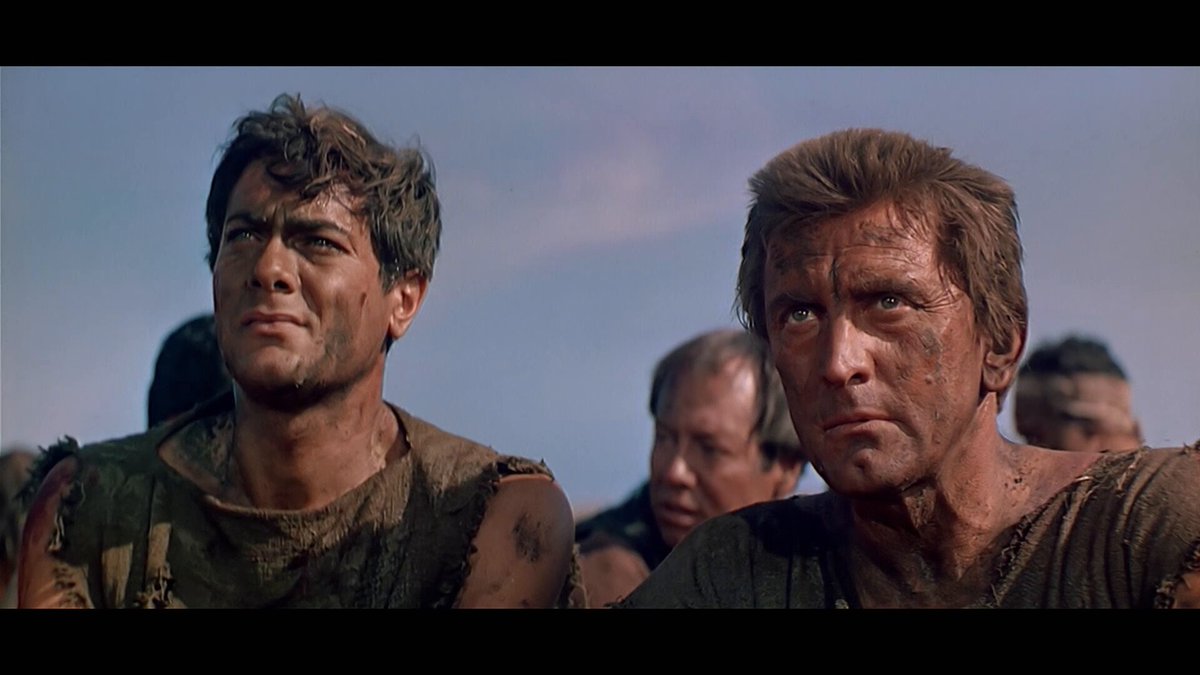
Despite "Spartacus" (1960) being a box-office success & winning four Oscars, Stanley Kubrick disowned the movie as he had no creative control & constant disagreements with Kirk Douglas, Dalton Trumbo & producer Edward Lewis. Kubrick considered the script to be "Pretty dumb". Kubrick believed he achieved only limited success... show more

0 Comments
No comments available
Comments from the original post will appear here



![Tom Cruise explains how people's preconception affected Stanley Kubrick's "Eyes Wide Shut" (1997) "Cruise: People had a preconception about 'Eyes Wide Shut' (1997). And I see how that affected the picture. I think they expected some big s€x movie. As opposed to— and Stanley was very specific about it— s€xual obsession and jealousy. It’s not about s€x. And there were rumors out there about how Stanley was going to make a p0rn0gr@phic picture. But that wasn’t the movie he was making. You can see that they didn’t quite grasp what the movie was, even when they saw it, because they carried the baggage in. They read [screenwriter Frederic] Raphael’s ridiculous book [which portrayed Kubrick as a self-serving collaborator]. And they kind of reviewed it based on that. Interviewer: Do you think the teaser trailer had something to do with the expectation of a more p0rn0gr@phic movie? Was he toying with those expectations? Cruise: Probably. That [trailer] was the first stage for him. You have to understand: it’s Stanley Kubrick. It’s not going to be what you think it is. And he’s not going to tell you everything. So even the people who think they know Stanley Kubrick’s movies... missed it. Because whatever preconception you have, you’ve got to take it on its own merits and not the surrounding elements. In the same way, when I look back at 'Ryan’s Daughter' (1970) and I hear and read the stuff that David Lean went through ... It’s a very painful, lonely, desperate picture. [Shakes head.] And a great one. (Tom Cruise's interview with Cameron Crowe, Vanity Fair, 2000)](https://image.24vids.com/tw-2043407554764476436/amplify_video_thumb/2043396088036724736/img/msznmxCD2N-VMUxf.jpg)
![Stanley Kubrick on why he doesn't like to explain about his movies: "Interviewer: All the books, most of the articles I read about you—It’s all conceptualizing. Kubrick: Yeah, but not by me. I thought I had to ask those kinds of questions. No. Hell, no. That’s my... [He shudders.] It’s the thing I hate the worst. Interviewer: Really? I’ve got all these questions written down in a form I thought you might require. They all sound like essay questions for the finals in a graduate philosophy seminar. Kubrick: The truth is that I’ve always felt trapped and pinned down and harried by those questions. Questions like [reading from notes] “Your first feature, 'Fear and Desire', in 1953, concerned a group of soldiers lost behind enemy lines in an unnamed war; 'Spartacus' contained some battle scenes; 'Paths of Glory' was an indictment of war and, more specifically, of the generals who wage it; and 'Dr. Strangelove' was the blackest of comedies about accidental nuclear war. How does 'Full Metal Jacket' complete your examination of the subject of war? Or does it?” Those kinds of questions. Interviewer: You feel the real question lurking behind all the verbiage is “What does this new movie mean?” Kubrick: Exactly. And that’s almost impossible to answer, especially when you’ve been so deeply inside the film for so long. Some people demand a five-line capsule summary. Something you’d read in a magazine. They want you to say, “This is the story of the duality of man and the duplicity of governments.” [A pretty good description of the subtext that informs Full Metal Jacket, actually.] I hear people try to do it— give the five-line summary — but if a film has any substance or subtlety, whatever you say is never complete, it’s usually wrong, and it’s necessarily simplistic: truth is too multifaceted to be contained in a five-line summary. If the work is good, what you say about it is usually irrelevant. I don’t know. Perhaps it’s vanity, this idea that the work is bigger than one’s capacity to describe it. Some people can do interviews. They’re very slick, and they neatly evade this hateful conceptualizing. Fellini is good; his interviews are very amusing. He just makes jokes and says preposterous things that you know he can’t possibly mean. I mean, I’m doing interviews to help the film, and I think they do help the film, so I can’t complain. But it isn’t... it’s... it’s difficult." (Stanley Kubrick's interview with Tim Cahill, 1987) Clip from: Full Metal Jacket (1987) Director: Stanley Kubrick](https://image.24vids.com/tw-2001764911060521163/amplify_video_thumb/2001665822293659650/img/Qbld2XYIg-OX-zqy.jpg)


