Video wird geladen...

Video konnte nicht geladen werden

Zur Startseite

Do this before you write a single word of your screenplay. Write down six scenes you genuinely want to see in your movie. Not the scenes that should be there structurally — the scenes you actually want to see. Specific moments. Specific images. Things that excite you. They don’t...

0 Kommentare

Keine Kommentare verfügbar

Kommentare vom Original-Post werden hier angezeigt

Ähnliche Videos

Naval Ravikant’s checklist for starting a company “The most important thing is there are no formulas. At the end of the day, you have to do what you love, and you have to do it even though people tell you it’ll never work. But that being said, if there was a formula [for starting a company], I would put it something like this.” Naval started seven companies before AngelList and this is the checklist he recommends running through before starting a startup: 1. Pick a great cofounder. This is most important: “You can do a company on your own, but it’s like you can raise a child on your own, but you probably shouldn’t. You need someone who’s going to be there with you.” This has it’s own checklist. Your cofounder should be: a. Very high intelligence (”hopefully they make you feel dumb, or they’re not smart enough”) b. Very high energy (”They should be extremely hardworking. A founder is someone who never has to be motivated. You should not have to be telling them to do their job.”) c. Very high integrity. (”a smart, hardworking crook who’s going to cheat you is the worst kind of person to be paired up with.”) 2. Pick a very large market. “Notice I don’t talk about the idea. I think ideas are almost irrelevant… The more important thing is that you pick a large space that you’re knowledgeable and passionate about. And then you will figure out what the right thing to do within that space is.” You want to be able to say to investors: “This is a space where there’s a huge market. I’m really knowledgeable and passionate about it. Here’s the great person that I have doing it with me. And here’s the minimum viable product that we have built. That will show that we can test in the marketplace… You iterate until you get to product/market fit… And then you go and you raise money from people you trust. And you use that money to scale.”

Startup Archive

36,050 Aufrufe • vor 1 Jahr

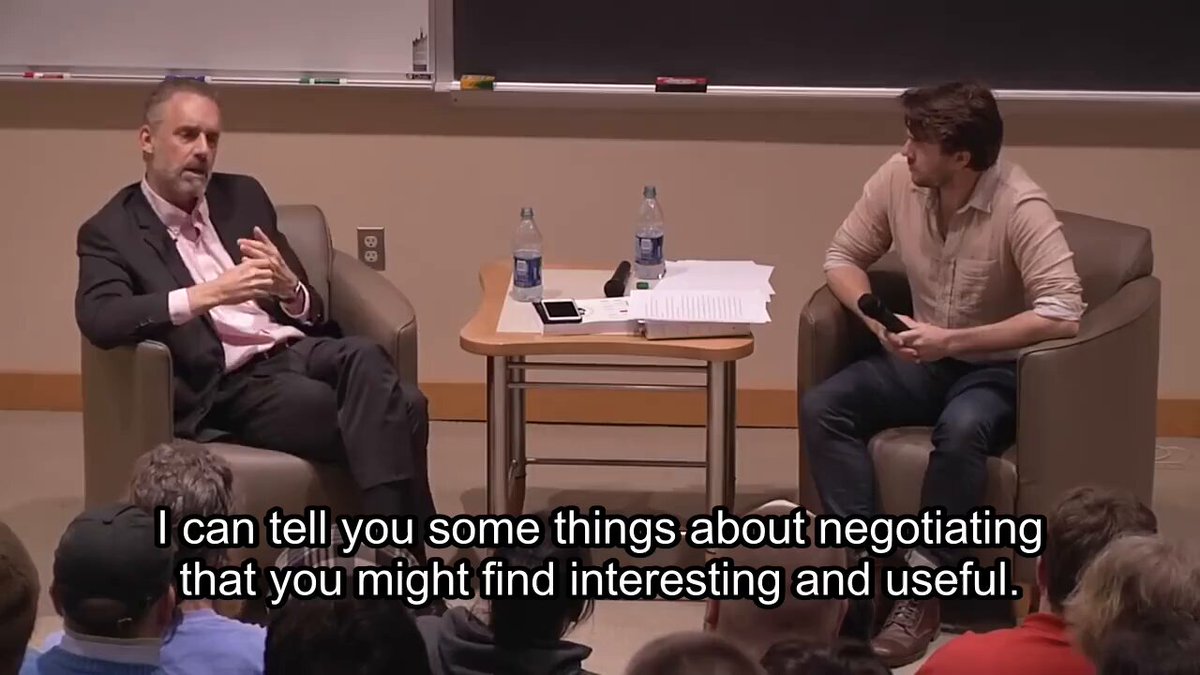
Jordan Peterson: "If you're competent and silent you will be ignored." "You might think well people should reward you because you're competent. And yes of course they should. But if you're competent and silent then you're just part of the background that's keeping everything functioning" On why you cannot negotiate from a position of weakness: "If you want to push your career forward you have to push it forward. You have to be competent and you have to be strategic" "To be strategic when you negotiate for a new position or a new salary you have to be able to say if you don't give me what I want then something you don't like will happen to you" "It's not a physical threat. It's that you have an option" "You have your CV in order. You're educated and competent and desirable to people outside of your immediate job. You're willing to instantly put yourself on the job market" "So that when you go talk to the person you're negotiating with you're credible" On the one thing most people completely miss about negotiation: "It's very seldom that you're talking to the person who's at the top of the pecking order. What you need to do is tell them a story that they can tell to their boss to make you not a problem" "A good story is look we really need this person because they're hyper competent and they have a better offer" "If you go in there with no power you're going to lose. Obviously" He concludes with the one thing every competent person needs to hear: "The first thing you need to know if you're going to negotiate is that you have to be able to say no. And what no means is that you're not going to do it"

Brad

35,334 Aufrufe • vor 3 Monaten

Elon Musk just described a future where money does not exist. Not reformed. Not redistributed. Gone. Musk: “I think things will just be free in the future. If you’ve got an AI robotics economy that is anywhere close to a million times the size of the current Earth economy, literally any need you possibly want can be met.” Forget the sci-fi framing. Listen to what he is actually saying. The entire structure of human civilization runs on a single variable. You need something you cannot freely access. That gap is not a flaw in the system. It is the system. Your employer does not pay you because your work has value. Your employer pays you because you have no choice but to show up. Your government does not protect you out of principle. It maintains order because your dependency on the economy makes you governable. Scarcity is not a natural condition. It is the most successful control structure ever built. Musk: “If you can think of it, you can have it.” Now ask what happens when that structure collapses. A population that does not need a paycheck cannot be managed by one. A population that does not need credit cannot be disciplined by debt. A population that has everything has no reason to comply with anything. This is not a conversation about free goods. This is a conversation about the largest redistribution of leverage in recorded history. But there is a second collapse no one is talking about. Most people have built their entire identity around the constraint. The career they resent is the structure that tells them where to be every morning. The bills they complain about are the exact reason they never had to ask a harder question. Musk: “There actually isn’t money in the future and there’s abundance for everyone.” When the constraint disappears, so does the excuse. The crisis of the coming century will not be material. It will be millions of people standing in total freedom. Discovering they have no idea who they are without the struggle. Every barrier will be gone. And you will finally have to face the one thing scarcity has been protecting you from your entire life. Yourself.

Dustin

41,999 Aufrufe • vor 6 Monaten

Jordan Peterson: "If you can't fix your room, you can't fix your life" "Why should you even bother improving yourself? The answer is something like: so you don't suffer anymore stupidly than you have to. And maybe so others don't have to either. It's not some casual self-help doctrine. If you don't organize yourself properly, you'll pay for it. In a big way. And so will the people around you." Peterson continues: "You can say, 'Well, I don't care about that.' But that's actually not true, you do care about it. Because if you're in pain, you will care about it. It's very rare that you can find someone in excruciating pain who would say, 'Well, it would be no better if I was out of this.' Pain brings the idea that it would be better if it didn't exist along with it. It's incontrovertible." On how to start: "Look around for something that bothers you and see if you can fix it. You can do this in a room. Sit in your bedroom and think: 'If I wanted to spend ten minutes making this room better, what would I have to do?' You have to ask yourself that, it's a genuine question. And things will pop out. There's a stack of papers bugging you. Some rubbish behind your computer monitor you haven't attended to for six months. Cables tangled up." He explains why this matters: "If you were coming to see me for psychotherapy, the easiest thing would be to get you to organize your room. You think, is that psychotherapy? It depends on how you conceive the limits of your being. Start where you can start. If something announces itself as in need of repair that you could repair, fix it. Fix a hundred things like that, your life will be a lot different." On fixing what you repeat every day: "People tend to think of their daily routines as trivial. You get up, brush your teeth, have breakfast. Those probably constitute 50% of your life. People think, they're mundane, I don't need to pay attention to them. No, that's exactly wrong. The things you do every day are the most important things you do. Hands down. Just do the arithmetic." On staying within your competence: "Sometimes you don't know how to fix something. Imagine you're walking down the street and there's a guy who's alcoholic and schizophrenic and has been homeless for ten years. That's a problem. It would be good if you could fix it, but you haven't got a clue. You walk around that and go find something you could fix. Just because something announces itself as in need of repair doesn't mean it's you, right then and there, who should repair it. You have to have some humility. You don't walk up to a helicopter that isn't working and just start tinkering away." Peterson shares the key insight: "As soon as you give your mind a genuine aim, it'll reconfigure the world in keeping with that aim. That's actually how you see to begin with. You've all seen the video where you watch basketballs being tossed back and forth, and while you're doing that, a gorilla walks into the middle of the video and you don't see it. If you thought about that experiment for five years, that would be about the right amount of time to spend thinking about it." He explains what it reveals: "What it shows you is that you see what you aim at. If you can get one thing through your head, that would be a good one. You see what you aim at. One inference you might draw from that is: be careful what you aim at. What you aim at determines the way the world manifests itself to you. So if the world is manifesting itself in a very negative way, one thing to ask is: are you aiming at the right thing?"

Jaynit

68,915 Aufrufe • vor 7 Monaten