Video wird geladen...

Video konnte nicht geladen werden

Zur Startseite

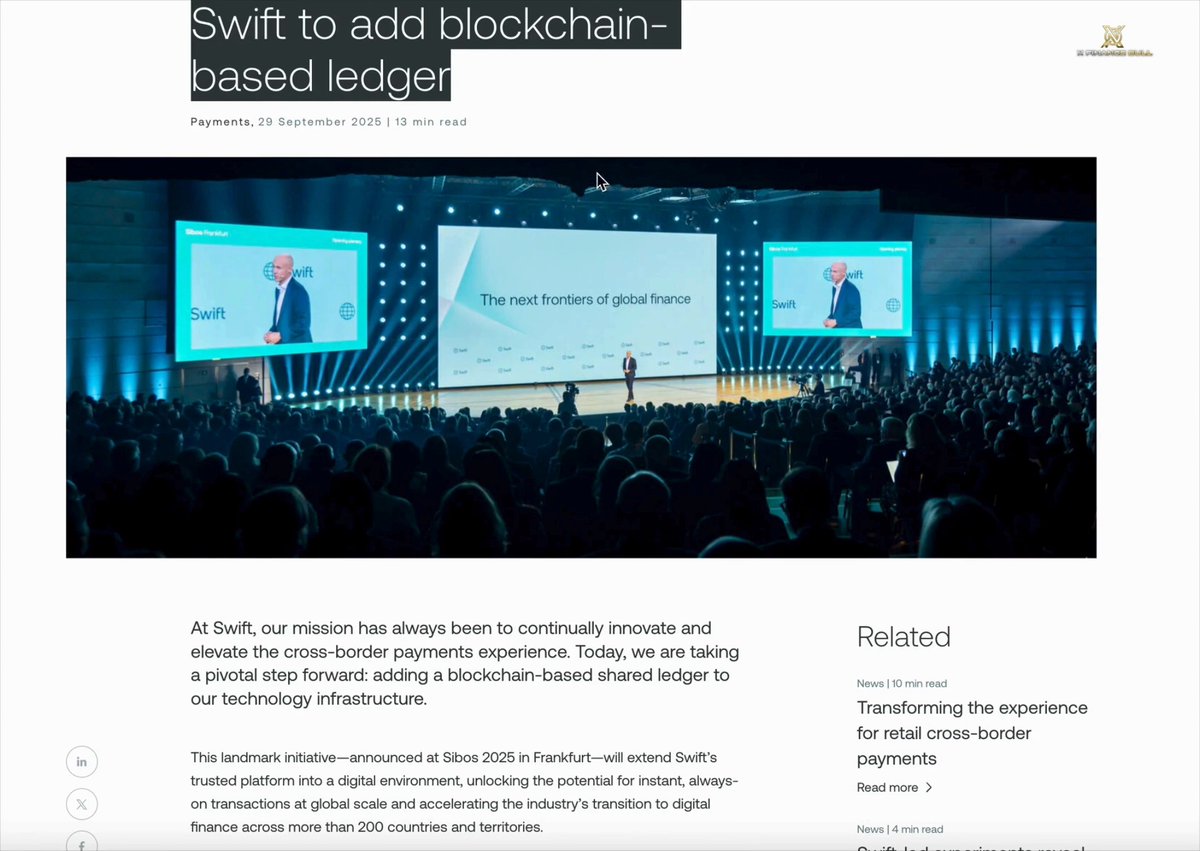
Document Found | Ripple Treasury CONFIRMED with SWIFT 🇺🇸 Today I found proof that Ripple Treasury is partners with SWIFT, the central bank of Italy confirms the entire Eurosystem is moving onchain and Delaware, the legal backbone of the United States upgrades their banking system to incorporate crypto. •...

132,832 Aufrufe • vor 5 Monaten •via X (Twitter)

0 Kommentare

Keine Kommentare verfügbar

Kommentare vom Original-Post werden hier angezeigt
Ähnliche Videos

🌋 Today Is the Moment Crypto Became Part of U.S. Banking Today, the Office of the Comptroller of the Currency issued conditional approvals for national trust bank charters tied to crypto and digital assets, including Ripple, Circle, Fidelity Digital Assets, Paxos, and BitGo. The federal banking system is changing in real time. Two new national trust banks: • Ripple National Trust Bank • First National Digital Currency Bank (Circle) Three state trust companies converting to federal banks: • Fidelity Digital Assets • Paxos • BitGo A national trust bank is a federally chartered institution focused on custody, trust, and fiduciary services, not retail deposits. That places crypto custody and stablecoin infrastructure directly under OCC supervision, instead of fragmented state-by-state frameworks. Zoom out and the pattern is clear: • DTCC approved to tokenize DTC-custodied assets • OCC confirms banks can buy and sell crypto for clients • Stablecoins gain regulatory clarity • Now crypto trust banking goes federal One detail worth paying attention to: BitGo, now moving into the federal banking perimeter, is also a Hedera Governing Council member. That puts a federally regulated crypto custodian directly inside the governance of a public network already being used for enterprise and government use cases. At the same time, Hedera’s end-of-year community call brings together network leadership, council voices, and technical leads to discuss enterprise adoption, real-world deployments, and what scales next. From the filings: • Circle’s charter supports USDC reserve and collateral management • Ripple’s charter supports RLUSD and institutional digital asset custody Worth noting: Ripple Custody already supports multiple networks, including HBAR, SOL, ADA, BTC, ETH, XLM, and others. This is not about one chain. It’s not about hype or short-term price action. It’s about regulated financial plumbing being installed inside the U.S. banking system. Crypto isn’t knocking on the door anymore. It’s being wired into the foundation.

King Solomon (Ryan Solomon)

20,455 Aufrufe • vor 9 Monaten

🚨RIPPLE CEO SAID “WE ARE TAKING OVER SWIFT” BACK IN 2018… SO WHAT HAVE THEY ACTUALLY DONE SINCE THEN? 🤯🔥 Back in 2018 during a Bloomberg interview, Brad Garlinghouse said Ripple was effectively “taking over SWIFT” by SOLVING the bank problem better — and that if Ripple could work with SWIFT, even BETTER. 👀 “What we’re doing and executing on a day-by-day basis is, in fact, TAKING OVER SWIFT…” 😳 At the time, that sounded like a huge claim. But fast forward to 2026… and the story looks VERY different now. 🤯 “SWIFT is owned by the banks and we are here to help the banks.” 👀 Since 2018, Ripple has spent YEARS BUILDING out the EXACT pieces an institutional payments GIANT would need: 👉 Expanded ODL / XRP settlement across 20+ countries 👉 Launched its own stablecoin $RLUSD to add regulated stablecoin liquidity 👉 Processed OVER $100 BILLION in Ripple Payments volume 👉 Acquired Hidden Road / Ripple Prime for institutional brokerage 👉 Bought GTreasury for $1 BILLION And THIS is the BIGGEST one. 🤯🔥 After acquiring GTreasury, Ripple Treasury became part of the SWIFT CERTIFIED PARTNER PROGRAM — giving it DIRECT access to SAME rails used by global institutions. ✅ Then ADD THIS. 👇 Ripple not only wants to “help banks”, but wants to BECOME a U.S. TRUST BANK. 😳 The OCC gave CONDITIONAL APPROVAL for the proposed Ripple National Trust Bank which soon will be FULLY APPROVED. 🚀 RIPPLE DIDN’T ABANDON THE SWIFT THESIS — IT SPENT 8 YEARS BUILDING IT.

Diana

14,143 Aufrufe • vor 5 Monaten

Know This With Full Conviction. In a post-Clarity Act world, Ripple becomes a monetary middleware giant - not the sovereign system itself, but the bridges between: banks → stablecoins → tokenized assets → custody → prime brokerage → global settlement → XRP/XRPL liquidity. Ripple now markets itself as financial infrastructure for payments, custody, stablecoins, and prime brokerage. Ripple Prime is the first global multi-asset prime broker owned by a crypto company, with 3T+ annual clearing and 300+ institutional customers. RLUSD is positioned as a regulated dollar stablecoin backed by cash, Treasuries, and cash equivalents, with NYDFS and DFSA approval. Ripple Custody is explicitly aimed at institutional tokenization, trading, stablecoin, and RWA infrastructure. The Clarity Act matters because it converts today’s regulatory fog into board-defensible adoption logic. The Senate Banking Committee is set to review the Clarity Act on May 14, 2026, with the bill focused on classifying digital assets and establishing regulatory guidelines. Ripple becomes one of the FEW “ready-now” institutional rails for compliant, global value movement. • RLUSD can serve the regulated dollar leg. • Ripple Custody can secure assets. • Ripple Prime can serve institutions. • RippleNet/Ripple Payments can move value. • XRPL can tokenize and settle. • XRP can serve as neutral bridge liquidity where dollar-to-dollar stablecoin rails are insufficient. Ripple makes large portions of correspondent banking, trapped liquidity, slow settlement, fragmented custody, and legacy FX plumbing ECONOMICALLY OBSOLETE where institutions are legally permitted to adopt faster rails. Ripple is today, the 6th largest, non-public company by market cap valuation, in America. And this is before open issues with China, Iran, Ukraine/Russia, Iraq and the Clarity Act are resolved. This is already world-realigning enough, and we still ain’t see nothing, yet. Two words: “Lock in.” America250 Ripple President Donald J. Trump

Rob Cunningham

12,090 Aufrufe • vor 4 Monaten

OMFG! 🚨🚨🚨The Ripple vs SWIFT thesis just got a REAL banking blueprint in South Korea. $XRP holders, look at what is forming. Don’t view JB Jeonbuk Bank by itself. Put it beside what Ripple has already built across Korea in 2026. 🟢Kbank -Digital-asset wallets + Ripple Custody + stablecoin remittance infrastructure. 🟢Kyobo Life Insurance -Tokenized government bonds + institutional custody + near-real-time blockchain settlement. 🟢JB Jeonbuk Bank -Ripple Payments + international business remittances + replacement of the traditional SWIFT/intermediary process. Three different doors into the same financial system: 👉Banking. 👉Capital markets. 👉Payments. That’s where this gets insane to me. Ripple is no longer approaching Korea with one product. It is touching how money is stored, how assets are tokenized and how international value moves. Jeonbuk Bank President Park Choon-won even described the partnership as a new growth engine and talked about reshaping the financial paradigm. Now plug $XRP into that ecosystem. Ripple says XRP and RLUSD underpin its solutions. RLUSD can handle stable dollar settlement. XRP can bridge currencies where liquidity is needed. XRPL provides the settlement rail. So imagine this Korean model spreading through APAC: Korean banks → Ripple Payments → more currencies → more FX routes → deeper XRP liquidity → larger institutional XRP inventories. That’s my hyper-bullish thesis. The huge XRP price catalyst isn’t a bank buying XRP once. It’s banks and liquidity providers needing XRP again and again as working liquidity while real businesses continuously move money across borders. South Korea may be showing us the blueprint first. The rest of the world will follow.

X Finance Bull

19,297 Aufrufe • vor 1 Monat

If you hold $XRP, remember this name: Rosie Rios. Her signature once appeared on roughly $1.8 TRILLION in U.S. currency. Then she joined Ripple. That career path still blows my mind. Rosie Rios served as the 43rd Treasurer of the United States. She worked around Treasury, the Federal Reserve ecosystem, the U.S. Mint and the Bureau of Engraving and Printing. She literally helped oversee the machinery behind America's physical money. Then in 2021, she joined Ripple’s Board of Directors. And she didn’t speak about crypto like some speculative casino. She said: “Blockchain and crypto will underpin our future global financial systems.” Then came the line every $XRP holder should know: “XRP’s primary purpose is facilitating cross border payments.” Think about who said that. Someone who spent years around the U.S. monetary system, public finance and institutional investment management. Years later, her message to banking executives became even more direct: “We are moving from fiat cash to computer code.” That transition is exactly what fascinates me. Physical dollars → digital money → blockchain settlement → global payments. And Ripple has kept building deeper into that direction with Ripple Payments, RLUSD, Ripple Prime, Ripple Custody, Ripple Treasury and XRP Ledger. Meanwhile XRP still does what Rosie highlighted years ago: bridge currencies and move value across borders in seconds. She went from helping oversee physical U.S. money to helping guide a company building digital financial rails. That connection alone deserves more attention from the $XRP community. I AM BULLISH!

X Finance Bull

92,404 Aufrufe • vor 1 Monat

What if the U.S. starts buying Treasury bonds with ripple:native or RLUSD and puts them on the XRP Ledger? South Korea’s YTN just asked a question that sounds wild at first: “Buying U.S. Treasury Bonds with Crypto?” But when I started connecting it with what Scott Bessent, Ripple, RLUSD and the XRP Ledger are already doing, this stopped looking like some random crypto theory. The pieces are already sitting right in front of us. The United States has now crossed roughly $40 trillion in federal debt. That means the government constantly needs buyers for enormous amounts of Treasury securities. Not once. Again and again. Old debt matures. New debt gets issued. Short-term bills need buyers. Interest keeps getting paid. The whole system depends on keeping demand for U.S. government debt strong. And this is exactly where stablecoins suddenly become much more important than most people realize. Scott Bessent has already talked about stablecoins creating more demand for U.S. Treasuries. The logic is actually simple. A regulated dollar stablecoin needs real assets behind it. Under the GENIUS Act framework, stablecoins are backed 1:1 by eligible high-quality reserves such as cash, short-term Treasuries, Treasury-backed repo and government money-market funds. So when stablecoins grow, their reserve pools grow too. And when those reserves include Treasury bills, stablecoin adoption can create another source of demand for U.S. government debt. That means crypto growth does not have to weaken the dollar. It can actually create another global buyer base for dollar assets. That completely changes how I look at RLUSD. RLUSD is not just another dollar token sitting beside USDC and other stablecoins. Ripple’s own RLUSD reserve structure already allows short-term U.S. Treasury bills with three months or less remaining maturity, overnight reverse repos backed by Treasuries, U.S. government money-market funds and bank deposits. Think about what that means. If RLUSD grows, the pool of assets backing RLUSD grows. If RLUSD becomes a major institutional stablecoin, Ripple’s ecosystem can become a major holder of the same short-term government assets the U.S. Treasury needs constant demand for. Imagine RLUSD at $10 billion. Then $25 billion. Then $50 billion. Then $100 billion. The bigger the supply becomes, the bigger the reserve base behind it becomes. And part of that reserve base can be short-term U.S. government debt. That already gives Ripple a direct connection to the exact stablecoin-Treasury thesis Scott Bessent has been talking about. But this is where it gets even more interesting. Ripple is not stopping at Treasuries backing RLUSD. Treasuries themselves are already being brought onto the XRP Ledger. Ondo Finance launched OUSG on XRPL. OUSG gives qualified institutional investors exposure to short-term U.S. government Treasuries. And what can institutions use to mint and redeem that Treasury exposure on XRPL? RLUSD. That means this architecture already exists: RLUSD ↓ tokenized U.S. Treasury exposure ↓ OUSG ↓ XRP Ledger This is the part that really gets me. We are not imagining some future where Ripple eventually connects stablecoins with U.S. Treasuries. That connection is already being built. You have Treasury assets sitting behind the digital dollar. Then you also have Treasury products represented directly on the blockchain. And both can interact through the same ecosystem. That gives Ripple two different positions inside the Treasury market. First: Treasuries can back RLUSD. Second: Treasuries can themselves be tokenized on XRPL. That means Ripple could potentially sit on both sides of a new digital Treasury market. Digital cash on one side. Digital U.S. government debt on the other. XRP Ledger between them. And ripple:native sitting underneath the network as the native asset and potential bridge between different pools of liquidity. That is a much bigger story than “Ripple has a stablecoin.” Ripple has also committed $10 million to OpenEden’s tokenized U.S. Treasury-bill product on XRPL. That tells me Ripple clearly understands where this is going. They are not waiting for tokenized Treasuries to become a trend. They have already put capital behind bringing those products directly onto XRP Ledger. Then you have Guggenheim Treasury Services. Ripple highlighted digital commercial paper administered by Guggenheim Treasury Services on XRPL. That instrument is secured by U.S. Treasuries and carries a Prime-1 Moody’s rating. Now step back and look at what is forming. RLUSD. Ondo OUSG. OpenEden Treasury bills. Guggenheim Treasury Services. Tokenized fixed income. Institutional custody. Ripple Prime. Ripple Payments. XRP Ledger. ripple:native. All of these pieces are starting to sit inside the same financial stack. That is why I think people are looking at the $40 trillion U.S. debt problem from the wrong angle when they only ask: “How will America ever pay this?” The more interesting question for me is: How will America keep finding buyers for trillions of dollars of government debt while modernizing the financial system at the same time? Stablecoins can help create buyers. Tokenization can help create distribution. Blockchain can help create 24/7 settlement. And Ripple is building in all three areas. Imagine how Treasury investing works for a normal global institution today. You may need banking relationships. Custody. Brokerage. Settlement infrastructure. Different accounts. Different systems. Different operating hours. Now imagine Treasury exposure existing directly on XRPL. The investor can hold RLUSD. Move into tokenized Treasury exposure. Redeem back into RLUSD. Move the dollar liquidity somewhere else. Do it around the clock. That is a completely different experience. Treasuries stop being something that only sits inside old databases. They become programmable financial assets. That matters because America does not just need Treasuries to exist. America needs Treasuries to remain attractive. Liquid. Easy to buy. Easy to hold. Easy to use. Easy to move. And eventually, easy to use as collateral. That is where tokenization becomes much bigger than simply putting a bond onchain. Imagine buying a tokenized Treasury and then using it as collateral. Borrowing against it. Moving it between institutions. Settling it against digital dollars. Redeploying that liquidity instantly. Now a Treasury is no longer just something you buy and wait for. It becomes a working financial asset. And the more useful Treasuries become, the more reasons global institutions have to hold them. This is why the XRP Ledger piece matters. XRPL can become infrastructure where those assets move. RLUSD can become the digital cash side. Then ripple:native can become the neutral liquidity layer between all the different assets and currencies touching that network. Because the future XRPL does not have to contain only RLUSD and Treasury products. Imagine it contains: RLUSD. Tokenized Treasuries. EUR stablecoins. MXN stablecoins. Tokenized deposits. Money-market funds. Commercial paper. Foreign government debt. Private credit. Different institutions will hold different assets. Different countries will use different currencies. That creates a liquidity problem. You cannot expect every possible asset pair to have a massive direct market. A Japanese institution may start with yen liquidity. A European institution may need euros. A Mexican institution may need pesos. A U.S. institution may need RLUSD. A Treasury fund may need to move into cash. This is where ripple:native becomes much more interesting. XRP can potentially sit in the middle as the bridge. Asset A → ripple:native → Asset B. So imagine a Japanese bank wants $1 billion worth of tokenized U.S. Treasury exposure. It starts with Japanese liquidity. The route could eventually become: JPY ↓ ripple:native ↓ RLUSD ↓ tokenized Treasury Then later that institution wants to exit. Tokenized Treasury ↓ RLUSD ↓ ripple:native ↓ JPY Now imagine the same thing happening from Europe. -South Korea. -Singapore. -Hong Kong. -UAE. -Mexico. -Brazil. The United States gets another global distribution channel for its debt. Ripple gets institutional activity. XRPL gets settlement volume. RLUSD gets dollar demand. And ripple:native can become part of the liquidity connecting all of those markets. That is where this gets much bigger than payments. Because once tokenized Treasuries become collateral, you are no longer only talking about buying and selling government debt. You are talking about credit. -Repo. -Margin. -Working capital. -Liquidity management. -Treasury management. -Institutional trading. Imagine a company holds $2 billion in tokenized Treasuries on XRPL. It suddenly needs $500 million of liquidity. Instead of selling everything and moving through multiple systems, it uses the Treasury position as collateral. Receives RLUSD. Then converts part of that liquidity into another currency through ripple:native. Now ripple:native is sitting in the middle of: -money -government debt -FX -credit -collateral That is a completely different role from people simply trading XRP on an exchange. And Ripple has been building the institutional infrastructure around that role. Ripple Prime gives Ripple a connection into professional capital markets. Ripple Custody gives institutions infrastructure for holding digital assets. Ripple Payments handles movement. RLUSD provides regulated dollar liquidity. XRPL handles tokenization and settlement. ripple:native sits natively underneath the ledger. When I put all of that beside what Scott Bessent is saying about stablecoins and Treasuries, I cannot ignore the alignment. The U.S. wants stronger global demand for dollars. Stablecoins can extend dollars onto digital rails. The U.S. wants buyers for Treasury bills. Stablecoin reserves can become buyers. The U.S. wants more efficient capital markets. Tokenized Treasuries can make those assets easier to move and use. Ripple already has a regulated stablecoin. RLUSD already has Treasury-eligible reserve assets. XRPL already has tokenized Treasury products. RLUSD already interacts with OUSG. Ripple has already backed OpenEden Treasury infrastructure. Guggenheim Treasury Services already has Treasury-secured digital commercial paper on XRPL. This is not one random announcement. It is a system starting to form. And there is another point I think is being missed. The bullish XRP thesis does not require the U.S. dollar to fail. I actually think the opposite scenario is much stronger. Imagine the dollar becomes even more dominant because regulated stablecoins make it easier for anyone in the world to hold and move digital dollars. Those stablecoins create more demand for U.S. Treasuries. Treasuries themselves become tokenized. Global investors buy them 24/7. And ripple:native becomes one of the liquidity assets connecting those digital dollars and Treasury products to currencies around the world. In that world: the dollar wins. Treasuries win. Ripple wins. XRPL wins. And ripple:native gets a much bigger liquidity role. That is why the GENIUS Act matters here too. The framework is pushing stablecoins toward regulated 1:1 reserve structures. Bessent has talked about stablecoins strengthening dollar dominance. Ripple already has RLUSD. RLUSD is issued through a New York-regulated structure. BNY is the primary custodian for RLUSD reserves. That is serious financial infrastructure. It means Ripple is not building some completely separate parallel monetary system. It is building directly around the same regulated dollar and Treasury framework Washington is encouraging. And that is what makes this thesis so powerful to me. The path does not need to be: America abandons the dollar. America adopts XRP. That sounds unrealistic and honestly misses the point. The much bigger setup is: America keeps the dollar. America keeps Treasuries. Stablecoins make the dollar more digital. Tokenization makes Treasuries more accessible. Ripple builds the infrastructure around both. And ripple:native connects them to the rest of the global financial system. That is a completely different level of adoption. Now take this to the highly bullish scenario. Imagine the global stablecoin market reaches $3 trillion. RLUSD becomes one of the major institutional stablecoins. Maybe it reaches $100 billion or more in circulation. That means an enormous reserve pool exists behind it. Part of that reserve base holds short-term Treasury securities, Treasury-backed repo and government money-market instruments. Ripple becomes a major private-sector participant in short-term U.S. government debt demand. At the same time, tokenized Treasury products on XRPL grow from where they are today into tens of billions. Then hundreds of billions. Global asset managers start holding Treasury exposure directly on XRPL. Banks use RLUSD to enter and exit those positions. Treasuries get used as collateral. Institutions borrow against them. Ripple Prime connects the professional market. Ripple Custody holds the assets. XRPL settles them. Then currencies from around the world need to enter and exit that system. That is where ripple:native can explode in importance. Market makers need XRP inventory. Liquidity providers need deeper XRP books. Banks need larger settlement capacity. More XRP sits inside institutional liquidity operations. The amount of financial value that needs to move through the system keeps increasing. And suddenly the market has to ask a very different question: Is the current dollar value of ripple:native large enough to provide liquidity for this kind of financial system? Imagine $100 billion of tokenized Treasuries. Then $500 billion. Then trillions of tokenized fixed income across XRPL and connected markets. Imagine RLUSD at $100 billion. Imagine global currencies continuously moving in and out. At that point, the amount of liquidity required looks nothing like today's crypto market. A higher ripple:native price means every unit can represent more dollar value. That gives liquidity providers more settlement capacity without needing absurd quantities of XRP for every transaction. That is why I see price and liquidity eventually becoming connected. The bigger the financial system that XRP is asked to connect, the deeper the dollar value of XRP liquidity needs to become. The full loop could look like this: U.S. debt keeps growing ↓ Treasury needs more buyers ↓ stablecoins expand ↓ stablecoin issuers buy more short-term Treasury assets ↓ RLUSD grows ↓ Treasury products become tokenized ↓ XRPL captures more of those assets ↓ global investors enter through RLUSD ↓ more global currencies connect ↓ ripple:native bridges fragmented liquidity ↓ market makers need more XRP inventory ↓ Ripple Prime expands institutional liquidity ↓ XRPL becomes deeper financial infrastructure ↓ ripple:native represents more value inside that system ↓ price reprices higher. That is the scenario I keep coming back to. Because the wild part is that the starting pieces already exist. RLUSD already has Treasury-eligible reserves. Scott Bessent already sees stablecoins as a potential source of Treasury demand. The GENIUS Act already created the regulatory direction. Ondo OUSG already exists on XRP Ledger. RLUSD already provides an entry and redemption path for that Treasury exposure. Ripple already committed $10 million to OpenEden Treasury products. Guggenheim Treasury Services already has Treasury-secured fixed income on XRPL. BNY already sits behind RLUSD reserve custody. Ripple already has Prime, Payments and Custody. So when YTN asks: “Buying U.S. Treasury Bonds with Crypto?” I do not read that as some distant fantasy anymore. I look at the infrastructure being built and think: What happens when the world's largest government debt market meets regulated stablecoins, tokenized securities and 24/7 blockchain settlement? And what happens if XRP Ledger becomes one of the rails carrying it? That is the part people should be thinking about. Because the real ripple:native thesis may not be about replacing the dollar at all. It may be about becoming the liquidity layer underneath a stronger, more digital dollar system. RLUSD can bring dollars onchain. Tokenized Treasuries can bring U.S. debt onchain. XRPL can become the marketplace and settlement layer. And ripple:native can connect that system to the rest of the world. If that scales into trillions, we are no longer talking about XRP as just another crypto asset. We are talking about ripple:native sitting inside the liquidity architecture connecting digital dollars, U.S. government debt, FX, collateral and global institutional capital. That is the scenario I am watching. You?

X Finance Bull

237,949 Aufrufe • vor 26 Tagen

🚨🚨🚨IF YOU HOLD $XRP READ EVERY WORD OF THIS! $13 trillion in corporate payments. AI-managed treasury. $XRP as the settlement engine underneath all of it. 𝐆𝐫𝐚𝐩𝐞 mapped the full Ripple architecture and it answers every question about how adoption actually happens. Corporations won't adopt XRP because crypto Twitter tells them to. They'll adopt it because it plugs into the enterprise tools they already run. SAP. Oracle. AP/AR. General ledger. Ripple Treasury connects to all of it through one API layer called ClearConnect. Same API connects to banks and SWIFT on one side. Ripple Payments, Ripple Prime, Custody, RLUSD, and XRPL on the other. The corporation picks which rails to use. Traditional takes days. Digital takes seconds. Every time they pick the digital rail, XRP settles the value. RLUSD handles the dollar side. The volume flows through XRPL. That's not speculation. That's how the plumbing works. AI makes it inevitable. GSmart optimizes cash flows, models liquidity, runs autonomous agents. The algorithm routes money through the fastest, cheapest path. XRP wins that calculation every time against SWIFT. The price isn't reflecting a speculative asset anymore. It's reflecting the market's failure to understand that $XRP is inside a $13 trillion payment system waiting for corporations to flip the switch. When they do, the volume creates demand the order books aren't prepared for. The architecture is built. The math is simple. $XRP HOLDERS TIME IS HERE! 🔥

X Finance Bull

138,188 Aufrufe • vor 5 Monaten

BIG DAY TODAY!🇺🇸🚨 Ripple, with $XRP as its North Star, is joining President Trump and major crypto and Wall Street leaders at the table. I hope you already bought the dip. Because look at what is happening in Washington within just THREE days. 🟢August 18: SEC Chair Paul Atkins moves forward with Regulation Crypto Assets, creating new pathways for crypto under federal securities law. 🟢August 19: Ripple joins Coinbase, Chainlink, Nasdaq, CME Group, DTCC, ICE and others at the White House-level meeting, with President Donald Trump expected to attend. 🟢August 20: Brad Garlinghouse takes his official seat on the CFTC Innovation Advisory Committee alongside leaders from Nasdaq, CME, DTCC, Franklin Templeton, Coinbase, Chainlink and other major financial players. That sequence gets me fired up. Ripple spent years fighting for its place in America. Now Brad is helping discuss how blockchain fits into American financial markets. And Ripple isn’t arriving empty-handed. It already has Ripple Payments, Ripple Custody, Ripple Prime, Ripple Treasury, RLUSD, Ripple Mint and the XRP Ledger. Brad himself said: “All roads lead back to Ripple’s North Star, $XRP.” Ripple also says XRP sits at the heart of its institutional XRPL use cases across payments, FX, liquidity, collateral, lending and settlement. That’s what makes today bigger than a photo with Trump. The rules are being rewritten. Wall Street is in the room. Ripple is in the room. And $XRP is the asset Ripple has spent more than a decade building around. This week could be remembered for a long time. Did you buy the dip?

X Finance Bull

45,299 Aufrufe • vor 1 Monat