正在加载视频...
视频加载失败
During her interview on Joe Rogan, Secrets in Stone mentioned that some people believe it’s simply a pile of sand. 👋 Guilty. I was among the first online to suggest that—not as a dismissal, but based on nearly two decades studying the Giza Plateau, time spent on the ground... show more

10,793 次观看 • 2 个月前 •via X (Twitter)
22 条评论

@joerogan @CassieCMartin Why don’t they dig up the hill? It’s sand. can’t they just like, move it and see? They can put it back. probably a stupid question; revealing my ignorance of the many reasons why it’s hard or otherwise impossible. But man, it’s like… move the dirt. End the mystery!

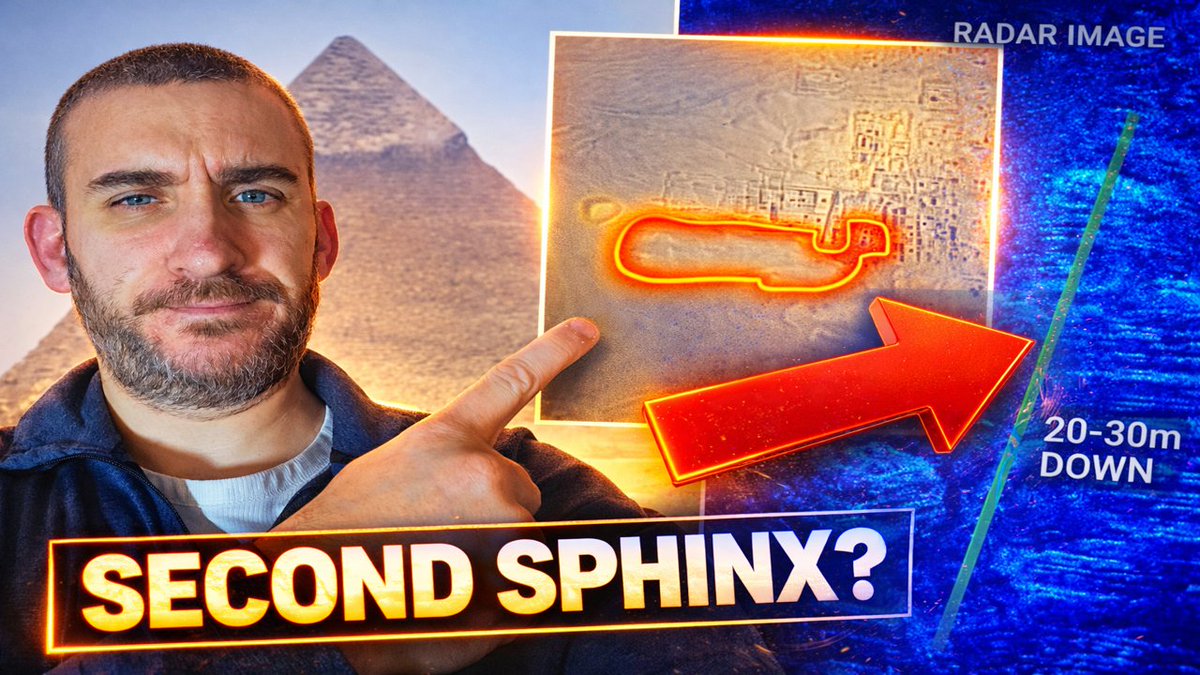
We already know there’s nothing visible above ground beyond the pile of excavation spoil. That spoil accumulated over decades, and there was no exposed monument there before it was dumped. (This is why Biondi had too shift the goal post from Damiano original 2nd sphinx hypothesis being the pile of sand above ground to Biondi’s new and improved version of being 100% certain a sphinx rests under the ground beneath the sand pile - after it was properly understood the sand pipe is a spoil dump.) If there had been a compelling reason to excavate that exact spot, the archaeologists working there would have done so. Instead, they chose to excavate right beside it. So the question becomes: why not simply remove the spoil and investigate beneath it? Because archaeological excavations aren’t driven by one person’s interpretation of proprietary software—especially when the underlying claims are already viewed skeptically. These projects require permits which require funding, planning, conservation, and months or years of work. You don’t just throw a shovel into the ground. Even if they excavated beneath the spoil, the most likely outcome would be additional tombs, cavities, or other features similar to those already being uncovered nearby—not necessarily a monumental sphinx. Keep in mind, the original Sphinx was inspired by its own head - a yarding or outcropping, extending from the outcropping which the ancient Egyptians carved down and formed a body. We don’t have a second outcropping like that. The real question is this: if Biondi is truly confident and has more than 100,000 people following this story, why not raise the funding? If every supporter contributed just $1, he could submit a formal proposal, obtain the necessary permits, and finance a proper archaeological investigation. He already has the academic credentials. If the evidence is as compelling as claimed, that’s the appropriate way to put the hypothesis to the test. The real mystery is not why won’t the Egyptian authorities dig there, rather, if Biondi is 100% certain a Sphinx lies below, then why isn’t he putting his money where his mouth is?

@joerogan @CassieCMartin Looks like a mastaba ? Could the excavation debris have been dumped on top or around a mastaba ?
When’s a Mastaba not a Mastaba? When it’s a pile of sand. 😉 Sand removed from the excavation right beside it, an excavation that revealed tombs. It’s possible the pile of sand is sitting on ground level and if you dig beneath the ground, you’ll find tombs. After all, the whole area has littered with them. Yes, it’s possible if we flatten all that sand pile down to the ground and dig beneath we could find something. Just right beside it as excavated tombs.

@joerogan @CassieCMartin Yet nobody talks about the true meaning of "the second sphinx" in art. The east and the west, not on the Giza plateau, but in the sky. The trefoil iconography in ancient cultures and its relation to the sky leopards and the stars.

@joerogan @CassieCMartin I like the Italians, but I'd like to seem some evidence on the ground.
@joerogan @CassieCMartin I like their cannolis. 🤣 “Take the Sphinx theory, leave the cannoli”
@joerogan @CassieCMartin Mmmm delicious!!!!! :)

@joerogan @CassieCMartin You can’t wrap up your opinion of a scientist with your comment section
@joerogan @CassieCMartin That’s the whole point of the scans brother to push people to excavate

@joerogan @CassieCMartin Why are there shafts going down under the random debris in the scans? A pile of rubble shouldn't have shafts going down. May not be a sphinx, but it isn't nothing according to the scans. Oh a wild idea, we could excavate it in a few months....

@joerogan @CassieCMartin When I listened to a clip from the Podcast today I thought she specifically mentioned that you had to clear that whole pile of sand away and then dig under the "level' ground area to see the second sphinx, not that the pile of sand hid a sphinx underneath the sand mound.
Yes, that’s correct. Damiano Piras originated the hypothesis and published a book about it before presenting it to Biondi a year later. I’ve remained in direct contact with Piras and know the original hypothesis very well. I’ve also followed all of Biondis claims and presentations. Biondi later adopted and embellished the original theory without ever sufficiently explaining Piras’s original work, focusing more on his interpretation of his scan interpretation, based on his own proprietary software applied to the commercial scan. As it stands, Biondi claims the second Sphinx lies beneath the surface, beneath the pile of sand.
@joerogan @CassieCMartin You always have the sauce. My man!
@joerogan @CassieCMartin I was taught to go straight to the source. When you’re from Boston, Massachusetts, as I am, the source becomes sauce. 😉

@joerogan @CassieCMartin Do you think the pyramids were built by 4th Dynasty Egyptians or are you of the belief they are older, likely 12k years or so?

@joerogan @CassieCMartin all else has failed, go back to the wall. that has not been covered up and rewritten history. the clues are there to go in to the map room. a 3D stone map of the entire plato to the (then) river location, 2 ways to get in by river or by the location of the stardate stamp.

@joerogan @CassieCMartin Both Damiano Piras & Filippo Biondi explain u are right - because the second sphinx is BELOW the surrounding surface level (by about 7 or 8 meters), which means that u could throw away all the excavation debris composing the mound and u are still 7-8 meters ABOVE the 2nd sphinx.

@joerogan @CassieCMartin Dig a facking hole and prove it or disprove it. Otherwise shut up

@joerogan @CassieCMartin If there was even a 1% chance of a Sphinx underneath that, Zahi Hawass would've been out there with a camera crew in the 1980s digging it up with his bare hands

@joerogan @CassieCMartin Just rent a bulldozer and level in the middle of the night. lmao Mystery solved.

@joerogan @CassieCMartin Just dig


![“Everything is connected—the Great Flood, the Zep Tepi, the pyramids.” Filippo Biondi’s research is about to rewrite human history. He discovered massive shafts that go 2,000 feet below the pyramids. Now, he’s convinced that the evidence is overwhelming enough to declare that the pyramids were built more than 11,000 years ago. Biondi’s discoveries could be the nail in the coffin for mainstream archaeology. He just broke it all down with Joe Rogan: “Inside the pyramids, they found a lot of salt on the walls.” “Two months ago, I went for the first time to visit the pyramids, and I found salt on the wall.” Rogan: “So you think that that salt is because the entire area was flooded?” Biondi: “Yes.” Rogan: “And that’s the reason why the shafts were flooded and filled with debris?” Biondi: “Yes.” Rogan: “Because everything just flooded into there, and then when the sea receded … you’re left with salt everywhere.” “John Anthony West thought maybe 30,000+ years to the construction of the Sphinx.” “And the water erosion [on the Sphinx], it’s vertical fissures that come from thousands of years of rainfall.” “And the last time there was like significant rainfall in the Nile Valley like that was 9,000 years ago.” Biondi: “That’s why this research … it is very important.” Rogan: “It would really rewrite everything.” What is your reaction to Biondi’s discoveries? Follow Holden Culotta Joe Rogan Joe Roganhq](https://image.24vids.com/tw-2015130476017602810/amplify_video_thumb/2015130387777769472/img/Ftwu6JZHHI-rCr-Z.jpg)

![Many times I'm asked, 'why not just drop a light and camera down the shafts on a string to see what's there?' It's a perfectly valid question, which is why I've already done it, with an 8k, 360° camera, to catch every side passage, tunnel and adjacent chamber. I've done it to MANY of them. I've documented, to their visible bottoms, about half the shafts on the Giza Plateau, and unless you've been there, you have no idea what a massive task that was... even though the vast majority are filled with sand to ground level. Recently, I've confidently stated that there are over a thousand vertical shafts at Giza, between the Eastern, Western and Southern Cemeteries, but in the past week, I've looked deeper into the matter. I have carefully zoomed in on satellite imagery and placed a red arrow on every single shaft that is clearly visible. Given the final count of copied layers in photoshop, and the obvious fact that many of them are still buried and not visible at all, I amend by previous statement. THERE ARE AT LEAST 3,000 SHAFTS AT GIZA! In the Western Cemetery alone are at least 1,800, near the Second Sphinx mound and the NC2 Complex. Yet still, we're told there's 'nothing to see beneath the pyramids'. Tomorrow I will share the satellite image maps, as they are included in my interview with Corrado Malanga, [ ] but today I will share this clip as an example. This one is not at Giza. Do you know where it is?](https://image.24vids.com/tw-2081507868717486179/amplify_video_thumb/2081507030322294784/img/IzrREGBZ1Ej19Ln3.jpg)
![Filippo Biondi says that the Great Flood, the Zep Tepi, and the pyramids are all connected. The Italian space engineer just told Joe Rogan that the seawater salt still stuck to the walls inside the Great Pyramid proves the entire area was flooded thousands of years ago. That same salt is the evidence that ties everything together with Zep Tepi. "Inside the pyramids, they found a lot of salt on the walls." "Two months ago, I went for the first time to visit the pyramids, and I found salt on the wall." Rogan: "So you think that that salt is because the entire area was flooded?" Biondi: "Yes." Rogan: "And that’s the reason why the shafts were flooded and filled with debris?" Biondi: "Yes." Rogan: "Because everything just flooded into there, and then when the sea receded … you’re left with salt everywhere." "John Anthony West thought maybe 30,000+ years to the construction of the Sphinx." "And the water erosion [on the Sphinx], it’s vertical fissures that come from thousands of years of rainfall." "And the last time there was like significant rainfall in the Nile Valley like that was 9,000 years ago." Biondi: "That’s why this research … it is very important." Rogan: “It would really rewrite everything.” This means the pyramids were built sometime between Zep Tepi and the Great Flood, which could push their age back dramatically. The salt on the walls is ocean salt from when the sea rushed in over 11,000 years ago and filled the shafts with debris. Biondi is convinced this changes everything we thought we knew about ancient history. What is your reaction to Biondi’s discoveries?](https://image.24vids.com/tw-2037215220125311092/amplify_video_thumb/2037214742872248320/img/szDrddleei5DWcM3.jpg)
![Filippo Biondi says that the Great Flood, the Zep Tepi, and the pyramids are all connected. The Italian space engineer just told Joe Rogan that the seawater salt still stuck to the walls inside the Great Pyramid proves the entire area was flooded thousands of years ago. That same salt is the evidence that ties everything together with Zep Tepi. "Inside the pyramids, they found a lot of salt on the walls." "Two months ago, I went for the first time to visit the pyramids, and I found salt on the wall." Rogan: "So you think that that salt is because the entire area was flooded?" Biondi: "Yes." Rogan: "And that’s the reason why the shafts were flooded and filled with debris?" Biondi: "Yes." Rogan: "Because everything just flooded into there, and then when the sea receded … you’re left with salt everywhere." "John Anthony West thought maybe 30,000+ years to the construction of the Sphinx." "And the water erosion [on the Sphinx], it’s vertical fissures that come from thousands of years of rainfall." "And the last time there was like significant rainfall in the Nile Valley like that was 9,000 years ago." Biondi: "That’s why this research … it is very important." Rogan: “It would really rewrite everything.” This means the pyramids were built sometime between Zep Tepi and the Great Flood, which could push their age back dramatically. The salt on the walls is ocean salt from when the sea rushed in over 11,000 years ago and filled the shafts with debris. Biondi is convinced this changes everything we thought we knew about ancient history. What is your reaction to Biondi’s discoveries?](https://image.24vids.com/tw-2057231248221687955/amplify_video_thumb/2057231183570677760/img/a2D3WfuzNgmDawS4.jpg)

![Filippo Biondi says that the Great Flood, the Zep Tepi, and the pyramids are all connected. The Italian space engineer just told Joe Rogan that the seawater salt still stuck to the walls inside the Great Pyramid proves the entire area was flooded thousands of years ago. That same salt is the evidence that ties everything together with Zep Tepi. "Inside the pyramids, they found a lot of salt on the walls." "Two months ago, I went for the first time to visit the pyramids, and I found salt on the wall." Rogan: "So you think that that salt is because the entire area was flooded?" Biondi: "Yes." Rogan: "And that’s the reason why the shafts were flooded and filled with debris?" Biondi: "Yes." Rogan: "Because everything just flooded into there, and then when the sea receded … you’re left with salt everywhere." "John Anthony West thought maybe 30,000+ years to the construction of the Sphinx." "And the water erosion [on the Sphinx], it’s vertical fissures that come from thousands of years of rainfall." "And the last time there was like significant rainfall in the Nile Valley like that was 9,000 years ago." Biondi: "That’s why this research … it is very important." Rogan: “It would really rewrite everything.” This means the pyramids were built sometime between Zep Tepi and the Great Flood, which could push their age back dramatically. The salt on the walls is ocean salt from when the sea rushed in over 11,000 years ago and filled the shafts with debris. Biondi is convinced this changes everything we thought we knew about ancient history.](https://image.24vids.com/tw-2066505612775538768/amplify_video_thumb/2066505417065136128/img/BHuvGsdrZih_m8fy.jpg)