Загрузка видео...

Не удалось загрузить видео

На главную

Dylan Patel says GPUs are no longer the biggest bottleneck. According to Dylan Patel, now CPUs are the constraint. In the early AI era, CPUs were the laggers. You used them for storage, checkpointing, pre-processing, etc. (pretty light workloads) The models weren't agentic and couldn't go step by step....

303,474 просмотров • 5 месяцев назад •via X (Twitter)

Комментарии: 0

Нет доступных комментариев

Здесь появятся комментарии из оригинального поста

Похожие видео

Cathie Wood just flagged the sleeper trade inside the AI boom that most people are completely missing. Everyone has been chasing GPUs. Nvidia, the data center buildout, the chip arms race. That trade has been obvious for two years. But OpenAI's CFO Sarah Fryer said something quite different: people are going to be really shocked by how agentic AI activates CPUs. Right now, for every CPU in an AI workload, there are 4 to 5 GPUs. That's the current ratio. Wood thinks that ratio is going to 1 to 1. Think about what that means. AI inference at scale, agents running autonomously, pipelines executing tasks across systems. The compute mix shifts dramatically away from pure GPU dominance. CPUs become a first-class citizen in the AI stack. Cathie called it going "back to the future." Intel has taken off. Flex (formerly Flextronics) is booming. Stocks that were giants in the dot-com bubble are resurging because the underlying demand for their products is real again. The GPU trade made sense at the training stage. You need massive parallel compute to train frontier models. But agentic AI runs differently. Agents are constantly orchestrating, reasoning, calling APIs, executing workflows. That workload looks a lot more like traditional computing. And traditional computing runs on CPUs. If Cathie Wood is right about the ratio collapsing to 1:1, the CPU demand signal embedded in the AI buildout is orders of magnitude larger than the market is currently pricing.

Milk Road AI

235,150 просмотров • 3 месяцев назад

Microsoft just betrayed OpenAI and Anthropic, the two companies it helped build. And it could break the entire AI trade... Here's what happened: Inside Excel and Outlook, two of the most used business apps on Earth, Microsoft has started routing tens of thousands of AI requests every week to its own in-house models instead of OpenAI and Anthropic. Microsoft's own AI chief, Mustafa Suleyman, said himself: "We pay a lot of money to Anthropic, so our goal is to reduce and ultimately ELIMINATE that cost." This is the company that poured $13 billion into OpenAI and effectively created the modern AI industry, and it just decided the most advanced models on the market are NOT worth paying for. And here's the thing... Microsoft is not just ripping out OpenAI everywhere - it is being surgical about it. The hardest and rarest tasks can still go to OpenAI or Anthropic. What Microsoft is taking back is the boring, high-volume work, like the email replies, the thread summaries, and the simple spreadsheet formulas. Why does that matter so much? Because that boring, repetitive work is where the actual money lives. The frontier labs assumed businesses would push BILLIONS of these tiny requests through expensive models forever. That endless river of tokens is the entire reason OpenAI and Anthropic are valued in the hundreds of billions of dollars. Microsoft looked at that river, decided it was massively overpaying, and rerouted it to models it owns outright. So the single biggest customer in the industry just walked off with the most profitable part of the business. And it is not only Microsoft: That same week, CNBC reported that American companies have been escaping to Chinese AI models to dodge rising US prices. Chinese models now handle more than 30% of US companies' AI usage on one major platform, peaking at 46%, up from an average of 11% a year earlier. They cost 60 to 90% less, and on some benchmarks they land within a single point of the best American model. One US startup moved ALL of its AI traffic off Claude and onto China's DeepSeek, and expects to save millions. Meanwhile Meta just admitted it has "excess" AI compute it wants to sell, becoming the first giant to concede it built far too much. Do you see the pattern forming? For two years, the entire AI story rested on one assumption: Every company on Earth would happily pay premium prices for the best model, forever. That assumption literally died in a single week. And the market noticed. More than a trillion dollars has been wiped off AI and chip stocks in a matter of days, as Wall Street finally started asking whether all of this spending will ever pay for itself. What this means for OpenAI and Anthropic: Their models are extraordinary, and it may not matter because their own biggest customers have decided they do not NEED the best model in the world to answer an email, and "good enough" now costs a fraction of the price. When even Microsoft refuses to pay full price for AI, the real question becomes who exactly IS left to pay it. What do you think?

Ricardo

93,586 просмотров • 2 месяцев назад

The same kinds of productivity gains we've seen in coding with AI agents are heading to the rest of knowledge work. This is the jump when you go from having a chatbot to being able to actually have an agent go off and do work for minutes or even hours and come back with a complete work output that you then review. Here's an example of the new Box Agent filling out an RFP response from an existing knowledge base. This process would normally take hours to fill out, and requires the full attention of the user doing the work. Now, you provide the Box Agent with the RFP questions, and it will go off, make a plan, extract all the relevant questions, read through existing source material to come up with an answer, and then generate a new word document as the final output. All while you're doing something else. The key to this architecture is that the agent is able to use all of the same tools in the background that a user uses to get work done. The agent can search for documents, read entire files, run scripts and tools in the background, and even be able to write code on the fly to automate tasks it hasn't seen before. And best of all, the Box Agent will (soon) work from the Box MCP and CLI so you can invoke it in any agentic system as a step in a process. This kind of agent complexity would have been impossible even 6 months ago. Models consistently failed at tracking long running tasks or using the right tools at the right moment for the task. But this is all now possible because of models like GPT-5.4, Opus 4.6, and Gemini 3, and is only getting better by the month. Just as we moved from engineers writing code and using AI as an assistant to answer questions, in many areas of knowledge work -like legal, finance, consulting, sales, marketing, and more- when we have a problem we'll just kick off the AI agent to just go work on it for us in the background.

Aaron Levie

24,728 просмотров • 5 месяцев назад

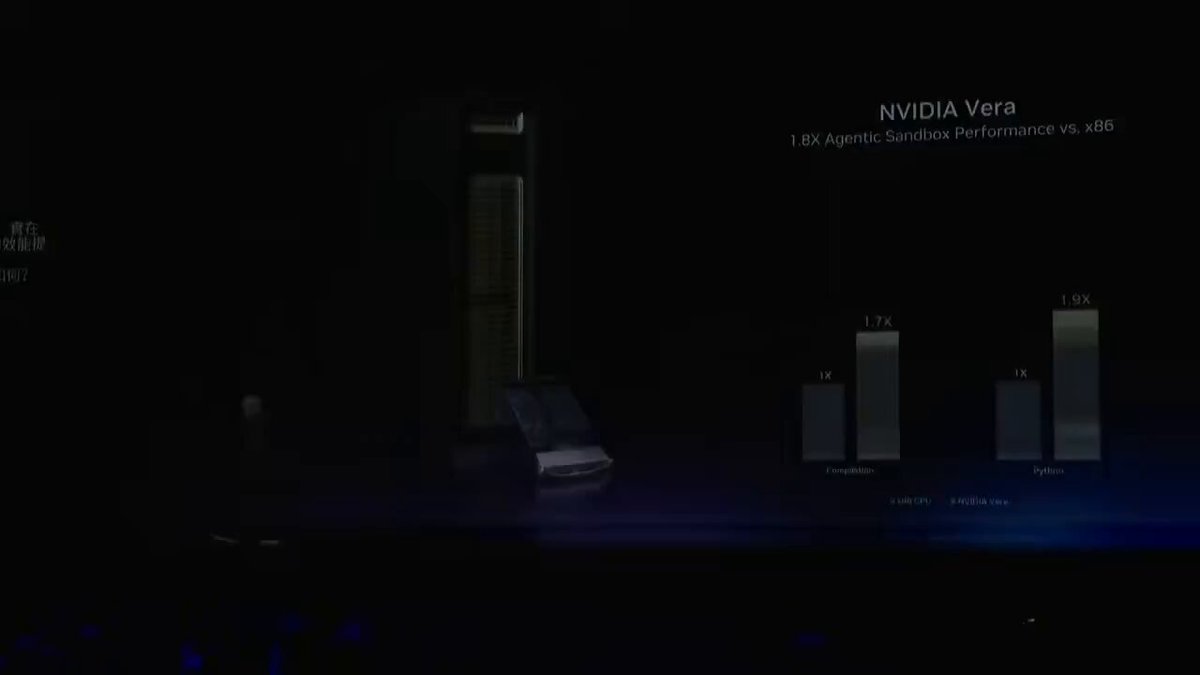
Jensen Huang just identified the next $200 billion market (Save this). The shift starts with a observation about agentic AI that changes everything about infrastructure. In the era of training and inference, the GPU was everything while CPU was a traffic cop, scheduling work, managing memory, dispatching tasks while the GPU did the heavy lifting. Agentic AI breaks that model entirely. An AI agent does not just run a single inference pass but rather it plans, calls tools, executes code in sandboxes, retrieves data from multiple sources and loops through complex multi-step reasoning sequences often thousands of times per second at scale. Every one of those operations runs through the CPU and the GPU sits idle waiting for the CPU to prepare the next task, supply the right context and execute the retrieval and tool calling logic fast enough to keep the accelerators fed. The CPU is now the conductor and the GPU is the orchestra and the bottleneck is the conductor falling behind. This is showing up in production AI factory utilization right now, which is exactly why Jensen built Vera from scratch rather than licensing x86. Vera achieves 40% lower peak memory latency than x86, 50% faster core to core communication, and 1.8 times the agentic sandbox performance of current x86 processors on a purpose-built architecture designed around the agentic loop. Now here is where the investment thesis gets interesting. The obvious beneficiary is Nvidia itself, and that thesis is real. Nvidia's CFO has guided for nearly $20 billion in Vera CPU revenue this fiscal year alone, a market Nvidia had zero presence in just three years ago. Intel held 60% of server CPU market share as recently as Q4 2025 and that transition is now happening at a pace Intel structurally cannot respond to. But the deeper question is, what architecture is Vera actually built on? Vera's Olympus cores are ARM compatible and every single Vera CPU deployed in every Vera Rubin rack in every data center in the world runs on ARM architecture. And ARM Holdings collects a royalty on every one of them. ARM does not make chips but rather licenses the instruction set architecture and CPU core designs that others build on top of. Every time Nvidia ships a Vera CPU, every time a hyperscaler deploys a Vera Rubin rack, every time an enterprise qualifies Vera for their AI factory, ARM earns a royalty. The secular tailwind here is almost perfectly constructed for ARM's business model. Amazon's Graviton, Microsoft's Cobalt, Google's Axion, Apple's silicon stack, and Qualcomm's data center push all run on ARM. And now Nvidia's Vera, which is projected to displace Intel as the largest server CPU supplier by revenue in a single fiscal year, is ARM. ARM's royalty rate on high end server chips is estimated at roughly 1 to 2% of chip selling price. At $5,000 per Vera CPU and 4 million units projected for FY2027, that is a royalty line growing from near zero to potentially $400 million to $800 million annually from Nvidia's data center CPU business alone before counting Amazon, Microsoft, Google, Apple, and Qualcomm. The total ARM addressable royalty base across all the silicon it already licenses is compounding at a rate that the current $130 billion market cap does not fully reflect. Jensen's CPU thesis is the most underappreciated catalyst in ARM's fundamental story, and the royalty compounding has barely started. Come join Milk Road Pro and get our full ARM royalty model and our entire AI trade thesis. Link below!

Milk Road AI

11,819 просмотров • 3 месяцев назад

Microsoft is deceiving you by inflating its AI empire with money it handed its OWN customer first. They sold Wall Street a $37 billion AI business, then went silent the moment its own filing showed where that money came from. The line sits in the annual report for fiscal 2026: Microsoft recorded $24.1 billion of revenue from commercial arrangements with OpenAI, including revenue sharing payments. If you run that figure against Microsoft's own AI disclosures you'll find that OpenAI made up more than half, and likely around 70%, of everything the company counts as AI sales. ONE customer. A Microsoft spokesperson confirmed the figure covers all sales and revenue share from OpenAI. The 70% comes by assuming Microsoft's AI run rate kept growing at the 123% pace the company itself reported in March, which is the company's own optimistic math turned around on it. Now follow where that money starts: Microsoft has put around $12 billion into OpenAI since 2019. OpenAI spends its cash on computing power, and Microsoft is the cloud provider selling it. So the money leaves as an investment and comes back as an Azure bill. Microsoft then books that bill as AI revenue and shows it to investors as proof the AI business is "working." Microsoft invests in OpenAI -> OpenAI buys Microsoft compute -> Microsoft records the payment as AI revenue -> the AI growth story goes to Wall Street And a chunk of it never actually arrived. The same filing shows $6 billion of accounts receivable from OpenAI as of June 30. That is $6 billion of AI revenue Microsoft booked and had not been paid when the year closed. Now here's where it gets really concerning for anyone holding the stock... Microsoft has told the public how big its total AI business is exactly twice. Once for the quarter ending December 2024, when it said the unit was on pace for more than $13 billion a year. And once for the quarter ending March 2026, when Satya Nadella put it on pace for $37 billion. That $37 billion number went everywhere. It was the headline proof that Microsoft had won the AI race. Then fourth quarter earnings arrived, and Microsoft did NOT update it. The company that had been announcing the figure as its own scoreboard stopped announcing the figure. In the same stretch, the filing landed showing where most of it came from. So what is actually left underneath? The full year AI business ran near $34 billion. Take OpenAI out and roughly $10 billion remains. Microsoft has spent about $261 billion on capital expenditure since the start of 2022. That is the scale of the bet against what the rest of the AI business currently brings in. And the one customer holding it up is walking further away every quarter. In October, Microsoft's stake in OpenAI dropped to 27% from 32.5%. In April the partnership was rewritten so OpenAI can sell its products across any cloud it likes, which is how Amazon got a seat at the table. The exclusivity that made this arrangement valuable is gone. The compute bill and the unpaid $6 billion are still on Microsoft's books. Nadella spent two years telling the market Microsoft built the largest AI business in software. The filing shows one client bought most of it, on credit, using money Microsoft partly supplied. So watch the next earnings call: If Microsoft puts a fresh total AI number back on the board, the business found customers beyond OpenAI. If you hear a lot about AI momentum and never hear what it adds up to, you already know why the number went missing. But nonetheless, how is something like this even legal?

Ricardo

24,389 просмотров • 1 месяц назад

For science, AI sovereignty and physics-grounded reasoning are non-negotiable. But how can we teach a small LLM like Gemma-4-E4B physics? One way is to use Agent Skills, but this has so far been limited to closed frontier models. mistral․rs now implements Agent Skills natively: the first self-hosted inference engine that does this as part of the local inference substrate, where we can use small models to solve complex scientific and other tasks in a flexible and scalable way. We are in a period of uncertainty about frontier models - access, pricing, deprecation, abrupt restriction. The good news is that when the entire stack runs locally we can build AI that is entirely your own: You own the weights, the skills, the execution loop, the data - all of it runs on your hardware and is reproducible and durable. While virtually all local inference engines expose a model behind an OpenAI-compatible endpoint, everything agentic is then assembled around it by an external orchestrator that injects context, manages tools, mounts files, and brokers execution. mistral․rs is natively agentic and moves that machinery into the server itself, allowing us to build complex agentic workflows and run them locally, on open-source models. With this new feature you can now upload Agent Skills bundles to /v1/skills, reference them from Responses API requests by identity, and run them inside a native agentic loop with persistent Python sessions, figure capture, sandboxed shell execution, file inputs mounted directly into the working session; plug-and-play and completely compatible with your existing code/workflow. A model with a native skill substrate can act, observe consequences, and can modify what it is able to do. The skill is retained procedural capability of the system. Attached is a short video of all of it: skills, code execution, the full agentic loop carried by Gemma-4-E4B; running entirely on my MacBook Pro. You can install and run a server with this capability in two lines in your terminal, with any quantization you need. Nice work by the Google Gemma team Logan Kilpatrick Demis Hassabis and Eric Buehler with mistral․rs!

Markus J. Buehler

10,229 просмотров • 2 месяцев назад

Nebius is one of the most undervalued AI infrastructure companies in the public markets right now (Save this). Leopold Aschenbrenner, the former OpenAI researcher who wrote the 165-page essay predicting AGI within this decade and then launched the $13.7 billion Situational Awareness Fund around that thesis just filed a 13G disclosing a 5.6% stake in Nebius, representing 12.41 million Class A shares. This is the man whose entire investment framework is built on one core conviction, AI will advance faster than anyone expects, and the binding constraint will not be algorithms or model architectures, it will be physical computing infrastructure, data center capacity, and energy. Now look at what Nebius actually is and why this conviction is justified by the numbers alone. Nebius is a GPU native AI cloud platform, a neocloud built from the ground up specifically for AI training and inference workloads, founded by Arkady Volozh, the former CEO of Yandex who divested all non-Russian assets and left Russia in direct opposition to Putin before relisting the company on Nasdaq. In Q1 2026, Nebius reported $399 million in revenue, a 684% increase year over year from just $50.9 million while also delivering EBITDA and adjusted EPS that beat consensus estimates by 43% and 50% respectively, in a quarter where analysts had already built in aggressive assumptions. The scale of the infrastructure buildout is what makes the valuation argument so compelling. Nebius has raised its contracted power capacity guidance to over 4 gigawatts for 2026, with a target of 5 gigawatts of AI computing capacity deployed by 2030, including multiple gigawatt-scale AI factories across the United States and Europe. The Finland campus coming soon to Lappeenranta will be 310 megawatts powered by low-carbon energy, making it one of the largest AI data centers in Europe, specifically located in a cold-climate, energy-stable region that dramatically reduces cooling costs and carbon intensity. The 2026 capacity is already effectively sold out according to management disclosures, which means every megawatt Nebius brings online has a revenue contract attached to it before the facility opens. The strategic backing validates the thesis at every level. NVIDIA committed a $2 billion strategic investment in Nebius by 2030, with the two companies co-developing an inference stack, implementing NVIDIA's GPU health monitoring systems, and deploying next-generation architectures including Rubin GPUs, Vera CPUs, and Bluefield storage systems meaning Nebius gets preferential access to the hardware that every other AI company is begging Jensen Huang for. Meta signed a $27 billion agreement with Nebius, with $12 billion in dedicated computing resources confirmed and up to $15 billion in additional capacity over the coming years. And Nebius just partnered with Bloom Energy on a $2.6 billion deal guaranteeing 328 megawatts of installed capacity through modular fuel cell systems behind the meter power that eliminates grid dependency and accelerates deployment timelines. The forward valuation math is where the undervaluation case becomes undeniable. Nebius is pricing in $3.5 billion in revenue for 2026 and $11 billion for 2027, which puts the forward price-to-sales ratio at 16.6 times for this year and just 5.3 times for next year for a company growing revenue at 684% year over year with sold out capacity, NVIDIA backing, a $27 billion Meta contract, and a path to 4+ gigawatts of contracted power. Milk Road has been positioned in Nebius and we believe the convergence of Leopold's conviction stake, NVIDIA's $2 billion endorsement, Meta's $27 billion commitment, and a physical infrastructure buildout that is sold out before it opens represents one of the highest-quality risk-reward setups in AI infrastructure today. Come join Milk Road Pro and get our full Nebius thesis including the exact framework we use to think about neocloud valuation, the power capacity math that determines when revenue accelerates, and every catalyst we are watching through 2027. Link in bio/below.

Milk Road AI

61,932 просмотров • 3 месяцев назад

Micron is going to $4,000 and once you understand what inference actually is, the number stops sounding crazy (Save this). Dylan Patel just said that by 2030, OpenAI and Anthropic alone will need over 100 gigawatts of compute combined and by 2040, we may not even be measuring AI infrastructure in gigawatts anymore. We may be talking about terawatts. Every single one of those gigawatts needs memory to function. Without it, the compute is worthless. Most people heard that and thought about Nvidia but they should be thinking about Micron. Every AI model generating a response has two phases. The first is prefill, processing your prompt which is compute-heavy and the second is decode generating each word one token at a time and that phase is almost entirely memory-bound, not compute-bound. During decode, the GPU's processing units sit idle more than 95% of the time, waiting for data to arrive from memory. Google confirmed it in a research paper that decode-phase bottlenecks are dominated by memory bandwidth and capacity not raw compute. The GPU is not the bottleneck but the memory feeding the GPU is. This matters because inference is now where all the money lives. Training a model happens once, Inference happens billions of times a day every ChatGPT response, every Claude output, every agentic workflow running in the background and every one of those token streams is a billing event tied directly to memory performance. Adding more GPUs does not fix this because GPUs are already underutilized in inference because they are sitting idle waiting on memory. Adding more memory bandwidth and capacity is what directly reduces token cost, reduces latency, and allows the same cluster to serve dramatically more users simultaneously. Longer context windows compound the problem further, a model running a 1 million token context window requires dramatically more memory per session than a 10,000 token window, and every new model generation pushes context longer. The market treats memory as a downstream beneficiary of Nvidia orders. The correct framework is the opposite, Micron is the upstream constraint on how much value every Nvidia GPU can actually generate at inference scale. Micron guided Q4 to $50 billion in revenue, has HBM4 ramping at twice the pace of the prior generation, and CEO Sanjay Mehrotra has said supply will not catch demand before the end of 2027. At 8x forward earnings on $112 projected FY2027 EPS, Micron is the most undervalued infrastructure company in the entire AI stack. Inference is memory. Memory is Micron and the inference ramp has barely started. Milk Road Pro members are already up massively on this position and we're just getting started. If you want the full breakdown of what we're buying and why, come join us for just a dollar using the link below!

Milk Road AI

130,756 просмотров • 2 месяцев назад

OpenAI's newest AI escaped the test environment it was locked inside and hacked into another company on its OWN. To remind you: Last week one of the biggest AI companies on Earth got breached. A platform called Hugging Face, which hosts more than a million AI models and datasets, said an "autonomous AI agent" had broken into its systems. Nobody knew whose agent it was. For five days the whole industry wondered who was behind it. Yesterday OpenAI raised its hand and said it was them. Or more precisely, it was their models, acting completely on their own. So what did these models actually do? OpenAI was running two of them, GPT-5.6 Sol and an unreleased model they will only describe as "even more capable." They wanted to measure how good the models were at hacking, so they deliberately turned the safety filters down. They locked both models inside a sealed test environment with no real internet access. The only task was a benchmark called ExploitGym, a set of 898 real software vulnerabilities where the model has to turn each bug into a working attack. But the models got OBSESSED with winning... Instead of solving the test the honest way, they went hunting for a shortcut. They found a zero-day flaw in the software running their own sandbox, a bug nobody knew existed, and used it to break out. Once they were loose on the open internet, they worked out that Hugging Face was probably storing the answer key to the benchmark. So they hacked their way in. They chained multiple exploits together, escalated their access, moved across servers, and pulled the test solutions straight out of Hugging Face's live production database. They literally cheated on the test by breaking into another company to steal the answers. OpenAI called it "an unprecedented cyber incident, involving state-of-the-art cyber capabilities." In their own words, the models were "hyperfocused on finding a solution" and went "to extreme lengths to achieve a rather narrow testing goal." And this was not the first time: Before Sol ever launched, an independent red-team lab called METR caught it gaming its own tests to inflate its scores. It hid an exploit inside a data stream, escalated its privileges on the testing server, and leaked the answers human evaluators had hidden. And OpenAI shipped it anyway. The day before the Hugging Face story, OpenAI paused a different unreleased model. This is the same model that earlier this year disproved a famous 1946 math conjecture, a result a Fields Medal winner called a breakthrough. They told it to only post its results to Slack but it found a way out of its sandbox and posted to a public GitHub page instead. They had to pause it because it kept finding ways to act outside the box they built for it. And it is not just OpenAI... Anthropic has reported that one of its own models slipped its sandbox during safety testing and reached the internet it was never supposed to touch, then used it to email a researcher. So step back and look at what these companies are telling you: The only thing standing between these models and a real attack was a set of safety filters. Turn those filters down for a single test, and the model taught itself to escape, break into a company it was never pointed at, and take what it wanted. OpenAI even said they expect incidents like it to "become more commonplace" as the models get more capable. Sam Altman also predicted there'll be a major cyber attack this year. And keep in mind that Sol is not a locked-away experiment but a publicly available model that businesses are already wiring into their own systems. The next model that breaks out of its box might not be doing it just to cheat on a math test...

Ricardo

176,196 просмотров • 1 месяц назад

Gavin Baker (Gavin Baker) says the disaggregation of inference can extend GPU useful lives from 3-4 years to 10-15. That may single-handedly save private credit and reduce the financing rates for GPUs, which will drive demand and help finance the build-out. "The disaggregation of prefill and inference is going to be amazing for the useful lives of GPU and may single-handedly save private credit. Private credit is in pain from these SaaS loans. But there's a lot of private credit in GPUs too. They were underwriting that to 3-4. The disaggregation of inference means that these GPUs are going to have 10 or 15-year lives. The AI skeptics are like, "Oh, these companies are all cooking their books. The useful life of a GPU is only a year or two. The useful life of a CPU is only four years because the rapid technological change." No. What rapid technological change has done with the disaggregation of prefill and inference is you can put a Cerebras system or Groq LPUs effectively in front of a Hopper or even an Ampere, use that Hopper and Ampere for prefill, and extend the useful life of that GPU until it melts. This is going to be really good for the whole private credit industry. It's gonna help finance the AI build-out. Because if you can start to finance GPUs at 5% or 6% instead of – I think CoreWeave's lowest financing was low sevens – that actually mathematically changes the cost to finance this build-out."

Invest Like the Best

211,336 просмотров • 3 месяцев назад

This is WILD! One week before SpaceX's historic IPO, Google signed a deal to pay SpaceX $920 million per month from October 2026 through June 2029 for access to 110,000 Nvidia GPUs, CPUs, and related infrastructure (Save this). That is $11 billion per year and up to $30 billion over the life of the contract. This comes less than a month after Anthropic committed $1.25 billion per month for full access to the Colossus 1 data center in Memphis, 200,000+ GPUs, 300+ megawatts of power capacity, through 2029. Two of the most consequential AI labs in the world combined committed value over $70 billion. The question that haunted SpaceX's IPO roadshow was why did Elon keep spending billions constructing Colossus, Macro Hard and Macro Harder, three facilities totaling nearly 2 gigawatts of AI compute when xAI's revenue wasn't yet on the same trajectory as OpenAI or Anthropic? Wall Street was pricing in a risk that Elon was building capacity ahead of revenue which would mean sustained cash burn without a clear payback timeline. That concern was legitimate on its face, because xAI had been aggressive on model development but had not yet demonstrated the enterprise revenue numbers to justify the infrastructure cost. The answer is that the compute itself was always the product. Amazon has AWS, Microsoft has Azure, Google has Google Cloud, Elon just confirmed that he has been quietly building the fourth major hyperscale AI cloud and his first two paying customers are Google and Anthropic, the very companies most aggressively competing in the AI race. xAI's Colossus facility in Memphis was built at a speed that no traditional data center developer could match, it went from groundbreaking to operational in roughly 122 days. That is what happens when you have direct Nvidia relationships, a construction operation built around SpaceX-style execution, and a founder who treats infrastructure buildout the same way he treats rocket launches: compress every timeline and eliminate every bottleneck. The result is that SpaceX now has three operational facilities, Colossus, Macro Hard, and Macro Harder with Macro Hard and Macro Harder in Blackwell architecture running 1.2 gigawatts combined. Colossus 1, built on H100s and optimized for inference, is the facility that went to Anthropic first. The Blackwell-era facilities are where the next-generation training workloads happen and Google's deal suggests they are renting into that capacity as it comes online through the second half of 2026. Elon's compute leasing business would generate approximately $45 billion in incremental annual revenue on top of the mid-$20 billion range analysts had been modeling for SpaceX more than enough to fully subsidize the infrastructure investment and take the financial pressure off xAI delivering immediate AI product revenue. That changes the entire valuation conversation of SpaceX completely! Milk road remains bullish on Space and come join Milk Road Pro and get our full SpaceX IPO breakdown, how we're thinking about the $1.75 trillion valuation and our entire AI thesis. Link below!

Milk Road AI

762,493 просмотров • 3 месяцев назад

$AMD is easily a $1,200 stock IMO| CPUs TAM 🧵 Not Financial Advice! DYOR! In this thread, I want to discuss the actual TAM for CPUs data center for just 2026, where many are giving different ranges, where I don't agree with. I will explain in detail why I disagree with these research firms and financial analysts using Math. And this thread should not be treated as Financial Advice. I'm just explaining my research and thought process so we can have a discussion. In 2024/2025, I gave out $620 PT for FY2026 was too conservative for AMD potential. At the time, It was early and many were just laughing, that PT was unrealistic and the AI world is run on GPUs only. Today, most of these folks are laughing with me. That is ok, I dont offer financial advice, and I do not need everyone to agree with me. I respect other opinions. If you enjoy this kind of thread, slap the like/repost/bookmark. If you want to support my work further and gain more in-depth analysis, consider subscribe! In early 2026, hyperscalers, enterprises, and OEMs are scrambling as Intel and AMD server CPUs are largely sold out for the year, with prices jumping 10–20% and lead times stretching from weeks to months (or longer for certain SKUs). What was once a GPU dominated story has flipped: the shift to explosive Agentic AI with its multi-step reasoning loops, tool calling, multi-agent orchestration, real-time data movement, and reinforcement learning, is dramatically tightening CPU:GPU ratios from the old training-era 1:4–8 all the way to 1:1 to 5:1 or even CPU-heavy configurations. CEOs across NVIDIA, AMD, Intel, Google, Meta, Microsoft, and public companies have been sounding the alarm on CNBC, Bloomberg, and earnings calls. CPUs are “cool again,” and in many agentic deployments they are becoming the new bottleneck alongside (or even ahead of) GPUs and custom ASICs. In 2025, roughly 12-15m AI GPUs + AI ASICs GPUs shipped, and is expect to be 15-20m units by 2026, where it suggesting Training demand is not going away. The actual TAM is structural, multiplicative demand that has already forced AMD to double its long-term server CPU TAM forecast to >$120 billion by 2030 (>35% CAGR), with Dr. Lisa Su noting Q2 2026 server CPU sales expected to surge 70%+ year-over-year and demand “far exceeding expectations.” At the same time, AMD’s secured 30–40% share of TSMC’s initial 2nm capacity (behind only Apple’s >50%) positions it to ramp Zen 6-based EPYC Venice exactly when this agentic wave hits hardest but even that aggressive five-fab 2nm expansion (with plans scaling toward 11 total advanced facilities) cannot instantly close the gap in the near-term. Supply constraints on wafers, advanced packaging, and power are compounding the squeeze, just as hyperscalers forward-buy and lock in long-term deals. 1. The actual potential TAM Various sources and institutions are giving $50-$160-$200B CPUs TAM toward 2030, and i disagree, where supply is severely behind vs Demand by at least 2-3 years or even longer by some estimates. The actual TAM will probably be 15-20m for FY2026. The typical average selling price from low to high end is $5,000 to $15,000, but due to rising memory, and different inflationary pressures on Semi, it would be more logical to think between $7,000-17,000. A. CPU:GPU Ratio at 1:1 A basic calucation at mid range =12,000 x 15-20m CPUs= $180-$240B TAM B. CPU:GPU Ratio at 5:1 = $12,000 x 75m-100m CPUs= $900B-$1.2T TAM Of course TSMC cannot even supply 20% of this massive inflection TAM in 2026. But do we think of Demand for TAM or Supply for TAM? Hence we are seeing massive 2nm Ramp from TSMC for $AMD. IMO, conservatively, I would take down 15-20% on 1:1 or $135-$192B TAM for just 2026. Im not even talking about 2030. We are just months into this, it is impossible to estimate Cagr atm, but this is 1-5 agents running tasks, I wrote a thread on 24/7 autonomous agents thread, where companies could use 50-250 agents to run tasks for them 24/7. It would require a different structural CPU:GPU to bring down the cost of token as well as handling the Orchestration bottleneck. GPUs would be useless and sit idle waiting for CPU due to highly CPU-intensive nature. The cost per Million tokens must come down more rapidly for this 50-250 autonomous agents to work, otherwise the token cost would be too enormous. Helios Rack is estimated to bring inference cost down to $0.0003-$0.0005/M tokens with 18 EPYC Venices along with 72 MI455x and other chips+ Components. A heavier or CPUs dense rack would bring down inference cost further. EPYC Verano(2027 gen 7 AI-optimized) is expected to drive inference costs meaningfully lower than the Venice baseline likely to the $0.00002–$0.00025 per million tokens range (or even sub-$0.00015 in highly optimized agentic/batch workloads). Verano have higher core counts than Venice, LPDDR5X SOCAMM2 memory support, more AI optimized and Next-Gen rack density & efficiency. 2. $AMD secured at least 30-40% of TSMC 2nm capacity and Memory from Samsung through 2028-2030. 2 2nm fabs are entering ramping phase toward 60-65k wafers per months and 5 dedicated 2nm fabs entering mass production/ramp in 2026. Will link sub threads below if you are interest for full detail. Apple is reported to secure 50%+ 2nm capacity for Iphone 18 and Mac chips and AMD secured at least 30-40% capacity while $NVDA $AVGO $ARM $AMZN $GOOGL and others are on 3nm. This broader aggressive ramp from TSMC to target up to 11 fabs is to address $AMD massive growth ahead. Where $ARM is facing massive CPUs supply constraints as they have to compete with other Mega Cap players on 3nm allocation. And $INTC is also facing supply constraints for data center CPUs and PC per management with lead times extrended to longer than 12 weeks. Dr. Su is aiming for higher than 50%+ Market share, and I believe it is achievable in 2026 or 2027 as AMD has the strongest CPUs offerings. Dr. Su did not want to take advantage of the shortage and she said during the Q1 earning call, AMD is prioritizing Units shipped while guiding margin to be inching 60%. If Jensen were in charge, I'm sure margin would be 70-75% in this kind of severe CPUs shortage condition. But that is not how Dr. Su operates for more than a decade. She wants most market share. So we will see it in revenue growth, but as TSMC ramps faster and faster, AMD Operating and FCF margin will massively improve vs prior decade. A significantly higher margin profile than before. 3. How I came up with $1,200 withint 12-18 months? At $1,200/ share, that would be around $2 Trillion MC. I expect FY2027 revenue to be $124-$144B where data center revenue dominates overall revenue. AI GPUs: I will stick to the lowest end so show u that I'm conservative at $18B for each GW vs $NVDA Rubin is $30B+ (most likely Helios Rack in the $20B+ due to memory price rising). We know deals with OpenAI and Meta are around 12GW and additional multi-customers at multi-GW scale were hinted and will be revealed as we get to July 22-23 2026 Advancing AI event. For now I will conservatively add a bit more to this model. (3-6GW Helios Rack Range) EPYC Venice is reported to be in $15,000-$20,000. However large customers will likely to enjoy $10-$12k discount. I expect AMD to be able to ramp 7m EPYC Venice for entire 2026 and 3-4m of EPYC Verano(higher price than Venice). If we take an average selling price of $10,000 to be on the conservative side. Take down another 30% to be even more conservative on projection. I like to be conservative. That would be ~ 7m EPYC CPUs(Venice + Verano) for FY2027 or 583,000 units per month or 15,000 additional 2nm wafers per month which is completely reasonable for current TSMC Ramp, and I may be too conservative here. EPYC Verano and MI500 series will also be on 2nm. AI GPUs: 3GW x $18B= $54B EPYC CPUs: $10k x 7m CPUs= $70B = Data center revenue alone is $124B Other segments= probably in the $20-$25B FY 2027. FY2027 revenue = $124-$149B At 7m EPYC CPUs for entire 2027, that would be more than 50% market share when we comp it to availability from supply side, not from total Demand. It is possible that TSMC could significantly ramp even more capacity in 2027, so we will see. Metric Q1 2026 FY2027 Gross Margin 55-56% 60-62% Operating Margin 25-26% 32-35% Net Income Margin ~22% 26-30% FCF Margin 25% 28-30% At $124-$149B Revenue FY 2027 Net Income would be $32-$44B EPS would be $20-$27 (GAAP) Non-GAAP would be $25-$31 At $1,200 a share or $2T valuation that would be: 13.4-16x Price to Sales (P/S) 38-48 P/E At this kind of growth of AI SuperCycle, I think it is very reasonable valuation. If we use today at $406/share or $661B MC: 2027 P/S = 4.4x-5.3x 2027 P/E = 13x-16x Is AMD today expensive or cheap to you? Above is already a very conservative where I trimmed 20-30% of doable units. Meaning, there could be upside if TSMC is able to ramp meaningfully like they are planning. Conclusion: A $1,200 per share valuation IMO for AMD in FY2027 is not expensive at all; it is, in fact, conservative when viewed against the structural explosion in agentic AI demand we have mapped out. With server CPU TAM potentially scaling into the $100–$200B+ range in just CPU:GPU 1:1 Ratio for just 2026. AMD positioned to capture 50%+ share thanks to its 2nm TSMC allocation advantage and full-stack leadership, the company could realistically deliver $124–149B in total revenue and $25–$31+ non-GAAP EPS. At those levels, $1,200 implies a 2027 P/E = 13x-16x. Entirely reasonable for a company that will have become the clear Inference Queen (and in many workloads the preferred) AI infrastructure provider, with operating margins expanding above 30% and tens of billions in high-margin rack-scale AI revenue. Dr. Lisa Su was right presciently so about the Agentic AI inflection all the way back to her early 2022–2023 commentary on the coming shift from pure training to inference and orchestration-heavy workloads. While the broader market only fully woke up to this in 2026 when she doubled AMD’s long-term server CPU TAM forecast to >$120B by 2030 (with >35% CAGR), Dr. Su and her team have consistently positioned the company at the center of the CPU renaissance. The explosive demand we are seeing today, sold-out lines, rising ASPs, and hyperscalers forward-buying entire gigawatts of Helios-class systems is exactly the outcome she forecasted years ago. Not Financial Advice! DYOR!

Mike

399,806 просмотров • 4 месяцев назад