Loading video...

Video Failed to Load

Go Home

E14 with Packy McCormick about building Not Boring, new media business models, Ramp vs Brex (timely?), his thesis of vertical integrators, his creative process and more. If you’ve spent any time in tech over the past few years, you’ve probably read Not Boring or at least seen a screenshot...

15,329 views • 6 months ago •via X (Twitter)

0 Comments

No comments available

Comments from the original post will appear here

Related Videos

Packy McCormick’s (Packy McCormick) uses AI to find, articulate, and invest behind the next big idea. He writes Not Boring, a newsletter that analyzes technology and startups for 200,000 subscribers every week. He also invests in early stage companies through his fund Not Boring Capital and is an advisor at a16z crypto. I spent an hour with him to understand how he’s baked AI tools into the way he thinks, writes, and invests. We get into: - How he uses AI to understand dense concepts and refine his arguments - His thesis around vertically integrated businesses being the future of tech - How Packy uses Anthropic’s Claude Projects to edit his newsletter - How he makes interactive graphics that represent concepts from his essays - The tools Packy uses to research, write, and edit Not Boring - When he thinks the next crypto bull run will take place We also use Projects to build an AI tool that grades Packy’s essays live on the show This is a must-watch for writers, investors, and anyone trying to understand the cutting edge of technology. Watch below! -- Timestamps: Introduction: 00:01:24 Packy’s thesis about the future of technology: 00:02:40 What Packy quick takes on your crypto portfolio: 00:07:42 Use LLMs to validate your understanding of complex concepts: 00:14:31 How Packy used Claude Projects to write an essay he published recently: 00:18:26 Packy’s process to make interactive visual graphics for his essays: 00:24:00 How to use AI to be thorough in your research: 00:31:10 How Packy uses Claude to edit his writing: 00:35:04 The tools Packy uses to create his newsletter: 00:36:44 Using Claude Projects to make a tool that grades Packy’s essays: 00:44:12

Dan Shipper 📧

52,701 views • 1 year ago

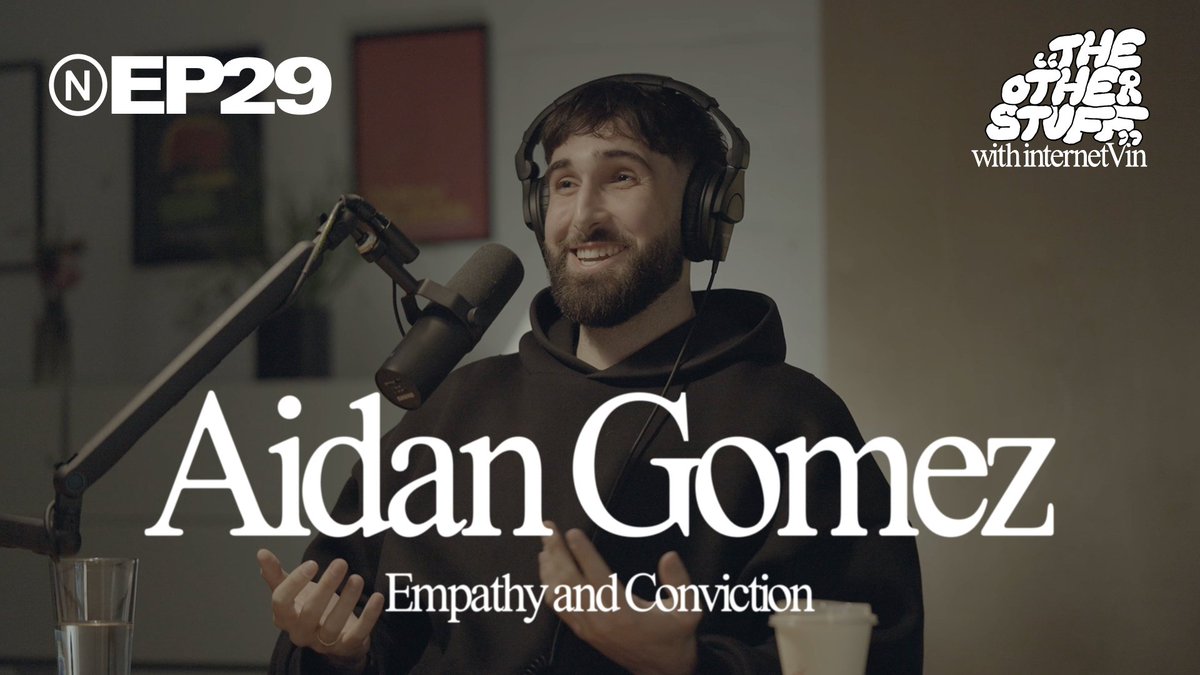
Aidan Gomez (Aidan Gomez) is a computer scientist, co-author of the seminal paper ‘Attention Is All You Need,’ and the CEO of Cohere. In this episode, we discussed his upbringing in the cabin his grandfather built in Codrington, a small town North of Brighton, and the values that were instilled in him through his family. We explored his path from Codrington to his undergraduate studies at the University of Toronto, emailing Geoffrey Hinton, and joining Google Brain where he co-wrote the paper on transformers. We discussed how he met his co-founders Ivan Zhang and Nick Frosst, and his insights on what it means to build a meaningful, successful company in Canada. Aidan shares his conviction about what is at stake — for Canada and for the world at large. This is a conversation about family, values, and what it means to live with conviction. The Other Stuff is hosted by internetVin — filmmaker, entrepreneur, and possibly the most curious man on Earth. Produced by New. The Other Stuff #29 — Aidan Gomez: Empathy and Conviction — Timestamps 00:00:00 Intro 00:03:10 The Malleability of Toronto 00:11:06 Growing Up in Codrington 00:13:50 The Story of Aidan Gomez’s Family 00:27:23 Introduction to the Internet 00:30:39 Values and Work Ethic 00:35:46 University of Toronto’s AI Scene 00:40:48 Emailing Geoffrey Hinton 00:42:16 Google Brain 00:45:15 Dropout: A Simple Way to Prevent Neural Networks from Overfitting 00:49:48 The Beauty of Research 00:54:24 One Model to Rule Them All 00:59:54 Meeting Ivan Zhang and Nick Frosst 01:04:00 The Birth of Cohere 01:06:56 Twitter Influencers and Alex Friedland 01:11:48 Being the CEO 01:12:51 Building for Canada 01:15:01 Three Fundamental Ingredients of Building a Company 01:21:39 Working with the Canadian Government 01:24:39 Reflexivity in Canada 01:36:22 What Is Evil? 01:42:40 The Role of AI in the World

The Other Stuff Podcast

45,297 views • 7 months ago

E16 of We The Builders with Mike Solana (Mike Solana), Editor In Chief of Pirate Wires and CMO of Founders Fund is now available wherever you get your podcasts. Twitter/X is a battleground where you defend your ideas and murder the ones you don’t stand for (as you will hear in Mike’s own words). There is little room for nuance as I too have observed and so the Twitter/X persona of people you see often wouldn’t be the right way to categorize the person. As I prepared for this episode, I discovered how Mike has changed his opinion on topics throughout the years after discovering new information. He is one of the most independent minded people out there and it was a lot of fun to sit down for a conversation on media, Pirate Wires, Founders Fund marketing, state of advertising, charter cities and more. Mario Gabriele 🦊 did a four part series on Founders Fund a while back and described their marketing strategy as soft power initiatives. Some of these included Peter’s book Zero To One, Hereticon and Pirate Wires to name a few. Mike Solana has been at the centre of this strategy which made him a billionaire media tycoon (iykyk). At Founders Fund, he has been able to stay ahead of rivals with a team only four full time people on the marketing team compared to teams of fifty at other funds of similar size. Now he helps us make sense of the world of tech, business and politics through Pirate Wires. Friend of the pod Christopher Lochhead 🏴‍☠️ ✍🏼🎙 would probably agree that Mike has been able to build new categories around ideas he stands for representing important problems of the time. Some of these are limited standalone brands, others are cultural movements. One example of this is Hereticon, where he was able to create the category of “Thoughtcrime” which went mainstream after Elon bought Twitter. There were two editions of Hereticon (2022 & 2024) and it looks like it won’t make a comeback. Mike’s strategy is to be different. Once you have created a category and are not unique anymore, you move on. In true Zero To One fashion. Timestamps 00:00 - Introduction 03:06 - Building a media company vs building a tech startup 05:41 - Building culture in a company 11:36 - Substack vs having your own website 17:51 - The utility of advertising 29:24 - Building a large audience vs. building a quality audience 35:55 - Twitter strategy and evolution in the past 5 years 47:10 - Pirate Wires master plan and inspiration from Walt Disney 53:16 - Charter cities in America 1:03:03 - The podcast experiment 1:15:03 - Mike’s information diet 1:29:18 - Working on Zero To One with Peter Thiel and marketing at Founders Fund 1:38:05 - Rapid fire and closing thoughts

Suffiyan Malik

25,095 views • 5 months ago

From Eric Vishria on how the top AI founders are building products completely opposite of the SaaS era: "One of the things that is really different in the AI world versus the SaaS world, is that in the SaaS world, over and over again, you had people who really understood the customer. And the problem. And then they understood a domain. They understood what the technology was more or less capable of. But it wasn't a real question of if you could build something or not. For example, take Salesforce, Workday, and ServiceNow. CRM existed before Salesforce. HR management existed before Workday. Same thing with ServiceNow. So in every case, Salesforce followed Siebel. Workday followed Peoplesoft. ServiceNow followed Peregrine and Remedy, and others. So they were just kind of, cloud SaaS versions of the prior generation product. They just understood the customers. They understood the problem. And they were just like, here's a better version. And that evolved a little bit over time in SaaS land. But that's what it is. And so product development in that way was done by people who really understood the customer and the problems. And then just took advantage of the next wave. And this is almost diametrically opposite of product development in the AI era. When I look at the teams that are having the most success today, they have intimate knowledge of the models. They are right on the frontier of understanding which models are better at what, and why, and when. And what they're going to be good at and what they're not going to be good at. And what they're spending their time on, is figuring out how do I apply this capability of this model to this domain or to this user. So they're actually working inside out or technology out, versus customer problem in. And of course, they understand the customer problem. And a lot of times they have firsthand knowledge of it. But they're really close to the metal and capability, and they're applying it. And I think this is a really different way to develop products than in SaaS. I started my career as a product manager a long time ago, and it's almost the complete opposite of everything you learned. "Listen to the customer, understand it, then bring it back to the engineering and product teams." If you did that right now, ask a bunch of customers what they want out of AI, and you brought it back, for the most part, it may not be possible today with today's technology. Whereas the teams that are winning right now really understand the technology and are applying it out. And so I think this reversal matters. I think it's a big difference in terms of how companies are getting built. And maybe even the types of entrepreneurs that will be successful. I'm not sure. You're seeing some real change there. Look at the Bret Taylor's at Sierra. That's a super, super technical founder who really gets it. Brett and Clay really get it. You look at Michael and his co-founders at Cursor. They're super technical founders and they get it. They all really understand what these things can and can't do. And that's a pretty different dynamic relative to the way the best SaaS companies got built." Link in bio for the full conversation going deep on the current class of startups going from zero to $100m+ in ARR within 12 months.

The Peel

209,752 views • 1 year ago

David Friedberg: “Gaming is the future of entertainment, and the future of gaming is AI.” @jason: “Friedberg, what are your thoughts on the gaming industry versus social media versus traditional media?” david friedberg: “One way to answer that question is to think about how people spend their time.” “Do you spend more minutes on social media, or on traditional media, or playing games? And how is that trending?” “But importantly, which of those will accrue more benefit, and as a result, drive more hours spent from AI?” “One way to think about this thesis is that AI is going to ultimately accrue to video game entertainment far more than social media entertainment or traditional content.” “If you believe in AI, and you believe in the improvements in productivity, generally speaking, people in the industrialized world will generally have more free time on their hands and be able to support themselves with the deflationary effects of AI over time.” “So if there's more time on people's hands, the general market for entertainment is growing, and if the general market for entertainment is growing, gaming is the future of entertainment, and the future of gaming is AI.” “Because I think you can create dynamic, more engaging experiences that will benefit from a back and forth sort of relationship than you can with traditional content or with social media.” “If you're a noob in Fortnite, like you're an early player in Fortnite, you're mostly playing against AI, because what they do is they tune the AI to be easier to beat so that you can slowly develop your skills.” “What was happening early was they were seeing a high degree of churn in Fortnite because kids would go on and play for the first time and they'd get paired up with kids that were better than them, and so they would never win, and they would get frustrated and they would quit the game and stop.” “So the churn rate was high. So AI unlocked higher engagement and higher retention, and I think we're seeing that in a lot of different gaming platforms now.” “So AI can be used, for example, to maximally increase time, engagement, satisfaction, happiness.”

The All-In Podcast

70,365 views • 9 months ago

At a Q&A, John MacArthur is asked about Christian nationalism. The kingdom of God is not of this world. Jesus said that. He said, “My kingdom is not of this world. If My kingdom were of this world, My servants would [fight].” His kingdom is not of this world. The kingdom of this world is a separate world; they’re not linked together. Let me say it another way: Nothing that happens in any nation, whether it’s a Communist nation, a Muslim nation, or a “quasi-Christian” nation, or an atheistic nation—nothing in that nation politically, socially has anything to do with the advancement of the kingdom of God, because the kingdom of God is separate from that system. God, in His sovereignty, is building His church, “and the gates of Hades will not prevail against it,” Jesus said. So the idea that you should link up some political effort, some political process, some social process, some gain of power or influence in a culture as part of the advance of Christianity is alien to Christianity. You never have our Lord approaching anything like that, nor the apostles, and particularly the apostle Paul. He sought to gain no favor with the Roman Empire whatsoever, or for that matter, with any other of the rulers that he ran into during his life. Now, that is not to say that we are indifferent to what happens in the nation. We’ve been talking about that the last couple of Sunday mornings. We have to be the people who uphold righteousness. When we come to vote, we want to vote for that which is the most righteous option. Obviously, we can’t vote in righteousness, but we have to vote in a way that reflects our commitment to the righteousness of God. So we couldn’t possibly elect somebody who was an abortionist, somebody who was LGBTQ or LGBTQ-affirming, or any other deviation from God’s righteous moral standard. So it gets harder, doesn’t it, nowadays, because even sometimes when politicians are more conservative and anti-abortion, they may be sinful and wicked in some other categories, and it’s very hard to find out who is really honest and who is simply dishonest and seeking power. But in the end, we do what we can with the understanding that the responsibility of the church is not to advance the kingdom of this world. That’s a faulty viewpoint. Christian nationalism is usually tied to what is called post-millennialism, and that is the view that the church, somehow, by influencing the culture, can bring in the kingdom of Christ. In other words, it’s the idea not that Christ returns and sets up His kingdom, but that the church establishes His kingdom and then hands it to Him. That is not what Scripture teaches. What Scripture teaches is what we’re learning from the book of Revelation. Things are going to get worse and worse and worse. And the end of human history is not the church triumphant, reigning in the world and taking over the structures of human kingdoms; that’s not what happens. At the end of human history, the believers are persecuted and murdered, and that’s the very opposite of what Christian nationalism would anticipate. So we believe the Bible teaches that things get worse and worse, headed toward the wrath of God, which we’re seeing in Revelation, and then our Lord returns, Himself, to establish His kingdom is clearly what we read in the book of Revelation. OK?

Terri Green

12,152 views • 13 days ago

Beethoven could not hear the music he wrote. At the age of 28, he realized he was no longer able to listen to a flute being played in the distance, and he spent the rest of his life composing the most enduring music in Western history in almost complete silence... He had been a working musician since childhood. His ears were everything. In 1798, in the middle of a heated argument with a singer, he noticed for the first time that something was wrong. The sound was thinning at the edges. He could hear voices, but high frequencies were beginning to disappear. He told no one for years. By 1802, the truth was no longer deniable. On his doctor's advice he moved to Heiligenstadt, a quiet village outside Vienna, hoping the country air would help. It did not. There, alone and surrounded by farmland, he wrote a letter to his two brothers that he never sent. It was found among his papers after his death. We now call it the Heiligenstadt Testament, and it is one of the most devastating documents ever written by an artist about himself: "You men who think or say that I am malevolent, stubborn or misanthropic, how greatly do you wrong me. You do not know the cause of my seeming so... what a humiliation, when one stood beside me and heard a flute in the distance and I heard nothing, or someone heard the shepherd singing, and again I heard nothing." He wrote, in the same letter, that he had thought of ending his life. And then he wrote the line that explains everything that followed: "Only my art held me back. It seemed impossible to me to leave the world before I had produced everything I felt called upon to produce." He went back to Vienna. He went on composing. Over the next two decades his hearing continued to fade. Friends began writing their words down in small notebooks instead of speaking them aloud, and waiting while he read. Modern scholars call these the conversation books. Around four hundred of them survive. To compose, he developed his own methods. He bit one end of a wooden rod and pressed the other against the soundboard of his piano, letting the vibrations travel through his jaw to his inner ear. He had stumbled, through trial and error, onto the principle that modern science calls bone conduction. The cause of his deafness has never been settled. What we do know is this: he realized he was losing his hearing at twenty-eight, and he could have stopped. He wrote the letter, he held the thought of dying in his hand, and then he put down the pen and went back to work. Most of what he is remembered for was composed after that moment: The Fifth Symphony. The Seventh. The Ninth. The Missa Solemnis. The late quartets. All of it was made by a man who could no longer hear most of what he was writing. There are people who give the world what they receive, and there are people who give the world what they were never able to receive. The most enduring beauty in human history has almost always come from the second kind... -- -- -- If you enjoyed this, I write a weekly newsletter read by over 50,000 people who love rediscovering the beauty of the past. You can join us here: I write about beauty in all its forms. If you'd like to support my work, a paid subscription is what makes it possible.

James Lucas

153,966 views • 2 months ago

You have not been had. What you are witnessing is one of the biggest events in human history. The last few days were drawn By the hands of one of the most brilliant minds, and in the middle of the mocking bird information warfare and media misdirection. The world is a stage. Those who think they are " awake " Are merely still barely in the womb my friends. Those who use their brain will understand why. This is theater of the last few weeks, and the last few days. That is right. You will not be able to even start to grasp the allocations and the variables that were intertwined, and the planned strategies. The mind would not be able to understand the complexities, and the level of planning that has been carried out thus far. Trump had this whole situation handled, before it even started. Before any bullet or missile had been fired. Before any command was given. Before any Idea was even conceived. And most are watching this and wont even get to know what you are reading on this page today. The sheep, they sleep. We are now shifting into a whole new paradigm. Some would say a new dimension. And you are here on earth playing your part and getting getting to see what you always asked for. This is your experience. Yes. You are experiencing the biggest shift, changes, and landscape that any human has ever experienced in their life. Here, and right now. What anyone has experienced so far, is but a speck of dust floating into the dormant wind of time. The history books are being rewritten, as your soul timestamps itself as present and serving today, ready to witness and experience giant changes coming. Welcome to the start of the Golden Era.

Łitecoin Bull | The News Before The News!

20,894 views • 1 year ago