Загрузка видео...

Не удалось загрузить видео

На главную

Each weaver ant can pull on a leaf much harder when in a group than when it works alone. The ants’ sticky feet and coordinated legwork, researchers believe, improve the ants’ collective efficiency—a finding that may provide insights into how to build and coordinate swarms of robots that work...

50,657 просмотров • 10 месяцев назад •via X (Twitter)

Комментарии: 0

Нет доступных комментариев

Здесь появятся комментарии из оригинального поста

Похожие видео

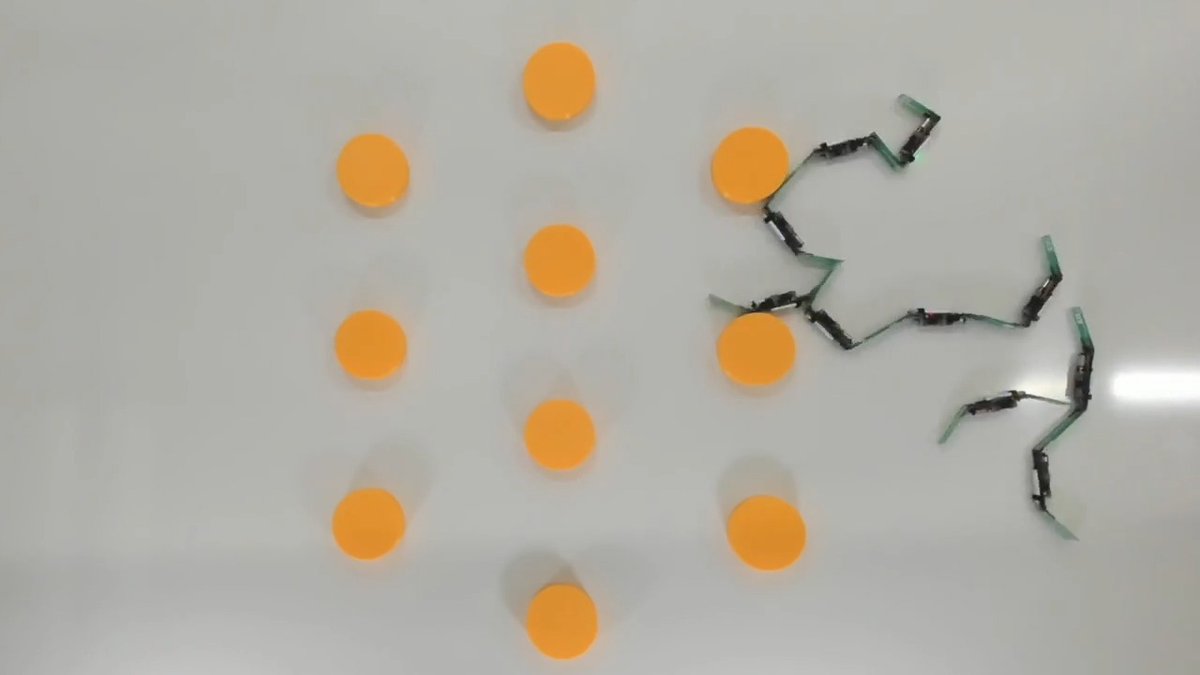
Robots that act like slime! 🫟 Cornell University engineers developed a robotic collective that behaves less like a machine and more like a material that flows, reshapes, and adapts without centralized control. It consists of dozens of small robots with limited individual mobility that exhibit coordinated motion when entangled. The system resembles soft matter, continuously deforming and reorganizing as it moves, driven by mechanical intelligence. Each robotic module measures 200mm long and 20mm wide, containing a small motor that oscillates between "I" and "U" shapes. These oscillations generate forces against the ground, allowing modules to inch forward and jostle together. On their own, modules move slowly and inefficiently. When they entangle into chains, they self-organize into shifting configurations that prove resilient in challenging environments. On incline surfaces, chains moved more reliably than individuals. In obstacle fields, the collective behaved like a flowing material, connections formed to maintain cohesion, then broke apart to prevent jamming. The system stays functional even when modules fail. Isolated modules emit an audible distress signal, prompting nearby modules to slow down so the straggler can reconnect. No centralized sensing or control, each module infers when it has lost contact by how much it's being jostled. Read more here: ~~ ♻️ Join the weekly robotics newsletter, and never miss any news →

Lukas Ziegler

13,026 просмотров • 1 месяц назад