Video wird geladen...

Video konnte nicht geladen werden

Zur Startseite

Edgar Wright explains why he watches "Raising Arizona" (1987) every time before making a new movie: "When I first saw "Raising Arizona" (1987) as a teenager, I watched it immediately again afterwards. I just couldn't quite believe that a comedy could be that stylish and that dense in terms...

288,775 Aufrufe • vor 18 Tagen •via X (Twitter)

0 Kommentare

Keine Kommentare verfügbar

Kommentare vom Original-Post werden hier angezeigt

Ähnliche Videos

Francis Ford Coppola on how young children convinced him to make 'The Outsiders' (1983) & the reason why he loves the movie: "Interviewer: 'Rumble Fish' (1983) is so completely different a film from 'The Outsiders' (1983), not just in black and white and color, but in the tone. And everybody said, “Well, he’s off in Tulsa, making two films,” rather in a way that, once, people would go up to the desert and make two westerns at the same time. 'Rumble Fish' makes 'The Outsiders' seem an odder film than I thought it was when I first saw it. 'The Outsiders' almost felt like a film in which you weren't quite there all the time. Coppola: No, I don’t think so. 'The Outsiders' (1984) was the type of film that I personally liked, a melodrama with a romantic tone. I liked the book a lot when I read it; I thought it was sweet and youthful and had something in its little, simple theme that was of value, and I wanted to make the picture very much as the book was. Maybe that’s what you're interpreting as my not always being there, except that I did make the decision to make it exactly like the book. The key to 'The Outsiders' is the score; the fact that it’s this schmaltzy classical movie score indicates that I wanted a movie told in sumptuous terms, very honestly or carefully taken from the book without changing it a lot, with young actors—putting the emphasis more on that kind of 'Gone with the Wind' (1939) lyricism which was so important to the young girl [Susie Hinton] when she wrote it. I liked the film on that basis. It’s how I made it and why I made it. But if you think about my career, I’ve never made two films that were alike... maybe the two Godfathers. But every one of my films is very different from one another and I was feeling that I was in kind of a journeyman period of my life, approaching a future style of work as a more serious, older man which would be based on a tremendous amount of exploration while I had the chance to do that. To me it’s nothing to say, well, I’m going to make that film and it’s going to be that kind of film. Like 'The Outsiders'—it’s not that I couldn’t make that sixteen other ways. People suggested, “Well, are we really going to make this book like that?” “Well,” I said, “little kids wrote me a letter and wanted me to make it that way.” Of all the letters I get from movies, 'The Outsiders' is the one where all of these cute little fourteen- year-olds . . . so I’m in it for them. I feel I must have gained something, although it wasn’t as challenging, cinematically or even on the level of acting and other things as, say, the one that came afterwards. But I always had this idea that I wanted to make one film that was romantic and schmaltzy, like 'The Godfather' (1972), and one film that was more of an art film, more in the direction of 'Apocalypse Now' (1979)." (Francis Ford Coppola's interview with David Thomson & Lucy Gray, 1983)

DepressedBergman

36,099 Aufrufe • vor 7 Monaten

Edward Yang on the impact of watching Aguirre, the Wrath of God (1972): "I found a job in Seattle at a research laboratory that contracted to do classified defense projects in microcomputers. I was among the first generation of designers and applicators for microcomputers and microprocessors. By the time I turned thirty I was pretty well established, with a team of seven or eight guys working on some very interesting projects. Later on I made the association that designing is like writing, and I realized that this background helped me a lot. After a couple of years as an engineer, of course, the routine bored me. One night, I was driving after work in downtown Seattle, and I saw a billboard outside a movie theater with the words, German New Wave, and the title, Aguirre: The Wrath of God. It made me curious, so I went in. I was fortunate. I came out a different person. That two hours just blew me away. It restored my sense of competence that I could be a filmmaker. This is what I thought a film should be. Film school would never teach you to make those kind of shots. That was one of the crucial moments of my life. I had turned thirty, I thought I was getting old, and three more years passed before I got the chance to work on a film project with a friend who asked me to write a script for him. I went back to Taipei, and also visited Hong Kong for the first time, and the film was shot in Japan. I got an offer to write and direct a made-for-TV movie in Taiwan, so I didn't go back to Seattle." — The Engineer of Modern Perplexity: An Interview with Edward Yang by Robert Sklar, published in Cineaste, Vol. 25, No. 3 in 2000

RadiantFilm

93,086 Aufrufe • vor 9 Monaten

Zack Snyder answers the major criticism of his remake of George A. Romero's "Dawn of the De@d" (1978): "Interviewer: The most common criticism of your film is that it doesn't go as deeply into sociology as Romero's film–I disagree with that read, I don't think the original is all that deep and, in fact, I think that your picture has a broader, subtler, more satirical edge. Snyder: I feel like it does, too. One of the comments I've made is that when Romero made his movie, mass consumerism was a really fresh topic, y'know, something that we were first waking up to. People were more unaware that they were living in a mass consumerist society, but now, man, if people don't know that we're living in a commercial, a cynically commercial, society now, a movie ain't gonna wake you up to it. We took a lot of time and effort on the satirical structure–even the construction of the mall was meant to reflect this corporate vision of our world. A sophisticated aesthetic to give the illusion of uniqueness when the truth is that it's mass-produced, manufactured, and given over to the illusion of specialness. Interviewer: Echoing the fact of the film itself… Snyder: Exactly. The way it's marketed and sold–a movie modeled after a cult classic to emulate that cult experience–but it's none of those things. I mean, it's Universal Studios. (laughs) That part of it, the movie itself is a conversation about mass consumerism and just how hard–how impossible–it is to replicate sort of the pioneering spirit of Romero. But we can do this self-knowing thing without being self-hating and that's the line to walk." (Zack Snyder's interview to Film Freak Central, 2004)

DepressedBergman

27,663 Aufrufe • vor 6 Monaten

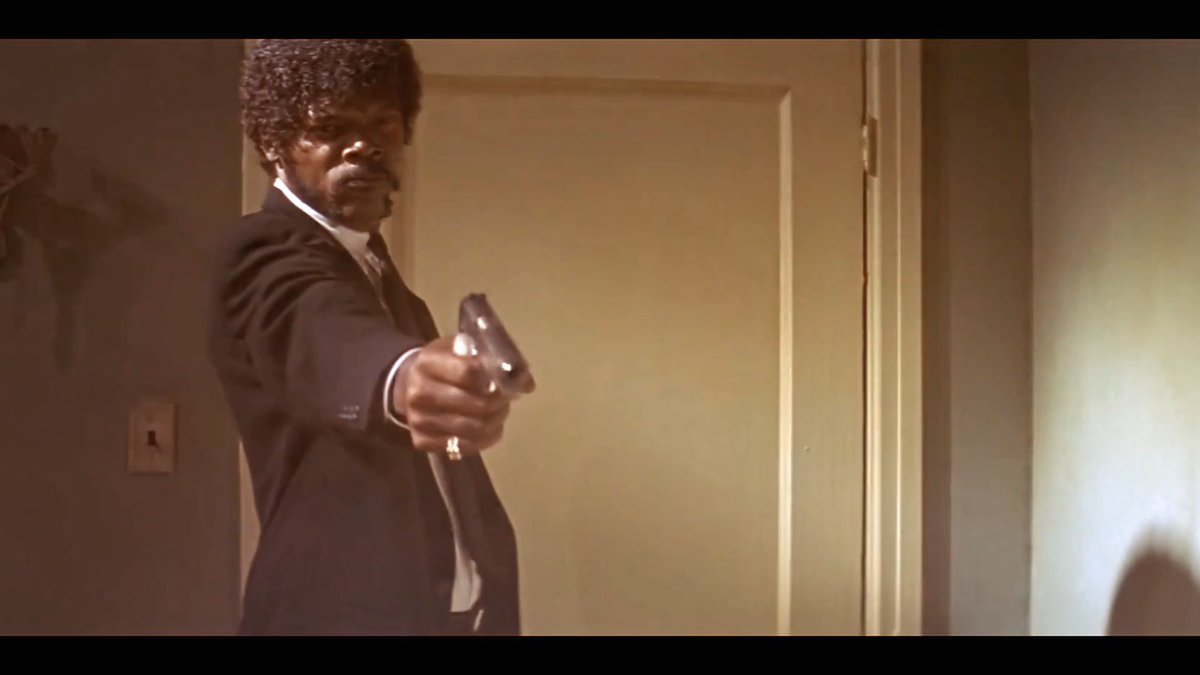
Samuel L. Jackson explains how he landed the role of Jules in Pulp Fiction, and what it was like seeing the film for the first time on the big screen: “Pulp Fiction and I came together in a very strange kind of way. I remember auditioning for Quentin for Reservoir Dogs in New York (for the role of of Detective Jim Holdaway, Mr. Orange’s police contact). And apparently I didn't get that role. But I was at Sundance the year that he screened it for the first time. I was sitting there and I watched that movie - I was awed by it. I mean, there were people running up the aisles when Michael Madsen was cutting the cop's ear off. People were going, "Oh my God, this is horrible!" All these “auteurs” were running out of the theatre. I was like, "This is good. This is happening. This is different." So after the film, I walked up to Quentin and said, "This film's amazing, man. It's great." And he looked at me and said, "Hey! How'd you like the guy who got your part?" And I was amazed that he even remembered who I was - but he remembered me. A year or so later, I got a phone call saying Quentin Tarantino wants to have dinner with you, because he'd seen Jungle Fever and he liked that Gator character. When we had dinner, we were sitting there talking. We started talking about Hong Kong films and cartoons and foreign movies and obscure things that we watched, horror movies. We found out we liked the same kind of stuff. And he told me he was writing this thing, and he was writing this part with me in mind. He was going to send it to me. I went off to do another film. I was in the backwoods of Virginia somewhere doing a film, and the script came. A little plain brown wrapper from Jersey Films. And Jersey's got these gangster images on the logo. And it said, "If you show this script to anybody, two guys named Ernie and Luigi will come and break both of your legs." Whatever. I went, "Yeah, right." So I sat down and read it. Boom. I read this thing. It's like, "Oh my God. This is awesome." And then I said to myself, "Nobody writes a script this good. There's no way that this script is as good as I thought it was." I closed it. I opened it again. I read it immediately. Okay. This is great - If whoever produces this film lets him shoot exactly what I just read, if they stay away from it, they don't try to edit any of this stuff out - this is going to be a great film. It's going to be kind of audience-specific, because I like that kind of stuff. I have friends that I knew would like it. It was a generational kind of film. I never thought it would cross over and do all this stuff. We shot it. We had a great time doing it. And the first time I actually saw the film was at the Cannes Film Festival. That night, it screened, and I was sitting there watching the film. The audience was loving this movie, loving it. About halfway through, I realized there were subtitles at the bottom of it. So I said, "Hey, these people are reading it, and they're getting it. This might be special. This really might be something special." And actually, by the time it was over, there were tears running down my face. I was just so pleased that I was part of that particular film… I never felt that satisfied, and that kind of full about a performance and about being part of something as I was in that particular moment.” Quote comes from an Interview with the American Film Institute 2010

Gangster Cinema Central

85,366 Aufrufe • vor 1 Monat

Will Ferrell says the iconic Anchorman news team fight was his favorite scene to film, revealing it was shot in 100-degree heat in just one day and captured the absurd comedy that defined the movie. “One of my favorite scenes in the movie. It’s such an incredible joke bag. Before we get into the fight, Brick Tamland, played by Steve Carell, is holding a grenade. We don’t know how he got ahold of it. There is a man on fire, there is someone being dragged by a net by horseback, which is kind of an homage to early Planet of the Apes.” “I think it’s something like 30 to 35 different setups, with two units, a stunt unit working at the same time as the main film unit in downtown LA in the middle of July. And I think it was 100 degrees that day.” “And we only had the one day to complete all that. And it’s probably a scene that should have taken three days to shoot. So silly, so absurdist. I think it is really one of the touchstone moments that defines the tone of Anchorman.” “I think Adam and I wanted to create this film where we got to indulge every comedy idea we ever had and follow it all the way through without someone telling us, “No, that scene’s too long,” “No one would ever do that,” “That doesn’t make sense.” We just wanted it to be like, it may not make sense, but it’s just funny.” “I think when people saw that film, they were like, “This feels like someone gave you the keys to a car and you’re 5 years old and you don’t know how to drive.” No one wanted to make it, no one understood why this would be funny. We just felt like we were playing with the house’s money, and let’s just make the craziest film we can, because we may never be allowed to make another movie ever again.”

Ruzy.hl

60,067 Aufrufe • vor 23 Tagen

Quentin Taratino said Lawrence Fishburne’s performance in King of New York was so incredible he thought - “he could be the greatest actor of his generation”. He explains: "As great as Christopher Walken is in this movie. To me, it's Larry Fishburne's movie - it was the rock that becomes a diamond aspect of the movie. It's why I could defend this movie against all comers, because to me, Fish's performance in this movie was comparable to a young Brando. It was the most exciting performance by an actor of his generation that I'd seen in a movie of that time. And I thought, well, that's it. There is a new Marlon Brando, and his name is Larry Fishburne - it was amazing, it was mesmerizing… He is the first hip hop gangster in movie history. That character had never been done before this. He invented that character. And he invented it as something to do. It wasn't in the original script. He came up with that himself… The three big Fishburne moments to me, is his opening sequence with…Tito. That's it, with Tito - black glove dude. And his reunion with Frank. And then it's the chicken scene (see below). Those are his three big arias. Not only that though - expressions that I would later hear for the rest of the decade, I actually heard for the first time in that scene. I'd never heard the expression; “I'll slap the black off you” before. That was the first time I heard it when Fish says it to Snipes. I've since heard it many times… And that was actually the first time I ever heard, “fuck you very much”. And I would proceed to hear that for the rest of the 90s. But those were the first times I'd ever heard those expressions… As terrific as he has been in other things - the level of excitement that I had over him when this movie was over, I have never had that excitement again. I thought, with this, he could be the greatest actor of his generation. That was an actual, real fucking thing. He could be the greatest actor of his generation after seeing this." Quote comes from The Rewatchables podcast

Gangster Cinema Central

657,359 Aufrufe • vor 2 Monaten