正在加载视频...

视频加载失败

Edward Yang on his Filmmaking Style: "Interviewer: Do you have a specific visual or editing style that you feel communicates your viewpoint on a story? Yang: Not really. My philosophy is that everything is decided by the subject matter. If the subject matter needs to be tense, restless, upsetting,...

44,059 次观看 • 10 个月前 •via X (Twitter)

0 条评论

暂无评论

原始帖子的评论将显示在这里

相关视频

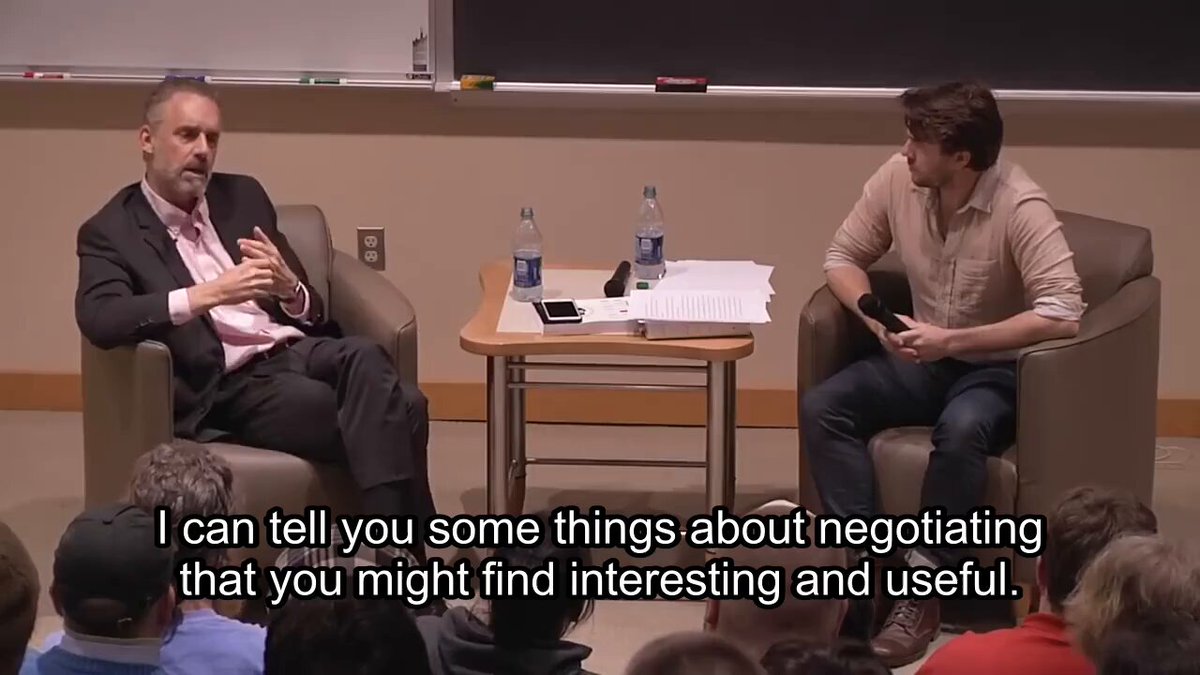
Jordan Peterson: "If you're competent and silent you will be ignored." "You might think well people should reward you because you're competent. And yes of course they should. But if you're competent and silent then you're just part of the background that's keeping everything functioning" On why you cannot negotiate from a position of weakness: "If you want to push your career forward you have to push it forward. You have to be competent and you have to be strategic" "To be strategic when you negotiate for a new position or a new salary you have to be able to say if you don't give me what I want then something you don't like will happen to you" "It's not a physical threat. It's that you have an option" "You have your CV in order. You're educated and competent and desirable to people outside of your immediate job. You're willing to instantly put yourself on the job market" "So that when you go talk to the person you're negotiating with you're credible" On the one thing most people completely miss about negotiation: "It's very seldom that you're talking to the person who's at the top of the pecking order. What you need to do is tell them a story that they can tell to their boss to make you not a problem" "A good story is look we really need this person because they're hyper competent and they have a better offer" "If you go in there with no power you're going to lose. Obviously" He concludes with the one thing every competent person needs to hear: "The first thing you need to know if you're going to negotiate is that you have to be able to say no. And what no means is that you're not going to do it"

Brad

34,669 次观看 • 9 天前

Jordan Peterson: "If you can't fix your room, you can't fix your life" "Why should you even bother improving yourself? The answer is something like: so you don't suffer anymore stupidly than you have to. And maybe so others don't have to either. It's not some casual self-help doctrine. If you don't organize yourself properly, you'll pay for it. In a big way. And so will the people around you." Peterson continues: "You can say, 'Well, I don't care about that.' But that's actually not true, you do care about it. Because if you're in pain, you will care about it. It's very rare that you can find someone in excruciating pain who would say, 'Well, it would be no better if I was out of this.' Pain brings the idea that it would be better if it didn't exist along with it. It's incontrovertible." On how to start: "Look around for something that bothers you and see if you can fix it. You can do this in a room. Sit in your bedroom and think: 'If I wanted to spend ten minutes making this room better, what would I have to do?' You have to ask yourself that, it's a genuine question. And things will pop out. There's a stack of papers bugging you. Some rubbish behind your computer monitor you haven't attended to for six months. Cables tangled up." He explains why this matters: "If you were coming to see me for psychotherapy, the easiest thing would be to get you to organize your room. You think, is that psychotherapy? It depends on how you conceive the limits of your being. Start where you can start. If something announces itself as in need of repair that you could repair, fix it. Fix a hundred things like that, your life will be a lot different." On fixing what you repeat every day: "People tend to think of their daily routines as trivial. You get up, brush your teeth, have breakfast. Those probably constitute 50% of your life. People think, they're mundane, I don't need to pay attention to them. No, that's exactly wrong. The things you do every day are the most important things you do. Hands down. Just do the arithmetic." On staying within your competence: "Sometimes you don't know how to fix something. Imagine you're walking down the street and there's a guy who's alcoholic and schizophrenic and has been homeless for ten years. That's a problem. It would be good if you could fix it, but you haven't got a clue. You walk around that and go find something you could fix. Just because something announces itself as in need of repair doesn't mean it's you, right then and there, who should repair it. You have to have some humility. You don't walk up to a helicopter that isn't working and just start tinkering away." Peterson shares the key insight: "As soon as you give your mind a genuine aim, it'll reconfigure the world in keeping with that aim. That's actually how you see to begin with. You've all seen the video where you watch basketballs being tossed back and forth, and while you're doing that, a gorilla walks into the middle of the video and you don't see it. If you thought about that experiment for five years, that would be about the right amount of time to spend thinking about it." He explains what it reveals: "What it shows you is that you see what you aim at. If you can get one thing through your head, that would be a good one. You see what you aim at. One inference you might draw from that is: be careful what you aim at. What you aim at determines the way the world manifests itself to you. So if the world is manifesting itself in a very negative way, one thing to ask is: are you aiming at the right thing?"

Jaynit

68,799 次观看 • 3 个月前

Martin Lewis, founder of MoneySavingExpert. com, on the four things it takes to be really successful, and why the most important one isn't what you'd expect: He opens with a clear framework: "It takes four things to be really successful. Talent, you've all got it, as do many more people than you think. Hard work. If you want to be really successful, you're going to have to work hard. Focus. Zone in on what you're good at." On focus, he pushes back against the idea that you need to be exceptional at everything: "Understand, none of us are unfailingly brilliant at everything. So, find the thing that you're good at and zone in on that. And that is what will create your success." But the fourth factor is where his message turns unexpected: "The most important thing is luck. You can do everything right, but it still not work for you. And you need to know that now." This reframes how he wants people to think about setbacks: "Failing does not make you a failure. Do not judge yourself. See it as a way to learn and to give yourself a better opportunity the next time." Martin Lewis then challenges a common assumption about what success actually delivers: "Success can be stressful. Success is not a synonym for happiness. As you go through your working careers, at sometimes you may want to make a call. Do I continue to push that hard or do I smile at what I've got and enjoy happiness and the other things that life starts to give me?" He closes with a message aimed at those who do make it big: "One or two of you in here will make it really big. If that's you, remember of those four things, the most important one is luck. And that means if you're that super successful one in the room, you have a moral duty to give back."

Big Brain Business

292,025 次观看 • 3 个月前

“What did you think of Lando being booed at race because people and I've seen it online as well say he doesn't deserve the title because McLaren favored him over his teammate. Do you think that's total nonsense?” Jacques Villeneuve: “That's a little bit ridiculous. When there was some booing in some races, that was embarrassing. You should never boo a driver that's clean, doesn't do anything dirty, on track is respectful, and on top of it is super fast. What's wrong with people? That was embarrassing. And, had it been that Piastri was a second a lap faster than him and somehow Lando was winning because a lot of things were happening, his car breaking down every time, then you could start thinking, okay, that's really not cool. That's not fair. But that wasn't the case. And in the second half, Norris has been faster right at the beginning as well, last year as well. So there's this whole middle of the season where Piastri was driving a lot better than Norris and was getting the points. Norris had an engine blowing up, not Piastri. And so those fans, they don't look at that either. You have to look at the whole picture, at the whole season. And suddenly if your favorite is starting to go backwards, you just got to bite the bullet and accept it. Your favorite is just going backwards. That doesn't mean that the other one is treated better or the other one is undeserving just because the one you're a fan of is not winning right now. That’s really wrong. If you're a fan of the sport, then you have to be a fan of the sport and understand when your driver is maybe not cutting it at this point in time, even though he was before and he will in the future again. It's all a question of timing. But that's the price we have to pay now with social media and how big F1 has become. It's very passionate. The people are passionate and once, you know, fans come from fanatism, you stop thinking, when you get in that mindset and it happens to all of us. You want something so much that you get attached and you cannot - it's hard to start seeing reality. So you will try to mold the reality to your thought process and if your champion is not winning then it cannot be his fault. It has to be something from the outside. It has to be the team destroying his chance or not favoring and so on and so on and so on. But there's nothing concrete behind those comments. It's pure fandom and it'll always be like this. And ultimately it's not a bad thing. You know drivers at that - sportsman at that level have to grow a thick skin. If not, you don't deserve to be there. You just have to have a thick skin because they're all very happy to get the compliments. They love it when it's just positive, but it gets balanced out with negatives and you need to be able to take and accept the negatives as well. It goes both ways. You cannot have the good. You just have to be a thick skin and know that it's part and parcels of what's going on. And in one month, it will be forgotten and maybe everything will change and it be the other driver that suddenly will be criticized and so on. So, it's just that's just the way it is.”

naenia ¹ ⁶³

29,833 次观看 • 7 个月前

French economist Thomas Piketty explains to Zack Polanski that how a local wealth tax should Include an exit tax, adding rich should pay their fair share in proportion: "Let me make very clear that individual countries like Britain or France can very well have uh, uh, progressive wealth tax and billionaire on their own right away." "They don't need to ask the permission of their neighbors or the United Nation, or they don't need to wait for world unanimity." "The only thing they need to do when they do wealth tax on their own is to make clear that if you have made your wealth in, in Britain for many decades by benefiting from the public services in Britain, by the legal system of Britain, because creating wealth, accumulating wealth is always the outcome, uh, of a collective process where you use institution, the legal system, the education system, the health system, the transportation system, the road system." "If you have benefited from this during many decades, you cannot simply walk away at age 50 or 60 or whatever and say, okay now, bye bye, I don't pay tax anymore." "So the first, the only important thing you need to do when you set up a wealth tax, say in Britain, is to say even if you go away, you keep paying." "The way the Americans do it, is by saying as long as you keep U.S. citizenship, you pay even if you're in Switzerland, wherever you want." "I don't think this is the best way." "I think a better way would be to make people pay in proportion to the years of, of residents that they have spent in the country." "So if you have spent your first 50 years in Britain, you move at age 51, well that's fine, do that." "But you know, you keep paying 50, 51st of the tax that you would have paid." "So the fiscal cost for the treasury is quite limited." "Yes, so that's the important point." "And once you have said that, I think all the arguments about tax evasion sort of fall down almost immediately." "Now people will tell you, oh, but you cannot do that." "Of course you can." "The problem is that we have put ourselves in a situation to think that the very specific treaties about capital flows, what we have come to call free capital flows that were set up in the 80s and 90s, are sort of law of nature." "The idea that you have a sacralized right to benefit from the public services legal system in a country as much as you want, and then you push on a button and you can transfer your assets wherever you want and nobody can follow you and nobody can make you pay." "And it's a sort of new sacralized right." "But look, this is a uh, completely crazy system." "This is a machinery to make normal people middle class and lower class people hate globalization." "And if you tell people there's nothing you can change about this." "There's nothing you can change about inequality, about economic policy." "We see the only thing government can do is to control their border for, uh, migrants." "And then of course, 20 years, 30 years later, the entire political conversation is about border control and identity." "But that's because you close the discussion entirely about, uh, uh, economic and fiscal policy." "So we have to reopen the discussion." "And the first thing to do that is to question free capital flows in the sense that you don't have the freedom to escape taxation after you have benefited from the public services and public institution of a country during so long." "So if you address this directly and make clear that you will keep paying in proportion to the number of years you have stayed in Britain, then um, um, I mean, you can also combine that with rules about the location of the assets themselves." "As long as the assets are located in Britain, of course you can make people pay." "But it's important to, to have also the number of years you've spent in the country so that even if you move your assets away, you keep paying and you don't have the choice otherwise your assets can be taken away from you if some of them are in Britain, if you return to Britain and you've not paid your tax, well, you will be subject to the sanction which anybody not paying your tax." "So that's the first big thing, is that you don't need to have a world wealth tax." "You can do a lot at the level of Britain." "And we should not use this global wealth tax idea as an excuse not to do at, uh, the country level what national governments can do at their own level."

Farrukh

240,358 次观看 • 3 天前

Mark Zuckerberg explains why he has never believed in delegation (and why founders shouldn't either): Most CEOs believe their job is to hire great people and get out of the way, but Mark disagrees. "I basically don't believe in delegation." He explains his thinking: "There's so much going on across the company that I can't possibly get involved in all of it. So all these people are going to have a ton of stuff that they're going to do." But that's not a reason to step back. It's a reason to be selective and then go deep. "Fundamentally, if there is a decision that I want to be involved with, I'm going to be involved in it." His argument is simple: if you're the one accountable for everything, why would you ever accept being locked out of something important? "If you're running the company and you're on the hook for everything and there's something that's important at whatever level of detail in the organization, I don't get the logic of saying I'm not going to be involved in that." He's not calling for micromanagement, and he acknowledges he can't be everywhere. What he's rejecting is the idea that hierarchy should be a barrier. That founders should stay in their lane. That diving into the details is somehow a sign of poor leadership. Mark Zuckerberg does add one caveat: "You want to have humility and know that if you're diving into some decision, you may not have the most context immediately." But humility about context is different from staying out entirely. His conclusion is a cultural one: "You want to have the cultural expectation that things are not going to be so hierarchical and you're just going to dive into whatever you want."

Big Brain Business

20,055 次观看 • 1 个月前

Richard Fleischer on how he directs a movie: "Interviewer: How do you work once you’re on the set? Do you have a specific approach? Fleischer: When you’re a director, you’re not only dealing with the actors, but everything needs your full attention at the same time, and that’s what I do for a living: I give a hundred and ten percent of my time and energy and have thought about the things that I am working on, and hopefully, there’s a way to cope with every element you have to deal with. After coming home from the studio in the evening, I plan the next day’s work and layout a plan of action for the blocking of the scenes. I try to block them in my mind before I get to the stage, the position of the actors and where will the camera be. However, when I get to the set, I try not to let the actors know that I have already planned it, I let them feel their way around, and by making slight suggestions, it comes out the way I want it to come out. But the actors feel they have contributed to the direction of the scene, which is what I want. So I am helping them find their way, that’s one of the things. Suppose you’re working on a scene that has already been blocked, or partly shot or well-rehearsed, then I have to figure out the order of shooting: what do I shoot first, second, third… and make a list of every setup I have to make in the order of shooting, not necessarily in the order of continuity. You try to find the most economical way to shoot a picture; for instance, if you got a scene where people are making a lot of entrances and exits through a door, but they’re separated in different parts of the film, you work it out so you shoot all of those doorway scenes one after the other and you save a lot of time. You don’t have to take down the lighting and everything else. However, if it interrupts the flow, if the actors kind of get lost in the scene they’re doing, then I stop that, and I’d have to do it the other way. But mostly, it’s a matter of deciding what you want to shoot the next day and in what order." (Richard Fleischer: “Orson Welles changed everything for everybody”, Film Talk, 2003) Clip from: See No Evil (1971) Director: Richard Fleischer

DepressedBergman

142,398 次观看 • 8 个月前