正在加载视频...

视频加载失败

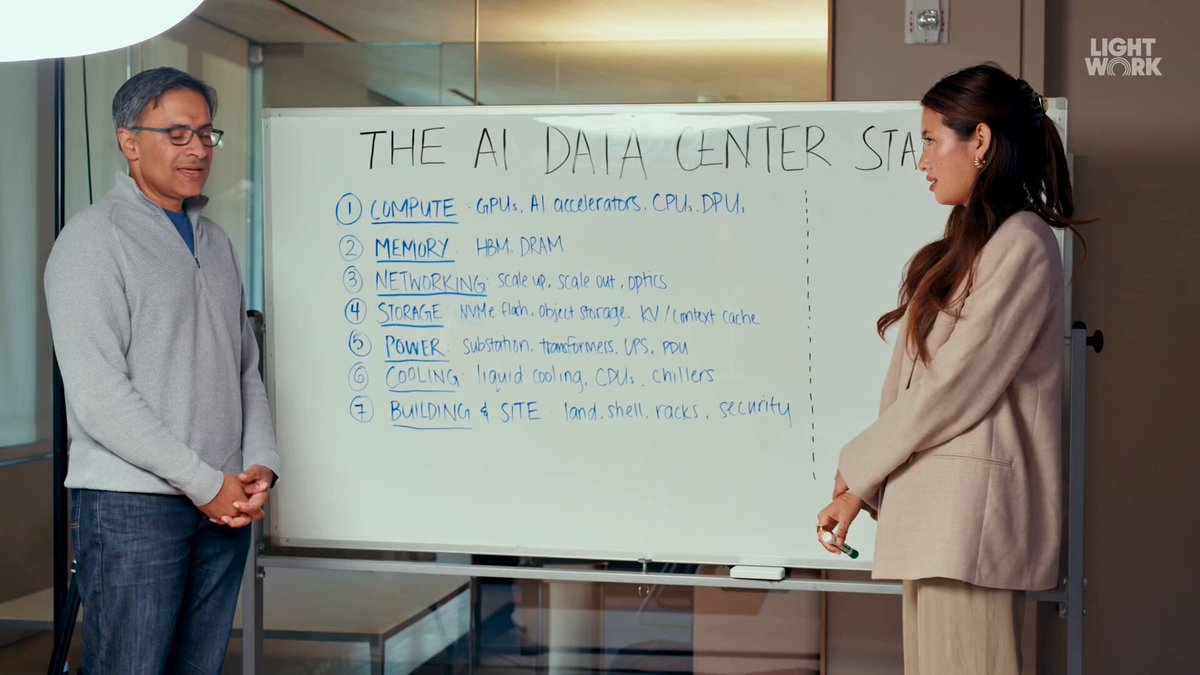
Efficiency is the real bottleneck in AI. As AI adoption accelerates, data centers are becoming some of the most energy-hungry assets in the world. $NBIS' approach is clear: sustainability isn’t an afterthought, it’s a design principle. The company designs its servers, racks, and data centers in-house, allowing: - Higher...

44,039 次观看 • 6 个月前 •via X (Twitter)

0 条评论

暂无评论

原始帖子的评论将显示在这里

相关视频

This is the next big plan for SpaceX: AI Data Centers in Space. • To achieve even a small fraction of a Kardashev Type II civilization (harnessing the full energy of the Sun), AI compute will require orders of magnitude more energy than Earth can ever provide. • Earth only intercepts about 1–2 billionths of the Sun’s total energy output. • Massive-scale AI (e.g., a million times more energy than Earth could produce) can only be powered by capturing far more solar energy in space. • Space-based solar-powered AI satellites/compute clusters are therefore inevitable. • In space, sunlight is continuous (no night, no clouds, no atmosphere), so no batteries are needed. • Solar panels in space can be extremely lightweight and cheap (no glass, no storm-proof framing required). • Cooling in space is dramatically easier and simpler: just radiate heat directly into the cold vacuum — no water, no fans, no liquids, no massive cooling infrastructure. • Most of the mass/volume of current supercomputer racks (e.g., GB300) is cooling hardware; in space that largely disappears. • The cost-effectiveness of electricity and compute in space will soon be overwhelmingly better than on Earth. • Elon’s Prediction: within ~5 years (by ~2030), the lowest-cost way to run large-scale AI will be solar-powered satellites in space. • A terawatt/year of AI compute is essentially impossible on Earth with any realistic build-out of power plants. • Scaling both power generation and cooling on Earth at the required rate is physically and politically unfeasible.

Nic Cruz Patane

48,991 次观看 • 6 个月前