Video wird geladen...

Video konnte nicht geladen werden

Zur Startseite

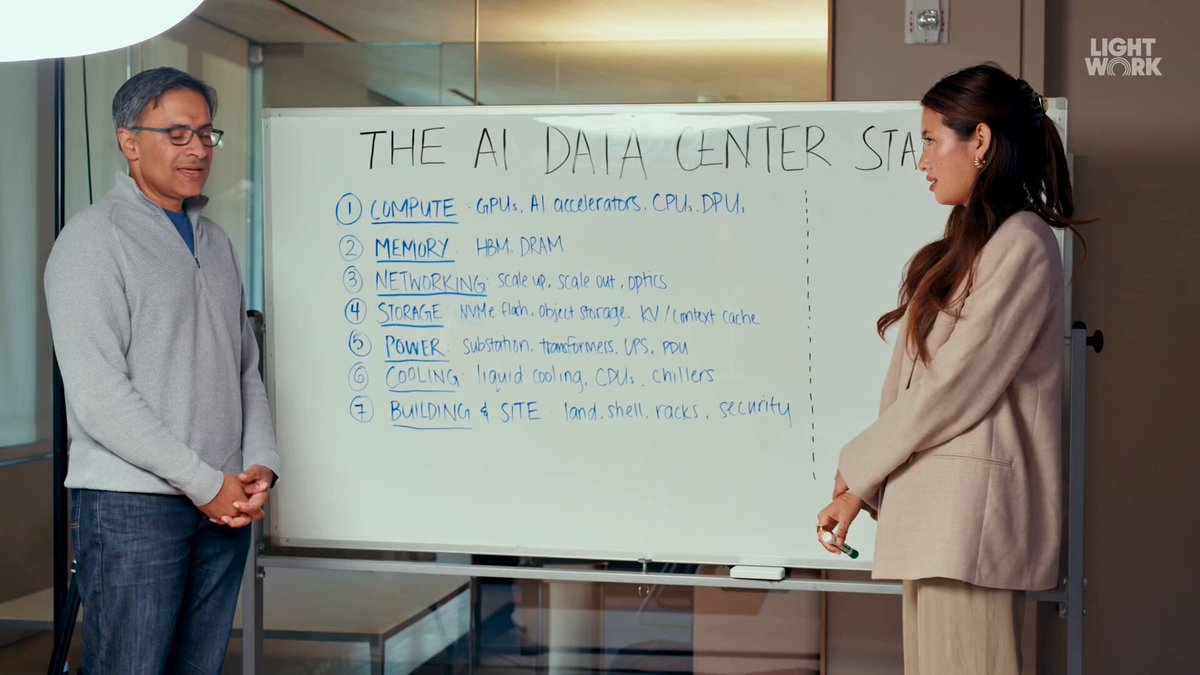
Efficiency is the real bottleneck in AI. As AI adoption accelerates, data centers are becoming some of the most energy-hungry assets in the world. $NBIS' approach is clear: sustainability isn’t an afterthought, it’s a design principle. The company designs its servers, racks, and data centers in-house, allowing: - Higher...

44,039 Aufrufe • vor 8 Monaten •via X (Twitter)

0 Kommentare

Keine Kommentare verfügbar

Kommentare vom Original-Post werden hier angezeigt

Ähnliche Videos

This is the next big plan for SpaceX: AI Data Centers in Space. • To achieve even a small fraction of a Kardashev Type II civilization (harnessing the full energy of the Sun), AI compute will require orders of magnitude more energy than Earth can ever provide. • Earth only intercepts about 1–2 billionths of the Sun’s total energy output. • Massive-scale AI (e.g., a million times more energy than Earth could produce) can only be powered by capturing far more solar energy in space. • Space-based solar-powered AI satellites/compute clusters are therefore inevitable. • In space, sunlight is continuous (no night, no clouds, no atmosphere), so no batteries are needed. • Solar panels in space can be extremely lightweight and cheap (no glass, no storm-proof framing required). • Cooling in space is dramatically easier and simpler: just radiate heat directly into the cold vacuum — no water, no fans, no liquids, no massive cooling infrastructure. • Most of the mass/volume of current supercomputer racks (e.g., GB300) is cooling hardware; in space that largely disappears. • The cost-effectiveness of electricity and compute in space will soon be overwhelmingly better than on Earth. • Elon’s Prediction: within ~5 years (by ~2030), the lowest-cost way to run large-scale AI will be solar-powered satellites in space. • A terawatt/year of AI compute is essentially impossible on Earth with any realistic build-out of power plants. • Scaling both power generation and cooling on Earth at the required rate is physically and politically unfeasible.

Nic Cruz Patane

49,035 Aufrufe • vor 8 Monaten

David Friedberg: Michael Burry’s Datacenter Math is Wrong “I actually think Michael Burberry's got this wrong.” “What Michael Burry is saying is that all of these hyperscalers have extended their depreciation schedule or the useful life of their data centers by roughly 2x, which cuts the operating costs in half when they report it in earnings. And so it's making their earnings inflate.” “So he's claiming they're cooking the books. Google first made this change in Q1 of 2021, where they said the servers are now going from 3 to 4 years. Separately in 2021, Google took networking equipment from 3 to 5 years. And then in 2023, they took it from 5 to 6 years.” “And so this is a result of this effort where they went in and did an analysis. So what happened?” “What happened in the data centers is that the data centers transitioned from being primarily data storage and data transfer systems, where you would use hard drives and RAM and memory to store data and then transmit it back out, to being data processing centers because of the AI boom.” “So as AI became more important in the data center, more of the dollars that are going into data centers were allocated towards chips from data storage, which initially was hard drives.” “And then suddenly, when you put these processors in to process the data to do AI, the majority of the spend and the majority of the energy is going towards the processors.” “I made some calls and I checked around with some other friends, and everyone says the same thing: that these 7-8 year old TPUs and GPUs that are sitting in the data centers are still being used and they're being used at 100% utilization.” “So that actually justifies and validates the depreciation schedule being much longer versus shorter.”

The All-In Podcast

304,297 Aufrufe • vor 9 Monaten

🚨$OSS is not an AI company. → It is the hardware that lets AI exist where the cloud cannot. Most investors don’t understand $OSS because they think AI = software. $OSS builds the physical “brains” that run AI in extreme environments where cloud computing fails. Jets. Ships. Tanks. Drones. Space. Hospitals. That’s the game. 1) What $OSS actually is $OSS (One Stop Systems) designs rugged high-performance computers and storage systems for AI at the edge. Meaning: They bring data-center-level computing power into harsh environments. Their products include rugged servers, GPU accelerators, storage arrays, and expansion systems used for AI, sensor processing, and autonomous systems. In simple terms: Cloud AI = brain in a safe building. $OSS AI = brain inside machines operating in chaos. 2) Why this is crucial Most AI today runs in data centers. But the future of AI is not in the cloud. It’s on: • autonomous vehicles • military systems • drones • ships • industrial machines • medical devices These systems cannot wait for the cloud. Latency, connectivity, security, and survival demand local AI. $OSS delivers “data-center performance at the edge” across land, sea, and air. Without companies like OSS, autonomous systems simply don’t work. 3) What OSS actually does: Think of OSS as building AI engines that survive reality. 🌊 SEA example: naval surveillance aircraft and ships. $OSS supplies rugged storage and compute systems for U.S. Navy reconnaissance aircraft to collect and process massive sensor data in real time. Translation: Instead of sending raw data back to base, the aircraft analyzes threats instantly onboard. $OSS = the onboard AI brain. 🪖 LAND example: military vehicles and tactical operations. $OSS delivers high-performance servers and FPGA systems for mobile military intelligence platforms used by the U.S. Department of Defense. Translation: Tanks and vehicles detect threats, process sensor data, and make decisions locally. $OSS = the battlefield computer. ✈️ AIR example: airborne AI. $OSS builds GPU-accelerated servers designed for aircraft, described as a “datacenter in the sky.” Translation: Jets and drones run AI models mid-flight. $OSS = flying supercomputers. 🚀 SPACE example: $OSS hardware is designed for extreme environments and autonomous systems across aerospace and defense. Translation: Future satellites, space drones, and autonomous spacecraft need onboard AI. $OSS = the computing core of autonomous space systems. BONUS: CIVILIAN & COMMERCIAL $OSS systems are used in: • autonomous trucking and farming • industrial automation • healthcare imaging • energy and mining • telecom and 5G Example:A medical imaging company uses $OSS hardware to run real-time AI diagnostics in next-gen breast cancer scanners. $OSS = AI where milliseconds matter. 4) Who their customers are (pattern, not names) $OSS sells to: • defense primes • government programs • industrial OEMs • AI infrastructure companies • medical device manufacturers These customers share one trait: They cannot rely on the cloud. That’s why $OSS exists. 5) The mental model that makes $OSS obvious $NVDA = AI chips $PLTR = AI software $OSS = AI hardware in the real world If AI is electricity, $OSS builds the generators that work in storms. Most investors understand AI software. Few understand AI infrastructure at the edge. That gap is the opportunity. 6) The real thesis The world is moving toward: • autonomous warfare • autonomous vehicles • real-time AI systems • distributed intelligence All of that requires rugged edge computing. $OSS is positioned exactly there. Infrastructure. The hardest layer to build. And often the most valuable.

Black Panther Capital

30,138 Aufrufe • vor 6 Monaten

Elon Musk just explained why the SpaceX IPO is an energy story and the energy constraint is why he believes space becomes the only viable path for AI to scale (Save this). The argument he is making is one of the most important and least understood things happening in technology right now. The United States currently consumes roughly 500 gigawatts of electricity on average. To double that capacity which is what continued AI expansion on the current terrestrial trajectory would eventually require would mean building as many power plants as currently exist in the entire country. He is not arguing that this is technically impossible, just that communities are not willing to accept it, that permitting timelines make it unrealistic, and that the hard ceiling on Earth based power generation means the expansion of AI compute will eventually hit a wall that no amount of capital can overcome on the ground. His observation is that in space, that wall does not exist. A solar panel in orbit produces roughly five times more power than the same panel on Earth, operates in continuous sunlight uninterrupted by weather or nighttime, and benefits from the vacuum of space as a completely passive cooling system meaning the two largest operating costs of any terrestrial data center, energy and cooling, are effectively eliminated. He then said that you could theoretically increase harnessed energy by a factor of one million and still be using less than a millionth of the sun's total energy output. This is the underlying physics of why SpaceX filed with the FCC to launch up to one million solar powered AI satellites, and why they described that constellation in their own filing as a first step toward becoming a Kardashev Type II civilization capable of harnessing the full power of the sun. To understand what makes this credible rather than visionary, you need to understand what SpaceX already controls that no other company on earth possesses. Starship, once operating at full cadence, can deliver 100 to 150 tons of payload to orbit per launch, at a target cost per kilogram that is an order of magnitude lower than any existing vehicle. Musk's stated ambition is to scale Starship to 10,000 to 30,000 launches per year, a frequency that would allow the deployment of orbital compute infrastructure at a pace that is currently unimaginable with any existing rocket. He told xAI staff earlier this year that achieving space-based AI at scale will eventually require manufacturing facilities on the moon, building solar panels and heat dissipation structures from lunar silicon and aluminum, and launching them into orbit from there rather than from Earth's surface because the moon's lower gravity makes the economics of launch dramatically more favorable. SpaceX's S-1 filing explicitly states that its launch capabilities could enable massive AI compute satellite constellations with the potential for millions of satellites for orbital data centers, with the first launch potentially occurring as soon as 2028. Google and Alphabet are already in advanced talks with SpaceX about deploying space-based data centers. Starcloud, a startup running Nvidia H100 GPUs in orbit, has already validated that high-performance AI inference workloads can operate in space, with plans to scale to five gigawatts of orbital compute power by 2035. This is why Musk believes the cost crossover happens in two to three years because SpaceX's launch cost trajectory intersects with the accelerating energy constraint on the ground in a way that makes space genuinely cheaper, faster, and less regulated at exactly the moment AI demand is hitting its hardest physical limits.

Milk Road AI

12,738 Aufrufe • vor 2 Monaten

Today we announced our new Fairwater datacenter in Atlanta, connected with our first Fairwater site in Wisconsin and our broader Azure footprint to create the world’s first AI superfactory. Fairwater exemplifies our vision for a fungible fleet: infra that can serve any workload, anywhere, on fit-for-purpose accelerators and network paths, with maximum performance and efficiency. AI workloads have evolved beyond large-scale pre-training. Today, they encompass fine-tuning, reinforcement learning (RL), synthetic data generation, evaluation pipelines, and more. Fairwater is built to support this full lifecycle: Max density: Fairwater’s two-story design and liquid cooling system lets us place racks in three dimensions and pack them with GPUs as densely as possible, minimizing cable runs and improving latency and effective bandwidth. Fleet: Each Fairwater DC can integrate hundreds of thousands of the latest NVIDIA GPUs into a single coherent cluster. This provides flexible infra that can support the full spectrum of workloads, and ensure no GPU is left unnecessarily idle. And that’s on top of the more than 100,000 GB300s coming online this quarter alone for inference across the rest of our fleet. For us, it’s all about turning every gigawatt into the maximum number of useful tokens. Not every GW is created equal! Planet-scale: Every Fairwater DC will connect through our continent-spanning AI WAN to prior generations of AI supercomputers, forming a truly fungible pool of compute. This enables developers to scale beyond the capacity of a single site and dynamically land workloads on the right infra for their needs. Together, these innovations let us bring together different generations of silicon and AI systems across DCs and geos into a single elastic system that scales seamlessly across training and inference workloads And this elastic AI capacity is all available alongside all the other cloud services (compute, storage, databases, app services) that AI agents and workloads need. This is what we mean when we talk about building a fungible fleet – a single, unified platform that pushes the limits of performance per watt and per dollar. Read more:

Satya Nadella

908,065 Aufrufe • vor 9 Monaten