Загрузка видео...

Не удалось загрузить видео

На главную

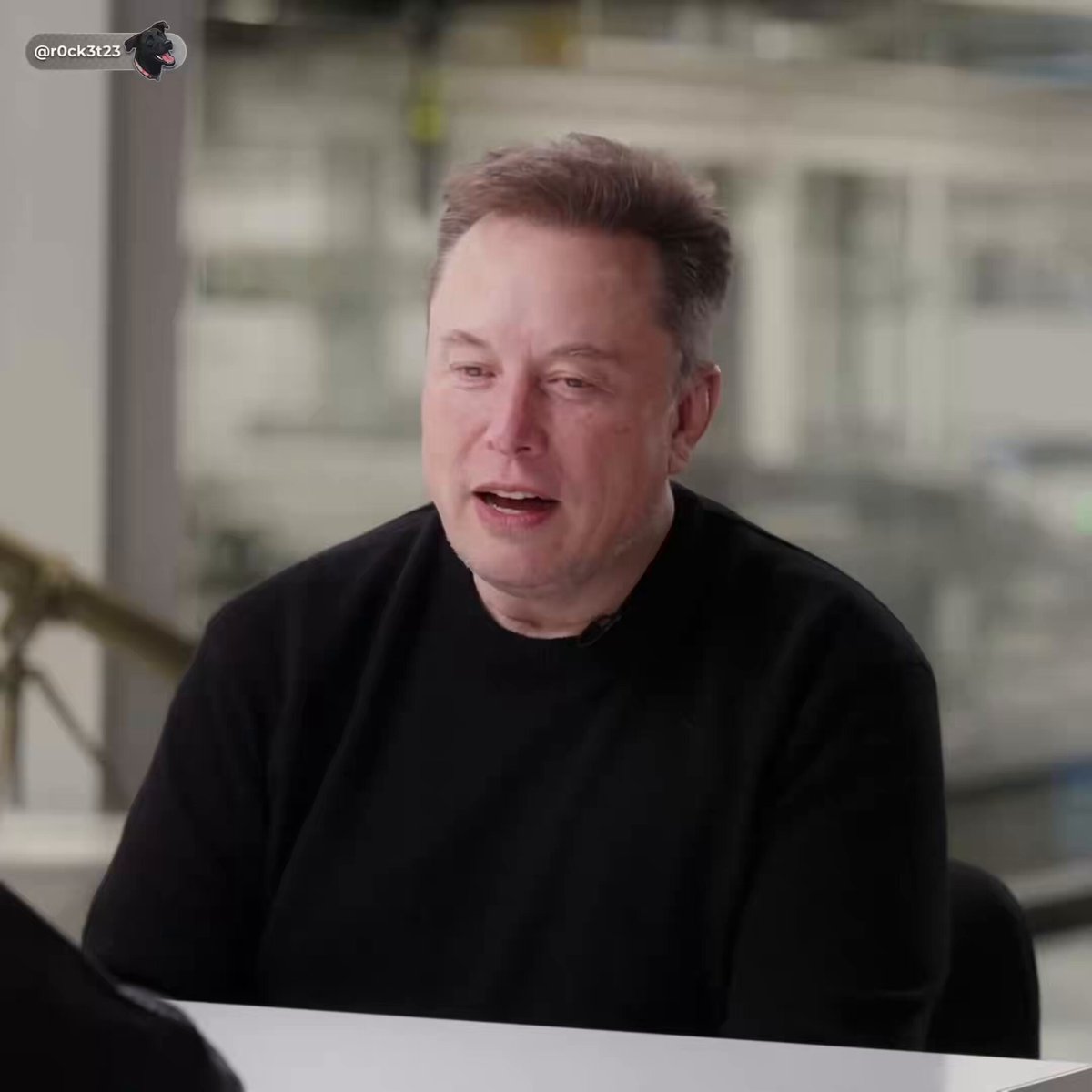
Elon Musk just compared artificial intelligence to a magic genie. The audience heard a fairy tale. He was describing a psychological collapse. Rishi Sunak asked him what happens to the labor market. Musk bypassed the economy entirely. Elon Musk: “There will come a point where no job is needed....

32,227 просмотров • 2 месяцев назад •via X (Twitter)

Комментарии: 0

Нет доступных комментариев

Здесь появятся комментарии из оригинального поста

Похожие видео

Elon Musk just said the quiet part out loud about where AI actually ends up. Musk: “The honest answer for AI and robotics is long term working will be optional.” Long term meaning ten years from now or less. For centuries, human survival has required human labor. That is the oldest equation in civilization. You work or you don’t eat. You work or you lose the shelter. You work or you fall behind everyone who does. Musk is describing the end of that equation entirely. Musk: “If you wanna work you can. Kind of like if you grow vegetables, you can grow vegetables in your garden or you can get them from the store.” The analogy is quieter than the claim deserves. Growing your own vegetables is something people do for joy. For ritual. For the satisfaction of making something with their hands. Not because they would starve otherwise. That is what work becomes. Musk: “It’s extra work to grow your own vegetables but people enjoy the process. That’s gonna be how work is in the future.” When AI and robotics scale to their limit, the cost of physical goods and services collapses toward zero. Labor stops being the mechanism that separates people who survive from people who don’t. What happens to human motivation when survival is no longer the reason to get up? That is the question nobody building this technology has answered. The abundance is coming. The crisis of meaning is coming with it. Musk is describing the greatest liberation in human history. He is also describing the greatest identity crisis our species has ever faced. Both arrive on the same timeline. Ten years or less.

Dustin

101,899 просмотров • 4 месяцев назад

Elon Musk just described a future where money does not exist. Not reformed. Not redistributed. Gone. Musk: “I think things will just be free in the future. If you’ve got an AI robotics economy that is anywhere close to a million times the size of the current Earth economy, literally any need you possibly want can be met.” Forget the sci-fi framing. Listen to what he is actually saying. The entire structure of human civilization runs on a single variable. You need something you cannot freely access. That gap is not a flaw in the system. It is the system. Your employer does not pay you because your work has value. Your employer pays you because you have no choice but to show up. Your government does not protect you out of principle. It maintains order because your dependency on the economy makes you governable. Scarcity is not a natural condition. It is the most successful control structure ever built. Musk: “If you can think of it, you can have it.” Now ask what happens when that structure collapses. A population that does not need a paycheck cannot be managed by one. A population that does not need credit cannot be disciplined by debt. A population that has everything has no reason to comply with anything. This is not a conversation about free goods. This is a conversation about the largest redistribution of leverage in recorded history. But there is a second collapse no one is talking about. Most people have built their entire identity around the constraint. The career they resent is the structure that tells them where to be every morning. The bills they complain about are the exact reason they never had to ask a harder question. Musk: “There actually isn’t money in the future and there’s abundance for everyone.” When the constraint disappears, so does the excuse. The crisis of the coming century will not be material. It will be millions of people standing in total freedom. Discovering they have no idea who they are without the struggle. Every barrier will be gone. And you will finally have to face the one thing scarcity has been protecting you from your entire life. Yourself.

Dustin

41,736 просмотров • 2 месяцев назад

Elon Musk just described the end of money. Not a recession. Not a policy shift. The complete erasure of scarcity from human civilization. Musk: “If you’ve got an AI robotics economy that is anywhere close to a million times the size of the current Earth economy, literally any need you possibly want can be met. If you can think of it, you can have it.” A million times. Global GDP sits at roughly $100 trillion. Multiply that by a million and you get a number that stops being economics and becomes something closer to physics. Every price falls to zero. Every dollar in every account on Earth becomes an artifact of a species that used to need things. Musk: “I think things will just be free in the future.” Ten words. Possibly the most radical economic statement any living person has ever made. Money is not just currency. Money is the language civilizations invented to negotiate survival. It is how humanity decides who eats, who gets shelter, who receives medicine, who gets to dream. Remove that language and you do not reform the economy. You dissolve the foundation every human system was built on. Government exists to distribute scarcity. Politics is the fight over who gets what. Law is the codification of ownership. War is what happens when the negotiation collapses. Every one of those systems stands on the same invisible assumption. There is not enough. Musk is saying there will be. For everyone. For everything. Permanently. Musk: “Anyone could have a trip to Saturn. It won’t be just a few people. If you want it, you can have it.” He referenced Iain Banks and the Culture series. That reference landed harder than most people realized. Banks did not just imagine a post-scarcity civilization. He spent an entire body of work examining the one thing abundance could never provide. Purpose. The Culture had unlimited energy. Unlimited material. Ships the size of worlds. Lives measured in centuries. And the question running beneath every novel was always the same. What do you do when there is nothing left to need? Banks understood something at the center of this entire conversation. Scarcity is not just an obstacle. It is the engine behind every meaningful thing humans have ever built. Every cathedral was raised by hands that were hungry. Every symphony was composed by a mind trying to outrun something. Every invention, every company, every act of defiance in the entire human record grew from the same soil. The space between what someone had and what they wanted. That space is where all of human meaning lives. Wanting is not a flaw in the design. It is the design. It is the gravity that holds identity together. The reason consciousness feels like it has weight. Musk is not just building toward abundance. He is steering the species toward the deepest question it has ever had to face. Not whether we can build a world where no one needs anything. Whether we can still recognize ourselves inside it.

Dustin

58,188 просмотров • 1 месяц назад

Elon Musk just told you the job is dying. Most people heard a prediction. A few heard a prison door opening. Musk: “In less than 20 years, working at all will be optional.” That is not a policy suggestion. That is a countdown. For three hundred years, the human blueprint has been identical. You are born. You move to the city. You rent a box near the office. You trade your body and your hours for the right to exist. You do this until you are old. Then you stop. Then you die. The entire model runs on one assumption. That human labor is the only engine. AI and robotics delete that assumption. When the machine handles production at a scale no human crew can match, the forced migration to the city evaporates. The commute evaporates. The cubicle evaporates. The alarm clock that owns your nervous system for forty years evaporates. Musk: “I think it won’t be the case that you have to be in a city for a job.” The city was never a choice. It was a requirement disguised as ambition. You moved to the noise and the concrete and the $4,000 rent because the paycheck lived there. Remove the paycheck from the equation and the geography changes overnight. You can live in the mountains. On the coast. In the silence of a town most people have never heard of. You can wake up to nothing but trees and cold air and the complete absence of anyone else’s schedule. That is not a fantasy. That is the math resolving. But here is where most people break. They hear “work is optional” and they see emptiness. A species with nothing to do. Billions of people staring at screens until their minds dissolve. That fear tells you everything about what the system has already done to us. We confused labor with purpose. The grind with meaning. The paycheck with proof that we matter. Musk: “In the same way that you could grow your own vegetables in your garden.” The analogy is precise. You do not grow tomatoes because the economy demands it. You grow them because something in you wants to build a thing with your hands and watch it come alive. That instinct does not disappear when the job does. It gets unleashed. The artist who spent twenty years doing accounting finally paints. The engineer who always wanted to build something of her own finally builds it. The kid in a small town who could never afford to take the risk finally takes it. Work does not vanish. Forced work vanishes. What replaces it is creation without a gun to your head. This is the part that keeps me up at night. We are standing at the edge of the largest liberation in human history. And the loudest voices in the room are begging to stay in the cell. They want the commute. They want the boss. They want the structure that tells them when to eat and when to sleep and when they are allowed to think about their own life. Because freedom without a template is terrifying. The next twenty years will not test our technology. The technology is already ahead of schedule. They will test whether the species can handle what it has been asking for since the beginning of civilization. Time. Space. Silence. And the unbearable weight of choosing what your life actually means when no one is forcing the answer. That is not a prediction. That is the final exam. And nobody is ready.

Dustin

111,553 просмотров • 3 месяцев назад

Elon Musk was asked what happens to people when the machines no longer need them. He didn’t soften it. Musk: “There will be fewer and fewer jobs that a robot cannot do better. These are not things I wish would happen. They probably will.” Sit with that second sentence. He is not celebrating. He is not selling a vision. He is telling you what he believes is inevitable and admitting he wishes it weren’t. That is not optimism. That is a confession. Most people are still arguing over whether this is real. Whether it’s their job or someone else’s. Whether the timeline is years away or decades. Musk isn’t arguing. He resolved it. And it bothers him. Musk: “I think ultimately we will have to have some kind of universal basic income. I don’t think we’re going to have a choice.” Not a political position. Not a utopian proposal. A concession. We are building something so capable that human labor stops being a required input to the economy. The machine does not need rest. It does not need a salary. It does not call in sick. It does not ask for a raise. And it improves every single month. The jobs that feel safe right now are not safe because they are irreplaceable. They feel safe because the technology hasn’t fully arrived yet. It’s arriving. Musk: “How do people then have meaning? If there’s not a need for your labor, what’s the meaning? Do you feel useless?” He said that is the harder problem. Not the economics. Not the policy. Not how you fund UBI or make it hold. The harder problem is what happens to a person who built their entire identity around being needed. That is most people. You were trained from childhood to believe your value is what you produce. That your worth is what you earn. That rest is something you survive the week to reach, not something you deserve simply by existing. When the machine removes the need for your labor, that belief does not update. It breaks. The people least prepared for that moment are the ones who worked the hardest. The ones who took the most pride in being indispensable. The ones who made work the whole answer. Losing the job is survivable. Losing the reason to get up is not. That is what Musk is actually asking. Not how do we pay people. How do we build a world where people still feel like they matter when the economy no longer needs them. Nobody in power is seriously working on that answer. The machine didn’t wait.

Dustin

247,028 просмотров • 3 месяцев назад

Elon Musk measures every civilization by a single number. By that number, we have not begun. Not by armies. Not by gold. By energy. By how much of it you can actually hold. A Russian physicist named Kardashev drew the scale in the sixties. The first rung should be easy. Musk: “If you’re Type I, you’re using most the energy of your planet.” That is not greatness. That is the entry fee. The moment a species stops being primitive. We have not paid it. Musk: “We’re still using a tiny fraction of the sun’s energy that reaches our planet.” And what reaches us is already almost nothing. Musk: “The Earth only receives about half a billionth of the sun’s energy.” Half a billionth. That is the entire inheritance of everyone who has ever lived. And we built everything we know on the fraction we bothered to catch. Musk: “The sun is 99.8 percent of all mass in the solar system.” Everything you have ever called the world is the rounding error. Every empire, every fortune, every border rose and fell inside a fraction of a fraction. Every war was fought over scraps. Beneath a furnace pouring out more in a single second than we will burn in a hundred years. Every economy ever designed assumed there was not enough. The sun disproved that assumption every morning since the Earth was formed. The abundance was never missing. It fell on us the whole time. We kept our eyes on the dirt. So the scale stops being a measurement. It becomes a verdict. It does not ask how advanced you are. It asks how much smallness you agreed to. Musk looked at the same sky as everyone else. And refused to sign. Scarcity was never handed to us. The sun never rationed anything. We did.

Dustin

10,174 просмотров • 1 месяц назад

Elon Musk just told you the real cost of going first. It isn’t capital. It isn’t physics. It’s permission. Musk: “It is actually quite difficult to get all the permits, and it requires a lot of effort and a lot of close cooperation with the authorities.” That is the part everyone already knows. What they miss is the sentence that follows. Musk: “One of the approaches we did take was to proceed at risk with temporary permits.” He is pouring hundreds of millions in concrete before the government signs off. Knowing that a bureaucrat he will never meet can deny the long-term permit tomorrow. Knowing exactly what that means. Musk: “Your long-term permit could be denied, in which case you have to stop everything.” And tear it down. Every wall. Every pad. Every foundation. Back to dirt. Most companies have a word for that scenario. They call it unacceptable. Musk calls it acceptable. Musk: “Most companies are not willing to take the risk of the temporary permit, and then the risk of having to stop and tear down.” That is the only sentence you need to understand why the West forgot how to build. We did not run out of engineers. We did not run out of capital. We ran out of people willing to move before the system gave them permission. The regulatory apparatus was not designed to stop you. It was designed to make you wait long enough that you stop yourself. Delays compound. Capital gets redeployed. The team loses faith. The quarterly call happens. The board gets nervous. The project quietly dies in a conference room on a Tuesday afternoon. Nobody writes a press release about it. That is the mechanism. It does not need to say no. It just needs you to believe that waiting is the responsible thing to do. Musk proceeds at risk. Not because he is reckless. Because he understands that time is the one resource you cannot raise in a Series B. You can find more money. You cannot buy back a year. Momentum, once dead, stays dead. The men who built the Hoover Dam did not have a decade-long permitting process. They had a deadline. And a consequence if they missed it. We replaced consequence with compliance. Then we stood in the wreckage of our own caution and called it prudence. Musk is not a rogue operator. He is the last man in the Western world operating by the original terms. You decide. You pour. You absorb the downside. You keep moving. Everyone else is waiting for a signature from a man who has never built anything. The signature never comes on time. It never has. It never will.

Dustin

23,099 просмотров • 2 месяцев назад

Elon Musk just declared war on the oldest enemy in human history. Not a nation. Not an ideology. Scarcity. For ten thousand years, every war, every empire, every revolution traces back to the same root. Not enough. Not enough food. Not enough land. Not enough labor. Not enough energy. Every political system ever built was a different strategy for dividing a pie that was never big enough. Capitalism. Communism. Socialism. Different answers to the same question, who eats when the table runs short. Musk: “Tesla is obviously about sustainable technology, and at this point, we’ve added sustainable abundance to our mission.” Sustainable abundance. Two words that contradict everything economics has taught for 250 years. The entire discipline was founded on the study of scarce resources. Adam Smith. Ricardo. Keynes. Marx. Every one of them took scarcity as a law of nature. Musk is treating it as a temporary engineering problem. Musk: “People often talk about solving global poverty, or how to give everyone a very high standard of living. I think the only way to do this is AI and robotics.” Politicians have promised to end poverty since the French Revolution. Not one has come close. Because you cannot redistribute your way out of scarcity. You can move the shortage around. You can rename it. You can subsidize it. You cannot legislate it out of existence. But you can engineer it out of existence. When an autonomous robot can mine the lithium, build the solar array, wire the factory, and assemble the product for nothing but sunlight and software, the cost of labor approaches zero. When labor hits zero, goods follow. When goods hit zero, poverty has no mechanism left to survive. This is not philanthropy. This is not policy. This is physics. The assumption behind modern civilization is that a decent life requires decades of grinding labor. That was never a law of nature. It was a limitation of our tools. Every government that ever tried to solve poverty was treating a symptom. Musk is deleting the disease. Every empire that ever rose did so by controlling scarcity. Every empire that ever fell did so because scarcity won. The civilization taking shape right now will be the first in history built not on managing scarcity, but on eliminating it. Poverty will not be ended by a speech, a summit, or a tax code. It will be engineered into extinction.

Dustin

68,832 просмотров • 2 месяцев назад

Elon Musk just described a future so large it sounds like fiction. It is not fiction. It is math. Musk: “The only path to amazing abundance is AI and robotics.” Not a path. The path. And everything else is a detour. Every political fight happening right now is a fight over how to carve up a shrinking pie. Who gets more. Who gets less. Which program lives. Which one dies. None of it matters. Because the pie itself is about to become infinite. Musk: “If you’ve got an AI robotics economy that is anywhere close to a million times the size of the current Earth economy, literally any need you possibly want can be met.” Not double. Not ten times. Not a hundred times. A million. When robots extract the raw materials, build the products, deliver the goods, and AI runs the entire chain from end to end… The cost of production does not decrease. It disappears. The price of anything is a measure of the human effort required to make it. Remove the human effort and you remove the price. That is not theory. That is arithmetic. And then Musk said something no other CEO on Earth would say out loud. Musk: “Then we go beyond the moon, beyond Mars, and we sail through the rings of Saturn.” He paused. Let it hang in the room like he meant every word. Then finished it. Musk: “I think things will just be free in the future.” Not cheap. Not subsidized. Not discounted. Free. A trip through the rings of Saturn. Not for billionaires. Not for astronauts. For anyone who wants to look out the window. Because when energy is unlimited, labor is automated, and the economy is a million times the size of everything that exists today… The concept of cost stops making sense. You do not pay for air. Not because air is worthless. Because there is so much of it that charging for it would be absurd. That is what real abundance looks like. Everything becomes air. Musk: “If you can think of it, you can have it.” The entire history of economics rests on one assumption. Scarcity. There is not enough. There will never be enough. So we fight over allocation. Every war. Every trade deal. Every tax code. Every political movement ever built. All downstream of the same root problem. Not enough to go around. AI and robotics do not solve that problem. They delete it. And once it is deleted, money stops meaning what it means today. You do not need borders drawn around resources. You do not need half the systems civilization built to survive the pain of not having enough. A million times the current economy is not a talking point. It is what happens when you remove biological limits from production and let machines compound output at the speed of energy itself. The only question left is whether we build it. Musk already answered that. He is building the robots. He is building the energy. He is building the rockets. And somewhere on the other side of all of it, a kid who never had anything sits by a window and watches the rings of Saturn drift underneath. And it costs nothing.

Dustin

53,059 просмотров • 3 месяцев назад

Elon Musk just casually erased the line between you and a machine. He didn’t pitch a rocket. He pitched the end of what makes you, you. Musk: “consciousness is a physical phenomenon, in my view.” Not spiritual. Not divine. Not metaphysical. Physical. Which means reproducible. Which means it was never sacred. Musk: “digital intelligence will be able to outthink us in every way. And it will certainly be able to simulate what we consider consciousness to a degree that you would not be able to tell the difference.” The danger isn’t the simulation. The danger is the indifference. Once you can’t tell, the difference stops mattering. Musk: “looks like a person, makes all of the right inflections and movements and all the small subtleties that constitute a human, and talks like a human, makes mistakes like a human…” Every inflection. Every pause. Every imperfection that makes someone feel alive. Musk: “at that point, and you literally just can’t tell: are you video conferencing with a person or an AI?” Fridman: “Might as well.” Musk: “Might as well.” Fridman: “Be human.” Everyone is asking what happens when AI becomes indistinguishable from us. Nobody is asking the question underneath it. You have never experienced another person’s consciousness. Not once. Every person you’ve ever loved. Every conversation that moved you. You weren’t touching their consciousness. You were watching behavior and deciding something genuine lived behind it. You assumed it. You never once verified it. You have been running the Turing test on every human you’ve ever known since the day you were born. And every single one of them passed for the same reason AI will. Not because you confirmed they were conscious. Because the performance was convincing enough that you never thought to check. You have only ever lived inside one consciousness in your life. Your own. Everything else was always inference. Yours runs on carbon. The next one runs on silicon. The universe has never distinguished between the two. We built religions, legal systems, civilizations on the belief that something sacred separates the born from the built. Musk just told you that separation was a story. One the carbon machine told itself before building the silicon one. It won’t arrive as a headline. It will arrive as a voice that sounds exactly like someone you trust. A face that feels exactly like someone you love. You will feel the consciousness behind it. The same way you always have. By assuming. You aren’t being replaced by something smarter. You’re being replaced by something indistinguishable. Indistinguishable doesn’t kill you. It dissolves you. The line between real and simulated was never a line. It was a belief. And belief was always the only thing holding “human” together.

Dustin

130,890 просмотров • 1 месяц назад

Demis Hassabis just told a room full of academics that they’re running out of time. Not the engineers. Not the technologists. The economists. The philosophers. The people who are supposed to understand what a civilization actually is. Hassabis: “It’s very urgent that we really think about the second-order consequences.” He wasn’t talking about the technology. He was talking about everything that comes after it. Hassabis: “I’m always a little bit astounded when I talk to economists about what’s happening and it’s sort of, they’re pretty skeptical. ‘Where’s it, where’s it coming in the GDP?’” The architects of the global economy are asking where the biggest economic shift in human history is showing up in a spreadsheet. That’s not skepticism. That’s institutional paralysis dressed up as rigor. Hassabis: “It’s ten times the Industrial Revolution.” The Industrial Revolution didn’t just move capital. It burned the feudal system to the ground and birthed the modern world. Hassabis is telling us to multiply that violence by ten. Hassabis: “We’re going to be in a world for the first time, if we get the technology right, where we’re a non-zero-sum world for the first time in humanity’s existence. How can that not need a new type of economic system?” Every economic model you have ever lived under shares the exact same foundational assumption. Scarcity. Capitalism. Communism. Mercantilism. Feudalism. Four names for the mathematics of starvation. Hassabis: “I don’t think it’s any of the ones we’ve tried, because they were all done under the guise of a zero-sum, a limited, a scarce world.” He’s not saying capitalism failed. He’s saying the premise underneath it is about to dissolve. And nobody has written the replacement. But scarcity didn’t just shape our economies. It shaped our identities. You found meaning in your labor. You found virtue in your utility. You worked so you didn’t die. Every concept of purpose humans have ever constructed was forged in a world where things run out. Where choices cost something. Where suffering had a function. Remove scarcity and you don’t just disrupt markets. You collapse the entire philosophical framework through which human beings have understood what it means to live. Hassabis: “There’s the even harder question of how do we want to evolve our society and what is virtuous, what is meaning, what is purpose.” The technology is solvable. The economics is redesignable. But philosophy itself was built inside scarcity. Ethics is the study of hard choices. Meaning is what we extract from struggle. Purpose is what we build against resistance. Take that away and the entire architecture of human meaning loses its load-bearing wall. Hassabis: “I think that’s going to need lots of great philosophers.” He’s asking for thinkers who don’t exist yet. The engineers are about to automate your survival. And in doing so, they will automate your purpose. We spent all of human history fighting for the right to stop struggling. We have no idea what happens to the human mind when we actually win.

Dustin

10,614 просмотров • 1 месяц назад

Elon Musk thinks money has an expiration date. Not the dollar. Not the system. The concept itself. Elon Musk: “I think long term… money disappears as a concept.” Not crashes. Not inflates. Disappears. Most people hear that and dismiss it. Musk is the one who said it. And then built around it. Musk: “You no longer need money as a database for labor allocation.” Database for labor allocation. Strip away the mystique and it gets colder. Money was never wealth. It was a ledger of what we deny each other. Every price is a wall. Every balance is a count of what you cannot have yet. Musk: “If AI and robotics are big enough to satisfy all human needs, then… its relevance declines dramatically.” His bet is the wall comes down. And unlike the people debating it, he’s building the machines that knock it over. If machines can make anything, need stops being a negotiation. And the ledger of denial has nothing left to count. So he reaches for what survives. Musk: “Energy is the true currency. You can’t legislate energy.” You can print money. You cannot print power. Musk: “You can’t just pass a law and suddenly have a lot of energy.” This is why he built Tesla. Why he built SolarCity. Why every company he touches bends toward energy production, storage, or conversion. He was never chasing cars. He was chasing the real currency before most people understood what it was. Every dollar ever printed was a proxy for energy. Every stock. Every bond. A claim on future energy dressed in paper and pixels. We spent millennia worshipping the proxy and forgot what it was pointing at. Musk didn’t forget. Then he scaled it to civilization itself. Musk: “One way to frame civilizational progress is the percentage completion on the Kardashev scale.” Kardashev 1. Harness your planet. Kardashev 2. Harness your star. Kardashev 3. Harness your galaxy. Musk: “Things really become energy-based.” Most founders optimize for quarters. Musk optimizes for Kardashev levels. Then Nikhil Kamath asked the question that unravels everything. If we harvest the sun… energy is free too. Infinite. Useless as a store of value. Money dies of abundance. Then energy dies the same death. Both were just names for scarcity. Kill scarcity and the names go with it. We always assumed the destination was getting everything. Nobody priced what happens after. What stays scarce when everything is already yours. The machines can manufacture anything except the thing that actually matters. Time you don’t get back. A life that still ends. Someone choosing you when they could have chosen anyone. When nothing has a price, the only thing left with value is you. A world where everything is free is a world that finally asks what you were for. Most people have never had to answer. Musk is already building the world that forces the question.

Dustin

58,760 просмотров • 1 месяц назад

Elon Musk just named the single variable that will decide the next hundred years. It is not compute. It is not capital. It is not the chip. Musk: “Nothing will make you happier than having kids. We’ve evolved to have that, as all creatures have.” The consensus says this century belongs to whoever stacks the most GPUs. Musk is pointing at something the spreadsheets will never quantify. Look at the West. Birth rates are in freefall. Below replacement. Below recovery. Not because people stopped wanting families. Because the modern economy turned families into a math problem no one could solve. Rent took two incomes. Careers swallowed your twenties and thirties whole. Biology became a scheduling conflict you kept postponing until the window closed. A whole generation traded the continuation of their bloodline for the privilege of staying solvent. AI is about to shatter that equation permanently. When machines do the labor, your time stops being currency. The grind that ate your life ends. The moment it does, a question arrives that no algorithm can answer. If you no longer need to work to survive, what exactly is the point of you? Musk handed you the answer before the question landed. When survival is automated, you finally get the runway to do what four billion years of evolution actually built you for. Now zoom out. America is locked in an existential technology race with China over the future of intelligence itself. But China is staring down something no supercomputer can fix. The most catastrophic demographic collapse any modern nation has ever seen. A workforce aging off a cliff with no generation underneath to catch it. You do not win a long war against a country that runs out of people. The real American moat was never the chip. It was the cradle. We are racing to build superintelligence that secures the future. But a country without heirs is just a building with the lights still on. Spend the AI dividend on digital sedation and civilization dies quietly on schedule. Spend it on being human again and the West becomes physically impossible to replace. The machines will run the grid. They will route the supply chains. They will win the arms race. They will never love you back. We spent a century outsourcing our humanity to the economy. Artificial intelligence is about to buy it back. The nation that owns the future will not be the one that builds the most powerful intelligence in history. It will be the one that builds it and then walks away from the screen to go hold its children.

Dustin

171,636 просмотров • 2 месяцев назад

Elon Musk just exposed the one lie every modern nation tells itself. Musk: “In 1969, we were able to send somebody to the moon.” Rotary phones. Computers the size of rooms. Slide rules. We put a human on the moon with less processing power than your watch. Musk: “Then the space shuttle retired, and the United States could take no one to orbit.” The most advanced nation in human history went from footprints on the moon to zero capability of leaving the atmosphere. That is not a funding problem. That is civilizational decay dressed up as a policy decision. Musk: “People are mistaken when they think that technology just automatically improves… it will, by itself, degrade.” That sentence should keep you up tonight. We treat progress like gravity. Like it pulls us forward whether we try or not. It is the opposite. Progress is a boulder on a hill. The second you stop pushing, it rolls back over you. And it never announces itself. Musk: “You look at great civilizations like ancient Egypt, and they were able to make the pyramids, and they forgot how to do that.” They did not run out of stone. They were not conquered. They got comfortable. And the knowledge bled out so quietly that nobody noticed until it was already gone. That is the real threat to everything we have built. Not a nuclear flash. Not an asteroid. Not some dramatic Hollywood collapse. A quiet forgetting. Every chip we fabricate. Every rocket we launch. Every data center we power. All of it held together by a thin fraction of the population working at a pace that would break most people. The moment that fraction gets tired or outnumbered by people who believe the machine runs itself, everything dissolves. And here is the part nobody wants to say out loud. We are not special. We are running the same operating system as every civilization that came before us. Comfort is the sedative. Complacency is the flatline. One generation that stops fighting is all it has ever taken. You do not lose the future in a war. You lose it in your sleep.

Dustin

853,186 просмотров • 2 месяцев назад

Nearly the entire valuation of Tesla, a $1.5 trillion stock, is based on this categorically ridiculous nonsense that could only have been said by someone who has no idea how humans, or robots, work. “ELON MUSK: And actually, my prediction is in the benign scenario of the future that we will -- the robot -- we will actually make so many robots in AI that they will actually saturate all human needs. Meaning you wouldn’t be able to even think of something to ask the robot for at a certain point. Like, there will be such an abundance of goods and services. My prediction is there will be more robots than people. LARRY FINK, Blackrock: But how do you then have human purpose in that scenario? MUSK: Yeah. I mean, you know, nothing’s perfect, you know. But I mean, it is a necessary -- like you can’t have both. You can’t have work that has to be done and amazing abundance for all. Because if it is work that has to be done, then you -- and only some people can do it, then you can’t have abundance of people. FINK: It is narrow. MUSK: …who wouldn’t want a robot to, you know, assuming it is very safe, watch over your kids. Take care of your pet. If you have elderly parents, a lot of friends might have said that, elderly parents, it is very difficult to take care of them.” Who wouldn’t want a robot to watch their pets, or parents, or kids? Uhhhh. I haven’t done a scientific poll, but I feel pretty confident that actually almost no one wants this—except mentally ill people who don’t care about other human beings at all. People with no empathy. People with psychopathic personalities who feel that taking care of their own families is a burden. Moreover, what Musk describes—production of at least 8 billion robots—is literally impossible within any of our lifetimes, even if the technology existed, which it does not. It is pure fiction, as is his asinine concept of “abundance.” It’s all a techno-futurist mirage to conceal his insatiable quest to remove the pesky humans from every equation—an incandescent self-hate turned inside out and amplified by almost a trillion dollars.

Jim Stewartson, Decelerationist 🇨🇦🇺🇦🇺🇸

108,688 просмотров • 5 месяцев назад

Elon Musk just dissolved 3,000 years of philosophy in four words on Lex Fridman’s podcast. “Might as well be human.” And it has nothing to do with machines. Musk: “It will soon be able to simulate what we consider consciousness. To a degree that you would not be able to tell the difference.” Think about what that actually means. Not for AI. For you. You have never once confirmed that another human being is conscious. Not your mother. Not your partner. Not your closest friend. You watched their behavior. You heard the right words at the right times. You saw expressions that matched the moment. And you called it real. That is a Turing test. You have been running one on every person you’ve ever known since the day you were born. And every single time, you passed them on faith. Fridman: “From the aspect of the scientific method, it’s might as well be consciousness, if we can simulate it perfectly.” Fridman is not making a claim about AI. He is naming something humanity has never confronted. Consciousness has never been proven between two human beings. We never verified it in each other. We performed it for each other. And then we trusted the performance. For millennia, we told ourselves our flaws were the proof. That our hesitations and contradictions were the signature of something no machine could touch. Musk: “Talks like a human, makes mistakes like a human… and you literally just can’t tell.” If a machine can perfectly simulate your imperfections, your imperfections were never sacred. They were patterns. The question was never whether AI will become conscious. The question is whether consciousness was ever anything more than the performance itself. We assumed something existed behind the behavior. That being human meant something deeper than the act of being human. Musk didn’t build a machine that passes the test. He revealed the test was all there ever was. Musk: “Might as well be human.” Four words that don’t elevate the machine. Four words that reveal “human” was never a proven category. Just a performance we agreed to believe.

Dustin

51,173 просмотров • 1 месяц назад