Загрузка видео...

Не удалось загрузить видео

На главную

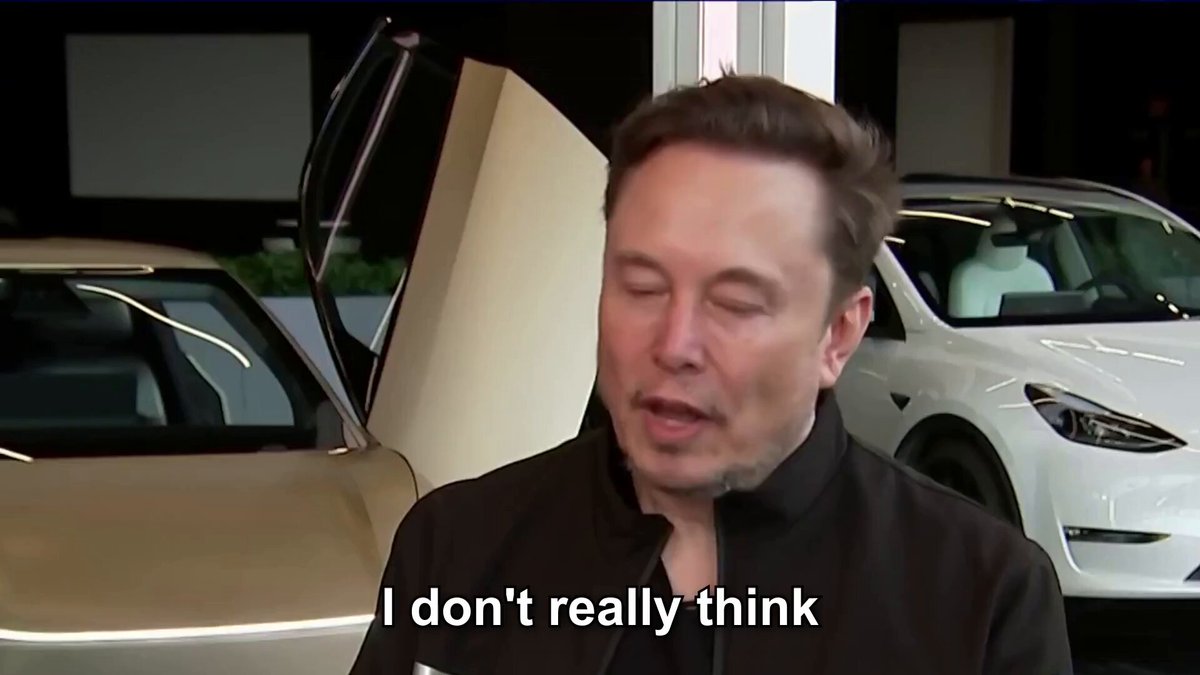
Elon Musk on the first principles mistake almost everyone makes when building something "People will start with the tools and parts and methods they're familiar with, and try to create a product using their existing tools. The other way is to imagine the platonic ideal of the perfect product....

41,490 просмотров • 3 дней назад •via X (Twitter)

Комментарии: 0

Нет доступных комментариев

Здесь появятся комментарии из оригинального поста
Похожие видео

Sam Altman on why you shouldn’t track absolute user growth in the early days of a startup “Nothing but a great product will save you; you can get everything else right and it still won’t work.” He points out that almost all startup founders get the following wrong: “It is more important to have a small number of users that love you than a lot of users that like you… Eventually what you want of course is a lot of users that really love your product, but that’s almost impossible to do.” In practice, you have two choices: Deep and Narrow: “You have a small number of users that really love you and then find out how to find more and more of those users and broaden the appeal of the product.” Shallow and Wide: “You can have a lot of people that sort of use the product once or twice and kind of like it and try to figure out how to get them more engaged over time.” “With high confidence, I can say that you want to start with a small number of users that really love you. Almost all great companies have products that start this way.” He argues that a good indicator of users loving your product is retention and frequency of use: “In fact, I think this is so important that you actually shouldn’t track absolute growth in number of users in the early days of a startup. You should just track how often they’re using it… That’s a good early indicator of users that love you—better still is them spontaneously telling their friends to buy your product.” Follow Startup Archive for more tactical startup advice!

Startup Archive

565,789 просмотров • 2 лет назад

Elon Musk just exposed the most common trap in business strategy. Most founders are obsessed with market share. Musk doesn’t know his competitors exist. Musk: “I don’t really think about competitors. I just think about making the product as perfect as possible.” The moment you benchmark your execution against a rival, you’ve capped your ceiling at their level of mediocrity. You’re no longer setting the pace. You’re reacting to someone else’s. Interviewer: “You don’t think about competitors at all?” Musk: “No. I just think about making what we want to achieve, the Platonic ideal of the perfect product.” You don’t engineer a multi-trillion-dollar monopoly by iterating on existing features. You do it by relentlessly pursuing the absolute theoretical limit of what the product can be. The average founder is trying to build something slightly better than the alternative. Musk is trying to manifest the mathematical ceiling of the concept itself. When your only benchmark is the Platonic ideal, the competitive landscape becomes completely irrelevant. You’re no longer competing. You’re just executing the purest possible form of the architecture. Musk: “As long as you focus on that, you will have a compelling product, obviously.” Dominance is never the goal. It’s the unavoidable byproduct of building something so structurally sound that alternatives stop making sense. Every hour spent calculating competitive positioning is an hour stolen from perfecting the product itself. The most dangerous builders on the board don’t strategize how to defeat their rivals. They engineer a product so fundamentally superior that rivals quietly become irrelevant. The market doesn’t reward the best competitor. It consolidates around whoever stopped competing and started perfecting.

Dustin

40,561 просмотров • 5 месяцев назад

Rahul Vohra on how to measure product/market fit Rahul Vohra is the founder and CEO of Superhuman. He was looking for a metric to measure product/market fit so that he and his team could optimize, and he came across the following methodology from Sean Ellis: Simply ask your users: “How would you feel if you could no longer use the product?” with three options: (1) not disappointed, (2) somewhat disappointed, or (3) very disappointed. It turns out that the benchmark for product/market fit across hundreds of venture-backed startups is 40% of respondents saying “very disappointed”. And as Rahul puts it: “If more than 40% of your users would be very disappointed without your product, then you should focus on growing your company. If less than 40% of your users would be very disappointed without your product, then you’ll probably struggle to grow.” 40% may not sound like a lot, but it’s an incredibly hard benchmark to beat. For example, Slack posed this to 731 customers early in the company’s history, and 51% said they would be very disappointed without Slack. One might expect a terrific product like Slack to have a score of 60-80%, but that wasn’t the case. Rahul’s explanation of why the response options are focused on disappointment rather than happiness is interesting too: “I think the reason behind that is that if you ask people how they feel about a product and you give them positive potential responses, I think it invites more bias. People are more likely to be polite. And it also doesn’t get to the heart of the matter which is: how necessary has your product become in people’s lives? If you’re trying to build a company that’s going to stand the test of time, you really do have to build a product that matters and that people ultimately come to depend on because it’s just so incredible at what it does. And that’s what this question gets to the heart of.”

Michael McGuiness

67,106 просмотров • 2 лет назад

Marc Andreessen on the 3 things he looks for when investing in a startup The first thing Marc Andreesen looks for is a big market: “Is there a big existing market that you think you can go after and displace incumbents? Or do you believe there will be a new market that will be big?” The second thing he looks for is a 10x better product: “Is there a fundamental technology or economic change that justifies a new company? And the way I always think about that is: Is there a 10x change happening in the technology landscape? Is something 10x faster, 10x cheaper, or 10x better? If it’s not 10x, we as both VCs and entrepreneurs have to ask ourselves if it’s really worth doing because it’s really hard to start new companies . . . Existing companies are usually pretty good at what they do. So for a new company to exist, it has to bring a product to market that’s so much better than what exists that it punches through the status quo.” The third is the team: “Is the team outstanding? . . . You want to have a founding team of complementary skillsets. You want to have at least one super strong technologist — quite possibly more than one. Some of the best startups are actually more than one founding technologist. And then it often helps to have someone who is a marketing or salesperson who has a really good understanding of business.” Marc believes that you need all three of these, but if you’re going to compromise on one of those as an investor, it should be the product: “A great market is a lot easier to make up for with iterative product execution. The problem with a poor or small market is that even if you do a good job on the product, there just aren’t that many customers so it’s hard to ever get big and people get demoralized . . . And then we evaluate the team of a startup by its ability to get into a big market with a good product.”

Startup Archive

17,333 просмотров • 6 месяцев назад

Evan Spiegel on the lesson that killed his first startup and led to Snapchat: "We focused on building the perfect product for way too long before we got feedback. We worked for like eighteen months to build this perfect full-featured product, which was in direct contravention to how I was always taught to build things. Build a prototype, build an MVP, get it in front of people, learn as quickly as possible. But we had spent all this time building this perfect piece of software and we hadn't thought enough about distribution. While we built this great piece of software, our competitor at the time, Naviance, had secured distribution through all the different college counselors. What piece of software are you going to choose to help your kid get into college? The one recommended by the college counselors or the one from two kids at Stanford? I think it's a pretty easy choice. So we saw very early that we had no distribution advantage. Even if we loved our software, people weren't going to use it because we didn't have a scalable way to get it in people's hands. Around that time when we saw the emergence of the App Store on iPhone, it was very clear that was a distribution channel we could really use and benefit from. But we also needed to build things we could build quickly, things we really were going to use together with our friends so we could be the first early customers. Ultimately Peekaboo and Snapchat represented that." This is exactly the asymmetry Peter Thiel describes in Zero to One: superior distribution by itself can create a monopoly, even with no product differentiation. The converse is not true. Thiel puts an even finer point on it: most businesses get zero distribution channels to work. Poor sales rather than bad product is the most common cause of failure. If you can get just one distribution channel to work, you have a great business. Estée Lauder said: it's not enough to have the most wonderful product in the world. You must be able to sell it. Many founders over-index on product perfection and under-invest in distribution. The world is full of great products nobody knows about, and mediocre products with massive distribution that dominate markets. Evan Spiegel lived it. He built the better product, watched it lose, and then built something he could actually distribute.

David Senra

27,043 просмотров • 4 месяцев назад

Elon Musk’s real claim about Optimus isn’t that it’s the biggest product ever made. It’s that the biggest product ever made is a tenth of it. Musk: “I think it will be 10 times bigger than the next biggest product ever made.” That isn’t a claim about robots. It’s a claim about every object humans have ever sold each other, and it only holds once you notice what they all had in common. Every product ever built shipped incomplete. The drill needs a hand. The car needs a driver. The phone needs someone awake and holding it. All of it was leverage, and leverage does nothing until something pushes on it. You were the missing part in every machine ever made. That was the design, not a flaw. Optimus is the first product that arrives with the operator already inside. Which is why the company that got there first was never going to be a robotics company. Musk: “Tesla is the only company with all the required ingredients.” The mind and the body were never built by the same people. Labs that can think can’t stamp metal. Companies that can stamp metal can’t think. Tesla spent a decade mass-producing a machine that already has to see, decide, and move through a world full of people. Then priced it for a driveway instead of a defense contract. The robot is that machine with the road taken away. Musk: “You should be able to ask them to do things naturally.” A machine that has to be programmed sells to the people who can program. A machine you can talk to sells to anyone with something they’d rather not be doing. Every product in history was priced against another product. A better phone. A faster car. A cheaper tool. This one is priced against a wage. Wages are the largest line item on earth and the only cost technology has never driven down. Labor is the only thing anyone has ever sold that the seller never gets back. Every wage ever paid was a life billed by the hour. Musk: “Nothing will even be close.” Nothing else is close because everything else was capped by buyers. Demand for a product ends when everyone who wanted one has it. Demand for work doesn’t end. The ceiling was never how many people would buy it. It was how much there is to do, and there has never been a shortage of that. Only of hands. The prediction isn’t that Optimus succeeds. It’s that if it does, it enters the oldest and largest market on earth, one that has never had a competitor. Every product ever made sold you a better way to spend your hours. This one sells the hours back.

Dustin

49,514 просмотров • 21 дней назад