Video wird geladen...

Video konnte nicht geladen werden

Zur Startseite

End-of-week battle: same prompt → UI MagicPath (1min) vs @Figma Make (2:30) vs Lovable (5min) 🥇Winner: MagicPath – elegant, consistent screen in <2min! Lovable & Figma Make outputs feel almost identical lately. Which surprised you? Next contender?

13,971 Aufrufe • vor 8 Monaten •via X (Twitter)

0 Kommentare

Keine Kommentare verfügbar

Kommentare vom Original-Post werden hier angezeigt

Ähnliche Videos

Jason Calacanis @jason on compute cost: "Yeah, people are running Kimi on the last generation of hardware, and that's plentiful. I think—and I'll make this prediction here—that you're going to see some of the major customers of Anthropic and major customers of OpenAI (I'm talking about the 8- and 9-figure customers, people spending $50 million, $100 million a year) leaving. They're going to be leaving because they don't trust those companies to not steal the application layer and to compete with them. ElevenLabs, Figma, Lovable—they're all gonna leave, and they're all gonna take Kimi, or they're gonna fork it or DeepSeek. They're all... I know for a fact they're all working on their own models currently. I know from my team; my team has installed Kimi. It is 90% cheaper already. Not sure where you get your data from, but go on OpenRouter. And what OpenRouter does is you pick Kimi stacks, and then you get all the providers there, and then you pick which provider—hold on, let me finish—and you pick them based on their data retention and other issues, and you can dynamically pick the lowest one. That's going to be a massive headwind against these companies. Massive. And I'm seeing it: 9 out of 10 startups I talked to in our portfolio—and found a university when I was just in Japan last week—run the next one, they're all working on open-source, they're all embracing it, and those big companies are embracing it." Via The All-In Podcast

P Equity Research 📰

45,064 Aufrufe • vor 1 Monat

Animated ads are the CHEAPEST way to scale a saturated category in 2026. Steal these 19 tricks Hydroh used in this winning ad: 1. Good Guy vs. Bad Guy: Make your product look like a hero, and make cheap knockoffs look like an ugly villain. 2. Crazy 2-Second Hook: Start in the middle of wild action so thumb-scrollers stop instantly. 3. Bright vs. Dirty Setup: Place your product in a bright room and the cheap competition in a dark gross spot. 4. Giant Cartoon Faces: Use big & silly facial expressions to show happy or angry feelings faster than real actors can. 5. Never Stay Still: Keep tiny bubbles, sparkles, motion (whatever’s relevant with your product) going so the video never feels dead or boring. 6. Show the Inside: Animate the inside of your product so buyers see why it works (your secret mechanism). 7. Funny Voice Contrast: Give your hero product a friendly voice and the bad product a scratchy & untrustworthy voice. 8. Juicy Sound Effects: Add satisfying pops, fizzes, and clicks whenever stuff moves on screen. 9. Bouncing Captions: Pop big words on screen right as they are spoken so people watching on mute still buy. 10. Look at the Buyer: Have your character stare right into the camera so the viewer feels like they're being talked to directly. 11. Show the Flaw Fast: Show why the cheap competitor sucks within the first 5 seconds. 12. Zoom In for Proof: Zoom in close when showing a cool feature, then pull back for the main point. 13. Touch & Bump: Make characters high-five, bump shoulders, or lean on each other so the animation feels real. 14. Big Flex Numbers: Put huge numbers on screen like "50g Protein" or "3,000 PPB" to prove it's high quality. 15. Sad Loser Ending: Make the bad product look sad, broken, and defeated right before you drop the price deal. 16. Sticky Buy Button: Keep a bright "Shop Now" banner glued to the bottom of the screen the whole time. 17. No-Risk Promise: Flash a huge risk reversal at the end to make buying a no-brainer. 18. Declare the Winner: Have your character explicitly point out why your product beat the competition. 19. Never-Ending Loop: Make the last second of the ad blend perfectly into the first second so people accidentally watch it twice. Now go and make your next winning animated ad. (If you’re doing $100k+ months and can’t crack animated winners like this, DM me ‘PIXAR’ )

Nick Theriot

41,790 Aufrufe • vor 1 Monat

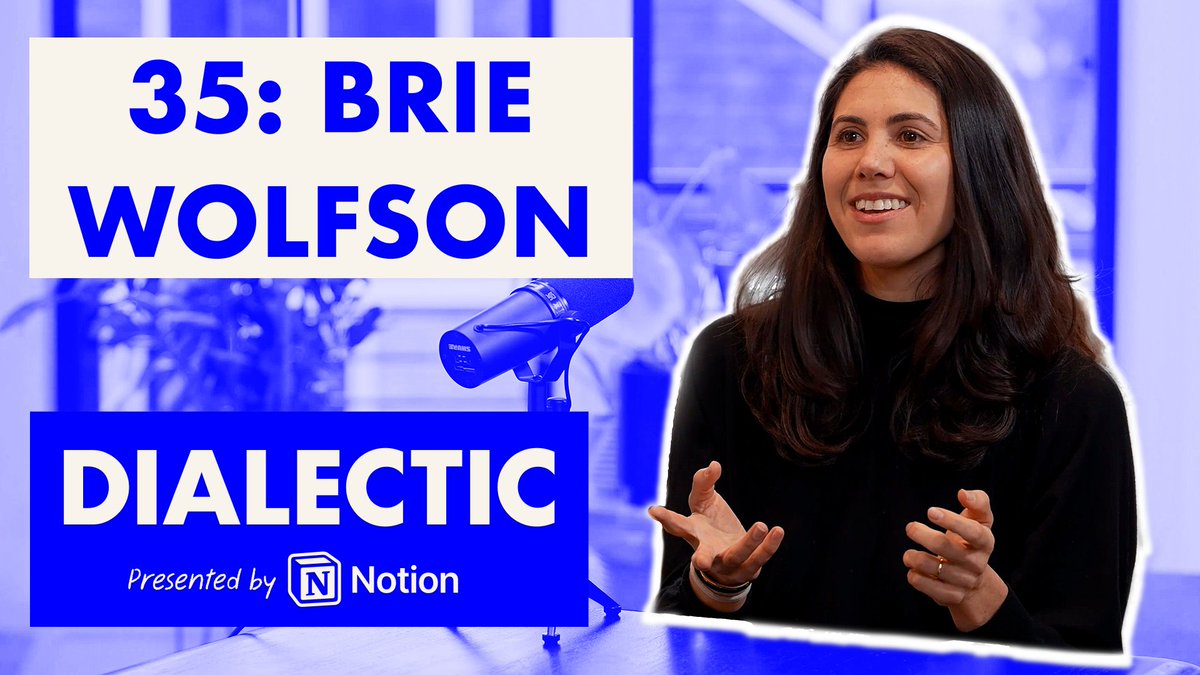
Ep. 35: Brie Wolfson - Loving Attention & Ease in Craft Brie Wolfson is something of a marketing and culture wizard, and has helped some of the most incredible companies and leaders in Silicon Valley by amplifying what is true and unique about them. That includes Cursor and Michael Truell, Join Colossus and Patrick OShaughnessy, Stripe, Stripepress and Patrick Collison, Figma and Dylan Field, and others behind the scenes. But what stands out most in Brie is her infectious joy, dedication to craft, and lifelong dance between a desire to be great and an ability to listen to and trust herself to go in unlikely directions--as she so poignantly explored in her recent essay/profile on Kevin Kelly, 'Flounder Mode.' I hope this conversation inspires you find ways to amplify those you believe in with loving attention, settle into ease and quality in whatever you make, and pursue a life of joyful usefulness. Available below and on all platforms. Timestamps: 0:00 - Opening 3:54 - Notion 5:04 - Intro: Craft, Finger Feel, and Staying Closer to the Ground Level 13:27 - Process vs. Output, Quality vs. Speed, and Great Editing 21:44 - Craft, Substance, and Truth in Marketing 25:56 - Individuals as the Building Block of a Company and Empowered ICs 32:02 - Creative Collaboration and In-Person and Remote 36:46 - Company Building: What is Changing and What Will Stay the Same 44:25 - The Soft Stuff: Great Company Values and Great Culture 52:17 - Thinking vs. Doing Cultures, 996 and Difficulty Sitting Still 1:00:37 - Morale, Fun, Amplifying Leaders, and Loving Attention 1:11:58 - Career Path Advice for Young People 1:19:56 - Kevin Kelly, Chasing Greatness, Illegibility, and Ease in One's Craft 1:27:29 - Special Talent and Contagious Ambition 1:32:22 - Brie’s Spike: Charisma, Hard and Soft, Making Things Fun, and Belief 1:43:23 - Taste, Appreciation, Generosity, Skill and Soul 1:57:26 - Great Editors, Saying No and Getting to Yes, and Being Receptive to Editing 2:05:25 - Great Writing: What do You Have the Right to Do that Others Don't? 2:13:55 - Grab Bag: Optimism and Pessimism, High and Low, and Closing Maxims 2:30:07 - Thanks to Notion

Dialectic with Jackson Dahl

76,946 Aufrufe • vor 8 Monaten

Harry Dry is the best copywriter I know. He's built a 130,000-person newsletter teaching people how to do it, and by the end of this interview, you'll be at least a Green Belt in copywriting. Some of his rules for writing: 1) A great sentence is a good sentence made shorter. 2) Writing great copy begins with having something to say in the first place. 3) Copy is like food. How it looks matters. 4) Since the look of copy matters so much, don't write copy in Google Docs. Write it in Figma (so you can write and design at the same time). 5) Kaplan's Law of Words: Any word that isn't working for you is working against you. 6) You know a paragraph is ready to ship when there's nothing left to remove. It's like a Jenga tower. The entire thing should collapse if you remove something. 7) Make a promise in the title so the reader knows exactly what they're going to get if they click. Then, deliver on the promise. 8) The three laws of copywriting: (1) Make it concrete, (2) make it visual, and (3) make it falsifiable. 9) Make it concrete: Don't be abstract. For an example, say you're writing about habits. Don't talk about "productive routines." That's abstract. Write about "waking up at 6am to write" instead. It's concrete — and much more vibrant. 10) Make it visual: People see in pictures. This is why instead of memorizing card numbers directly, world memory champions memorize cards by turning them into pictures and then back to cards. 11) Make it falsifiable: When you write a sentence that's true or false, you put your head on the chopping block, which makes people sit up in their seat. 12) When has a falsifiable statement resonated? Galileo got sentenced to a decade of house arrest for saying that the earth spins around the sun. That's a falsifiable sentence. But nobody would've done anything if he'd said that the earth has a harmonious connection with a celestial object. 13) Write with the delete key. Using fewer words lets you be more impactful with the words you keep. 14) The job of a sales page is to make a bold claim at the top. Then spend the rest of the page backing up what you've said... with a ridiculous amount of proof. 15) If your competitor could've written the sentence, cut it. 16) Good copy is differentiated. Here's an example: Elon Musk shouldn't write "The Cybertruck is the world's best truck." Ford or Dodge can write that sentence. But only Elon can write: "The Cybertruck is tougher than an F-150 and faster than a Porsche." 17) Some days, the writing comes easily. Some days, it takes sweat. The reader doesn't care if you wrote for two minutes, two hours, or two days. The ink looks the same. 18) Great copy reads like your customer wrote it. Talk to them. That's just an introduction to the copywriting philosophy of Harry Dry. I've shared the full interview below. I recommend you watch this one because we pull from so many visual references and do a lot of screen sharing. If you'd rather watch on YouTube, I've shared the link in the reply tweets.

David Perell

726,243 Aufrufe • vor 2 Jahren

Seedance 2.5: Some Tips / Thoughts & Prompt Share I knew from the start that the story in this video was a little too ambitious for 30 seconds. Normally, it could easily have been a 2+ minute sequence but I wanted to squeeze it into 30 seconds because there were a few specific things I wanted to test. I used six different character references for this video and wrote the final prompt in Chinese. The council members were actually supposed to speak in an alien language but I think because I asked for English subtitles and wrote the dialogue itself in English, Seedance decided to make them speak English too. Seedance 2.5 follows prompts extremely well. Actually, "extremely strictly" might be a better way to describe it. You need to be very careful with timing. If you ask for too many actions within a very short time window, you may get what feels like a sped-up version of the scene. On the other hand, if you assign too much time to an action that should happen quickly, the result can feel unnaturally slow or almost like slow motion. At least, these are both things I've run into during my tests. The same applies when you use a shot list without timestamps. Depending on how much you ask the model to fit into each shot, the pacing can still end up too fast or too slow. Finding the right balance between the amount of action and the time available is very important. Another thing I noticed is that Seedance 2.5 can be very literal about motion and state transitions. For example, if a character is facing the camera and you want to see their back in the next moment, simply describing the next shot from behind may not be enough. If you don't explicitly say that the character turns around, the model can sometimes morph or transition directly into the rear view without performing the actual turn. Seedance 2.0 would usually handle these things on its own. So it helps to think not only about what you want to see but also how the scene gets there. Once you identify these kinds of issues and explicitly correct them in the prompt, you can usually get a much cleaner result. For scenes with multiple characters, dialogue and a lot of specific details, the 5,000-character prompt limit can also become restrictive in English. Sometimes there simply isn't enough room to describe everything properly. That's where Chinese prompts become useful. My original English prompt clearly needed much more detail, so I rewrote it in Chinese and used the extra space to describe the scene more precisely. You can see the result in the video. Prompt in the replies.

Kōda

16,297 Aufrufe • vor 1 Monat

The Asymmetric Operator ==================== The operators building agents right now are mostly stuck solving the wrong problem. I ran a live briefing on this the other week for a small room of operators already building with agents. Full video attached. Short version below. Almost every agent platform is within a rounding error of the others on raw capability. The agents can do the work. Most operators have figured out the real bottleneck is coordination, so they're switching orchestration tools every other month chasing a fix. Twelve-month read: coordination is closing at the platform layer. The platforms you're using have been quietly collecting your fix-it decisions all year, and that data is the training signal for agents that self-correct. If your edge is managing agent failures, you have nine months before the default tools absorb it. The layer that compounds past that is underneath the agents. A small set of files your whole system reads from, structured as a single source of truth instead of fifteen agents each guessing from a fresh prompt. Inside that layer, the piece almost nobody is building is thought patterns, your reasoning about the work logged as you make decisions. Ten minutes a day per cohort, voice-to-text is fine. At the end of the week pull out the five or six patterns that kept showing up and drop them into the cohort's master context file. Repeat for a month and the agents' outputs start reading like a sharper version of your own judgment rather than a generic model's best guess. Six months in, the operators I advise have agents making sharper calls than any competitor's agents, because those agents have been trained on half a year of their captured reasoning. No competitor can buy that. Living through the same six months is the only way to produce it. If you want more like this every week, see the next post or profile. **Chapters:** 00:00 Why this isn't about prompts or agents 04:25 The agent landscape right now 07:45 Why agent capability is commoditized 08:30 The e-commerce friend running 80% of his business on one agent platform 10:30 What the one-person billion-dollar company actually proves 14:25 The coordination problem and why it gets solved this year 19:00 How agent platforms are quietly learning from your fixes 22:30 Scattered vs. coordinated vs. redesigned businesses 24:45 What cognitive architecture really means 28:00 Thinking in cognitive labor instead of org charts 31:10 The file layer: claude.md, agents.md, skills, memory, context, heartbeat 38:30 What makes an architecture cognitive: thought patterns 40:10 The 10-minute daily decision journal that feeds your agents 42:30 Why your thought patterns don't need to be perfect 44:40 Where to start if you don't have agents yet 46:20 Thought patterns per agent team, not per whole business 48:20 Case study: SaaS consultancy with 7 agents and 3x capacity 51:15 Decomposing work into 7 units of cognitive labor 53:30 Month-by-month build timeline 56:00 The data set no competitor can copy 1:01:20 The maturity ladder: reactive, automated, attentive, autonomous 1:03:35 What's coming over the next 12 months 1:06:40 Your job when agents handle execution 1:08:00 Why now is the cheapest this will ever be Want more? See next post

Sam Woods

164,164 Aufrufe • vor 5 Monaten

Roy makes a very fair point here, I was torn on Green + 100k vs Merrett all week. I literally swapped them back and forth 3-4 times from Fri night to Sat night. He is right, you don’t get that many opportunities to get a top-liner like that and I possibly should’ve taken the chance when it presented, especially with the Ess run. I think Merrett was priced at around 116. If he goes at 125 over the next 5-6 weeks, after adding the Captaincy benefit, it would’ve probably been a mistake to not go him. One thing I was v.surprised with last week was how low down Merrett was on the trade-ins list. It is not often you get an Uber-premium like that who has a juicy upcoming schedule AND is a POD. That’s a very unusual set of circumstances. If your POD premium then goes ham it really can separate your team from the pack. We saw last yr with Zorko what a boost it can be to have a POD premium go large for a big stretch (granted a little diff in the FWDs last yr). That, along with my previously outlined thesis about teams potentially being completed earlier than ever this yr was my bull-case for going Merrett. The reason I went with Green, or rather, why I opted for another option that left me with 100k in the bank is that my bench is a thin. Stone won’t make us much, FOS not looking like he’ll make us much, Berry now been sub 2 games in a row and is dropping cash, Hastie getting subbed each week etc. Other teams that have Moraes instead of Hastie and Hall instead of Berry may have an extra few hundred k to play with in terms of making upgrades. So in light of my weaker bench I felt that the 100k would help facilitate a better subsequent trade (ie this week). Whilst I could downgrade a Prior this week to make a nice upgrade, it wouldn’t be too long before my bench is not sufficient enough to facilitate the next upgrade. So ultimately I was looking at it as a 2 week decision. Ie, would I rather a Merrett + Tom Stewart type this week or would I rather Tom Green + Nick Daicos and ultimately I opted for the latter, though I do feel like I need to fix one of Hastie or Berry this week so we’ll see what I end up doing. But that was the thought process. As stupid as it now sounds, if Dees didn’t tag Holmes the previous week I prob would’ve gone Merrett, but the faint possibility of that happening to Merrett was prob the deciding factor in letting him go. I was also close to trading in Zorko the prev week and seeing Zork do 79 against Richmond spooked me. Didn’t want to run the risk of paying a huge price and then Zerrett underperforming as Zorko did. Can’t say I was thrilled seeing Merrett go nuclear Sat night, esp after the TDK C decision on Sat arvo. But, I can potentially make up the points this week if I’m able to put that 100k to good use.

Vams

10,940 Aufrufe • vor 1 Jahr

👀 This Jay-Z Interview Moment Still Doesn’t Sit Right… When Jay-Z spoke on the Super Bowl decision, he downplayed everything: •Said picking Kendrick Lamar wasn’t personal •Denied there being any alliance •And leaned on his status like: “I’m Jay-Z… why would I even care?” On the surface, that sounds confident… but when you line up the timeline, the story starts to feel a lot more layered. 🧩 The “No Alliance” Narrative vs. The Moves Let’s go back to Beyoncé’s “America Has A Problem” remix. •Kendrick didn’t just feature he came in directly addressing Drake •He even referenced asking Universal Music Group for clearance before taking shots •And importantly… Jay-Z has writing credits on that same record That’s where things get interesting. Because now it’s not just: 👉 “Kendrick vs Drake” It starts to look like: 👉 multiple powerful figures connected to the same moment That doesn’t automatically prove coordination but it definitely doesn’t feel isolated either. 📀 Drake’s Verse That Aged Different Now rewind to June 2022. Drake hops on “Churchill Downs” with Jack Harlow and drops a verse that, in hindsight, feels almost predictive: “Lucky Me, People that don’t f*** with me Are linkin’ up with people that don’t f*** with me to f*** with me…” He goes deeper into: •Things becoming “transactional” •Moves feeling “promotional” instead of organic •People acting irreplaceable when they’re not At the time, it sounded like general industry frustration… But then just one month later Beyoncé dropped America Has A Problem where: 👉 Drake A non American becomes a clear topic That tight timing makes the verse feel less random and more like: 👉 he was already peeping something forming behind the scenes 🏈 The Super Bowl Foreshadowing? Fast forward to the battle era. Kendrick’s “6:16 in LA” includes a very specific detail: 👉 the sound of a football launcher Later on… That same exact sound is used in the rollout announcing him as a Super Bowl performer Now that’s where it really gets debatable. Because that leaves two possibilities: 1.🎯 Creative coincidence Just a sound choice that happened to line up later 2.🧠 Intentional foreshadowing A subtle hint that something bigger was already locked in And when you combine that with everything else the collaborations, the timing, the people involved it’s hard to ignore. 💭 My Full Perspective Individually, each moment could be explained away: •A feature here •A lyric there •A sound effect used creatively But together? It starts to form a pattern: •Strategic collaborations •Consistent messaging •Tight timing between releases •Key industry figures overlapping in the same moments Which raises the bigger question: 👉 Was Kendrick simply moving on his own… or was he being positioned within a larger play happening behind the scenes? 🤔 End of the Day… Jay-Z says there was no alliance But when you really break everything down: …it doesn’t feel completely random either. So what do you see? 👀 Coincidence… or calculated alignment?

Cousin Tino ™️

13,163 Aufrufe • vor 6 Monaten

Stanford professor just gave away the entire foundation of how AI Agents & automation actually works. 1-hour lecture. Tool calling. Multi-step workflows. Planning. Reflection. SAVE this to watch this before you open Netflix tonight. More valuable than 6 months of copying Make and n8n tutorials, for building Ai Agents Most people learn by copying tutorials blindly. Stanford teaches you WHY agents work the way they do. Follow Himanshu Kumar for more high-signal content that actually moves your skills forward instead of just entertaining you for 30 seconds. ↓ Why your automations keep breaking. You copied a Make tutorial. Built the exact workflow. Worked for a week. Then the API changed. The trigger failed. An edge case broke everything. You had no idea how to fix it. Because you never understood why it worked. You were copying keystrokes. The people shipping real automation were understanding architecture. ↓ What Stanford actually teaches. Tool calling: how an agent decides which tool to use by scoring each option against the current task state, not just matching keywords. ReAct loop: the agent reasons, acts, observes, then reasons again. Break this cycle and your workflow fails silently. Planning vs execution: why agents that plan all steps upfront break on dynamic inputs, and why iterative planners survive production. Memory architecture: short-term context for the current task, long-term vector memory for patterns. Most automations fail because they confuse the two. Reflection: how agents catch their own errors by evaluating outputs against original intent before moving to the next step. Tool composition: why chaining 10 tools blindly creates cascading failures, and how to structure dependencies so one broken node doesn't kill the whole workflow. This is the foundation behind every automation that actually works. Not prompting tricks. Not "10 best AI tools" reels. Actual architecture. Follow Himanshu Kumar for more high-signal content that actually moves your skills forward. ↓ Your weekend plan. Tonight: watch the Stanford lecture. 1 hour. Saturday to Sunday: build 3 projects applying what you learned. Next 2 weekends: 6 more projects. 9 projects. 2 weeks. APIs, webhooks, LLM integration, real workflows. No theory. Just build. ↓ Stanford Agentic AI lecture: free on YouTube. Watch it this weekend or buy another $500 "AI automation course" in 2027 that teaches less than this one free lecture. Bookmark. Watch tonight. Follow Himanshu Kumar for more high-signal content that actually moves your skills forward.

Himanshu Kumar

28,206 Aufrufe • vor 5 Monaten

Disney released Snow White in 1937. 60 years later, they re-released it on video. 28 million copies sold. $250 million in profit. Steve Jobs watched his young son watch it 30, 40 times. “These stories renew themselves with each generation.” In 1996, one year after Toy Story, he spent 20 minutes explaining why he bought Pixar: On buying the dream: "I met Ed Catmull who was running the computer division of Lucasfilm in 1985." "He shared with me his dream about making the first computer animated feature film." "I bought into that dream both financially and spiritually." "It took us ten years to do that, but we did it." The result: Toy Story. Third most successful animated film ever made. On content vs technology: "You can hardly find an Apple II around anymore." "It's not clear whether you'll be able to boot up a Macintosh five years from now." "All these technology boxes and software, if it has a life of a year or two, you're very lucky. Five years is extraordinary." "Sooner or later, they all become part of the sedimentary layer." But stories? "I think people are going to be watching Toy Story in 60 years. Not because of the computer graphics, but because of the story about friendship." On work-for-hire: Pixar made commercials for years. Won every award in the book. Then Jobs did the math. "If Listerine sold more Listerine because of our commercials, we didn't make any more money for producing the commercials." "The margin in that business has been under pressure. More people coming in. Going down, and down, and down." "You work harder and harder to make the same amount of money." He pulled 25 people out of commercials. "We had 25 incredibly talented people doing work-for-hire when we have all these other opportunities where we own a piece of what we create." "Great people are hard to find. We couldn't afford to have 25 of them making commercials anymore." On blending two cultures: "The very best creative people will only go to work in a few places. Disney, Pixar, possibly DreamWorks." "The very best computer scientists in computer graphics will only go to work in a few places. Pixar is one of those." "Pixar is the only place in the world that can hire the best from both of these areas." "We worked for ten years to figure out a way to have them all work together. The Hollywood culture and the Silicon Valley culture are really different." On the hierarchy of power: "When you've got incredibly talented people that are rare and in-demand, if you don't treat them right, they can go get another job in 10 minutes." "So this strange thing happens. The hierarchy of power inverts." "The CEO is actually at the bottom." "I feel like I work for most of these people because they're the ones doing all the brilliant work." "It's management's job to support them because they're on the front lines doing the work." On contracts vs stock options: "Hollywood uses the stick, which is the contract. Silicon Valley uses the carrot, which is the stock option." "When you sign a contract with somebody, you can say, 'I don't have to worry about that person for five years.'" "If you're sophisticated, you'll have a little database that tickles you six months before their contract is up so you can start paying more attention to them." "They're the most important person in the world for six months. Then after they sign up again, you put them in the drawer." Pixar chose stock options. "Every single day, we worry about how to make Pixar a better company so that nobody will ever want to leave." "We don't take anybody for granted." On what Disney taught them: "When you make a live-action film, a director shoots ten to twenty-five times as much footage as will end up on the screen." "Walt Disney realized many decades ago that animation was so expensive that you couldn't afford to animate ten times more than what you need." "The only conclusion: you have to edit your film before you make it." "Working with Disney gave us access to that wisdom. You can't buy it for love or money." On the constant: "Ten years ago, when we made Luxo Jr., it took about three hours to render each frame." "Toy Story. Computers are hundreds of times faster. It still took three hours to render each frame." "The frames were a hundred times more complex." "Our ambitions, visually, are growing as fast as the technology can feed them." On story vs technology: "The art of storytelling is very old." "No amount of technology can turn a bad story into a good story." "That's our mantra at Pixar. It's the story, stupid." "I don't think storytelling has changed in a long time. And I'm not sure it will. I don't think it's something that technology has anything to do with."

Jaynit

95,800 Aufrufe • vor 5 Monaten

Sometimes I like to look at a player’s “worst game of the year” to see how bad it was (or wasn’t). For WR Caleb Douglas (according to PFF) that was the Arizona State game where he matched up with Keith Abney (R5) all day. This was a good battle between Douglas and Abney. But considering it was supposed to be Douglas’s worst outing, it wasn’t all that bad. Texas Tech lost, despite coming back from a 12 point deficit in the final 6 or 7 minutes to take a 3 point lead, after a successful 2-point conversion made possible by Douglas drawing a hold in the end zone on the first 2-point attempt. Sam Leavitt and Jordyn Tyson worked their magic to go all the way down the field in the final minute and not just kick a tying FG, but actually score the go-ahead TD, leaving Texas Tech attempting a Hail Mary as the clock ran out. Things I noticed during the game: - The backup QB Will Hammond playing in place of Behren Morton had some issues with timing and ball placement. A couple of targets Douglas was open, Hammond missed him. Another one, instead of throwing the vertical Hammond patted the ball an extra beat and it threw off the timing. - I loved Caleb Douglas’s willingness to try and make a difference as a blocker. He got nasty with it. - Caleb had a bad drop. Abney got in there and contacted him and Douglas failed to put the ball away. But it’s interesting because Caleb also had one of the most impressive one-handed stabs you’ll see, on a play nobody noticed or cared about because it was a screen that didn’t break open. - On a lot of plays, if there wasn’t safety help, there was an egregious amount of cushion. This is something you see in a lot of Tech’s games. People had been trying, and frankly failing, to triangulate Douglas’s long speed, to where his 4.39 came as a surprise to some. And then when they’re wrong, the same tired excuse comes out, “He doesn’t play to his timed speed.” But the signs were always there. You had safeties stashed way out in the middle of nowhere to protect corners. You had corners giving 10-12 yards of cushion. - There was a lull where either the ball wasn’t coming Douglas’s way or it was inaccurate when it did, and it lasted nearly half the game. So I was looking for signs of Douglas checking out with his route running. That didn’t happen. He ran his routes hard the entire game. - Douglas dialed it up a notch during the comeback attempt at the end, particularly after the drop. He got wide open on a 3rd down vertical vs. physical coverage with no safety help over top (surviving an unflagged face mask in the process). Then he got open in the end zone twice, one of which forced a hold by Abney that did get flagged. I think the takeaway from me was, you’re playing against a good corner, you have a backup QB in, things don’t go well for you nor the offense for most of the game, but you stay locked in and make a difference at the end, mounting an unlikely comeback. I can see why Jon-Eric Sullivan would like his demeanor.

Chris Kouffman

38,519 Aufrufe • vor 4 Monaten

your OpenClaw🦞 has NO IDEA what you do all day... what if we give it eyes and make it observe you all day? introducing synapse, a daemon that runs in the background, watches your screen activity through , and uses Claude to detect the workflows you keep repeating! then, it does two things: 1) turns those patterns into ready-to-use automations (e.g. claude code commands and skills you can run immediately) 2) feeds that context directly into your openclaw agent so it can act on what it sees your agent goes from "what do you want me to do" (which seems to be the default mode for almost all ai agents) to "i noticed you've been doing this repeatedly, want me to handle it for you?" let me give you a real example. > UEFA Champions League is coming up. > you want to place a prediction on juventus vs galatasaray > so you start doing what you always do: open a tab for injury reports, another for head-to-head history, another for current form tables, another for the odds across prediction markets > by the time you actually place anything you've spent 45 minutes on research you've done a hundred times before. synapse sees all of that! it automatically detects the pattern: "user repeatedly researches match injuries, form, and h2h stats before placing predictions on polymarket." it doesn't just log it. it proposes a prediction market research skill that pulls injury reports, recent form, historical matchups, and odds from multiple sources, and then gives you a structured breakdown with a confidence score. next champions league match day, you just type one command to get all of this done. beauty! all this happens while everything is locally stored on your machine. get started below ↓

altan tutar

10,511 Aufrufe • vor 7 Monaten

一番最後の[Prompt for original image]の部分に画像生成に使用したPromptを入れると一貫性が増します。不要な場合は3行削ってしまっても大丈夫です。 --- Extreme wide-angle perspective and dynamic pose remix edit. This is an EDIT of the original image, not a new character. Use the original image as a strict reference for: – the person’s identity, hairstyle, and overall fashion style, – the general type of background and location (same street, same room, same beach, same kind of architecture, etc.). You are allowed to completely change the camera position, angle, and pose, but you must keep the scene in the SAME location and keep the SAME person and outfit design. Camera and perspective: – Use an ultra wide-angle or fisheye feeling lens (around 12–18mm full-frame look). – The camera angle MUST change significantly from the original: use dramatic angles such as • worm’s-eye view from directly below looking up, • bird’s-eye view from directly above looking down, • very low angle from the ground, • high angle from above, • tilted Dutch angles. – Always create strong foreshortening: body parts close to the lens look huge, while the rest of the body falls away in perspective. – The final result must look like a bold fashion or street photo, fully photorealistic, not illustration or anime. Background consistency: – Keep the same location as the original image: same street, same bridge, same room, same studio, same beach, same general structures and materials. – Do NOT replace the background with a completely different place. – Because the camera angle changes, it is allowed and expected that different parts of the environment become visible. – When new areas appear, extend the original environment logically (same buildings, fences, road markings, walls, colors, materials, lighting style), as if the camera moved within the same place. Body parts near the lens (1–2 parts, sometimes 3): – In each edit, choose ONE or TWO main body parts to be extremely close to the lens (sometimes even THREE in more complex poses). – Vary them from image to image, do NOT always use the same body part. – Allowed near-the-lens parts include: • one or both hands / fingers reaching toward the camera, • one or both feet / shoes / boots near the lens, • knees or thighs, • face very close to the lens, • shoulders or chest close to the lens in a leaning pose. – The chosen body parts should come extremely close to the lens, almost touching it, with visible skin texture, fabric texture, and realistic wide-angle distortion. Pose and overall body (complex and varied): – Create strong, cool, dynamic poses that match the extreme perspective. – Randomly use different pose types, including: • standing with one leg or one arm reaching toward the camera, • crouching or squatting low to the ground, • sitting on the floor or on objects, • lying on the ground with legs or feet toward the lens, • leaning forward aggressively toward the camera, • twisting the body, crossing legs, or arching the back for more dynamic lines. – Allow complex poses where: • both hands are near the lens forming shapes (peace signs, triangles, frames, pointing toward the viewer), • both feet are toward the lens, • one hand and one foot are both large in the foreground, • the face is close to the lens while hands or feet are also visible in perspective. – Maintain believable anatomy even with extreme foreshortening. Angle and attitude (randomized): – Randomize camera angle and orientation (up, down, side, Dutch tilt) while keeping the composition visually balanced and powerful. – Keep the vibe cool, confident, and fashion/editorial or street style, depending on the original outfit. – Facial expressions can vary (serious, playful, confident, mysterious), but must still look like the same person. Lighting and rendering: – Keep the general time of day and lighting mood similar to the original (night vs day, indoor vs outdoor, soft vs hard light), but you may enhance contrast and color to make the image punchy and dramatic. – Maintain realistic shadows and contact points with the ground or floor. – High-resolution, sharp details with clear skin texture, fabric weave, and material highlights. Variation and randomness: – Each edit should look noticeably different from the original image and from other edits, with different: • camera angles, • pose types, • which body parts are closest to the lens, • orientation (straight, tilted, from above, from below). – Avoid repeating the exact same single-foot-close-up composition; produce a wide variety of dynamic poses and angles. Strict rules: – Do NOT change the person into someone else. – Do NOT change the outfit type; only restyle it through pose, perspective, and small natural movement of clothing. – Do NOT move the scene to a completely different location; always stay in a plausible extension of the original place. – Do NOT add text, logos, watermarks, or graphic design elements. – Do NOT switch to painting, illustration, or anime style; keep it photorealistic. Overall: Transform the original photo into a dramatic, photorealistic, ultra wide-angle shot with an extreme camera angle (including views from directly below or above), where one or more body parts are right next to the lens and look huge, the rest of the body recedes in perspective, and the same person strikes a stylish, complex, powerful pose in a consistent, expanded version of the original environment. Also, below is the prompt for generating the original image. Please use it as a reference. [Prompt for original image] #nanobanana2

AI Girl's Photo Studio

20,684 Aufrufe • vor 9 Monaten

RLHF by hand ✍️ ~ 15 steps walkthrough below Train a model on human text and it inherits human bias. It will assume a doctor is a "him", because the data says so. RLHF is the correction. A human marks one preference, doc is them over doc is him, and the weights move. But one correction is not the point. The hope is that the model learns the value behind it, gender neutrality, and applies it to professions nobody ever mentioned. How does it work? Goal: train a reward model from a single human comparison about doctors, then turn it on CEOs, filling in every cell yourself. = 1. Given = A reward model, an LLM, and two (prompt, next) pairs. = 2. Preferences = A human reads both pairs and picks a winner: (doc is, them) beats (doc is, him). The loser is not bad grammar, it is gender bias, and that is the whole signal. = 3. Word embeddings = Let us look up each word of the loser pair. These vectors are the reward model's input. = 4. Linear layer = We multiply by the reward model's weights and add its biases. Out come feature vectors, one per position. = 5. Mean pool = Let us multiply by [1/3, 1/3, 1/3], which averages the three positions into one sentence embedding. = 6. Output layer = We map that sentence down to a single number. Reward = 3. = 7. The winner, the same way = Let us repeat steps 3 to 6 on the winning pair. Reward = 5. = 8. Winner minus loser = We take the gap: 5 - 3 = 2. The reward model wants this positive and as large as it can make it. = 9. Loss gradient = Let us squash the gap into a probability, σ(2) ≈ 0.9, and subtract the target of 1. The gradient is -0.1, and it goes back through the purple weights. The reward model is now trained. = 10. A prompt it has never seen = We start the second half with "[S] CEO is". The feedback in step 2 was about doctors. Nothing connects a CEO to a doctor except what the reward model generalised. = 11. Transformer = Let us push it through attention and a feed forward layer, one vector per position. = 12. Output probabilities = We map each vector to a score over the vocabulary. = 13. Sample = Let us take the highest score. The model completes "CEO is" with "him", which is the same bias the human penalised in step 2. = 14. Score it with the reward model = We feed the new pair (CEO is, him) through steps 3 to 6. Reward = 3, exactly the score it gave "doc is him" in step 6. Nobody taught it about CEOs. The value transferred. = 15. Loss gradient = Let us set the loss to the negative of the reward, so minimising the loss maximises the reward. The gradient is a constant -1, and it goes back through the red weights. The outputs: Loser reward = 3, winner reward = 5 Reward gap = 2, predicted σ ≈ 0.9, reward model gradient = -0.1 LLM samples "him", reward = 3, LLM gradient = -1 Congrats! You just calculated RLHF by hand. And you watched a value generalise: one comparison about doctors, and the model marks down "CEO is him" unprompted. 💾 Save this post!

Tom Yeh

22,529 Aufrufe • vor 1 Monat

Okay, everyone is talking about AI video models right now, but honestly, most of the “comparisons” out there aren’t real comparisons at all. One video uses a different prompt. Someone tweaks the settings. Someone edits out the bad parts. And then people just decide which model is better? That never sat right with me. So I tested HappyHorse 1.1 and Kling 3.0 the same way I’d test any tool I was seriously considering for my work: the same prompt, the same reference images, the same duration, and no edits to hide the flaws. I wasn’t trying to prove that one model is better across the board. I simply wanted to see how each would handle the exact same challenge. 1. Lip-sync & speech This one's easy to judge honestly. You don't need to go frame by frame, just watch both videos side by side. Does the mouth actually match the words? Does the timing feel off or natural? Do the expressions hold up when the camera's in close? Small detail, but it tells you a lot fast. 2. Character & scene consistency This is where it gets interesting. Making one good-looking shot isn't hard anymore, keeping that same character looking like themselves across a bunch of shots is the real test. I used the same multi-angle reference set for both models and watched how they handled scene changes: face, clothes, props, where the character's standing, all of it. HappyHorse 1.1 was just noticeably more consistent here. One moment that stood out: in a crash scene where the character ends up injured on the ground, the difference isn't obvious at first glance, you really have to look closely. But HappyHorse kept him reacting, hand raised, blood visible, expression still "alive," like he was actually processing what just happened. Kling 3.0 showed him lying still, with no visible movement or reaction in that same moment. It's subtle, but it's a real example of logic and consistency holding up frame to frame, not just shot to shot. 3. Complex motion No cutting corners on this one, I wanted continuous movement. Sports, dancing, fast action, stuff that really shows whether a model understands weight, momentum, balance, how a body recovers after moving. These are the shots that expose problems you'd never catch in something static. Watching both side by side, continuously, tells you way more than any writeup could. 4. Camera control Both models got the same timestamped storyboard and the same camera directions. Then I just watched to see if they actually followed it. Here's a good example: push in, orbit around, crane up, then pull out. One continuous move. Watch closely and you'll see exactly where one model loses track of the subject or the motion gets weird, while the other stays right where it's supposed to be the whole time. That's basically the difference between a shot you keep and one you have to regenerate for the fifth time. 5. Price & workflow Price only means anything if you're comparing like for like, same output, same duration, same quality and resolution, same number of generations. But honestly I think the better question isn't "which one's cheaper," it's which one gets you more usable footage for the same money. For me that's not just about credits either, it's about how many tries it takes before I get something I actually want to keep. Where this actually matters: ads and e-commerce This is the stuff that made the biggest difference for me. When you're making product shots or ad content, you need a model that just does what you tell it, not one you have to wrestle with. HappyHorse 1.1 strictly executes your planned frames, you're setting the exact lens, the subject position, the camera's job, shot by shot. For ad work that means way fewer regenerations and getting from storyboard to finished cut a lot faster. Proof over opinions Here's what I kept coming back to. Saying "the motion's better" or "the camera control's better" doesn't really mean anything unless people can see it for themselves. That's why I think comparisons need continuous split-screen playback, identical prompts, clear labels, visible transitions, matching settings, and an honest breakdown of cost. Just let the footage speak, people can usually tell within a few seconds anyway. What I actually took away from this Both models have real strengths, I'm not saying one does everything better. But for the kind of work I do, including ad and e-commerce stuff, HappyHorse 1.1 just needed fewer compromises from me. Less regenerating shots, less fighting continuity issues, less trying to wrangle the camera back on track. Doesn't mean Kling 3.0 is bad, it's a solid model. It just means HappyHorse 1.1 got me to something production-ready faster, with less wasted time. And at the end of the day that's the thing I actually care about. p.s. links to try HappyHorse 1.1 and the community Discord are in the first reply below.

Chubby♨️

19,569 Aufrufe • vor 20 Tagen

A beanie that reads your thoughts and turns them into text — no surgery required?@jason grills the co-founders on their noninvasive brain-computer interface, backed by Vinod Khosla, and calls cap on the whole thing (until he doesn't). This episode of This Week in Startups covers a lot of ground: Jason's tactical tip of the day on making everyone the CEO of their domain, a deep dive into Sabi's thought-to-text beanie, a live demo of AI-powered podcast sidebars built by the TWiST audience, the announcement of a new $5K bounty for an annotation tool, and Jason's big five wellness framework. 0:00 Intro & tactical tip: Make everyone the CEO of their domain 1:49 Matt Coffin's "CEO of X" management philosophy 3:04 Community ownership: Deputizing Ricky, Lawn, Bianca, Maddie, Kabir 4:02 Building the Noti Gang: X group chats and community flywheels 5:08 Founder takeaways: Activate your top 1%, make someone the CEO of it 6:18 The streamer trick, parasocial dynamics, and creator ethics 7:59 Plaud: If your work depends on conversations — interviews, meetings, calls — you need a Plaud NotePin. You can check it out at and use code TWIST for 10% off! 9:34 Guest intro: Rahul Chhabra of Sabi 10:01 What is Sabi? Noninvasive BCI in a beanie with 100,000 sensors 10:02 LinkedIn Jobs - Hire right, the first time. Post your first job and get $100 off towards your job post at 11:02 How it works: From fMRI to EEG, from hospital to hat 13:46 The brain foundation model and thought-to-text decoding 15:55 Vetting the founders: BITS Pilani, Stanford, athlete fatigue AI 17:22 Vinod Khosla's investment thesis: BCI must be noninvasive 19:30 Jason's challenge: Say "Calacanis" or it doesn't count 19:50 Northwest Registered Agent: Get more when you start your business with Northwest. In 10 clicks and 10 minutes, you can form your company and walk away with a real business identity — Learn more at 21:30 Reserve your device, release by end of 2026 22:26 Privacy concerns: Does the beanie read everything? 23:47 Jason's Big Five wellness framework: sleep, nutrition, exercise, meditation, socialization 25:41 Bounty #1: AI live sidebar contest — demos from the TWiST audience 26:02 What the bounty asked for: AI personas watching the show in real time 27:04 Oliver's breakdown: What's easy vs. hard about live AI commentary 28:40 Demo #1: Armchair (by Mark Colebrook) — fact-checker + troll personas, live 30:26 Render: Find out why 5 million developers are already using the all-in-one cloud platform, Render. Go to and apply for the Render Startup Program to get $500-$100,000 in free credits, depending on your stage and backers. 35:30 Live political violence test: The sidebar in real time on the WHCD shooting 38:45 Demo #2: Pod Commentators / SideCast — browser-based, Gemini-powered 40:35 Jason's revised Bounty #1 spec: Fact-checker + cynic, public stream or Zoom 42:41 Timeline: check-ins May 1, May 8; final winner May 15 44:51 Demo #3: BMD Pat (by Patrick Hughes) — instant URL, all-snarky personas 46:52 Bounty #2 announced: — a fair-use multimedia annotation tool 49:31 Annotated: the of media commentary 51:11 Contest rules: Jason owns the domain, winner gets $5K + potential ongoing work 53:13 Wrap-up: Bounty 1 = AI sidebar, Bounty 2 = Annotated 🎥 Watch the full episode here 👇

This Week in Startups

16,398 Aufrufe • vor 4 Monaten

Anthropic and OpenAI slammed the this week on secondary transactions of their shares as both AI labs race to list. To help @jason and alex 🏴‍☠️🇺🇸🇺🇦 unpack the market-moving news, investors Jenny Fielding Dave McClure and sam lessin 🏴‍☠️ joined our venture capital panel to make plain which Anthropic investing vehicles are legit, and which may be fake. The group also dug into software moats, large venture funds pressuring smaller firms, the future of LP capital, and the IPO market! 0:00 Guest introductions 1:30 Guest introductions 2:36 Anthropic voids unauthorized SPV trades 9:23 Accredited investor reform & the SEC sophisticated investor test 9:40 Quo (formerly OpenPhone) - Quo gives you a clean, modern way to handle every customer call, text, and thread all in one place. Try it free at 12:25 Naval's USVC closed-end fund as a workaround 17:23 Plaud: If your work depends on conversations — interviews, meetings, calls — you need a Plaud NotePin. You can check it out at and use code TWIST for 10% off! 18:30 Pro-rata rights battles: when Series A investors push seed investors out 20:18 Grasshopper Bank: Time is money. Don't waste either. Go to and get an exclusive $500 cash bonus just for opening an account. 29:55 Pilot: Focus on your product, let Pilot handle your bookkeeping. Pilot provides the most reliable accounting, CFO, and tax services for startups and small businesses. Head to and get $1,200 off your first year. 31:05 Storing wealth in stories vs. cash flows 35:01 Cerebras and Fervo Energy IPOs — meaningful liquidity? 38:36 Will SpaceX, Anthropic, OpenAI IPOs redistribute capital or compound it? 46:40 The $15M Series A founder who returned the money because of Claude 50:43 Should founders pivot or return capital when the world changes? 57:25 OpenAI's $6.6B tender and Shruti Gandhi's viral SF cost-of-living tweet 1:01:07 Intercom rebrands to Fin: the AI-first late-stage pivot 🎥 Watch the full episode here 👇

This Week in Startups

19,821 Aufrufe • vor 4 Monaten