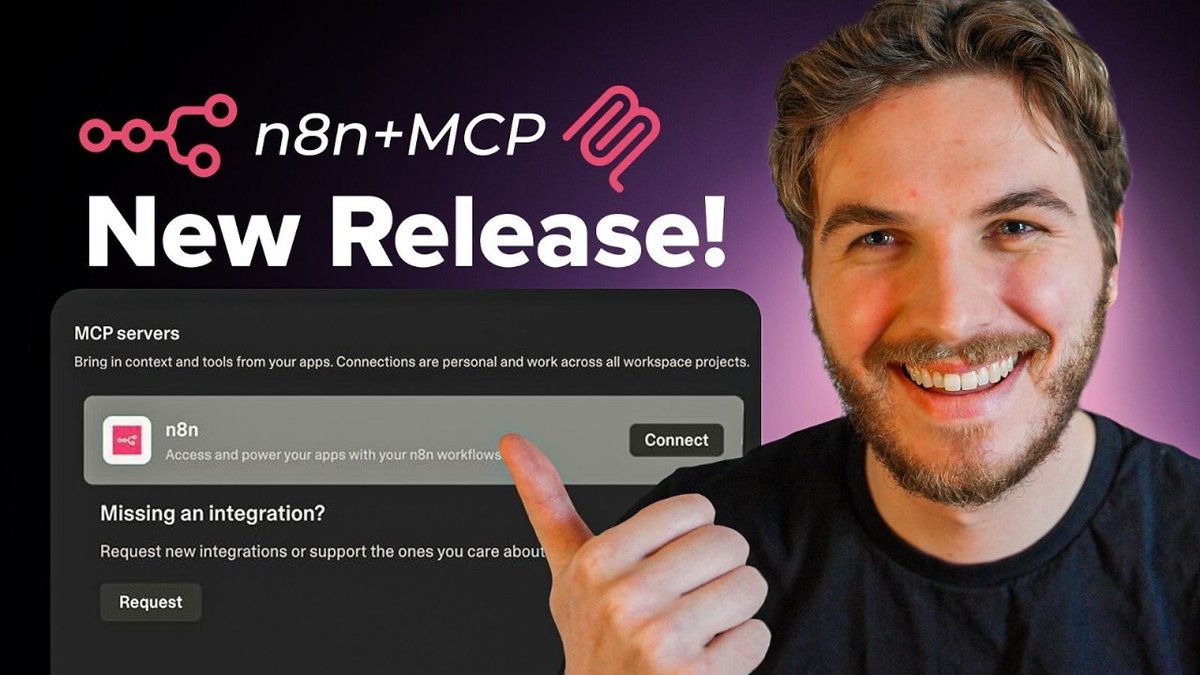
正在加载视频...

视频加载失败

Every automation expert has shipped a workflow, then found out it broke when the client did. APIs time out. Credentials expire. A node gets a value it wasn't built for. The question was never "will it fail," it's "how fast do I find out." So I built a self-fixing...

46,436 次观看 • 5 个月前 •via X (Twitter)

0 条评论

暂无评论

原始帖子的评论将显示在这里

相关视频

How to build a $25K website with AI, every click from zero (Claude Code + n8n, beginner guide) An agency would charge about twenty-five thousand dollars for this website. Here's how you build it with AI, from zero, every click, and wire it so every good lead gets a real answer in under a minute. You never type code: at every step you say one sentence to Claude, and it does the work. What you need: a paid Claude plan (Pro is enough) and a few free accounts: GitHub, n8n, Resend, Vercel, plus an Anthropic console account with $5 of credit. The Cloudflare tunnel needs no account. The steps, and the exact sentences to say: 1. Download VS Code. Open Extensions, search "Claude Code", click Install, click the spark icon and sign in. Make an empty folder called alder-slate and open it. 2. Say: "Interview me about my business, then write CLAUDE.md." Answer its questions in plain words. CLAUDE.md is the brief Claude reads every time: colors, fonts, services and rules (no stock photos, no purple gradients). 3. Say: "Build the website from CLAUDE.md, with a big serif headline, lots of space, real-looking photos, and a five-step quote form." For a real client, use their real job photos. 4. Say: "Take screenshots of every page on a laptop and a phone, look at them, and fix what's off." 5. The form goes to the website's own server first, which adds a secret password from the .env file (a locked drawer for your keys) before passing the request to n8n. The browser never sees it. 6. Create a free GitHub account. Say: "Put this project on my GitHub." Open the link Claude gives you, type the code, click Continue, then Authorize. 7. Say: "Set up n8n on my computer." Create the owner account, then Settings, n8n API, create an API key and copy it (you only see it once). In the Anthropic console, add $5 of credit and create an API key. 8. Say: "Connect yourself to my n8n, here are the two keys." Claude adds the n8n MCP (a connector that lets Claude work inside n8n). Type /mcp in a new conversation and n8n shows connected. 9. Say: "Add a workflow to CLAUDE.md. When the website sends a new project request, save it to a leads table, check the ZIP code and budget with simple rules, have Claude score it and write a reply, then email Marco and the customer." Then: "Now build that workflow in n8n." 10. Create a free Resend account, API Keys, create, copy. Say: "Use this key to send the emails from n8n." Until you add your own domain, every email comes to you. 11. Say: "Add a daily follow-up, and alert Marco if anything breaks." 12. Say: "Give my n8n webhook a public address with a Cloudflare tunnel, and only let the webhook through." The editor stays closed; the webhook still asks for the password. 13. On Vercel, Continue with GitHub, Add New, Project, Import. Ask Claude: "Which environment variables does Vercel need?" Paste the two (the webhook address and the secret), Deploy. 14. Before real customers: n8n on a real server set to your time zone, your own domain in Vercel and the Pro plan, and verify your domain in Resend. 15. Say: "Install Cloudflare's security audit skill from GitHub." Then: "Security audit this codebase." Then: "Fix what you found." Finally, make fresh keys in every app and swap them in. If you don't even know what I'm talking about and you want to learn all of this from scratch, I break every step down inside my community. If you're interested, the link is in my profile. #claudecode #n8n #aiautomation #vibecoding

Professor Glitch

20,000 次观看 • 28 天前

MCP explained in one drawing: how your AI gets inside your apps (Claude, n8n, Gmail) Here's how your AI actually gets inside your apps. It's called MCP, and it fits in one drawing. On its own, an AI is a brain in a box. It can talk and think, but it can't open your email or build anything in n8n. It has no hands. 1. The door is the API. Most apps have a door for other software: Gmail has one, GitHub has one, n8n has one. Every door is a different shape, with its own rules and its own key. 2. The plug is MCP. It's one standard shape. On one side is the AI. On the other side is a small program called an MCP server, one per app, and it knows that app's door. The AI plugs in, and the server does the walking through the door. 3. The menu is the list of tools. When the AI plugs in, it sees every tool the app offers, in plain words. Gmail's server offers create a draft, search mail and read a message. n8n's server offers list workflows, create a workflow and test it. The AI reads the list like a menu, picks a tool and calls it. That's how Claude builds a whole workflow inside n8n, node by node, and checks its own work, while you never open n8n. 4. Connecting one takes one sentence. In Claude Code, say: "Connect yourself to my n8n, here's the address and a key I made just for you." Claude writes a small settings file with the server's name and the key. Type /mcp and it says connected. That's the setup for most apps. Some, like Gmail, you just sign in to instead. 5. The key is the important part. An MCP server can only use the tools on its menu, and only as far as its key allows. So make a key that can do the job and nothing more. If the app lets you limit a key, make it read only when reading is all you need. If it doesn't, use a test account. And if a key ever leaks, cancel it inside the app. One click, and nobody can use it, the AI included. One honest line: MCP doesn't make the AI smarter. It gives a smart thing a way to act, and everything it does through that plug, it does as you. So you still check the work, like you would a new hire's. If you're starting from scratch, I have step-by-step lessons for all of this inside my community. There are eight courses, in order, from the basics of AI to automations, building websites and apps, and AI agents. If you're interested, the link is in my profile. #mcp #cli ##aiagents #aiautomation #claudecode

Professor Glitch

18,500 次观看 • 27 天前

How to put an AI agent to work this week: AI agents explained for beginners, n8n vs Claude Code How to put an AI agent to work this week, drawn start to finish: what an AI agent is, what it's made of, and which tool to build it in. AI agent vs chatbot vs automation: - An automation is a sprinkler on a timer. Six in the morning, every day, same water, even when it's raining. That's a workflow: same trigger, same steps. - A chatbot is a smart friend on the phone. Great advice, but you're still the one under the sink holding the wrench. - An AI agent is the handyman you let into the house. You hand over the job and he does the work, in a loop: goal, plan, act, check, repeat, until the job is done or he needs you. The four pieces of every AI agent you'd trust with real work: 1. The brain: the AI model inside Claude, ChatGPT or Gemini. It reads, reasons and picks the next step. 2. Context: instructions (the job sheet), memory (notes from last time) and knowledge (your price list, services and documents). This is the piece people skip, and it's why their agent writes like a stranger. 3. Tools: the keys you hand over, like your email, calendar and files. Only the keys this job needs. 4. Guardrails: house rules. Anything that leaves the house (an email, a payment, a deletion) waits for your approval. Human in the loop. One real example, end to end. The goal, in one sentence: follow up on today's client call. The AI agent reads the call notes in Google Drive, checks Google Calendar for an open slot (your client notes say she likes mornings), drafts the follow-up email in Gmail with the price sheet linked, and updates your client sheet in Google Sheets. Then it stops, so you can read it and hit send. n8n vs Claude Code, the doorbell and the desk: - n8n is the doorbell: a visual workflow automation tool that connects your apps and waits for a trigger. A call note lands in a Google Drive folder and the follow-up gets drafted, day or night. For the step that needs judgment, the n8n AI Agent node holds the same four pieces and runs the same loop. - Claude Code is the desk: an AI agent that works next to you, on your computer, in your files. It reads CLAUDE.md (the job sheet), uses skills (your steps written down once) and reaches Gmail and your calendar through MCP (the keys). - Doorbell jobs go in n8n: something happens, same steps, every time. Desk jobs go to Claude Code: messy, different every time, or living in your files. They work together, too: n8n has a built-in MCP server, so Claude Code can build n8n workflows for you. How to put an AI agent to work this week: 1. Pick one job you do every week that starts the same way (follow-ups, quote requests, the Monday report). 2. Write the context: one page with the job, how you like it done, and three good examples. 3. Hand it one key, drafts only. It reads and drafts, and nothing sends. 4. Two weeks of yeses. It drafts, you send, and every fix goes into that one page. That's your first agent: one job, one page, one key, two weeks of yeses. The only part left is the setup: n8n, Claude Code, and the keys wired into your real tools. I teach all of it inside my community, course by course, in that order. If you're interested, the link is in my profile. #claudecode #aiagents #n8n #aiautomation

Professor Glitch

18,500 次观看 • 29 天前