Video wird geladen...

Video konnte nicht geladen werden

Zur Startseite

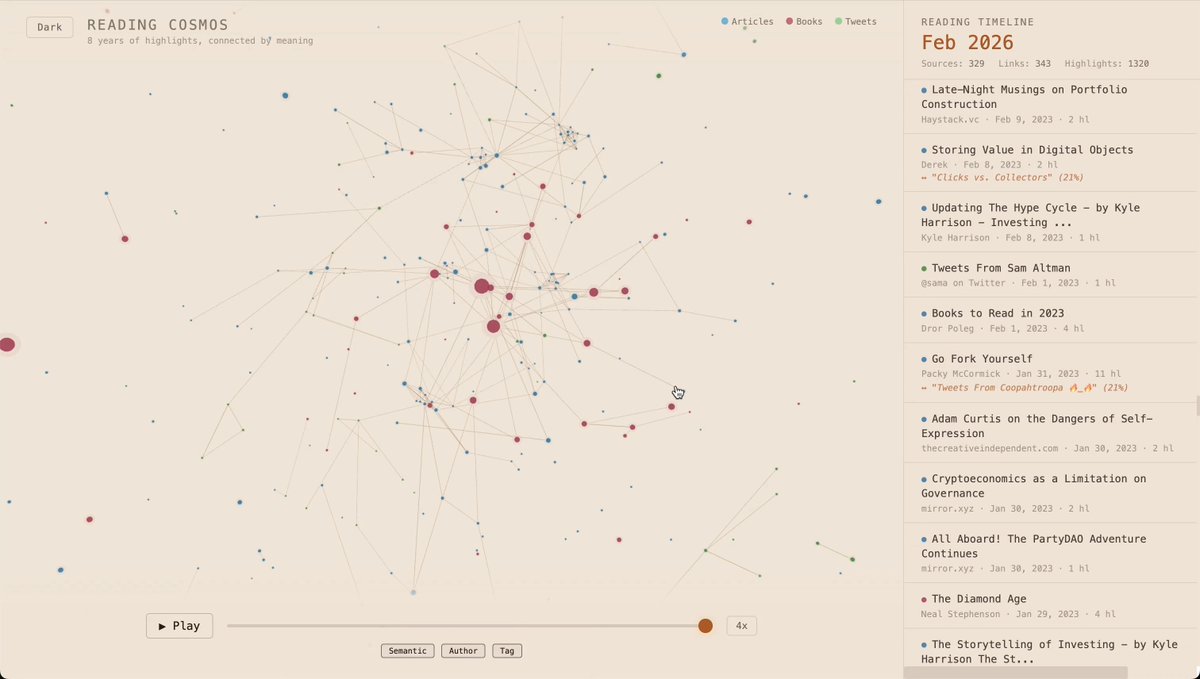
Everyone talks about building a second brain. 450 notes. 3 years of curation. Books, podcasts, articles, videos. I built a section of my site where an agent forces connections between ideas and writes exploratory essays from it. Your notes are dead if they sit in folders.

39,117 Aufrufe • vor 5 Monaten •via X (Twitter)

0 Kommentare

Keine Kommentare verfügbar

Kommentare vom Original-Post werden hier angezeigt

Ähnliche Videos

This is Farzapedia. I had an LLM take 2,500 entries from my diary, Apple Notes, and some iMessage convos to create a personal Wikipedia for me. It made 400 detailed articles for my friends, my startups, research areas, and even my favorite animes and their impact on me complete with backlinks. But, this Wiki was not built for me! I built it for my agent! The structure of the wiki files and how it's all backlinked is very easily crawlable by any agent + makes it a truly useful knowledge base. I can spin up Claude Code on the wiki and starting at index.md (a catalog of all my articles) the agent does a really good job at drilling into the specific pages on my wiki it needs context on when I have a query. For example, when trying to cook up a new landing page I may ask: "I'm trying to design this landing page for a new idea I have. Please look into the images and films that inspired me recently and give me ideas for new copy and aesthetics". In my diary I kept track of everything from: learnings, people, inspo, interesting links, images. So the agent reads my wiki and pulls up my "Philosophy" articles from notes on a Studio Ghibli documentary, "Competitor" articles with YC companies whose landing pages I screenshotted, and pics of 1970s Beatles merch I saved years ago. And it delivers a great answer. I built a similar system to this a year ago with RAG but it was ass. A knowledge base that lets an agent find what it needs via a file system it actually understands just works better. The most magical thing now is as I add new things to my wiki (articles, images of inspo, meeting notes) the system will likely update 2-3 different articles where it feels that context belongs, or, just creates a new article. It's like this super genius librarian for your brain that's always filing stuff for your perfectly and also let's you easily query the knowledge for tasks useful to you (ex. design, product, writing, etc) and it never gets tired. I might spend next week productizing this, if that's of interest to you DM me + tell me your usecase!

Farza 🇵🇰🇺🇸

2,065,699 Aufrufe • vor 3 Monaten

THIS GUY CONNECTED HIS AI AGENTS TO HIS OBSIDIAN AND BUILT A BRAIN THAT LEARNS ON ITS OWN. HERE'S HOW TO BUILD IT Obsidian is just markdown files sitting in a folder. That turns out to be the perfect memory for an AI agent, because an agent can read and write those files directly. He wired his agents into the vault so they pull context from it, do the work, and write what they learned back. The notes aren't the point. The loop is, and it gets sharper every cycle How to build it: 1. Point an agent at your vault. The fastest way, no plugins, no API keys: open a terminal and run npx obsidian-mcp /path/to/your/vault. That exposes your Obsidian folder to Claude as a tool it can read, search, and write to. Add it to your Claude Code or Cowork config and restart 2. Confirm it can see the brain. Ask it: "list the notes in my vault and summarize what's in them." If it reads them back, the connection is live. Now it starts every task with everything the vault already holds instead of from zero 3. Give each agent one job and a write-back rule. Tell it: "research this, then save what you found as a new note in /brain with links to related notes." One agent researches, one summarizes, one plans. Each writes its output back into the vault 4. Close the loop. Add one line to every agent's instructions: "read /brain before starting, write your result back when done." Now each task leaves the vault richer, and the next run reads that before it works. It compounds instead of resetting 5. You only steer. Review what the brain produces, point it at the next thing. The agents handle the reading, writing, and connecting The edge isn't better notes. It's a brain that feeds itself, so the work gets sharper every cycle instead of starting over Bookmark this

Yarchi

57,975 Aufrufe • vor 1 Monat

Tiago Forte has pioneered the concept of a Second Brain. As the author of two books, he's learned that quantity and quality aren't opposing forces. Here's what else he's taught me about writing: 1. The brain is for having ideas, not storing them. Write stuff down. 2. If you really want to learn something, don't just consume information. Create something about it. 3. Note-taking is a form of time-travel. You don’t just take notes to remember ideas. You also take notes to remember experiences. Reading your notes takes you back to a different state of consciousness. Note-taking is a rebellion against the entropy of memory. 4. Save only the best notes: Don't hoard information. Save only the top 5-10% of your ideas. That way, you can trust that everything in your note-taking system is high-quality. 5. Tiago’s dad is an artist who taught him an important lesson: the energy to create art can dissipate in small, invisible ways if you let it. Set up a structure where you have the peace of mind and the bandwidth to do art. 6. The ultimate goal of note-taking is to improve your ideas. Too many people treat note-taking as an end in itself. But the goal of note-taking isn’t to save information. It’s to have ideas you wouldn’t have had otherwise. To be smarter, faster, and more creative. 7. Link notes together. Organize your ideas by topic, not by source. As you browse your note-taking system, consider the serendipity you want to create for your future self. For example, if you read two books about a topic, link those notes together. 8. In school, we’re taught to research before we write. Do the opposite. Compile notes over time. Then, once you have an idea, start writing immediately — right when you have an epiphany. Start researching after you've written a draft. 9. Create evergreen notes. Like a good investment, the benefits of your note-taking system should compound in value. Save ideas that will stay relevant for many years. Read the classics, skip the news. 10. Tiago publicly tested every idea in his book. For most, the internet is a blackhole of distraction. But it can instead be used as a place to do low-stakes experiments before you go all in. 11. The more expensive the location for a writer's retreat, the more it forces you to be productive. 12. "Be regular and orderly in your life, so that you may be violent and original in your work." — Gustave Flaubert, one of Tiago's favorite quotes. 13. The less formal and “official” a software program feels, the better Tiago writes. And he believes some of the best turns of phrase come out in messaging apps with friends. Stuck on something? Close the word doc and text a friend about it. 14. Every time you compress an idea, you make it more accessible. But you also lose context, depth, and nuance. 15. The ultimate test of how well you understand something is how clearly you can explain it in writing — clear writers are clear thinkers. 16. Twitter can help too. Stuck on a paragraph while writing your book? Well, send a tweet about it. If the idea resonates, bring it into your book. 17. Too many choices can cloud our creative process. The key to making progress is knowing when to take in new information and when to shut off all sources of distraction. Divergence and Convergence. 18. Anything you might want to accomplish—executing a project at work, getting a new job, learning a new skill, starting a business—requires finding and putting to use the right information. 19. Instead of working in “Heavy Lifts,” you can work in “Slow Burns.” Taking notes makes you less dependent on those long blocks of creative time you need when you have to complete creative projects in a single sitting. 20. Tiago: “If I could leave you with one last bit of advice, it is to chase what excites you.” 21. A bonus: “Run after your obsessions with everything you have. Just be sure to take notes along the way.” I've shared the full conversation with Tiago Forte here. If you'd rather listen on YouTube, Spotify, or Apple, check out the replies below.

David Perell

101,346 Aufrufe • vor 2 Jahren