正在加载视频...

视频加载失败

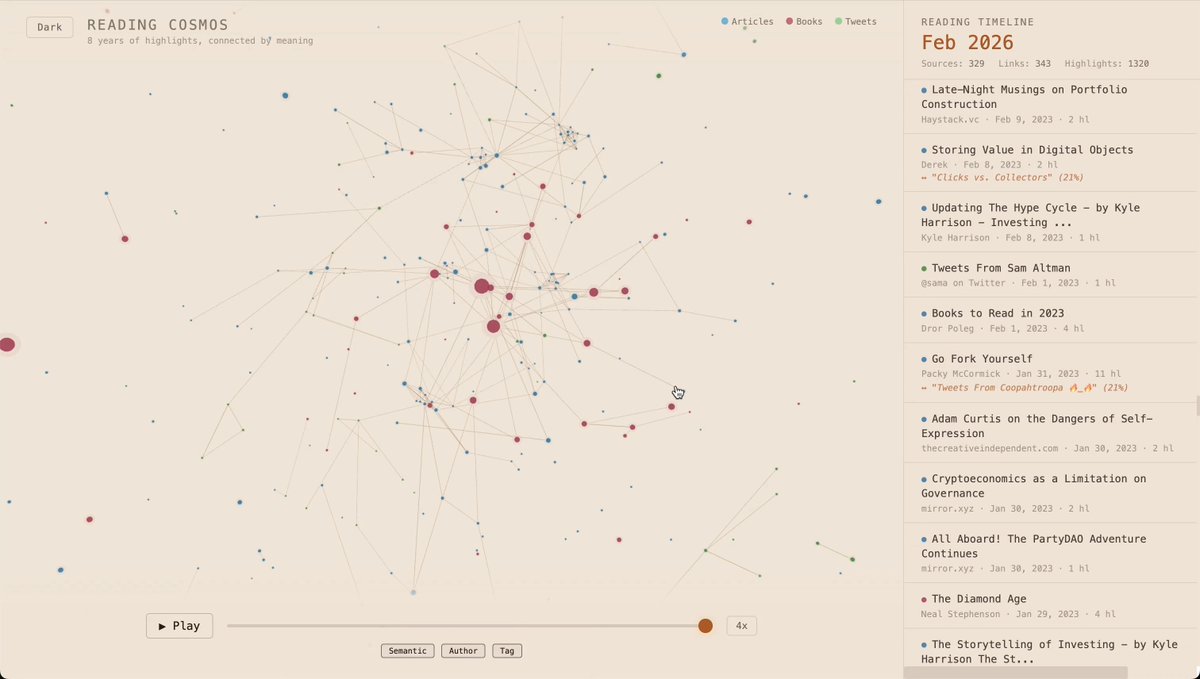
Everyone talks about building a second brain. 450 notes. 3 years of curation. Books, podcasts, articles, videos. I built a section of my site where an agent forces connections between ideas and writes exploratory essays from it. Your notes are dead if they sit in folders.

39,316 次观看 • 5 个月前 •via X (Twitter)

0 条评论

暂无评论

原始帖子的评论将显示在这里

相关视频

Andrej Karpathy keeps his entire second brain in Obsidian 1 folder of plain text files, nothing else. Here’s the exact setup, free, that turns 1 vault into a brain you can actually query. Why most “second brains” die: Notion is a database you forget to open, ChatGPT memory wipes itself after 30 messages, and both lock your notes inside their cloud. Karpathy rule is the opposite: your notes are the 1 dataset nobody else on earth has, so keep them in plain markdown, own them forever, and let the AI read them later. 3 phases. Phase 1 — Capture with 0 friction. Install Obsidian free, local, 1 hotkey to a daily note. Dump everything into it: ideas, links, quotes, 2-line thoughts, no folders, no tags, no system. Target is 5 notes a day. Phase 2 — Let the graph connect itself. Install Smart Connections and it runs embeddings on every note you’ve ever written, so 2 notes you wrote 4 months apart and never linked by hand suddenly surface as neighbors. That’s the fireworks in the 3D graph each burst is a cluster of ideas your brain forgot it owned. Phase 3 — Query your brain. Point Claude at the vault and ask: “What did I actually think about X across all my notes?” It answers from 1,200 of your own notes, not the internet your taste, your edge, your dataset. The realistic curve looks like this: Week 1 — 40 notes, graph looks empty, feels like a waste. Month 1 — 300 notes, first real cluster forms. Month 3 — 1,200 notes, and the embeddings start surfacing links you’d long forgotten. Month 6 — you stop googling your own past ideas and just ask the vault. Before — 9 tabs, 3 note apps, 0 memory. After — 1 folder, 1,200 notes, 1 brain that compounds. The gap between people who consume and people who compound isn’t talent, it’s architecture. You build your own life so choose the right path.

Spike 1%

16,390 次观看 • 1 个月前

This is Farzapedia. I had an LLM take 2,500 entries from my diary, Apple Notes, and some iMessage convos to create a personal Wikipedia for me. It made 400 detailed articles for my friends, my startups, research areas, and even my favorite animes and their impact on me complete with backlinks. But, this Wiki was not built for me! I built it for my agent! The structure of the wiki files and how it's all backlinked is very easily crawlable by any agent + makes it a truly useful knowledge base. I can spin up Claude Code on the wiki and starting at index.md (a catalog of all my articles) the agent does a really good job at drilling into the specific pages on my wiki it needs context on when I have a query. For example, when trying to cook up a new landing page I may ask: "I'm trying to design this landing page for a new idea I have. Please look into the images and films that inspired me recently and give me ideas for new copy and aesthetics". In my diary I kept track of everything from: learnings, people, inspo, interesting links, images. So the agent reads my wiki and pulls up my "Philosophy" articles from notes on a Studio Ghibli documentary, "Competitor" articles with YC companies whose landing pages I screenshotted, and pics of 1970s Beatles merch I saved years ago. And it delivers a great answer. I built a similar system to this a year ago with RAG but it was ass. A knowledge base that lets an agent find what it needs via a file system it actually understands just works better. The most magical thing now is as I add new things to my wiki (articles, images of inspo, meeting notes) the system will likely update 2-3 different articles where it feels that context belongs, or, just creates a new article. It's like this super genius librarian for your brain that's always filing stuff for your perfectly and also let's you easily query the knowledge for tasks useful to you (ex. design, product, writing, etc) and it never gets tired. I might spend next week productizing this, if that's of interest to you DM me + tell me your usecase!

Farza 🇵🇰🇺🇸

2,092,829 次观看 • 4 个月前

Obsidian + method Karpathy + Claude Code = a quantum second brain that talks back. Most second brains are graveyards you clip 300 articles, tag 80 notes, build a graph that looks like a galaxy, then never open it again. Karpathy fix is stupid simple: 1 file, append only, new thought on top, review by scrolling no folders, no tags, no 40-minute “PKM setup” videos. The capture layer is 1 Obsidian vault with 1 file called stream md, where every idea, quote and link lands in under 10 seconds, because anything slower and you quit by day 4. Once a week Claude Code reads the whole vault from the terminal with 1 prompt “find the 5 ideas I keep circling without noticing” and sees patterns across 6 months you can’t hold in working memory. Instead of searching keywords you ask questions like “what did I think about agent pricing in March,” and Claude greps 4,000 notes and quotes your own words back with file paths. Then the vault becomes context drafting a post, a pitch or a spec, Claude pulls in your past thinking instead of generic internet mush, and your output starts sounding like you, compressed. The first week feels pointless at 20 notes, month 1 brings the first “wait, I already solved this” moment, by month 3 Claude connects 2 notes written 70 days apart and that connection becomes your best post of the year, by month 6 you stop asking Google things you already answered. The whole setup costs $0 in software and 1 evening. Notion sells you a workspace, Obsidian gives you files, Claude gives them a voice. Everyone rents a second brain this one lives on your disk and grows. You wrote the notes, and now something finally reads them.

West Lord

68,836 次观看 • 23 天前

Obsidian + Claude Code is how Andrej Karpathy turns 15 years of notes into a brain that works while he sleeps. The method behind it costs $0 and takes 5 minutes a day and it outlived every productivity app since 2011. Every idea, link, and half-thought gets appended to the top of a single note, with no sorting, no folders, no tags. Once a week he scrolls through, and anything that still matters gets copied back to the top. Weak ideas sink. Strong ideas resurface 5, 10, 20 times and by the 20th pass your brain has already wired them into everything else you know. Repetition as a filter. That's the whole system. Now the 2026 upgrade almost nobody is running: Drop that note into an Obsidian vault and open the folder with Claude Code not the chat app, the terminal agent that reads files. 3 commands change everything: read my last 30 days of notes and find the 3 ideas I keep circling without acting on link every note mentioning this project into a CLAUDE.md of what I actually believe about it draft this week's post from the idea that resurfaced most Claude Code doesn't search your vault it walks it, follows the wikilinks, and hands you the patterns you were too close to see. Karpathy method filters the signal, Obsidian stores it, Claude Code compounds it. One is a habit, one is a folder, one is $20 a month together they're the closest thing to a second brain that thinks back. Most people collect notes for 10 years and never read them once. His notes read him.

Spike 1%

12,291 次观看 • 20 天前

THIS GUY CONNECTED HIS AI AGENTS TO HIS OBSIDIAN AND BUILT A BRAIN THAT LEARNS ON ITS OWN. HERE'S HOW TO BUILD IT Obsidian is just markdown files sitting in a folder. That turns out to be the perfect memory for an AI agent, because an agent can read and write those files directly. He wired his agents into the vault so they pull context from it, do the work, and write what they learned back. The notes aren't the point. The loop is, and it gets sharper every cycle How to build it: 1. Point an agent at your vault. The fastest way, no plugins, no API keys: open a terminal and run npx obsidian-mcp /path/to/your/vault. That exposes your Obsidian folder to Claude as a tool it can read, search, and write to. Add it to your Claude Code or Cowork config and restart 2. Confirm it can see the brain. Ask it: "list the notes in my vault and summarize what's in them." If it reads them back, the connection is live. Now it starts every task with everything the vault already holds instead of from zero 3. Give each agent one job and a write-back rule. Tell it: "research this, then save what you found as a new note in /brain with links to related notes." One agent researches, one summarizes, one plans. Each writes its output back into the vault 4. Close the loop. Add one line to every agent's instructions: "read /brain before starting, write your result back when done." Now each task leaves the vault richer, and the next run reads that before it works. It compounds instead of resetting 5. You only steer. Review what the brain produces, point it at the next thing. The agents handle the reading, writing, and connecting The edge isn't better notes. It's a brain that feeds itself, so the work gets sharper every cycle instead of starting over Bookmark this

Yarchi

58,186 次观看 • 2 个月前

Tiago Forte has pioneered the concept of a Second Brain. As the author of two books, he's learned that quantity and quality aren't opposing forces. Here's what else he's taught me about writing: 1. The brain is for having ideas, not storing them. Write stuff down. 2. If you really want to learn something, don't just consume information. Create something about it. 3. Note-taking is a form of time-travel. You don’t just take notes to remember ideas. You also take notes to remember experiences. Reading your notes takes you back to a different state of consciousness. Note-taking is a rebellion against the entropy of memory. 4. Save only the best notes: Don't hoard information. Save only the top 5-10% of your ideas. That way, you can trust that everything in your note-taking system is high-quality. 5. Tiago’s dad is an artist who taught him an important lesson: the energy to create art can dissipate in small, invisible ways if you let it. Set up a structure where you have the peace of mind and the bandwidth to do art. 6. The ultimate goal of note-taking is to improve your ideas. Too many people treat note-taking as an end in itself. But the goal of note-taking isn’t to save information. It’s to have ideas you wouldn’t have had otherwise. To be smarter, faster, and more creative. 7. Link notes together. Organize your ideas by topic, not by source. As you browse your note-taking system, consider the serendipity you want to create for your future self. For example, if you read two books about a topic, link those notes together. 8. In school, we’re taught to research before we write. Do the opposite. Compile notes over time. Then, once you have an idea, start writing immediately — right when you have an epiphany. Start researching after you've written a draft. 9. Create evergreen notes. Like a good investment, the benefits of your note-taking system should compound in value. Save ideas that will stay relevant for many years. Read the classics, skip the news. 10. Tiago publicly tested every idea in his book. For most, the internet is a blackhole of distraction. But it can instead be used as a place to do low-stakes experiments before you go all in. 11. The more expensive the location for a writer's retreat, the more it forces you to be productive. 12. "Be regular and orderly in your life, so that you may be violent and original in your work." — Gustave Flaubert, one of Tiago's favorite quotes. 13. The less formal and “official” a software program feels, the better Tiago writes. And he believes some of the best turns of phrase come out in messaging apps with friends. Stuck on something? Close the word doc and text a friend about it. 14. Every time you compress an idea, you make it more accessible. But you also lose context, depth, and nuance. 15. The ultimate test of how well you understand something is how clearly you can explain it in writing — clear writers are clear thinkers. 16. Twitter can help too. Stuck on a paragraph while writing your book? Well, send a tweet about it. If the idea resonates, bring it into your book. 17. Too many choices can cloud our creative process. The key to making progress is knowing when to take in new information and when to shut off all sources of distraction. Divergence and Convergence. 18. Anything you might want to accomplish—executing a project at work, getting a new job, learning a new skill, starting a business—requires finding and putting to use the right information. 19. Instead of working in “Heavy Lifts,” you can work in “Slow Burns.” Taking notes makes you less dependent on those long blocks of creative time you need when you have to complete creative projects in a single sitting. 20. Tiago: “If I could leave you with one last bit of advice, it is to chase what excites you.” 21. A bonus: “Run after your obsessions with everything you have. Just be sure to take notes along the way.” I've shared the full conversation with Tiago Forte here. If you'd rather listen on YouTube, Spotify, or Apple, check out the replies below.

David Perell

101,346 次观看 • 2 年前