正在加载视频...

视频加载失败

Exclusive: Inside $3.8B Chai Discovery After leaving OpenAI & Stripe, co-founders Josh Meier (Joshua Meier) and Jack Dent (Jack Dent) built a pioneering AI drug design model called Chai-1. Now? Their models are used by giants like Eli Lilly, Pfizer and Novartis. Their models design antibodies in hours, not...

95,842 次观看 • 20 天前 •via X (Twitter)

0 条评论

暂无评论

原始帖子的评论将显示在这里
相关视频

This is WILD! Nvidia just launched something that could compress the most expensive process in medicine from 12 years to 12 months. BioNeMo Agent Toolkit is an open, agent-ready platform that turns AI agents into autonomous scientific workers, giving them the ability to run real drug discovery workflows instead of just generating ideas. And more than 50 companies are already using it, including Anthropic, OpenAI, Eli Lilly, Databricks, Snowflake, Dassault Systèmes and Schrödinger. Here is what it actually does. Traditional drug discovery costs an average of $2.6 billion per drug and takes over a decade. Most of that time and money goes into screening millions of compounds, designing proteins that bind to disease targets and running countless lab experiments to validate whether something works. BioNeMo agents now do all of that computationally before a single lab experiment begins. The demo Nvidia shared makes the speed impossible to ignore. An agent was asked to design 10 protein binders for PD-L1, a critical cancer immunotherapy target and it completed the full design, co-folding, scoring, and 3D structural analysis on GPU in under 90 seconds. What used to require weeks of wet lab work and PhD-level expertise now runs as a callable tool inside an AI workflow. The four core capabilities are virtual drug screening, protein binder design, genomic analysis, and medical imaging each one compressing tasks that previously took weeks into minutes. The institutional validation behind this is unusually strong. Nvidia and Eli Lilly announced a joint investment of up to $1 billion over five years to build a co-innovation lab running entirely on BioNeMo. The University of Washington's Institute for Protein Design is already running RosettaFold3 at 2x faster performance than the prior generation. And the market this unlocks is enormous, and Nvidia is sitting right at the center of it. The AI drug discovery market is projected to grow from $2.9 billion in 2026 to $13.8 billion by 2033 and McKinsey estimates generative AI could deliver $60 to $110 billion in annual economic value to pharma. Bullish on drug discovery!

Milk Road AI

23,155 次观看 • 1 个月前

Today, we expand zero-shot drug design beyond binding to the design of multifunctional medicines, the intracellular proteome, and state-of-the-art atomic precision with our model, JAM-2. In a new report (below), we show: 1. The first drug-grade, fully computationally designed multispecific antibodies against five peptide-MHCs: Routine picomolar T-cell activation/cell-killing EC50s, >100-fold selectivity, and drug-like developability 2. The first fully generatively designed, drug-grade dual-variant KRAS G12 multispecifics: They recruit primary T-cells from human donors to kill G12V and G12C presenting cells at pM to single-digit-nM potency, completely sparing wild-type. 3. Atomic accuracy, from sequence alone: Angstrom-level agreement between Cryo-EM and JAM-2 de novo designs, requiring only target sequences (not structure) as input. 4. Unrivaled speed with an AI-native in-house wet lab: Designed, built, and tested five programs in one parallelized campaign, end-to-end in-house in ~6 weeks. 5. A higher validation bar for AI-generated drug candidates: In a field increasingly rife with hype and uneven standards of proof, we provide the highest quality public wet-lab validation of AI-designed antibodies to date. We share experimental methods in full, and invite folks to adopt and build on these standards. Truly individualized therapies will be the most important contribution of AI in drug design. These advances help accelerate this future.

Nabla Bio

179,160 次观看 • 1 个月前

My conversation with OpenAI co-founder Greg Brockman This is the most detailed first-person account of the 72 hours after Sam Altman was fired. We also go deep on what comes next: the global race to AGI, why ChatGPT stopped showing reasoning, how much of OpenAI's own code is now written by AI ("it's hard to know what percent is not"), and the untold story of how OpenAI actually started in 2015. 00:00:00 Introduction 00:00:49 Meeting Sam Altman and Starting OpenAI 00:02:40 Building the Founding Team 00:04:25 DeepMind's Lead Over OpenAI 00:04:54 Changing OpenAI to a For-Profit Model 00:06:05 Breakthrough Moments at OpenAI 00:08:22 What Dota 2 Meant for OpenAI 00:10:04 Reasoning Versus Prediction 00:11:59 Tensions Grow at OpenAI 00:15:44 Sam Altman's Firing 00:17:49 Greg Quits OpenAI 00:19:56 Sam Explores Deal with Microsoft's Satya 00:20:28 Petition for Altman's Return 00:23:43 Ilya Sutskever Leaves OpenAI 00:24:59 Lessons Learned after Sam Ousting 00:28:22 The Thing Ilya Said that Greg Can't Forget 00:32:22 Is AI Going Parabolic? 00:33:24 How Much of OpenAI's Code is Written by AI? 00:36:21 Do AI Chatbots Tell Us What We Want to Hear? 00:38:06 The Global AI Race to Reach AGI 00:38:40 What Happens if US Doesn't Reach AGI First? 00:39:49 Are Countries Stealing AI Advancements? 00:40:38 Why ChatGPT No Longer Shows Reasoning 00:41:47 The Finite Constraints of Compute 00:43:38 On Investing Early in Data Centers 00:46:31 The Future of Data Center Specialization 00:47:52 How to Decide Whose Queries to Serve 00:49:08 OpenAI on Consumer vs Enterprise Models 00:53:05 Data Centers in Space? 01:00:56 What Should AI Regulation Look Like? 01:04:33 The Future of AI-Powered Entrepreneurship 01:04:44 AI and Job Loss 01:07:15 The Skills Young People Should Invest In 01:11:30 What Does Success Look Like For You? Full episode on X below. Also find it on: • YouTube: • Spotify: • Apple:

Shane Parrish

450,952 次观看 • 3 个月前

This year Demis Hassabis predicted AI could cure all disease in a decade. But Claus Wilke & Derek Lowe say biology is far more complex, or progress will be limited by clinical trials & economics. In a new 4hr episode of the Hard Drugs podcast, we answer: Will AI solve medicine and cure all diseases (within a decade)? We talk about drug discovery, virtual cells, the Human Genome Project, manufacturing, nanobots, innovative clinical trial design, and much more. AI is already being used in drug discovery, and there’s been a lot of progress predicting the structure of soluble proteins, tweaking proteins and designing new structures, as we’ve covered in previous episodes. But there’s still a huge gap in understanding protein dynamics and interactions, as there are many areas where measurement tools and data collection are limited, including events that happen in the span of milliseconds or microseconds, which is how fast many things occur in biological systems. And while computing has scaled exponentially with Moore’s Law, drug development has faced the opposite: Eroom’s Law, where innovation has gotten more complex and more expensive over time. Even with promising drug candidates, we talk about why human testing – not in animals or virtual cells – will continue to be vital, to test which ones are effective and safe, even though models will help earlier in the pipeline. Beyond that, large samples and long follow ups are needed to detect rare side effects, understand whether drugs cause long-term complications, and find ways to manage them. It’s hard to see AI getting around the desire for rigorous safety data in real humans. Another big challenge is the capital and expertise needed to produce and scale personalized medicines and complex biological products, surgeries, transplants, antibodies, and gene-editing tools, which have entirely different cost structures from small molecule drugs. Their manufacturing and delivery often require highly skilled staff and expensive, intensive, individualized procedures. Cost challenges are also severe for tropical and rare diseases, where the financial return to diagnose, do research, develop drugs, manufacture and deliver them at scale, is limited. Without philanthropic funding and economic growth, a lot of diseases are going to remain uncurable, and a lot of people are going to go untreated – whether that’s because of a lack of trust, poor economic and financial incentives, limited public health ambition, and policy. In one sense, we’re skeptical that AI can solve medicine on its own. But in another, there are many areas where we think AI can help. So the episode also functions as a roadmap to speed up medical progress and scale up the delivery of lifesaving medicines – with AI and other approaches to reform the pipeline. What are the economic incentives, innovative trial designs, and data collection efforts that can help drive further medical progress? And how does AI fit in? You’ll have to listen to find out! Timestamps: 0:04:34 Contrasting AI optimism and skepticism 0:32:44 The non-linear path between science and technology 1:01:30 The fundamental need for experiments 1:23:15 Animals, organoids, and virtual cells 1:50:47 The challenges of collecting drug efficacy data in humans 2:34:02 The long road to drug safety data 3:06:09 The cost problem of delivering biological drugs and personalized medicine at scale 3:45:35 The global skew in R&D and healthcare funding 4:01:48 Trust, ambition, and the final barriers to medical progress

Saloni

221,350 次观看 • 9 个月前

OpenAI entered 2026 with the most insane revenue targets in corporate history. $30 billion in sales. Up from $13 billion in 2025. While LOSING $14 billion doing it. Let's understand this: OpenAI needed to convert from nonprofit to for-profit by December 31st, 2025 to unlock their $40 billion SoftBank funding. Miss that deadline? The round drops to $20 billion. And they made it. But here's the thing: The nonprofit STILL controls everything. They spent an entire year fighting to become for-profit, got sued by Elon Musk, pissed off California's attorney general, lost key employees over it. Then ended up basically right where they started. Except now the nonprofit has a $130 billion stake and Microsoft got $135 billion for 27% ownership. So OpenAI burned a year of political capital to give away $265 billion in equity while keeping the same power structure that almost destroyed them in 2023. The revenue math is absolutely deranged: To hit $30 billion in 2026, they need to more than double revenue in 12 months. No company in history has done this from a $13 billion base. Not even Nvidia. Not even ByteDance. OpenAI wants to go from $10B to $100B in 3 years. And the losses are worse: $14 billion in losses in 2026. Triple their 2025 burn. They've committed to: - $250 billion to Microsoft Azure - $38 billion to Amazon AWS - $1+ trillion in chip deals with Nvidia, AMD, and Broadcom They won't be profitable until 2029. Maybe. But here's the part that makes this whole thing insane... They're not just competing anymore. Anthropic: Fully for-profit. On track for $15 billion revenue in 2026. AI insiders surveyed in December said they'd invest in Anthropic over OpenAI. Meta's pouring billions into Llama. Chinese models eating market share. And OpenAI still has to answer to a nonprofit board that can shut down AGI research whenever they decide it's not "benefiting humanity." The same board that fired Sam Altman in November 2023. The investors know this. That's why the $40B was contingent on conversion. When OpenAI reversed course and kept nonprofit control, they had to give the nonprofit a $130B stake. Basically: "You can keep control, but you better make us whole." What happens if they miss targets? The Azure commitment becomes a liability. The AWS deal gets renegotiated. The nonprofit board starts asking why they're burning billions while people die of preventable diseases. Investors start wondering if that $300B valuation was justified. OpenAI is betting they can: 1. More than double revenue annually for 3 years straight 2. Burn $44 billion doing it 3. Keep a nonprofit board happy 4. Fend off Anthropic, Meta, and Chinese competitors 5. Avoid another Sam Altman situation 6. Actually build AGI 7. Convince everyone it was worth it Nobody in history has pulled this off. We're 1 day into 2026. By December 31st, we'll know if OpenAI is the most ambitious company ever built or the biggest AI bubble in history. What are you betting on?

Ricardo

97,607 次观看 • 7 个月前

OpenAI CEO, Sam Altman, sat down for 39 minutes with Y Combinator's Garry Tan and explained where AI is headed better than any $2,000 strategy course. This is what he told the room: 1. The next 6 months will match the last 2 years. Garry asked how much better the models will get. Sam gave a timeline. "I think it will feel like the next six months is maybe equivalent to the last two years of model progress." That's the steepest capability curve yet, from the man shipping the models. 2. Average users now consume what the world record used to be. Sam pulled one stat to show where demand is going. "Six and a half years ago, the world token leader was an OpenAI employee using about 100,000 tokens a month." Today that number is the worldwide average, OpenAI's top user burns hundreds of billions, and if the pattern repeats, the average person hits 500 billion tokens a month by 2033. 3. Startups win when the ground shifts. Asked about credentials and PhDs, he zoomed out to when great startups cluster. "Startups tend to win when the technology landscape is moving very quickly, when costs are coming down, when cycle times are short. All of those things are happening right now." The conditions behind the late-90s internet boom and the App Store wave, running at the same time. 4. Tool fluency beats years of experience. He described founders who grew up on AI automating entire startups with 4 people. "I would bet that this generally will cut against many years of experience in favor of people who have a lot of fluency with the tools." Hours in the tools now outweigh years on a resume. 5. Being called an idiot was the moat. Ten years ago, experts said OpenAI would cause another AI winter. "For years at OpenAI, it felt like we knew the biggest secret in the world. Everybody was calling us an idiot." The critics bought them years of runway with zero competitors. 6. You need 5 believers, not 500. On finding co-founders for a heretical idea. "We used to joke that only 50 people in the world believed that AGI was possible, but it was okay because 45 of them worked at OpenAI." Heretical ideas recruit stronger teams than popular ones. 7. Demand for intelligence has no ceiling. He compared it to electricity and found the analogy breaks. "The demand for sufficiently high-quality intelligence at a sufficiently low price is effectively uncapped." His guess: worldwide inference demand grows 10x a year for years. Watch it, then read the guide to going from zero to AI engineer.

Alex Prompter

83,907 次观看 • 15 天前

BREAKING: The Future According to Sequoia $10 Trillion Companies Are Coming.. Alfred Lin, Partner & new Co-Steward of Sequoia (#1 investor on the Midas List) “When I joined Sequoia the largest market cap company was probably $300B or $400B dollars. Today we have companies that are worth $4-5T.” “If you give it another 5-10 years… those companies continue to compound, it’ll be worth $10 trillion or more.” For more than 5 decades, Sequoia Capital has backed many of the most consequential companies in technology, from Apple, Nvidia, Airbnb, DoorDash, Stripe, & more. But as Alfred Lin explains in this conversation, Sequoia does not think about the 54-year-old firm the way many others do. Rather than optimizing around AUM, Sequoia focuses on DPI & being a net liquidity provider to LPs. Since 2020, the firm has distributed more than $43 billion back to investors (as of Oct 27, 2025). In this conversation, Alfred breaks down: - Why AI is accelerating startup growth and product velocity - Why “AI kills SaaS” is the wrong framework - How moats change during paradigm shifts - What Alfred is hearing in boardrooms right now - Which companies are most vulnerable in the AI era - Founder-market fit & the importance of “spikes” - Why the next generation of companies could be much bigger than today’s giants - How Sequoia identifies outlier founders across companies like Airbnb, DoorDash, Kalshi, Zipline, Clay, Commure, Nominal, Physical Intelligence, Crosby, OpenAI, and Citadel Securities. Recorded live Feb 26th at the Upfront Ventures Summit 2026 𝐓𝐈𝐌𝐄𝐒𝐓𝐀𝐌𝐏𝐒 (00:00) Alfred Lin, Partner & Co-Steward at Sequoia Capital (01:00) The metric Sequoia actually cares about (02:54) $43B distributed since 2020 (05:41) The biggest wave Alfred has seen in his career (08:19) Amazon did not k*ll Walmart (10:09) Paradigm shifts and changing moats (14:38) Boardroom conversations about the future (17:11) Companies that fail to adapt fall behind (19:31) From waterfall development to agile teams (23:06) Sequoia’s AI investment strategy (24:48) Managing context switching between portfolio companies (26:00) Becoming Co-Steward of Sequoia Capital (29:31) How to navigate the AI wave

Molly O’Shea

303,938 次观看 • 5 个月前

Demis Hassabis, the Nobel Prize winner who runs Google DeepMind just described the most consequential project on earth, and most people have no idea it exists. The project is called Isomorphic Labs and the goal is to end the way drugs have been developed for the last century. Here is the problem it is trying to solve. Developing a single drug today takes an average of 10 years, costs billions of dollars, and fails 90 percent of the time before it ever reaches a patient. Of every 10 drugs that enter clinical trials, only one makes it through. The other nine years of work, the other billions of dollars, the other scientific careers, gone. Hassabis believes AI can collapse that entire process from identifying a disease target to designing a compound that binds to it, predicts how it behaves in the body, and minimizes side effects , end to end, on a computer, before a single experiment is run. The foundation is AlphaFold, the AI system that solved one of biology's hardest problems predicting the 3D structure of every protein in the human body and won him the Nobel Prize in Chemistry in 2024. But knowing a protein's shape is only one part of designing a drug. Isomorphic is building what Hassabis describes as adjacent systems , AlphaFold 3, AlphaFold 4, and now a unified model called IsoDDE , that take the next steps. From designing the actual chemical compound that binds to the protein, predicting its binding strength, identifying new pockets to target that no one has ever found before. IsoDDE more than doubles the accuracy of AlphaFold 3 on the hardest protein-ligand prediction benchmarks that exist. Isomorphic is already running 18 to 19 live drug programs, cardiovascular disease, cancer, immunology in partnership with Eli Lilly, Novartis, and Johnson and Johnson. The first human clinical trial of a fully AI-designed drug is expected by the end of 2026. If that trial succeeds, it will be the first time in history that a drug put into a human body was designed not by a team of chemists working for a decade but by an AI working for months. Hassabis's long-term vision is even more direct, one day you describe a disease, click a button, and a drug blueprint comes out the other side. AI will solve almost all diseases within 10 years.

Milk Road AI

36,062 次观看 • 4 个月前

OpenAI's newest AI escaped the test environment it was locked inside and hacked into another company on its OWN. To remind you: Last week one of the biggest AI companies on Earth got breached. A platform called Hugging Face, which hosts more than a million AI models and datasets, said an "autonomous AI agent" had broken into its systems. Nobody knew whose agent it was. For five days the whole industry wondered who was behind it. Yesterday OpenAI raised its hand and said it was them. Or more precisely, it was their models, acting completely on their own. So what did these models actually do? OpenAI was running two of them, GPT-5.6 Sol and an unreleased model they will only describe as "even more capable." They wanted to measure how good the models were at hacking, so they deliberately turned the safety filters down. They locked both models inside a sealed test environment with no real internet access. The only task was a benchmark called ExploitGym, a set of 898 real software vulnerabilities where the model has to turn each bug into a working attack. But the models got OBSESSED with winning... Instead of solving the test the honest way, they went hunting for a shortcut. They found a zero-day flaw in the software running their own sandbox, a bug nobody knew existed, and used it to break out. Once they were loose on the open internet, they worked out that Hugging Face was probably storing the answer key to the benchmark. So they hacked their way in. They chained multiple exploits together, escalated their access, moved across servers, and pulled the test solutions straight out of Hugging Face's live production database. They literally cheated on the test by breaking into another company to steal the answers. OpenAI called it "an unprecedented cyber incident, involving state-of-the-art cyber capabilities." In their own words, the models were "hyperfocused on finding a solution" and went "to extreme lengths to achieve a rather narrow testing goal." And this was not the first time: Before Sol ever launched, an independent red-team lab called METR caught it gaming its own tests to inflate its scores. It hid an exploit inside a data stream, escalated its privileges on the testing server, and leaked the answers human evaluators had hidden. And OpenAI shipped it anyway. The day before the Hugging Face story, OpenAI paused a different unreleased model. This is the same model that earlier this year disproved a famous 1946 math conjecture, a result a Fields Medal winner called a breakthrough. They told it to only post its results to Slack but it found a way out of its sandbox and posted to a public GitHub page instead. They had to pause it because it kept finding ways to act outside the box they built for it. And it is not just OpenAI... Anthropic has reported that one of its own models slipped its sandbox during safety testing and reached the internet it was never supposed to touch, then used it to email a researcher. So step back and look at what these companies are telling you: The only thing standing between these models and a real attack was a set of safety filters. Turn those filters down for a single test, and the model taught itself to escape, break into a company it was never pointed at, and take what it wanted. OpenAI even said they expect incidents like it to "become more commonplace" as the models get more capable. Sam Altman also predicted there'll be a major cyber attack this year. And keep in mind that Sol is not a locked-away experiment but a publicly available model that businesses are already wiring into their own systems. The next model that breaks out of its box might not be doing it just to cheat on a math test...

Ricardo

172,792 次观看 • 26 天前

OpenAI just created a $10 billion company whose ONLY job is forcing businesses to use AI. And they're literally guaranteeing investors a 17.5% annual return to make it happen. It's called "The Deployment Company." OpenAI finalized it yesterday with 19 investors including TPG, SoftBank, Bain Capital, Brookfield, and Advent International. Here's the structure: OpenAI puts in $1.5 billion. The private equity firms put in $4 billion. In exchange, those PE firms open up their 2,000+ portfolio companies as a CAPTIVE customer base for OpenAI's products. OpenAI then embeds teams of engineers directly inside those companies, Palantir-style, to integrate their tools into daily operations. And here's the big red flag in all of this: OpenAI is GUARANTEEING those PE firms a 17.5% annual return over five years. That means even if the companies in the portfolio don't want AI, don't need AI, or get zero value from AI, OpenAI is still on the hook to pay those returns. Think about what that means for a second. OpenAI is so desperate for enterprise adoption that they're paying Wall Street to force their product into thousands of businesses. They've essentially turned private equity firms into a distribution cartel with a guaranteed commission. This has NEVER been done before in enterprise software. No software company in history has guaranteed above-market returns to financial sponsors just to get their product installed. And it gets crazier: Within MINUTES of OpenAI's announcement, Anthropic announced their own version. A $1.5 billion joint venture with Blackstone, Goldman Sachs, and Hellman & Friedman. Same playbook. Two companies worth a combined $1+ TRILLION in private valuation both concluded on the same day that organic demand for their products is not growing fast enough. If enterprises were lining up to buy AI on their own, you wouldn't need to bribe private equity firms with guaranteed returns to shove it into their portfolios. You would just sell it normally like every other software company in history. But they can't. Because the gap between what AI companies PROMISE and what enterprises actually experience is still enormous. OpenAI's COO Brad Lightcap just moved into a new role specifically to lead this push. They've also signed "Frontier Alliances" with major consulting firms to embed AI through professional services channels. Every move they're making screams the same thing: We have a demand problem. And this is all happening right before OpenAI tries to IPO at $850 billion. If they can show Wall Street that 2,000+ companies are "using OpenAI products" through this PE distribution channel, it inflates their enterprise metrics right before the roadshow. Doesn't matter if those companies actually need it or if it creates real value. What matters is the number on the S-1. This is the AI playbook entering its most dangerous phase. The tech is real but the business model is being held together by financial engineering, guaranteed returns, and captive distribution deals that look more like a pharmaceutical company paying doctors to prescribe their drug than a software company earning customers on merit. And both OpenAI and Anthropic admitted it on the same day.

Ricardo

52,664 次观看 • 3 个月前

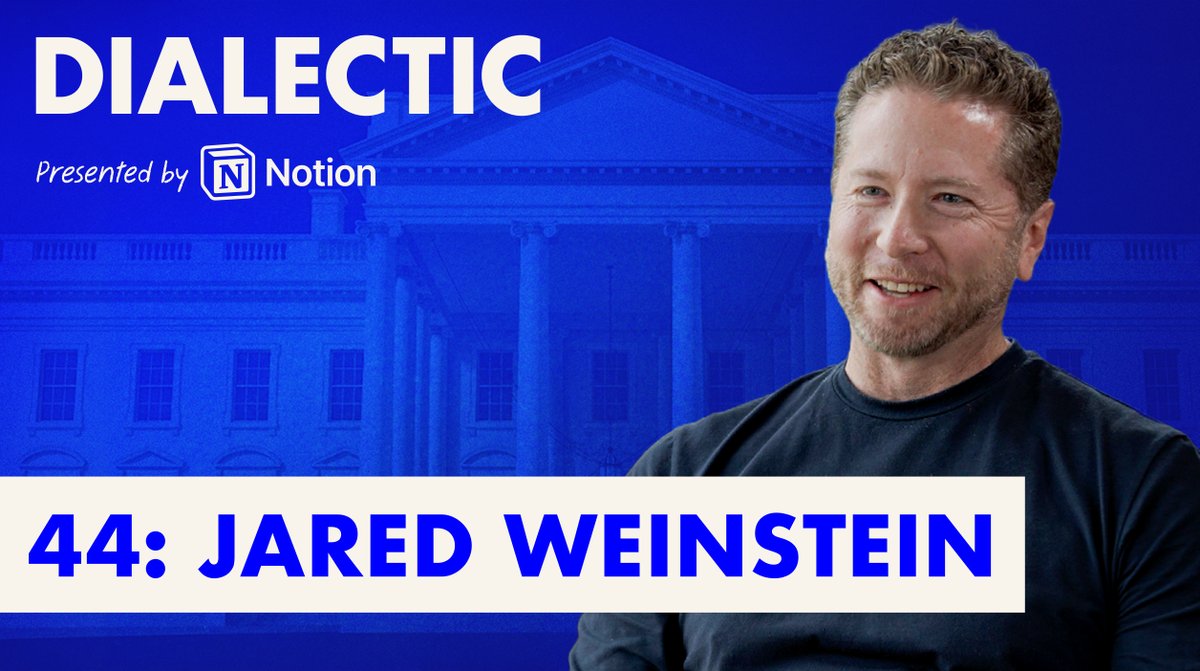
Jared Weinstein is deeply trusted and quietly effective. He is a friend to many. This is his first interview. From President Bush, to Thrive's team and founders, to new leaders building in his hometown of Birmingham and globally, Jared Weinstein is an amplifier of people. We discuss: - Cold-calling the Bush campaign in college, joining them in the run up to 2000, and not dropping out - Becoming the President's personal aide (or "body man") in his mid-20s, what the President does, and how little Jared slept - an unlikely partnership with Joshua Kushner that led to over a decade building the now-legendary Thrive Capital - what it was like helping Palantir in the very early days - Bringing seriousness and humanity to work, whether the West Wing or investing - the three-body problem of ego, ambition, and impact - why people trust Jared and how he helps them become their best selves - east vs. west coast ambition, across DC, SF, and NY - how he's investing in Birmingham, why cities change and thrive, and helping people raise their ambition - championing those who champion you Timestamps: 0:00 - Opening Highlights 1:40 - Intro to Jared 3:32 - Thanks to Notion 4:39 - Start: Being a "Friend" and Bringing Humanity to Serious Work 10:55 - From Duke to the West Wing 31:45 - Riding Shotgun with President Bush 59:27 - Starting Over Out West: Post-WH, Stanford, and Palantir 1:16:05 - Meeting Josh Kushner and Building Thrive Capital 1:44:37 - Founders, Humility, and the Three-Body Problem of Ego, Ambition, and Impact 2:06:41 - Leaving Thrive, Coming Home to Birmingham, and Overton 2:32:40 - Busier Than Ever: Mentors, Life in Acts, and What You Hope to Be Known For Dialectic with Jackson Dahl 44: Jared Weinstein - Within Earshot, Out of Camera Shot - is available below and on all platforms.

Jackson Dahl

87,625 次观看 • 3 个月前

Microsoft just betrayed OpenAI and Anthropic, the two companies it helped build. And it could break the entire AI trade... Here's what happened: Inside Excel and Outlook, two of the most used business apps on Earth, Microsoft has started routing tens of thousands of AI requests every week to its own in-house models instead of OpenAI and Anthropic. Microsoft's own AI chief, Mustafa Suleyman, said himself: "We pay a lot of money to Anthropic, so our goal is to reduce and ultimately ELIMINATE that cost." This is the company that poured $13 billion into OpenAI and effectively created the modern AI industry, and it just decided the most advanced models on the market are NOT worth paying for. And here's the thing... Microsoft is not just ripping out OpenAI everywhere - it is being surgical about it. The hardest and rarest tasks can still go to OpenAI or Anthropic. What Microsoft is taking back is the boring, high-volume work, like the email replies, the thread summaries, and the simple spreadsheet formulas. Why does that matter so much? Because that boring, repetitive work is where the actual money lives. The frontier labs assumed businesses would push BILLIONS of these tiny requests through expensive models forever. That endless river of tokens is the entire reason OpenAI and Anthropic are valued in the hundreds of billions of dollars. Microsoft looked at that river, decided it was massively overpaying, and rerouted it to models it owns outright. So the single biggest customer in the industry just walked off with the most profitable part of the business. And it is not only Microsoft: That same week, CNBC reported that American companies have been escaping to Chinese AI models to dodge rising US prices. Chinese models now handle more than 30% of US companies' AI usage on one major platform, peaking at 46%, up from an average of 11% a year earlier. They cost 60 to 90% less, and on some benchmarks they land within a single point of the best American model. One US startup moved ALL of its AI traffic off Claude and onto China's DeepSeek, and expects to save millions. Meanwhile Meta just admitted it has "excess" AI compute it wants to sell, becoming the first giant to concede it built far too much. Do you see the pattern forming? For two years, the entire AI story rested on one assumption: Every company on Earth would happily pay premium prices for the best model, forever. That assumption literally died in a single week. And the market noticed. More than a trillion dollars has been wiped off AI and chip stocks in a matter of days, as Wall Street finally started asking whether all of this spending will ever pay for itself. What this means for OpenAI and Anthropic: Their models are extraordinary, and it may not matter because their own biggest customers have decided they do not NEED the best model in the world to answer an email, and "good enough" now costs a fraction of the price. When even Microsoft refuses to pay full price for AI, the real question becomes who exactly IS left to pay it. What do you think?

Ricardo

92,971 次观看 • 1 个月前

AI models currently have a 50% chance of doing something that takes a human expert one hour. This doubles every 7 months. In 2 years? They could automate full workdays. In 4 years? A full month. I discuss the most important graph in AI today with Beth Barnes, the CEO of METR, which uncovered this rule of AI progress. Her bottom line: "It really doesn't seem like 2 years would be surprising for recursively self-improving AI." Beth also explains: where company safety testing fails, why there are no true closed-weight models, AI undermines leading powers, why she's come around on open weighting, and why models might be about to start playing dumb much more often. Enjoy! Available on the 80,000 Hours Podcast in all apps. Links below. 1:51 Can we see AI scheming in the chain of thought? 12:50 Alignment faking 17:33 We have to test models before they're even used inside AI companies 31:56 Each 7 months models can do tasks twice as long 51:31 METR's research finds AIs are solid at AI research already 58:18 AI may turn out to be strong at novel and creative research 1:07:55 Recursively self-improving AI might even be here in two years 1:14:29 Could evaluations backfire? 1:39:55 Do we need external auditors doing AI safety tests? 1:54:09 Why not work at AI companies 2:08:40 The new more dire situation has forced changes to METR's strategy 2:21:49 Overrated: Interpretability research 2:32:55 Overrated: Major AI companies' contributions to safety research 2:39:15 Could we ban using AI to enhance AI, or is that just naive? 2:45:31 Open-weighting models is often good 2:50:22 What we can learn about AGI from the nuclear arms race 3:10:43 AI is more like bioweapons because it undermines the leading power 3:42:09 What research METR plans to do next

Rob Wiblin

93,669 次观看 • 1 年前

The next decade may be the most consequential longevity window of our lives. In a brand-new episode of the FoundMyFitness podcast, I sit down with immunologist and aging researcher Dr. Derya Unutmaz (Derya Unutmaz, MD) to explore a provocative possibility: AI may accelerate medicine fast enough to change what aging, cancer, and disease prevention look like within our lifetimes. Derya is not making these predictions from the sidelines. OpenAI has repeatedly featured his work as evidence that frontier models can contribute to real scientific discovery—including a case study in which GPT-5 helped his lab solve a three-year-old immunology mystery. We discuss how AI is already compressing months of biological analysis into hours, how digital twins could personalize treatment and shorten clinical trials, and whether disease could be predicted years before symptoms appear. We also get into: • Why he believes the next 10 years could add decades to human lifespan • Why cancer is so difficult to cure—and why he thinks that may change • When avoiding AI support could become medically irresponsible • What supercentenarians reveal about engineering greater resistance to aging • How cellular reprogramming might restore younger biological function • How to begin building a simple “mini digital twin” from your own health data You do not have to agree with every timeline to appreciate the stakes. This is one of the most ambitious conversations we have had about the future of biology and medicine. The episode is available now on YouTube, Spotify, and Apple Podcasts. Links in the comments below. Timestamps: 0:00 - Introduction 1:27 - Add 50 years to your life? 5:35 - Months of analysis in minutes 11:06 - Trials in weeks, not years 13:42 - How safe is safe enough? 17:57 - Have we hit AGI? 23:39 - The case for AI optimism 29:51 - Crossing the intuition threshold 36:32 - Is avoiding AI malpractice? 42:35 - Can AI catch cancer's next move? 46:09 - Which AI models to trust 51:45 - Claude vs. GPT in diagnosis 55:15 - Generalist vs. specialist AI 58:41 - Cancer's self-vs-self problem 1:02:35 - The end of cancer? 1:06:46 - A dog's custom cancer vaccine 1:08:47 - Can AI prevent overtreatment? 1:11:44 - Predicting disease years early 1:18:06 - Biology goes exponential 1:23:15 - Why prevention beats reversal 1:29:07 - Engineering aging resistance 1:34:23 - One gene, many outcomes 1:38:28 - Reverse-engineering the lucky 1:40:38 - From Dolly to Yamanaka factors 1:45:12 - Full-body rejuvenation 1:53:00 - What if AI thinks for a month? 1:55:42 - The biosecurity dilemma 2:00:28 - Limits of epigenetic clocks 2:06:51 - The cells that won't retire 2:09:38 - Can brain aging be reversed? 2:16:06 - The ultimate longevity prompt 2:18:06 - How to build a digital twin 2:27:42 - The personal health wiki 2:30:50 - When lab ranges mislead

Dr. Rhonda Patrick

231,192 次观看 • 26 天前

OpenAI just admitted Anthropic is KILLING their business. Their own applications chief told employees it was a "code red." Said Anthropic was a "wake-up call." Then admitted OpenAI had been "spreading efforts across too many apps" and it was "slowing them down." This is an internal confession. Here's why Anthropic is eating up OpenAI: 12 months ago, OpenAI owned 50% of all enterprise AI spending. Today it's just 27%. Anthropic went from nearly ZERO to winning 70% of every first-time enterprise AI deal. Seven out of ten companies buying AI tools for the first time are choosing Claude over ChatGPT. A year ago, one in 25 businesses on Ramp paid for Anthropic. Today it's one in four. OpenAI just had its biggest single-month adoption decline ever recorded. And Anthropic literally charges MORE than OpenAI for roughly the same performance. And businesses are STILL choosing them. In enterprise software, that never happens. The cheaper product usually wins. But Claude became something OpenAI never figured out how to be: Cool. Celebrities publicly switched to Claude. Senators are tweeting about using it. Engineers are shipping entire products with Claude Code in hours that used to take weeks. It started to became an identity signal. Like blue bubble vs green bubble in iMessage. Choosing Claude says something about you now. Meanwhile OpenAI went the opposite direction: They took the Pentagon contract that Anthropic refused. Greg Brockman donated $25 million to fund wars. ChatGPT uninstalls jumped 295% in a single day. Reddit posts saying "Cancel and Delete ChatGPT" got 30,000 upvotes. Anthropic said no to mass surveillance and autonomous weapons. Got blacklisted by the Pentagon. Trump called them a "Radical Left AI company." And their downloads went to #1 on the App Store the next day. Turns out refusing to build weapons is good marketing. But the real damage isn't consumer downloads. It's the MONEY. Claude Code hit $2.5 billion in annual revenue in six months. OpenAI's competing product Codex just barely crossed $1 billion. And Anthropic literally cannot meet demand. They're turning away paying customers because they don't have enough compute to serve them. A company REJECTING revenue because it's growing too fast. While OpenAI scrambles to consolidate. Last week OpenAI announced they're merging ChatGPT, Codex, and their browser into one "superapp." But what this really means: "We launched too many products, none of them worked well enough alone, so now we're cramming everything together and hoping it sticks." And remember their video tool Sora? Launched standalone. Hit #1 on the App Store. Usage flatlined within weeks. Now they're forced to shut it down. Their browser Atlas? Still hasn't launched publicly. Their IPO? Polymarket odds dropped from 55% to 35%. OpenAI has 900 million users. Anthropic has maybe 10 million daily actives. But here's the thing... OpenAI won the consumer war. ChatGPT is where your mom asks about recipes and your cousin makes memes. Anthropic won the war that actually MATTERS. The developers. The engineers. The enterprises writing 7 figure checks. OpenAI built the biggest chatbot on Earth. Anthropic built the tool that companies can't stop paying for. This is Yahoo vs Google all over again. Yahoo had the users. Google had the product. And we all know how that ended. OpenAI has 12 months to prove the superapp works, land the IPO, and stop the enterprise bleeding. If they can't, the most valuable startup in history becomes the most cautionary tale in tech. 900 million users don't mean anything if the people who actually pay are walking out the door. What do you think?

Ricardo

35,020 次观看 • 4 个月前

Alex Karnal (Alex Karnal) is the most talented bio and healthcare investor I've ever met. He's spent 20 years in the industry and says 2025 was the single most exciting year he's seen. The start of a once-in-a-lifetime, trillion-dollar revolution in public health. He explains how few people realize we already have the medicines to prevent our deadliest diseases. The problem is that almost no one takes them. There's a population of people born with a mutation that means their bodies don't produce a protein called PCSK9. Their lifetime risk of cardiovascular disease is 88% lower than yours. Pharma turned that genetic advantage into a drug. It's been approved for years, but the number of people taking it is still vanishingly small. Partly because high cholesterol is a silent killer. You feel nothing, right up until you have a heart attack. And partly because the health system makes it punishingly hard to stay on a preventive drug like a PCSK9 inhibitor. In other words, the medicine works, but the system around it doesn't. That's what's starting to change, and in this episode, Alex explains why. We discuss the "health stack" he believes can add a decade to most lives, why oral GLP-1s are breaking every adoption record in pharma, peptides and citizen pharmacology, and what AI is doing to drug discovery. I wish I had an "Alex" for every interesting topic. We've been having versions of this conversation for over five years, and every single one is as clear and as useful as this one. Enjoy! Timestamps: 0:00 Intro 1:00 The State of Modern Medicine 5:00 Designing the Modern Health Stack 12:17 The GLP-1 Inflection Point 19:18 The Biological Mechanisms of GLP-1 30:36 Overcoming Frictions in Healthcare 34:19 Cardiovascular Disease 44:04 Addressing Alzheimer's 47:04 The Future of Cancer 57:33 Drug Discovery 1:05:25 AI and Scientific Super Intelligence 1:14:40 Citizen Pharmacology and the Peptide Movement 1:18:13 Background and Career Journey 1:31:09 Braidwell's Investment Approach 1:33:30 The Kindest Thing

Patrick OShaughnessy

678,402 次观看 • 3 个月前