正在加载视频...

视频加载失败

EXCLUSIVE: Morpho 🦋 CEO Paul Frambot 🦋 on how Morpho Midnight is new infrastructure for institutional private credit. This week, Morpho launched Midnight, which enables fixed-rate, fixed-term onchain lending, starting with one cbBTC/USDC market on Base across multiple maturities. This is unlike most DeFi today, where protocols like Aave...

11,740 次观看 • 3 天前 •via X (Twitter)

0 条评论

暂无评论

原始帖子的评论将显示在这里

相关视频

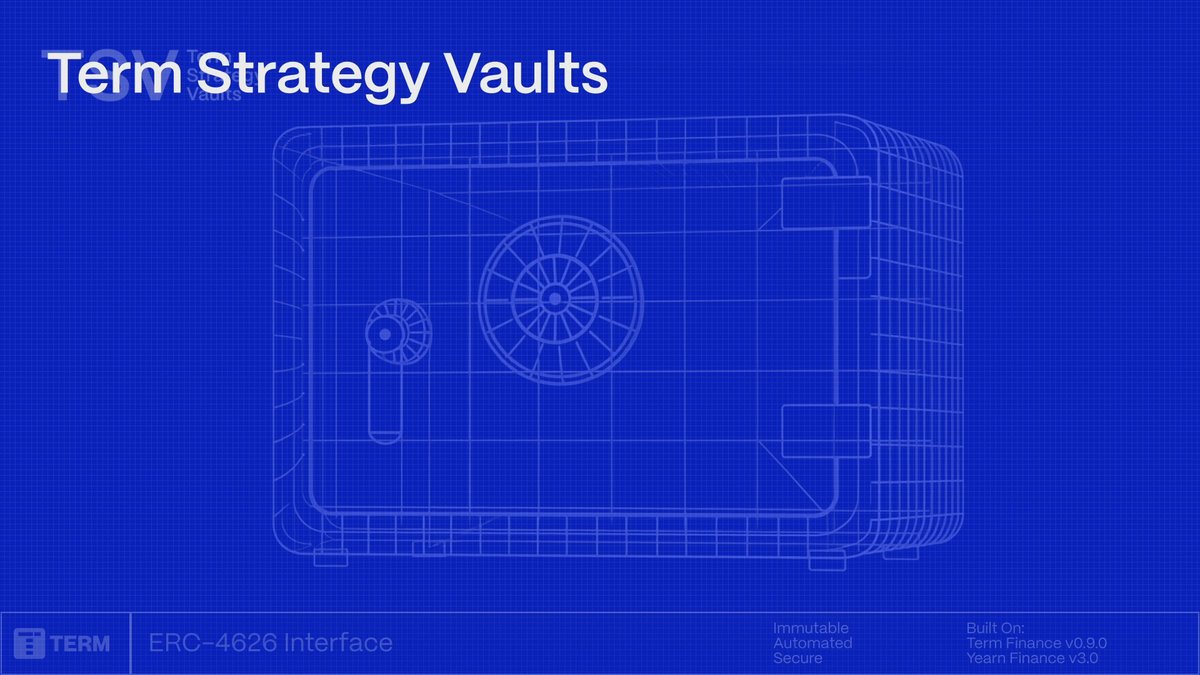
You experienced Term Auctions, you’ve signed the Blue Sheets, now it’s time to enter the Vault. Term Strategy Vaults are built on yearn V3, and are automated to make fixed-rate lending effortless. - Pick your strategy - Deposit your funds - Secure predictable yields Everything is audited, automated, and available for any user. Welcome to seamless DeFi, with Term. Let’s dive deeper 🧵 1/ What are Term Strategy Vaults? They’re automated DeFi tools that make fixed-rate lending effortless. Built on yearn V3, these vaults simplify liquidity management, reinvest earnings, and optimize risk-adjusted yields for passive investors. 2/ How does it work? Funds are re-balanced across lending positions while maintaining prudent portfolio risk controls: ▫️ Participate in Term Auctions & Blue Sheets. ▫️ Focus on fixed-rate lending = capital efficient and consistent yields. 3/ Why choose Term Strategy Vaults? 🔹 Automated lending + strict portfolio controls 🔹 Stable, reliable yields 🔹 Professional risk curation 🔹 Non-custodial + verifiable on-chain 4/ No expertise required! You deposit $USDC, $wETH, or other supported assets, and the vaults handle the rest. It's DeFi lending made simple. 5/ How secure is it? ☑️ Term Vaults are non-custodial. ☑️ Funds are locked in immutable smart contracts. ☑️ Protected by strict smart contract-enforced constraints. ☑️ Third-party audits reinforce safety. Your funds, your control. 6/ Who can benefit? Passive lenders who want set-it-and-forget-it lending. Yield hunters tired of inefficiencies in floating-rate protocols. Risk-conscious DeFi users who want professionally curated and tailored strategies, not a one-size-fits-all approach. 7/ Getting started is easy: > Pick a strategy based on your risk preference. >> Deposit your assets. >>> Relax while the vault optimizes yield. Why work harder when you can let your money work smarter? Start your Vaults journey →

Term Labs

632,651 次观看 • 1 年前

EXCLUSIVE: Robinhood is going to pay 7% on dollars to 27.7 million customers. In this Interview Johann Kerbrat, their SVP of Crypto explains how it all works. Robinhood Earn lives inside the main investing app. You can buy the USDG stablecoin in a few taps, and it gets deployed into vaults built with Morpho and Steakhouse, and the target yield is roughly 7%. Where does 7% come from? Market makers and liquidity providers pay it. These are traders who need USDG liquidity to run spot and perps trading. Your deposit is funding someone else's 50x leverage, and you're the one getting paid for it. Assuming you get paid back. Which, as we've seen, doesn't always work in DeFi with hacks and smart contract risk. But Robinhood has done something extra to make this retail-grade. Robinhood's answer is an insurance program with Lloyd's of London and Relm covering smart contract and vault failure. He says it's one of the largest ever built for a crypto product. Earn was one of 12 announcements; some others that caught my eye: Stock tokens in 120+ countries, backed 1:1 by real equities. You can withdraw them to a self-custody wallet and post them as collateral. Borrowing against a stock portfolio used to be a private banking perk; now it's a smart contract. Robinhood Chain went to public mainnet after 200 million transactions on testnet. Perps on stocks, crypto, and commodities at 20 to 50x leverage, bringing an entire new asset class to the mainstream. Robinhood is all in on DeFi. DeFi protocols spent a decade fighting for users. Robinhood just made a Morpho vault look like a savings account, in front of 27.7m funded customers. See the 15-minute highlights below and the full episode on the Tokenized Podcast youtube channel Full interview with Johann on bryton k. YouTube

Simon Taylor

344,896 次观看 • 19 天前

🎙️New pod just dropped! I sit down with my old friend Stani, Founder of Aave Labs, to deep dive into Aave v4 and its biggest updates compared to v3. This is Ep. 1 of a new series where I analyze the evolving architecture of onchain lending markets and their impact on DeFi. Just as onchain spot trading evolved from p2p models like EtherDelta to pooled AMMs like Uniswap v2—and now to modular designs like Uniswap v4, built as lower-level protocols for sophisticated actors to run custom strategies without fragmenting liquidity—lending is following a similar path. ETHLend struggled to scale its p2p fixed-rate lending approach and lacked sophisticated actors building on top of the protocol to abstract this complexity. Aave v1 introduced pooled liquidity, making it easier for retail users to borrow and lend using the same strategy dictated by the Aave DAO. Now, Aave v4 marks a new phase: a modular hub-and-spoke design for deploying bespoke credit markets. 🧩 Hubs = Capital allocators that determine rates & provide credit lines 🛠️ Spokes = isolated, configurable lending strategies that draw capital from a Hub Use cases range from RWAs to fixed-rate credit to looped LP vaults (e.g., strategies pioneered by Arrakis on Uniswap v3 + MakerDAO). Critically, Aave evolves from a vertically integrated DAO—the sole allocator of protocol capital—into a permissionless platform where institutions (e.g., BlackRock) and DAOs can co-allocate capital alongside Aave itself. This is the beginning of a modular credit layer for all of DeFi. 🎧 Listen here: 📺 Watch here: 📖 Aave v4 proposal:

Hilmar

26,014 次观看 • 1 年前

Today, we unlock a new era for onchain finance: one where treasuries are self-custodied, secure—and earning yield by default. For years, Safe.eth multisigs have been the operating system for DAOs, crypto companies and high-net-worth individuals, safeguarding well over $100B. Yet much of that capital – especially stablecoins – has stayed idle because moving funds to external DeFi apps compromises the very security and governance model multisigs were built to protect. Kiln 🧱🔥's mission is to democratize value creation in digital assets – embedding productive staking and lending directly into the tools treasury teams already use, rather than forcing them through new approvals, bridges and dashboards. That vision is now live in Safe {Wallet}. 🔹 One multisig transaction routes idle wETH, wstETH, USDC, USDT or WBTC into Morpho Labs Earn, powered by Kiln DeFi. 🔹 The Safe receives non-transferable vault-share tokens, so signer policies and audit trails remain intact. 🔹 Yield, Steakhouse Financial risk scores and fees appear beside existing balances – no extra API work required. Behind the scenes, Morpho Labs vaults keep capital productive while preserving instant liquidity, and Kiln delivers the end-to-end infrastructure, audits, and SOC 2 Type II controls institutions expect. This is the next frontier of crypto finance: where security and yield are no longer at odds. Where onchain treasuries can finally operate with the sophistication and confidence they deserve. I’m grateful to the teams at Safe.eth, Morpho Labs and Steakhouse Financial for sharing this product philosophy and executing on it so seamlessly. Excited wait to see what DAOs, startups and treasurers build on this new foundation. To anyone still doubting: the future of finance is being written in Europe—and these four teams are holding the pen 🇪🇺 Try it now 👇 Massive thanks to the ones involved lukasschor.eth, Thibaut 🍉Multis, Julian Grigo, Christoph Simmchen, Christoph Sonn, Florent - gecko arc, Paul Frambot 🦋, @MerlinEgalit, T, SebVentures, adcv_ & and everyone at Kiln who brought this to life (you know who you are)

Laszlo Szabo

13,246 次观看 • 1 年前

Chamath and Larry Summers Debate the Market Reaction to Trump's Tariffs Lawrence H. Summers: "If this is such a terrific thing, why do markets think it's so terrible for the American economy?" "Maybe the market's just completely wrong ... but the job of markets is to look forward." "It's to look passed the immediate." "It's to see what the long run consequences are going to be." "And markets are making a pretty devastatingly negative judgment on this step." Chamath Palihapitiya: " Larry, that's not true." " So let's just establish a couple facts about 'the markets.'" "Number one, there are two markets and they behave totally differently, and sometimes inversely to each other." "There's the stock market and there's the bond market." 1) Stocks: mean reversion "With respect to the stock market, what they are debating, and you're right Larry, is what is the effective long-term rate of return a dollar needs to generate in order to pay me back that dollar?" "That is what the fundamental stock market does." "And what we've seen for many years with trade imbalances, trade deficits, and close-to-zero interest rates, of which more of that happened under Democrats than Republicans, we have allowed the stock market to inflate past historical averages." " What we've actually seen happen in the last week is what most people would call mean reversion." "The stock market is still way above where it was last year, two years ago, three years ago." "What has happened is that the forward multiples have compressed. So that's number one. That's a fact." 2) Bonds: it's possible a major trade blew up "And then with respect to bonds, what we are seeing now is there are two very complicated issues." "In the last two days, we saw one part of the bond market totally get out of whack." "And what we know is that the yields changed materially in a very acute way, which is atypical of how the bond market typically digests a philosophical change in approach to policy." " What we heard in the last 24 hours is a lot of this move may have been attributed to an enormous levered bet on US treasuries by a Japanese hedge fund." " It will take three, and four, and five, and six weeks for us to really know." 3) Private credit: something to watch closely " Separately, what we do know, though, where the structural complexity of the market — and this is where, Larry, I agree with you — is acute and important to observe is in the credit markets for private companies." "And that is where you have to pay a lot of attention."

The All-In Podcast

98,290 次观看 • 1 年前

🚨🚨🚨BORDER HORROR: Border Expert Jaeson Jones explains how "Debt Bondage” works to Dr Phil: "What Americans need to know is that what I'm holding in my hand here today is America's new slave trade." This is a must-watch. Jones explains that children as young as 10 DAYS OLD come across the border with wristbands, how women are sold into sex slavery and how illegals are forced into criminal activity in the US. This is horrifying, and the Biden Administration is fine with it. JONES: “In the old days, the cartels didn't care where you came from, what country you came from to cross that river right there was $100 on average. But when we got overrun, they said we can send them throughout the country and we can keep them indebted to us for years, if not decades to come." "So they began collecting what we call their personal identifying information. And once they found out their country of origin, where they came from, their mothers name, their fathers, their home, their phone number. And then they figured out where they were going. They got a wristband." "Then their family's going to pay for it. Okay. So they're controlling getting this child across the river and they know the family roots of this child. And what do they do with that information? They hold them hostage. That's exactly right. Not only are they indebted on our side in the United States, but yet their family in the country where they came from can be held accountable." "This is a tectonic shift and their normal operation. So what are they doing to pay this off? How many of them have skill sets? Many of them don't. So now this is where many of the women are going to go into commercial sex. This is where many of the men are going to become burglars, robbers, drug dealers, all to pay these organizations in a foreign country."

Western Lensman

175,984 次观看 • 2 年前

🚨 WARNING: THE WORST DAY OF 2026 IS TOMORROW. JPMorgan is preparing to dump $165,000,000,000 into the market right at open. Thinking this won’t move the market? You’re in for the rudest awakening of your life. Every time JP Morgan sells stocks, the S&P 500 drops 10–20%. And this isn't just about the stock market. It's about liquidity. It's about investor sentiment. And it's about a market that isn't prepared for what's coming. Let me explain: JPMorgan isn't some retail trader taking profits. It's one of the largest and most influential financial institutions on the planet. When they move capital at scale, markets pay attention. And history shows that large institutional selling rarely happens in a vacuum. It usually signals something bigger. A shift in risk appetite. A change in liquidity conditions. Or growing concerns beneath the surface that most investors haven't recognized yet. Now here's the part almost nobody talks about. The direct impact isn't limited to the stocks being sold. Because when a major institution dumps billions of dollars worth of equities, it affects sentiment across the entire market. Selling creates more selling. Liquidity gets thinner. Volatility increases. And risk assets everywhere start to feel the pressure. That's why this isn't just an S&P 500 story. The S&P 500 is the first domino. But the effects will spread into AI stocks. International equities. Commodities. Credit markets. And even digital assets. Today, people are positioned for stability. They're positioned for higher prices. They're positioned for the rally to continue. Which means they're vulnerable if liquidity suddenly moves in the opposite direction. THIS IS THE WARNING. Not because one institution is selling. But because markets often underestimate what large-scale institutional selling can trigger. The risk isn't the transaction itself. The risk is how everyone else reacts to it. Markets aren't pricing that possibility today. But eventually, they will. I've spent more than a decade studying macro and market cycles. I've called some of the biggest market tops and bottoms of the past 10+ years. And I'll call the next market crash in 2026 before the crowd sees it coming. Follow and turn notifications on. I'll post my next market call here first.

WhaleTwits

340,625 次观看 • 1 个月前