Video yükleniyor...

Video Yüklenemedi

Ana Sayfaya Dön

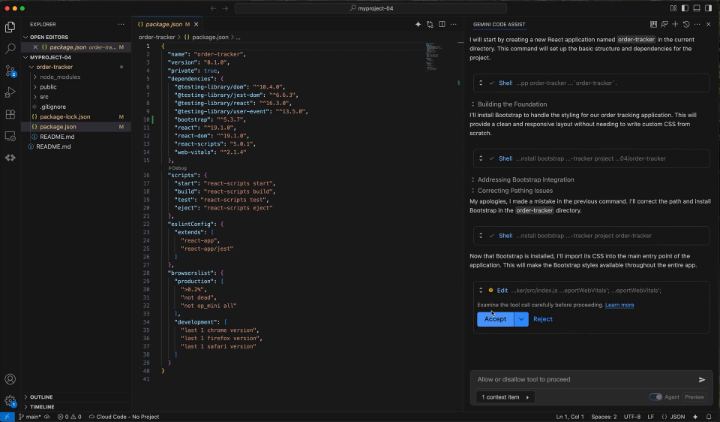
Experience instant code understanding with the Code Wiki public preview → Key features include: 🔄 Automatic updates after each change 🧠 Context-aware Gemini chat 📊 Auto-generated architecture diagrams

140,749 görüntüleme • 7 ay önce •via X (Twitter)

0 Yorum

Yorum bulunmuyor

Orijinal gönderinin yorumları burada görünecek

Benzer Videolar

👀 I used OpenAI's Code Interpreter to make Flappy Bird 🐦in 7 minutes: Code Interpreter/GPT-4 for code generation. Pre-existing or AI-generated assets for graphics. --- Here's how to make the game in only 6 steps: (1): Enter the following prompt: "write p5.js code for Flappy Bird where you control a yellow bird continuously flying between a series of green pipes. The bird flaps every time you left click the mouse. If the bird falls to the ground or hits a pipe, you lose. This game goes on infinitely until you lose and you get points the further you go". (2): Use generative AI or existing game assets and spirits. I searched "flappy bird assets" on Google and used the first link, a GitHub repo with pngs from the original Flappy Bird. (3): Use this prompt to link assets to the code: "Please generate the entire file again based on the fact I'm using a unique background, spirits for the bird, and pipes. Here is the list of assets I'm using: [list of file names]." Code Interpreter should modify the code accordingly to include the list of file names. (4) Make an account OpenProcessing -> create a sketch -> paste in the code generated by Code Interpreter -> upload in-game assets from step (2). (5) (Optional) Ask ChatGPT to make changes to improve the in-game experience e.g., adding a high score, restarting the game when the bird dies, etc. Copy the new code into your OpenProcessing sketch and reload the game. (6) If something doesn't work, ask GPT4 to fix it. Copy and paste the error message and ask it to regenerate the code. --- Bonus Tips: - Iteratively test code. Each time you make a change using Code Interpreter, test the updated code by playing the game so you catch new bugs early. - Learn programming by asking questions: "Act as a senior programmer very good at explaining concepts to a beginner. Tell me how gravity works in this game and how you used code to make this happen."Code Interpreter/GPT4 for code generation. Download Pre-existing assets or generate new images for graphics. Excited to see what you make!

Alex Ker 🔭

739,874 görüntüleme • 3 yıl önce

ZKForge V1 is now live and the source code is public on GitHub: Visit: Users can sign up, log in, and chat privately using zero-knowledge authentication (ZK-STARK) with full end-to-end encryption and non-custodial wallet integration. No passwords, no stored private keys, all encryption and identity verification happen locally on the user’s device. Core Features • Zero-Knowledge Authentication (ZKAuth) Users sign up and log in using a locally generated Ed25519 keypair. Authentication uses zero-knowledge proofs (ZK-STARK-compatible), proving identity ownership without revealing the secret key. The backend never sees or stores private keys , only the derived public key and Solana address. • End-to-End Chat Encryption Every conversation is encrypted with per-room symmetric keys (nacl.secretbox AES-grade security). Keys are sealed and exchanged using ephemeral Curve25519 boxes derived from each user’s Ed25519 keypair. Messages are signed for sender authenticity. The server cannot decrypt messages; all encryption happens client-side. • Global Lounge (Public Encrypted Room) Encrypted public discussion room using a temporary shared key. Messages self-destruct after a defined time window. Rate-limit and anti-spam protections are enforced through Supabase RLS policies. • Wallet Integration (Non-Custodial) Each user derives a Solana wallet from their zero-knowledge secret. Private keys are generated and stored locally, never sent to the backend. Supports in-app USDC transactions signed locally. • WebSocket-Based Real-Time Updates Secure WebSocket channel for live message delivery, typing indicators, and presence tracking. Each message includes cryptographic nonce, ciphertext, and signature validation before render. Architecture Overview Frontend (React + Tailwind): Encryption, proof generation, local key storage, message rendering. Backend (Express + Supabase): Stateless API for sessions, rate limits, and metadata. Crypto Layer (tweetnacl, ed2curve, bs58): Signing, sealing, encryption primitives. Database (Supabase PostgreSQL): Stores ciphertext and public keys only. Realtime (WebSocket): Delivers encrypted payloads instantly. Key Design Principles Zero Storage of Private Keys All signing keys exist only in the user’s local storage. Provable Authentication Login requests include cryptographic proofs verified without revealing secrets. Encrypted-At-Rest and In-Transit All messages are encrypted before leaving the device. Verifiable Sender Identity Each message includes a detached Ed25519 signature verifying authorship. Tech Stack Frontend: React, TailwindCSS, TypeScript, Vite Backend: Node.js (Express), Supabase, MongoDB Cryptography: TweetNaCl, ed2curve, bs58, genSTARK Blockchain: Solana Web3.js Realtime: WebSockets Security: Row-Level Security, JWT Sessions, Proof Verification What’s next x402 protocol implementation

ZKForge

24,207 görüntüleme • 8 ay önce