Video wird geladen...

Video konnte nicht geladen werden

Zur Startseite

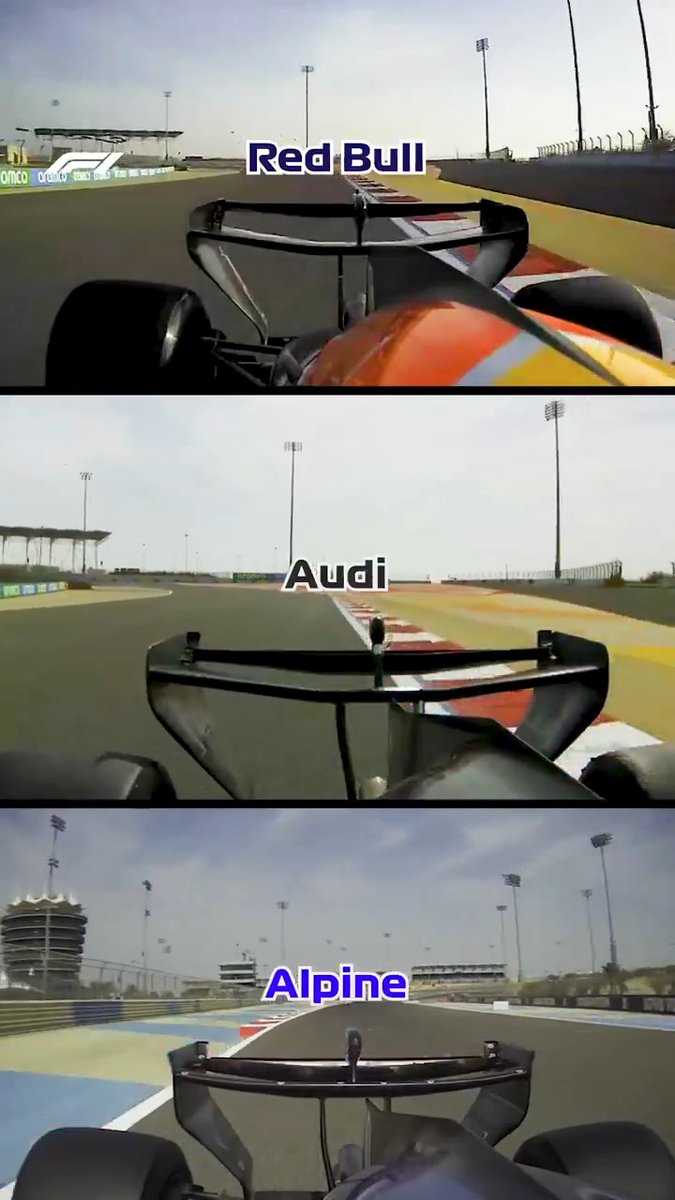
F1 2026 Overtaking Systems 🔋 Boost button: Extra electrical power from the battery 🪽 Active aero: Front & rear wings switch to low-drag mode Thoughts?

748,191 Aufrufe • vor 6 Monaten •via X (Twitter)

0 Kommentare

Keine Kommentare verfügbar

Kommentare vom Original-Post werden hier angezeigt

Ähnliche Videos

This is why Tesla makes the safest vehicles in the world: • All Tesla models have received five-star safety ratings from the National Highway Traffic Safety Administration. • Built from the ground up with an all-electric architecture, resulting in low rollover risk and reduced occupant injury probability. • Uses anonymous/aggregated real-world data from millions of miles driven to enhance safety via over-the-air updates and inform future vehicle designs. • Battery packs designed to isolate and vent heat away from the cabin; historically (2012–2020 U.S. data), Tesla vehicles ~10x less likely to experience fire per mile than average gas vehicles. • Before a crash occurs, Tesla uses the front cameras to observe the scenario and prepare the seat belt system to react faster and with adequate force and timing when impact occurs, reducing the amount of slack in each seat belt. • Tesla’s advanced airbags are tuned to deploy according to crash type and different-sized occupants. This includes active venting that changes the amount of pressure within the inflated cushion by releasing gas according to the expected crash severity. • When a serious collision is detected, the hazard lights will turn on to increase your visibility and doors will automatically unlock for emergency access. At the same time, your Tesla will automatically contact emergency services to get help to you as quickly as possible. • Tesla vehicle structures are designed to cushion and protect the battery in the event of an accident. Onboard systems will automatically disconnect the high-voltage battery upon impact. If a battery fire does occur, the battery pack is designed to spread heat away from the cabin to protect occupants.

Nic Cruz Patane

74,333 Aufrufe • vor 7 Monaten

🚨 SCIENTISTS JUST BUILT A CHIP THAT CAN SEE, THINK, AND REMEMBER ALL AT THE SAME TIME. And it works more like a biological brain than a traditional computer. Researchers at RMIT University have created a neuromorphic vision chip that mimics the human eye and brain. Unlike conventional systems that capture images and send data to external processors, this chip performs sensing, processing, and memory storage directly where the light hits. The active layer is thousands of times thinner than a human hair. It uses doped indium oxide to detect light, process the information on-chip, and retain what it sees over time without constant electrical refreshing. Why this matters: • It dramatically cuts energy use and latency by eliminating data transfer to separate processors • Enables much faster real-time decision making for autonomous systems • Works more like biological vision than traditional machine vision • Could power the next generation of efficient edge AI in vehicles, robots, and remote sensors The deeper implication: For decades, we’ve built vision systems by bolting cameras, processors, and memory together like separate organs. This chip collapses those functions into one biological-style unit. It’s a step toward machines that don’t just “see” but actually perceive and remember in a more efficient, brain-like way. If scaled successfully, it could become a foundational component for autonomous systems that need to operate intelligently with minimal power and minimal delay. We’re moving from cameras that take pictures to chips that truly see. How do you think neuromorphic vision chips like this will change what’s possible for self-driving cars and autonomous robots? Follow for more frontier neuromorphic computing, AI hardware, and brain-inspired technology.

TheNewPhysics

23,196 Aufrufe • vor 1 Monat

‼️🇯🇵🇨🇳 BREAKING - Due to the threat from China, Japan will allocate an additional $5.4 billion in its 2025 budget for missiles and ships. Japan’s government has approved an additional $5.4 billion in 2025 to purchase extra ships and anti-ship systems. The corresponding document was published by Japan’s Ministry of Defense. The supplementary budget is allocated separately from the main defense funding. Specifically, $370 million is allocated for the acquisition of SSM-2 anti-ship missiles and Type-12 coastal defense missile systems. It is noteworthy that the missiles planned for delivery are not long-range versions — their maximum range will be up to 250 km. Japan will also purchase Type-03 Kai medium-range surface-to-air missile systems. The systems will be deployed on Yonaguni Island, located about 110 km from Taiwan. In total, Japan’s Ministry of Defense plans to acquire 29 batteries of the new surface-to-air missile systems. At the same time, about $800 million will be directed primarily toward accelerating orders for the construction of military vessels — specifically, multi-purpose frigates and submarines. In addition, part of the budget will accelerate purchases of UH-2 multi-role helicopters produced by Subaru. It should be recalled that the adjustment of Japan’s military budget is taking place in the context of the threat coming from China, especially following the national-security comments of Prime Minister Sanae Takaichi, who emphasized that a Chinese attack on Taiwan would threaten Japan itself, and that Tokyo might become a party to this conflict. For this reason, China has intensified its propaganda campaign, accusing Japan of returning to militarism and imperialist approaches. Moreover, in recent days, incidents involving increased activity of Chinese forces near Japanese territory have become more frequent. In response to China’s increased violations of Japan’s borders, both at sea and in the air, Japan’s Ministry of Defense announced the deployment of Type-03 air-defense batteries and electronic warfare systems on Yonaguni Island, 110 km from Taiwan — a move that sparked even greater dissatisfaction in Beijing. Japan’s multi-billion-dollar special boost, aimed at rapidly strengthening its military capabilities, suggests that geopolitical tectonic shifts may soon begin in East Asia and across the Indo-Pacific basin. Furthermore, the strengthening of Yonaguni Island — and Japan’s effort to turn it into an “unsinkable aircraft carrier” — signals that Japan does not intend to passively wait while China begins its struggle for state hegemony through the use of hard power, which would primarily affect neighboring states. See the latest updates with us: Visioner

Visioner

127,878 Aufrufe • vor 7 Monaten

Why Jamming the Venezuelan Systems Is Unlikely Well, when I hear about jamming in Venezuela, I immediately picture the Americans talking about the EA-18G Growler with the NGJ. The NGJ is specifically designed to degrade advanced Russian radars, with high power and directional AESA beams. To cover an area the size of Caracas would require multiple squadrons, and there were indeed a lot of birds in the sky, but… jamming such a large area with diverse systems on high alert is extremely complex and improbable. The radars of the S-300VM use rapid frequency hopping to avoid continuous jamming, along with LPI modes that reduce the radar’s signature, making it difficult for jammers like the NGJ to detect and interfere. The Buk-M2 has similar ECCM capabilities, with high resistance to noise jamming. This isn’t to say the Americans can’t do it, but sustaining it continuously across so many dispersed batteries is unlikely. Additionally, both the Buk-M2 and the Pechora-2M have electro-optical/TV/IR channels as backups, allowing tracking without active radar in heavy jamming scenarios. If they were being operated, it would have been impossible for those helicopters to fly over Caracas. And finally, systems like the S-300 have Home-on-Jam (HOJ) capability, a mode in which the missile is fired directly at the jamming source (electronic interference) as a passive target. With so many aircraft in the sky, I’d say it would be impossible to shut down all the radars in perfect synchronization against a hypersonic missile. Lastly, there are the MANPADS that were not used. We saw helicopters flying extremely low with no reaction whatsoever from MANPADS, which would have been effective in that situation. Well, this has nothing to do with jammers and everything to do with orders not to fire. I’m not here saying that American EW with F-35 + Growler + NGJ cannot overcome these defenses in some scenarios, but rather stating that, given the scale and the conditions, it is unlikely that this is the reason for the silence of the Venezuelan air defenses.

Patricia Marins

386,162 Aufrufe • vor 6 Monaten

Seedance 2.0 on Haimeta is next level. It doesn’t even look AI-generated anymore, it looks filmed. Prompt: FORMAT: 15s / 180 BPM / ONE CONTINUOUS SHOT / 360 POV downhill stair run, viral energy, max chaos SUBJECTS: First-person cyclist, handlebars and front wheel flashing low in frame during drops and hard turns. Vendors, laundry, scooters, dogs, chickens, cars, and pedestrians erupt around the rider as sudden obstacles. ENVIRONMENT: Dense Brazilian hillside streets, painted concrete stairs, tight landings, tiled corners, hanging wires, murals, awnings, puddles, hot late afternoon light, deep alley shadows, city sprawling below. MOOD: Adrenaline, max chaos, and nonstop street speed with violent spatial intensity in every direction. COLOR LOGIC: Hyperreal Pop Look CAMERA DETAILS: 360 action-cam POV, horizon-stable but brutal, nonstop forward drive, minimal roll, heavy stair vibration, sharp side and rear parallax, full-sphere chaos, no release. TIMELINE: 0:00-0:03: POV freefalls down a steep stairwell. The front wheel punches over the first steps, bars jackhammer below frame, the whole sphere shuddering with every hit while a child lunges in from the left to yank a rolling soccer ball out of the rider's line and walls, rails, balconies, and faces whip past on both sides. Violent forward descent with brutal stair vibration. SFX: (city hum, distant funk beat, tire chatter, breath, rapid stair hits, frame rattle). Hard sun above, deep shadow pockets below. 0:03-0:05: POV slashes left across a tiny landing, skips a broken crate, and drops again as laundry cracks across the front hemisphere, shoulder missing painted concrete by inches while side-wrap onlookers recoil. Hard lateral shake, immediate snap back into the stair run. SFX: (cloth slap, skid, crowd shout, chain buzz, stair chatter). 0:05-0:08: POV hammers the next staircase as a stray dog cuts center frame and startled chickens burst upward from the side steps, wings flaring across the sphere. The rider flicks the bars, rear wheel skates loose, then needles between a fruit cart and handrail with almost no clearance while the sphere jitters from every stair impact. Fast vibrating continuous-shot chaos. SFX: (tire chirp, crate clack, wings flapping, squawks, paw skitter, stair thuds, bass from window, metal rattle). 0:08-0:10: POV blasts out of one stair run, skips across a short asphalt gap between two stair sections without slowing, slams the opposite curb, and drops straight into the next descending steps. Only once the rider is fully back on the stairs do horns burst behind while passing cars rip through the side wrap. Full-speed crossing with strong lateral parallax and zero release. SFX: (engine idle, tire buzz, chain rattle, curb thump, car horns behind). 0:10-0:13: POV keeps attacking the next stair section immediately after the asphalt gap, machine-gunning through two tight landings and another steep stepped lane, every hit punching a fresh jolt through the sphere as stacked homes, wires, and alley mouths curl around the viewer and the overlook rushes closer. Forward lunge with impact drive and nonstop shake. SFX: (air rush, heavy thump, stair chatter, horn echo fading, chain lash, wind buffeting). 0:13-0:15: POV rips through the final stepped approach to the overlook and throws the rear wheel into a savage sideways skid, dust and gravel spraying across the lower frame while stair-lined drops fall away to both sides and the skyline blooms around the entire sphere in one fast violent sweep. The bike stays hot through the slide as the city fills every direction. SFX: (rear tire screech, gravel spray, freewheel spin, city roar, music drop)."

Iqra Saifi

25,727 Aufrufe • vor 3 Monaten

💥 The Chinese authorities have known for 4 years that a pilot of a China Eastern Airlines jet — flight MU5735 — deliberately crashed the aircraft, killing all 132 aboard, according to data from the US. The data, released by the 🇺🇸 National Transportation Safety Board (NTSB), confirms earlier leaked US accounts that Flight 5735, a Boeing 737, was intentionally crashed into mountains in Guangxi in Mar 2022. The NTSB readings from the flight recorders show two pilots wrestling over the controls after both engines were shut down by hand, the automatic pilot was switched off and the jet was pushed into a nosedive as it cruised between Kunming and Guangzhou. In the face of public anger, Beijing has failed to publish a report. Last July the Chinese Civil Aviation Administration responded to an inquiry with a warning that “disclosure [about the crash] may, if released, endanger national security and social stability”. Beijing is under pressure from international aviation organizations to come clean over the disaster, which appears to have followed a similar pattern to suspected murder-suicide acts by airline pilots that have killed hundreds since 2014. The NTSB was asked to decode the flight recorders of Flight 5735 and transmitted its readings to China two weeks after their recovery in 2022. The US agency released extracts from its findings on Thursday in response to a Chinese citizen’s freedom of information request. “It was found that while cruising at 29,000ft, the fuel switches on both engines moved from the run position to the cut-off position,” the NTSB said. “Engine speeds decreased after the fuel switch movement.” Graphs of control inputs and the aircraft’s movement showed a pilot’s yoke pushing the aircraft into a steep dive and efforts by the other pilot to halt the dive. The two pilots were turning their yokes in opposite directions, commanding left or right rolls from the ailerons on the edges of the wings. The report said that a power failure had halted the data recorder after 90 seconds but the battery-powered crew voice recorder had continued. The agency did not reveal the contents, which it transmitted to Beijing at the time and said it had not stored a copy. Video from the ground showed the Boeing plunging vertically. The crew made no radio calls and no emergency radar code was transmitted. Previous Chinese reports have said that all systems appeared to have been functioning normally. Two months after the crash, a US investigator said “the plane did what it was told to do by someone in the cockpit”. China removed all references to that report, including screenshots, from social media. Three pilots were on the flight deck. Captain Yang Hongda, Zhang Zhengping, the first officer, and Ni Gongtao, a second officer in training. Speculation in China has centred on Zhang, one of the airline’s most experienced pilots, who had recently been demoted from his captain’s rank.

Byron Wan

348,300 Aufrufe • vor 2 Monaten

The difference between SEALSQ silicon-based spin-qubit QPUs and quantum processors built on superconducting circuits or trapped ions comes down to physics, manufacturability, and long-term industrial scalability. SEALSQ’s approach uses electron spins confined in silicon semiconductor structures—essentially quantum dots fabricated with CMOS-compatible processes—where the qubit is the spin state of an electron rather than a macroscopic electrical current or a free ion. This makes spin qubits orders of magnitude smaller, potentially allowing millions of qubits on a single silicon wafer, and critically aligns the technology with existing semiconductor fabs, supply chains, and design tools. In contrast, superconducting qubits rely on exotic materials and microwave resonators that are physically large, wiring-heavy, and difficult to scale beyond a few thousand qubits without massive cryogenic and control overhead. Trapped-ion systems achieve excellent qubit coherence but depend on ultra-high vacuum chambers, precision lasers, and optical alignment, making them closer to scientific instruments than manufacturable chips. Silicon spin qubits also benefit from long intrinsic coherence times (especially in isotopically purified silicon), low power dissipation, and a natural path to tight integration with classical control, cryogenic electronics, and security primitives—an area where SEALSQ’s semiconductor and hardware-security DNA becomes a strategic advantage. The trade-off is that spin qubits are technically harder to control at the single-qubit level and are earlier in large-scale deployment than superconducting systems, but if solved, they offer the most credible route to industrial-scale, cost-effective, secure quantum processors, rather than lab-scale demonstrations.

Carlos Creus Moreira

19,616 Aufrufe • vor 5 Monaten

The Russian FAB-3000 with Extended 200 km Glide Kit: A Devastating Precision Weapon The FAB-3000, or Fugasnaya Aviabomba 3000, represents one of Russia's most formidable unguided aerial bombs from the Soviet era, now revolutionized by modern glide kits. Originally developed in the 1950s as a high-explosive demolition weapon, the FAB-3000 weighs approximately 3,000 kilograms (6,614 pounds), with a length of 3.84 meters and a diameter of 680 millimeters. Its warhead contains about 1,370 kilograms of TNT or a similar high-explosive filler, capable of generating a blast radius exceeding 200 meters and penetrating up to 1.5 meters of reinforced concrete. Designed for strategic bombing, it was historically dropped from heavy bombers like the Tu-22M3, but its revival in contemporary conflicts stems from integration with advanced guidance systems. The key transformation comes from the Universal Module for Planning and Correction (UMPK), a tail-mounted kit produced by Russia's Bazalt Design Bureau. The standard UMPK equips the bomb with folding wings spanning up to 3 meters when deployed, a streamlined fairing for aerodynamic stability, and a satellite-navigation system using GLONASS for mid-course corrections. This converts the inert FAB-3000 into a standoff glide bomb, extending its effective range from a mere free-fall drop to 50-60 kilometers when released from altitudes of 5,000-12,000 meters. Guidance achieves a circular error probable (CEP) of 10-30 meters, allowing strikes on bunkers, fortifications, and urban targets with minimal collateral risk compared to unguided variants. The kit adds roughly 200-250 kilograms, including control surfaces and inertial sensors, and is compatible with Su-34 fighter-bombers, which carry it externally on the centerline pylon. Recent upgrades have pushed the envelope further with the jet-powered UMPK-PD variant, achieving an extended range of up to 200 kilometers. This iteration incorporates a compact turbojet engine—sourced from commercial Chinese suppliers like the SW800Pro-Y—mounted in a tubular rear section, providing thrust for powered gliding. The design features enhanced aerodynamics with a curved, sloping tail and lighter composite materials, reducing drag by 20-30%. A 12-antenna controlled reception pattern antenna (CRPA) array bolsters resistance to electronic warfare jamming, ensuring reliable terminal guidance even in contested airspace. Released from high altitudes, the bomb rotates 180 degrees post-drop, deploying wings and igniting the engine for sustained propulsion, reaching speeds of 800-900 km/h. In operational terms, the FAB-3000-UMPK-PD has been combat-tested in eastern Ukraine since mid-2025, targeting deep rear-area logistics and command nodes. Its 1.4-ton explosive yield can level multi-story buildings or crater runways, while the standoff capability shields launch aircraft from ground fire. Production ramps up at facilities like the Izhevsk Mechanical Plant, with monthly outputs exceeding 500 units. However, challenges persist: the bomb's mass limits fuel efficiency, capping practical range at 150-180 kilometers under load, and vulnerability to advanced air defenses remains a concern. Nonetheless, this evolution underscores Russia's shift toward affordable, mass-produced precision munitions, blending Cold War brute force with 21st-century lethality.

𝐃𝐚𝐯𝐢𝐝 𝐙 🇷🇺🇮🇪

45,498 Aufrufe • vor 8 Monaten

Iran’s Post-War Air Defense: Changes in System Integration and Deployment Tactics The 12-Day War, marked by Israeli air superiority, prompted accelerated reforms in mobility, autonomy, and hybrid integration in Iranian air defenses, particularly in their long-range battery, the Bavar-373. 1. Hardware Changes - Miniaturization and Autonomy (TELAR): The Babar-373-II now integrates AESA radars into each launcher, eliminating cables and vulnerable central radars, enabling independent operations. The range is 300-400 km for large targets and about 85-150 km for stealth fighters. - New Sayyad-4B+ Missiles: Featuring dual seekers (active radar and IR), extended range (300-400 km), and a focus on counter-stealth, Iran believes these new missiles can overcome jamming and past failures against drones heavy drones. - Integration of the Arman System: This is Iran's equivalent to AEGIS, covering medium-range defense (up to 120 km) in self-sufficient vehicles. Investments improved setup agility to just 3 minutes; moreover, if links fail due to satellite disruptions like last year, both the Bavar-373-II and the 15th Khordad can continue operating autonomously. This was a major issue for Iran that caused blackouts in their air defenses. - Surveillance Drones as "Flying Radars": Models like the Mohajer-10 and Karrar conduct patrols and transmit data via satellites (BeiDou), allowing passive detection and keeping radars off until engagement. 2. Tactical Changes - Radar Ambush (Passive Tracking): The implementation of modern sensors was another shift. Now, optical/IRST sensors and drones detect targets; radars activate only for seconds to lock on, reducing exposure to counter-attacks. - Geographic Dispersion: This autonomy allows units to spread across 10-15 km² in tunnels and civilian sheds, emerging only after drone alerts and integrating with smaller systems for layers resistant to saturation. It seems Iran is attempting an interesting tactic that could work if cyber elements don't cause issues. - Radical "Shoot-and-Scoot" Mobility: I've never seen this tactic with long-range air systems before, but Iran claims repositioning in under 4 minutes, with logistics for remote reloads, transforming this system tactically like MLRS or artillery. 3. Post-War Comparative (2025 vs. 2026) Comparing configurations before and after the war, in 2025 connections relied on physical cables and centralized infrastructure, while in 2026 it adopts wireless datalinks with independent launchers, seemingly built with Chinese assistance. Dependency evolved from a giant, vulnerable search radar to a hybrid sensor network incorporating drones, IRST systems, and satellites. Reaction time, which previously took a long time to move the entire battery, is now reduced to under 4 minutes for the first vehicle to depart. Finally, the target focus shifted from conventional missiles and aircraft to advanced threats, such as counter-stealth, counter-drones, and, according to them, even hypersonic missiles. 4. Persistent Fragilities - Slow Reload Logistics: Missile reloading takes 30-60 minutes with cranes, exposing them to orbital surveillance. However, all heavy batteries are like this. - Datalink Vulnerability: Although Iran has strong link protection technology as seen in drone, it has limits against interference, and the number of American assets dedicated to this indicates that jamming or hacking loads won't be small. - Massive Thermal Signature: Heat from the chassis detectable by LEO satellites is another vulnerability that would also nullify camouflage, but it's the same with every system. - Radar Horizon vs. Cruise Missiles: The truck-embedded radar has a short tracking radius of 35-45 km, with a brief reaction against low-altitude or terrain-masking threats, which in certain situations could favor Tomahawks.

Patricia Marins

69,042 Aufrufe • vor 5 Monaten

🔄 Ever wondered how a substation “understands” electricity? Currents flow. Voltages fluctuate. Temperatures rise. But protection relays don’t read analog waves — they read numbers. Before a breaker trips or an alarm appears on SCADA, an invisible process converts raw electrical signals into digital intelligence. That silent hero? Analog-to-Digital Conversion (ADC). Let’s break it down step by step 👇 📡➡💻 From Analog Signal to Digital Decision 1️⃣ Low-Pass Filtering (Anti-Aliasing) ⚙️ Purpose: Remove high-frequency noise before sampling. Why? If unwanted frequencies enter the ADC, they cause aliasing — distortion that corrupts measurements. 💡 Clean input = accurate digital output. 2️⃣ Sampling 📉 The continuous analog waveform is captured at fixed time intervals. Sampling rate matters. Too slow → information loss. Too fast → unnecessary data overload. In power systems, sampling is often synchronized with system frequency (50/60 Hz). 3️⃣ Quantization 🪜 Each sampled value is approximated to the nearest discrete level. Resolution depends on ADC bits: • 8-bit → 256 levels • 12-bit → 4096 levels • 16-bit → 65,536 levels Higher resolution = finer accuracy in current and voltage measurement. 4️⃣ Encoding 🔢 Quantized values are converted into binary form. Example: Analog value → Quantized level → 110010 Now the signal is no longer a waveform — it’s data. 5️⃣ Digital Output 📲 The binary stream is transmitted to: ✔ Protection relays ✔ IEDs ✔ RTUs ✔ SCADA systems From here, algorithms detect faults, measure harmonics, calculate power, and trigger protective actions. 🧠 Without accurate ADC: ❌ Protection misoperations increase ❌ Fault detection becomes unreliable ❌ Automation decisions degrade With precise ADC: ✔ Real-time protection ✔ Advanced fault diagnostics ✔ Accurate metering ✔ Seamless IEC 61850 integration Every digital substation depends on clean, time-synchronized data. ⚡ From a simple CT secondary current to a breaker trip command — it all begins with precise sampling and conversion. Next time you analyze disturbance records or SCADA logs, remember: Behind every number lies an ADC working in microseconds.

Taha Alasemi | طه العاصمي

24,417 Aufrufe • vor 5 Monaten