Video wird geladen...

Video konnte nicht geladen werden

Zur Startseite

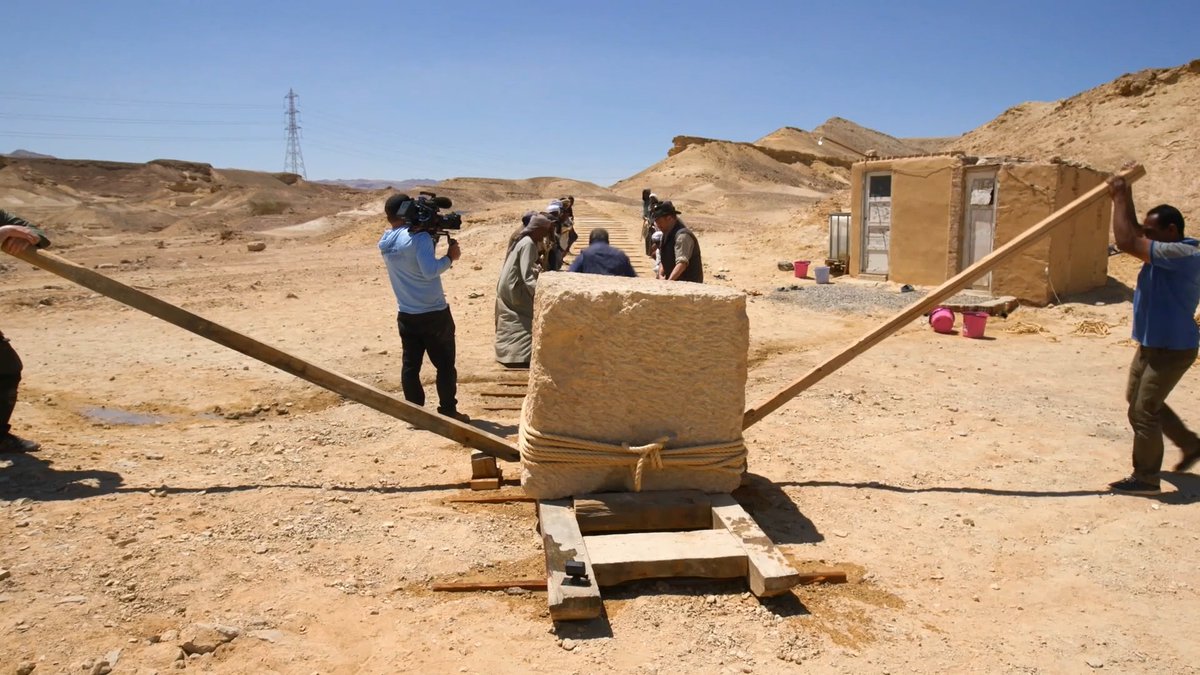
Feel like having your mind blown? 🤯 This replica Moai StatuešŸ—æis only 5Tons (10,000lbs), and was moved just 100 meters. šŸ“YET, the Egyptians inexplicably transported the 1,000 metric tonne (2.2M lbs) Ramesseum Statue 170 miles! šŸ“That’s 220X HEAVIER than this Moaiā€¼ļø Something tells me that the Egyptians didn’t toggle...

67,258 Aufrufe • vor 1 Jahr •via X (Twitter)

11 Kommentare

Profilbild von Jimmy Corsetti
Jimmy Corsettivor 1 Jahr

šŸ“Another way of putting it: This Moai statue is 220X LIGHTER than the Heaviest Egyptian statue… …and the Egyptians moved the 220X HEAVIER statue nearly 2,300X the distanceā€¼ļø Think about that 🤯

Profilbild von Thinborne
Thinbornevor 2 Jahren

RT @UniverseIce: Yo, @thinborne is the new king of aramid fiber (600d) cases. They're super thin, have Magsafe, and come with a free temper…

Profilbild von The Stone-Nub Language
The Stone-Nub Languagevor 1 Jahr

Size comparison shows the walking method to be false.

Profilbild von Jimmy Corsetti
Jimmy Corsettivor 1 Jahr

Thank you for sharing this!! Yes, they need to test the method on the tallest Moai to demonstrate it could be done.

Profilbild von 3MIKE
3MIKEvor 1 Jahr

The thing is, the statues of Easter Island are much taller.

Profilbild von Jimmy Corsetti
Jimmy Corsettivor 1 Jahr

This replica Moai is 10ft tall, whereas the Ramesseum statue is 60ft tall. The avg height of the Moai is 13ft, with the largest at 33ft.

Profilbild von C. Hunter McConnell šŸ‡ŗšŸ‡² (This Is/Ridiculous)
C. Hunter McConnell šŸ‡ŗšŸ‡² (This Is/Ridiculous)vor 1 Jahr

It's not as hard as you might think. Most of your colossal statues in Egypt were probably moved via a "fulcrum" method where they set the statue on its back and used a pivot point, like a smaller hard rock, quartz for example, and just spun it around on that point, fairly easily. I will add a video that elaborates from an amateur researcher, Wally Wallington.

Profilbild von Jimmy Corsetti
Jimmy Corsettivor 1 Jahr

Do you really consider that method feasible over a distance of 170 miles? Btw, Wally used his fulcrum on a concrete foundation.

Profilbild von scrumpyjobe
scrumpyjobevor 1 Jahr

I thought they were bigger, with most of the Moai Statue underground ?

Profilbild von Fanta
Fantavor 1 Jahr

That'd explain how they moved them, except their replica only represents the visible part of the Moai

Profilbild von Texblonde2023
Texblonde2023vor 1 Jahr

Yeah, nothing about the building of pyramids makes sense!
Ƅhnliche Videos

Bear with me while we dive into the math here… let’s start out with the King’s Chamber in the Great Pyramid. Now the King’s Chamber is a rectangular room, but upon closer examination you’ll notice it’s also a perfect double-square. Now before we begin, academia has confirmed that the ancient Egyptians’ knowledge of mathematics was fairly rudimentary, and they had NOT discovered pi (Ļ€) nor phi (φ), commonly referred to as the golden ratio. Remember, phi is a ratio between two numbers that is endless and exhibits incredible mathematical properties (permeating throughout all nature). As a ratio system, we can use phi in all it’s variations—including it’s square and square root—and still preserve these unique properties. The same goes for pi. See below, we’ll come back to these in a bit: Ļ€ = 3.14159 | φ = 1.61803 Getting back to the King’s Chamber, the short side of the rectangle (or the width of the room) measures 5.236 meters. The length of the rectangle measures 10.472 meters. Now take 5.236 x 2 + 10.472 x 2 (which would be the perimeter of the chamber floor or ceiling) and you get 31.416 meters. That gives us Ļ€ x 100. Interesting… let’s keep going. Again, let’s take the width of the rectangle of 5.236 meters and add φ^2 (1.618^2 = 2.618). Now, we’ll add 5.236 meters + 2.618 meters = 7.854 meters. Now the diagonal measurement from the bottom corner to the top corner of one of the faces at either end of the rectangular chamber is… 7.854 meters. Wow. Let’s continue. Now we’ll again add 2.618 (φ^2) to 7.854 which then equals 10.472 meters. Hmm… If you recall, 10.472 meters also equals the length of the rectangle. And again let’s add φ^2 + 10.472 = 13.09 meters. 13.09 meters also exactly measures the length from the upper corner of the King’s Chamber to the lower corner on the opposite-side of the room. Now for the kicker. NONE of this would occur in METERS (or any derivation of the metric system) if the room were ANY other size, even if the proportions remained the same. Remember, the meter was derived in the late 18th century and is based on the meridional circumference of the Earth at its poles. Academia tells us the Egyptians had no knowledge of the world as a globe… Academia also tells us they had no knowledge of Ļ€ nor the golden ratio. How then were they able to achieve the extraordinary metric proportions of the King’s Chamber? šŸ¤” ā€œThe important thing is not to stop questioning. Curiosity has its own reason for existing. One cannot help but be in awe when he contemplates the mysteries of eternity, of life, of the marvelous structure of reality.ā€ — Albert Einstein

Therion

399,290 Aufrufe • vor 3 Jahren