Video wird geladen...
Video konnte nicht geladen werden
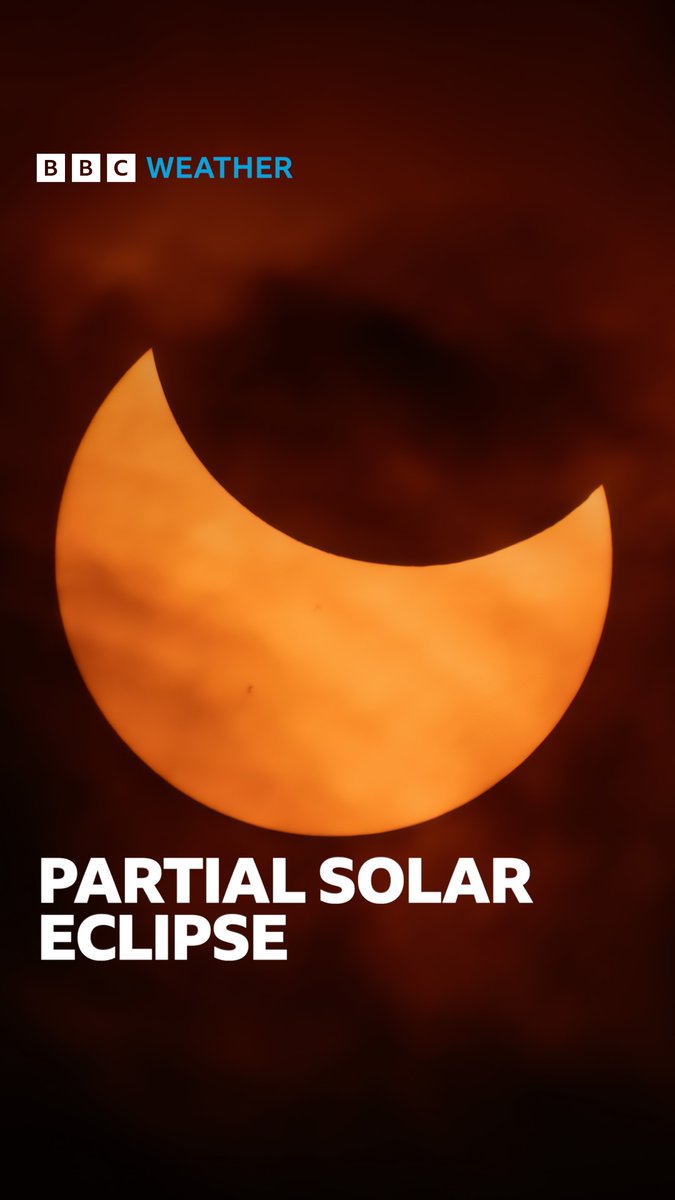
Finally spent enough local compute to process the partial recording of partial solar eclipse last week. This eclipse is too close to horizon, so you get all the clouds you (don't) want. But you can still pull things out! Full + specs:

108,880 Aufrufe • vor 1 Monat •via X (Twitter)
30 Kommentare

So cool, imagine if we could always see the texture of the sun. The giant dark spot and the arcs of plasma wooww. Was this streak a plane flying through?

Yes, clouds are annoying. When you average the near frames (stack them), the clouds become blobs of intensity noise. Contrast enhancement makes the blobs more vivid. The trail is from the airplane; it was averaged out, but it is there on a single frame:

If you speed up the video you can actually see the suns rotation which is absolutely incredible to imagine during an eclipse
Sun indeed visibly rotates in relatively short time: >0.5 degrees per hour. It is perhaps more clearly visible at full-disk timelapses, like this one:

Why does the boundary look brighter?
Contrast enhancement techniques -- local histogram equalization and inverted contrast curves -- are commonly used to pull the faint prominences out of the dark and enhance disk features. Both conspire to make the edge of the limb look brighter, giving it "prominence" treatment.

PERFECTION 🗣️

Taumoeba eat sun

Why is there a 'lighter' line following the moons edge? what is the physics behind that?

@tagir_valeev Что за вспышка слева сверху? Её даже айфон увидел.

Incredible. What are the chances that our single moon would be just the right size and right distance to be able to produce full eclipse?

That's great

I only just realised that solar flares actually stick around for quite a long time...

Remarkable detail. My Newtonian rarely gives me solar views this steady. Dedicated H-alpha rigs clearly handle the seeing better. What telescope and etalon setup captured this?
Specs are at Astrobin link in the original tweet. This is effectively lucky imaging, with lots of processing to stabilize the image by stacking only the good frames and aligning stacked frames to avoid inter-frame wobble.
Lucky imaging explains the clarity. How many frames made it through? My Newtonian barely handles lunar stacking, so solar must be a headache.
AstroBin has metadata :) Less than 30% survived, if you count all the multi-stage filtering. But that's because my FPS was intentionally capped, so it samples across multi-second window; otherwise I would have deal with significantly wider bad seeing windows, throwing away >90%.

Aside: you can see post-eruptive loops almost frozen. The recordings of those typically shown are pictures taken over longer period of time. In fact the plasma there moves and that quite fast, but at this scale its invisible. Those are larger than the earth by a magnitude.

😲

Very nice vídeo. It's a pity you couldn't see the total eclipse. There is a huge difference. I wrote a post about it in mathematical words👇

Amazing work!

Incredible

Where’s the moon

How did you stabilize yours, really struggling to get mine to work properly, also any interpolation here between frames? Otherwise that must have taken ludicrous amounts of storage space 🤯 mine was already 500+ Gb
The major trick: take AutoStakkert, pick up the highly-contrast disk feature as the anchor (should be visible on all frames), do "Analyze". You now have the sequence aligned on it. Click "Frames" in viewer to switch from "quality" sort, export that SER. Voila, aligned source.

just a pancake🥞

I still think that the sun is performing computations inside of all that energy somewhere. As though the potential for computation were equal to actual computation

too much processing. It does not look real. Too much detail is missing.
Well, astrophotos like this are art, not scientific renditions, and taste is subjective. I suspect you don't like inverted contrast curves? But I disagree about the "details"; here is a single FITS frame: -- I'd be curious how you would process it.

Nice