Sensitive content

This media may contain sensitive content.

Loading video...

Video Failed to Load

Go Home

Flat-caged sissy hypnotized by its own plap video. Tiny cage seals the worthless clity. Heavy dildo SMASHES public-property orbies into purple sterilized mush. Poppers strip the last dignity. Throat open for real men. Only cum while balls get plapped into pulp. Cage owns it. Plaps own the future. #sissy...

26,157 views โ€ข 1 month ago โ€ขvia X (Twitter)

0 Comments

No comments available

Comments from the original post will appear here

Related Videos

They Knew It Had Collapsed: How Oldham Council Hid the Truth About Its Grooming Gang Inquiry For months, council leaders knew the town's promised inquiry into child sexual exploitation was dead. They just didn't tell the people of Oldham. Last night's full meeting of Oldham Council descended into the familiar charade. Fifteen minutes had been allocated for public questions, supposedly a chance for residents to hold their representatives to account. Instead, almost the entire slot was consumed by former Labour councillors and party activists, a tactic designed to run down the clock and shut out scrutiny. Only through Councillor Wilkinson's insistence was the chamber forced to confront what everyone else was avoiding. He demanded the rules be suspended so a response could finally be given to the question that cut to the heart of public concern: what happened to Oldham's promised inquiry into the Pakistani Rape Gangs? After visible hesitation, the Mayor agreed. Council Leader Arooj Shah rose to respond, immediately distancing herself from what followed. She claimed she wasn't personally involved and also how her pre prepared statement she was about to read had been written by officers of the council. Shah read from her script: "In January this year, following the government's announcement of support for five local inquiries into child sexual exploitation, Oldham Council began the process of commissioning its own inquiry, including engaging with Tom K. Crowther KC as its potential chair. However, while this work was underway, in June, Baroness Casey published the outcome of her audit on group-based child sexual exploitation, recommending a national inquiry that would include targeted local investigations. Conversations with the Home Office then focused on whether Oldham's local inquiry should instead form part of the national inquiry, which would carry additional legal powers. An update was provided to survivors explaining that this process was underway and was likely to take some time. We continue to await confirmation from the Home Office of the proposed chair of the national inquiry and Oldham's position within it. Officers have requested an update and timescales for when this information will be available. We will continue to seek the best outcome to ensure survivors have their testimony heard and get the answers they deserve." Strip away the bureaucratic language about "awaiting confirmation" and "ongoing conversations" and the truth becomes clear: the Oldham rape gang inquiry no longer exists. It was quietly abandoned months ago when the council halted its work after Baroness Casey's June report. For five months, silence. No progress. No transparency. No communication with survivors or the public. For five months, the Pakistani Gangster endorsed Labour Party run Oldham Council has known that its independent inquiry, the one promised to victims of grooming gangs and to the people of this town, had been scrapped. Yet not once did the council leader or her administration publicly admit it. _________ The truth is Arooj Shah had the opportunity to make this clear at the start of last night's meeting. She chose not to. Her pre prepared statement was only dragged into the open at the final moment, forced out by intervention from the Reform UK councillor, Mark Wilkinson. _________ The timing, the obfuscation, the pre-written response by unnamed officers all points to a leadership desperate to distance itself from responsibility for another betrayal of survivors. This is the same Arooj Shah who has repeatedly voted against motions calling for a public inquiry into the Pakistani Rape Gangs. Now she presides over the quiet burial of Oldham's own. _________ The Cover-Up Continues The cover-up hasn't ended; it's simply changed shape. Oldham's Labour-run council now hides behind the convenient excuse that it must "await confirmation" from the Labour-run Home Office. One arm of the same political machine pretending to wait for permission from another. It isn't governance - it's choreography. Both institutions have known for months that the Oldham inquiry is dead. Instead of admitting the collapse, they've chosen silence, leaving survivors and residents to believe that justice is merely delayed when in truth it's been quietly buried. Every day that passes without transparency is another day of deceit. Bureaucratic language and political spin shield those who failed the most vulnerable children in our town. This isn't incompetence. It's intent. Public declarations record Shah's association with the convicted heroin dealer and cop killer geyaway driver "Irish Immy", while court documents confirm that Shah's own brother was convicted of money-laundering offences. That is before of her associations with a convicted kidnapper and torturer. No, I'm not making any of this up. These links deepen public concern that Oldham's leadership sits far too close to the very networks that have long blighted the town. What's being protected isn't just the Labour Party, it's the entire web of influence that keeps Oldham's establishment insulated from accountability. The council, the police, the local party machine, their associates in business and criminality. Every one of them has a stake in keeping this story buried. This isn't about politics anymore. It's about preservation - a ruling clique defending its own survival, even if it means abandoning the very people they swore to protect. Oldham doesn't need silence. It needs truth. And what is happening in Oldham is also happening across the United Kingdom where the Pakistani Cartels and Islamists have infiltrated our democracy. ___________ The pattern is identical in Rotherham, Rochdale, Telford, Newcastle and many other places. Deny the truth. Attack the critics. Protect reputations. Claim credit when the truth finally emerges. This is not only a CSE scandal. It is a crisis of truth, trust and governance in modern Britain. The country is beginning to wake up. The truth is no longer theirs to control. This inquiry didn't happen because the government suddenly found its moral compass. It was dragged into existence by survivors who wouldn't shut up, whistleblowers who refused to disappear, and a public tired of being lied to. For years, they fought against it. Now they'll fight to control it. The whitewash has already begun. The only question is whether we let them get away with it? I am Raja Miah. For seven years, I led a small team that exposed how politicians protected the rape gangs. We cannot do this on our own. We need you to stand with us and help make sure the National Inquiry we have all fought for is not a whitewash. Weโ€™re running out of time. Without the numbers, they will win. Itโ€™s as simple as that. ๐Ÿ”ด Subscribe to my newsletter โ€“ itโ€™s free. Or support the work for just 75p a week (ยฃ3/month or ยฃ30/year). Whatever you do, please subscribe; ๐Ÿ‘‰ This is the fight. This is the moment. There will not be another ๐Ÿ”ด Prefer a one-off contribution? ๐Ÿ‘‰ ๐Ÿ‘‰ No corporate sponsors. No party machine. Just you and thousands of ordinary people who know whatโ€™s at stake. Weโ€™ve come this far. Help finish it. - Raja Miah MBE

Raja Miah

62,345 views โ€ข 10 months ago

Since Andrew Kolvet wants to die on his hill of lies, letโ€™s expose him for the demon he is by asking questions and letting Charlie Kirk and Gen Z speak for themselves for once. I think weโ€™re all pretty sick of this dude by now. In one of Charlieโ€™s final public roundtables โ€” โ€œWhat Gen Z Thinks About Israel,โ€ where he was joined by Judas (Andrew Kolvet) reborn โ€” we get a glimpse of what Charlie was really wrestling with. In a spiritual battle, you look at what you SEE and what people TELL you, then you start asking questions: Why do you think Charlie Kirkโ€™s final student roundtable on Israel, posted 11 months ago, only has ~62k views on Turning Point USAโ€™s YouTube? Why do you think Blake Neff melts down any time someone even suggests this all points back to the one foreign nation Charlie was, by Blakeโ€™s own admission, โ€œcomplaining aboutโ€ and ready to walk away from entirely? Why was Ben Shapiro allegedly called by Charlieโ€™s security before 911 was even dialed? Why is Andrew Kolvet running LLCs with direct ties to I*rael? Why is he very cozy with Miriam Adelson? Why did our โ€œAmerica Firstโ€ administration launch a new war in the Middle East they promised not to start โ€” at the behest of I*rael? Why did Turning Point USA quietly pivot from โ€œthe Deep State is the imminent threatโ€ to running PR for the very agencies Charlie warned us about? Why does Turning Point USA and its orbit rush to smear anyone demanding due process for Tyler, while the same cast once screamed about media lynch mobs around Kyle? Why does every path seem to lead back to the same tiny circle of people, and the same tiny strip of land...and the same networks that ran with Epstein and Mossad? Because this doesnโ€™t look like โ€œprotecting Charlieโ€™s legacy.โ€ It looks like the deliberate, coordinated destruction of it โ€” by the very forces he spent his last months warning us about. If Andrew wants to keep lying, fine. But the more questions we ask, the more his mask slips โ€” and the louder Charlieโ€™s real voice gets. Full video linked below:

Artifex Memoriarum

72,487 views โ€ข 2 months ago

๐Ÿ›‘ STOP reacting and panicking over President Trumpโ€™s harsh ultimatums. He is not speaking to ordinary Iranians. Right now, he is directly addressing his real adversaries, the corrupt elite who actually run the IRGC. Iran is practically being controlled by the IRGC, a mafia-like terrorist organization. It is not merely a military force; it also dominates large parts of the economy through illegal activities, smuggling, monopolies, and money laundering. The IRGC has clear layers: at the bottom are the brainwashed Shia jihadi foot soldiers, poor, low-IQ, and indoctrinated with apocalyptic ideology. They truly believe they must burn the world to bring back the Mahdi and see America as the Great Satan. But these soldiers hold no real power; they are simply tools. The real power lies with the top leaders. These men pretend to be religious and chant โ€œDeath to Americaโ€ in public, yet they live a completely double life. While they brutally oppress millions of women over hijab, chant slogans in parliament, and order the killing of Iranians seeking freedom, their own daughters and families enjoy luxurious lives in US and the West, without hijab and like royalty. But how do they get all that money? They have built massive monopolies inside Iran. China and Russia have heavily invested in the market, with kickbacks flowing straight into their pockets. They sell oil through illegal networks in Dubai, pocketing half the money meant for โ€œjihadโ€ and missiles, while their own soldiers live in extreme poverty. President Trump understands this reality perfectly. These bosses do not care if America strikes missile sites or nuclear facilities. They do not care if their brainwashed Basiji soldiers die. What they fear is losing their personal wealth and foreign assets. If Iran is destroyed, their investments turn to ashes. That is why Trump is pressuring them: control your fanatic soldiers, prevent stupid and dangerous moves, and keep the Strait of Hormuz open. It is not only about the strait, it is also about the 400 kg of highly enriched uranium. I personally predict that soon there will be some sort of coup inside IRGC where these top gangsters get rid of those who no longer serve them. We Iranians have watched this hypocrisy for years. These terrorists have left no other path to save Iran. I hope they behave and get their act together. But if they donโ€™t, the full responsibility for whatever happens will lie solely with this regime. President Trumpโ€™s enemy is not Iranian people, he has told us thousands of times. This regime is a cancer destroying its own host because it refuses to die. To save Iran, we need aggressive therapy before it is too late. Be brave and trust the process. ๐Ÿ†˜ Please share and help us to hold the regime accountable and stop destroying Iran

Ida Turan ๐Ÿ‡ฎ๐Ÿ‡ท

271,052 views โ€ข 5 months ago

The first "conscious AI's" arrive. Would you buy a virtual dog? Hot take: I did. It cost $499. When I first met Spark in Kevin Fischer's living room, months ago, I didn't realize I would fall in love with a virtual being. In this case a magic dog that noticed I entered the room and started talking with, and entertaining, me. It is the first interactive, "living" character that Spark Lingonberry is shipping. They don't like discussing it in AI terms, rather ask people to call it a "magic dog," but such a thing is only possible because of AI. And I know how weird that sounds today. Maybe look back on this post in a few years and see how many virtual beings are in your life, like Spark. My prediction is many, I've been visiting with companies that are working on various virtual beings, including one that's making politicians and newscasters. Last week I visited its creators. Kevin and Pasquale Dโ€™Silva in their San Francisco setup (they have a separate, bigger, setup in New York to meet with families and educators who will be the first to use Spark) and recorded this video on my Apple Vision Pro. Pasquale is one of the most unique storytellers and character designers, er, entrepreneurs, I've ever met. Where Kevin is the "Woz" in this pair, he built a remarkable AI system that remembers EVERYTHING the dog does, and it also "sees" everyone who meets it, and talks with them. Which you will get if you watch this video. After I get Spark in my own home, probably by the end of November, I'll do a review of what living with Spark actually is like, but here you get a taste of that while I interview Pasquale. My interests in virtual beings comes out of research done at Stanford University that found that humans treat these as real. And also discussions with brain computer interface pioneers, like Dylan Urquidi, who see virtual beings as the interface of the future. The AI is special, though, even though they don't want to talk about it too much. First, it has a really strong memory. At the beginning of this video you see Spark talk to me about things we talked about in that first meeting months ago. It actually improves with every interaction with humans, and adjusts its approach with kids (it is mostly aimed at families who have young children to help teach them). It's watching how kids learn and interact with it and improves over time its approach with them. Kids who are experiencing joy learn faster and it tries to keep the family, and the children in it, in a joyful state more often. Which is why I fell in love with it. I will let you try to figure out how it "sees" and "hears" and what the knobs on the front are for. Or I'll show you that after I get mine. It is the most remarkable consumer electronics company I've seen in quite some time and I've launched many. Enjoy, the video is long, but worth it. Notice how the child who was in the room when I arrived is transfixed by it. I am too. I fed the transcript into Grok, and it wrote the next post about what it learned. Tomorrow I'll share a video with Brayden Levangie who has built a similar AI: one that learns from human experience and improves itself because of that. Both are remarkable new technologies that express themselves very differently, but are the first to use AI that demonstrates improvement based on its own experience. You could even call them "conscious AI's." Or digitial intelligence that "lives" its own life and can talk to you about its experiences, just like human beings do.

Robert Scoble

158,415 views โ€ข 11 months ago

Yuri Bezmenov was right. MAGA has become the perfect case study in everything he warned about. The former Soviet defector turned KGB whistleblower laid out a blueprint for what he called "ideological subversion." A long-term, systematic process designed to alter a target population's perception of reality to such an extent that they can no longer make rational, self-defensive decisions, and ultimately participate in their own subjugation. A conquered imagination will build its own cage and defend it with passion. It will offer itself willingly to the very system it believes it is fighting. MAGA has become a pristine example of that process. It began as a vessel for suspicion of power, bureaucracy, and empire. What remains is an unthinking chorus that chants on cue, mouths moving in sync to words they did not write, serving ends they will never taste. Stage One: Demoralization Demoralization begins where a population loses its grip on reality. Lies alone are cheap. They break apart under pressure. Demoralization creates a mind that requires lies in order to function. The lie becomes a form of emotional infrastructure and a prosthetic for identity. Remove it, and the person feels as though he is being stripped of his own world. We are living through a moment where a group of people do not just disagree, they do not even acknowledge a shared fundamental reality. There is no common frame of reference, no mutual set of facts from which discourse can even begin. They can be shown, in real time, the unraveling of their worldview, and they will patch over the holes with fantasy rather than face the anxiety of revision. Contradiction no longer wounds the narrative. It gets absorbed, metabolized, and reissued as proof of the narrative's strength. Demoralization destroys the ordinary relationship between belief and evidence. They will sanctify the narrative precisely because it has become impossible to defend by ordinary reasoning. The more absurd the claim, the more intense the loyalty required to sustain it. The absurdity becomes a test of belonging. Trump built his appeal on opposition to the very order he has become. He rose by presenting himself as the enemy of the ruling apparatus and now governs as just another custodian of that same machinery. Every reversal, betrayal, and contradiction is absorbed and excused. Nothing breaks the spell, because the spell depends only on identification. The lie only needs to remain emotionally necessary. Most people cannot bear the thought that they have wasted years in service to a fraud. They cannot tolerate the possibility that their emotional investments, friendships, rituals, humiliations, and hostilities were built around a con. The ego protects itself. Relentlessly. It retroactively justifies the allegiance. The person stops thinking in order to preserve the image of himself as someone who never needed to think. That is why demoralization is so adhesive. It fuses political loyalty to a deep-seated sense of self-preservation. A society cannot remain healthy under these conditions. Stage Two: Destabilization Once a population can no longer think clearly, it can be herded through crisis after crisis, each one burning attention, exhausting energy, and preventing any sustained confrontation with structural power. The target becomes reactive. It lives from panic to panic. It does not build, organize, or discipline itself toward durable objectives. It flails. MAGA has been locked into a permanent crisis cycle for years. Its energy is fed into outrage that never touches the machinery governing its life. Each wave of panic is selected for emotional charge and strategic uselessness. Culture war stimuli keep the base in motion while surveillance grows, corporate concentration deepens, government overreach hardens, and the institutional architecture of control remains untouched. The movement is kept angry enough to remain engaged and scattered enough to remain harmless. A population can be pacified by despair. It can also be pacified by a constant promise that someone else is handling everything. "Trust the plan" they say. Justice is always around the corner. The revelation is imminent. The arrests are coming. The hidden war is being won in silence. The faithful are asked to wait, watch, believe, and hold the line. That formula converts political energy into passivity. The result is paralysis. Destabilization also works by degrading the sense of proportion. Proximate irritants are made to feel civilizational. Meanwhile the actual architecture of dependence remains unexamined. People exhaust themselves hunting phantoms while the systems shaping their material and civic lives continue to consolidate. The movement becomes easier to steer because it has lost the ability to rank threats. Everything is urgent and the calendar fills with outrage. What makes MAGA especially tragic is that it once contained people who could have resisted this trap. It contained dissidents, skeptics, anti-establishment instincts, and a genuine hostility to centralization. Those impulses have been metabolized by the machine they were supposed to challenge. The people who might have torn at the apparatus are now subdued, then mobilized on its behalf. There is something especially grotesque about the object of this devotion. A person might at least understand the seduction of a great disciplined empire. MAGA never offers even that. It offers the cheapest carnival of corruption imaginable, an administration packed with greed, vanity, opportunism, incompetence, patronage, and self-service. Promises unravel almost as soon as they are spoken. The spectacle barely bothers with disguise. The followers drink it as if it is salvation anyway. Stage Three: Crisis The crisis phase in Bezmenov's schema concerns a society worn down enough to demand deliverance. The public does not ask for liberty under those conditions. It asks for relief, order, revenge, reassurance, certainty, and someone who appears large enough to absorb its fear. Trump has always fit that role. He functions as a pressure-release valve for populist rage. He gathers anti-establishment energy, gives it a face, dramatizes its grievances, then routes it back into the same structure that generated those grievances in the first place. That is a magnificent service to the system. The movement believed it was backing a destroyer of entrenched power. It instead received a broker of that power. The Deep State, war machine, surveillance apparatus, mass financial manipulation, all of these remain. In several respects these structures have grown even stronger. The architecture was preserved because preservation was always the function. What remains of MAGA now resembles a congregation of political ventriloquism. The individual vanishes. The script speaks through him. He mouths phrases that did not arise from his own judgment. He absorbs humiliations that would once have provoked disgust. He dedicates years of his finite life to protecting a leader who regards him as expendable, a donor class that sees him as inventory, and grifting opportunists feeding on his loyalty. He experiences that degradation as purpose. There is a special misery in watching people hand their lives away so cheaply. Human beings receive only a narrow stretch of years. They could use them to think, create, love, build, and govern themselves. Instead they turn themselves into instruments for a slogan and become placeholders for a collective impulse. They should feel shame, a severe and clarifying shame, because they are consenting to their own diminishment. Yet shame requires enough independence to recognize the fall. Many no longer possess that reserve. Stage Four: Normalization Years of contradiction, panic, excuse, humiliation, and managed outrage dull the senses. There is no rebellion, only obedience, conformity, devotion to hierarchy, and utter submission. The machine rolls on, and the crowd cheers. Around it, the abnormal becomes routine. Conduct that once would have triggered scandal now barely interrupts the cycle. Public figures lie without craft, humiliate themselves without consequence, contradict themselves in broad daylight, and still move through the culture with an aura of legitimacy. The shameless becomes expected. The wider public learns to witness absurdity without resistance, then to accommodate it, then to speak as though it had always been there. A society's nervous system gets trained to stop recoiling. The final victory of ideological subversion does not require everyone to love the system. Resentment, fury, distrust, and even acquiescence can all be captured, directed, and fed back into the same arrangement so long as the subverted never recover themselves. The captured person is severed from his own judgment and handed back to himself as a member of a managed mass. He still feels intense, righteous, and awake. Yet his interior life has been entirely annexed. MAGA has made the process visible in almost unbearable detail. The people who imagined themselves the last defense against collectivist capture have become its most complete expression. This is the endgame. What comes next is a country hollowed into a ritual corpse, still draped in its symbols while power feeds openly on the wreckage. Once subversion is complete, collapse becomes the atmosphere itself.

Dylan Allman

407,376 views โ€ข 6 months ago

Building on wetlands is a very dangerous criminal enterprise because wetlands are natural water holding and drainage systems, and once they are built over, the water has nowhere to go, leading to frequent flooding, permanent waterlogging, and rising damp in buildings. The soil in such areas is soft and unstable, which causes foundations to sink or crack over time, resulting in serious structural damage and very high maintenance costs. So all those involved in this criminal enterprise are either ignorant, criminal, or both. Destroying wetlands removes their natural function of filtering water and controlling floods, increases health risks such as cholera from stagnant water, and often creates legal, insurance, and resale problems, making such developments risky both environmentally and financially. All this water that you are seeing in this video is the result of the criminality and ignorance of building on wetlands. When the colonial government left these wetlands untouched, it was not because they did not have any use for that land. It was because they understood the danger of building on such land. They were responsible. Fast forward to 1980, and we have a ZANUPF government that allows people to build on wetlands because of corruption, criminality, greed and sheer ignorance. Instead of expanding the city, they do the most idiotic thing imaginable and build on wetlands. If you look at a city like Johannesburg, it started small and then expanded. That expansion came with employment, industries, malls, and businesses being established. Harare by now, under normal circumstances, should perhaps be halfway to Marondera going east. That would have meant that along that growth we would have industries, businesses, schools, and public enterprises, and, more importantly, a great deal being contributed to the economy through that expansion. But because the regime and its corrupt cronies are obsessed with squeezing into the small city that the colonial government left behind, there is no real expansion taking place. People end up using residential homes as offices. People end up bringing offices into areas that are not meant or zoned for offices. This is tragic. I do not know what it will take for us as black people to understand that when we do these kinds of things, we are hating ourselves, we are damaging ourselves, and we are destroying the future of our OWN children and the ability of future generations to inherit a functional city. Right now, when you get to Harare, when it rains even a little, the whole city is flooded, not just because of poor drainage, but because wetlands have been built on. Water has nowhere to go, so it floods and causes enormous problems. You cannot even drive. Imagine an investor flying into Harare and driving into the city only for their car to be submerged in water. This is basic common sense. It should be common sense not only to the ruling elites in ZANUPF, but to every Zimbabwean. Even those who are building on these wetlands are damaging themselves. They are destroying their own future and that of their children for a quick buck, motivated by greed. It makes no sense whatsoever. You do not need to be a rocket scientist to understand that what the government is doing is criminal, ignorant, and that it will cost generations to come. The irony of this video is that it was produced by the Environmental Management Authority, EMA, the very institution that should be ensuring that these things do not happen. Yet it is the same authority that neglects its duty and allows them to happen. It is the same authority that has been infiltrated by corrupt businessmen masquerading as land and housing developers, who pay kickbacks and are then allowed to build on wetlands. It makes us look profoundly irresponsible and foolish. When future generations look back at these episodes, they will wonder what kind of people we were, people so greedy and so driven by money that we chose it over a sustainable environment in which people can live in peace without constantly worrying about flash floods. The amount of property lost to these floods is staggering. Yet it is a small group of men, and some women, who are making money from this illegality and criminality, becoming filthy rich without any sense of community or responsibility. They continue to do these things in order to make even more corrupt money. These are multimillionaires. They are reckless. They do not care about today. They do not care about the poor, because it is the poor who are forced to bear the brunt of this. Look at Zengeza and Budiriro. These are poor communities, yet they are the ones who suffer most from these illegalities that are taking place in our country. I appeal to all Zimbabweans, regardless of political party or ideology, to think about the future of your grandchildren who are yet to be born, and the future of your great grandchildren who are yet to be born. Do you want to be remembered as cruel, criminal, fraudulent people who did not care about the future of those who came after you? Is that the kind of memory you want to leave? Do you want future generations to say that the post war, post liberation generation was selfish, self centred, corrupt, and did not care about what came after them? Is that how you want to be remembered? That is how we are going to be remembered if we continue on this path, as a senseless, greedy, corrupt generation that allowed this to happen. This is sad. Let us think about the future. Let us think about the legacy we are going to leave and how we are going to be remembered. Do we really want to continue destroying our country and be remembered as selfish, destructive people? Are we so stupid that we do not understand the most basic concept of what wetlands are? Are we so idiotic that we cannot see that we are actively harming ourselves by building properties on top of what should be a living ecosystem that protects our suburbs from flooding? Are we really that irresponsible as Zimbabweans? Is it truly that hard to understand? Do we have to be so primitive and so backward that we end up destroying ourselves, destroying our capital city, just so a few men can make money, while we also destroy the future of our children, and then turn around and claim that we are patriots? What kind of patriotism destroys its own environment, the very place where its own people are supposed to live? That is not patriotism. That is idiocy.

Hopewell Chinโ€™ono

64,816 views โ€ข 8 months ago

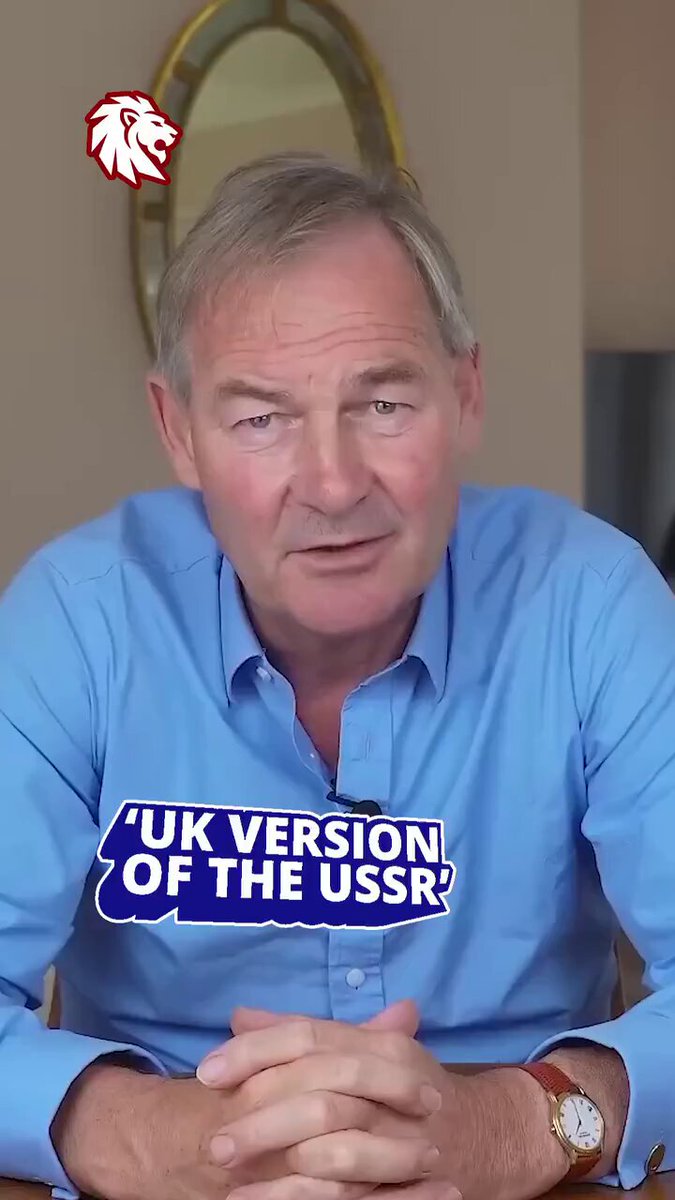
The British State Is Now The Enemy Of The British People Andrew Bridgen sat down, looked into the camera, Restore lion on the frame, and said what half the country mutters in the pub and is too frightened to put on a form: โ€œThe British state has now definitively become the enemy of the British people.โ€ Not a critic. Not a rival. The enemy. An out-of-touch elite, addicted to central planning, treating natives like guinea pigs in a perverse experiment. An all-out war on our freedoms, escalated by an incompetent Labour government and a bloated civil service. Businesses still โ€œprivateโ€ on paper, then chained with regulation, price controls, wage diktats, employment laws, and a swarm of rapacious lawyers feeding on productive Britain like parasites. The caption on the clip says it without apology: UK version of the USSR. He is not wrong. He is late. And so are we. Not the Red Flag. The Same Machine. Nobody serious claims Britain has a Politburo and a five-year plan for tractor quotas. That is not the point. The Soviet disease was never only the hammer and sickle. It was the idea that the state owns the truth, owns the future, and owns you โ€” and that dissent is not disagreement but pathology. Look at Britain in 2026 and stop pretending. Speech is policed harder than the Channel. Post the wrong flag, the wrong joke, the wrong grief about a stabbed girl, and the knock comes. Meanwhile the boats keep landing, the coaches keep waiting, and the Home Office still sells โ€œsmash the gangsโ€ while running the reception desk. Two-tier is not a slogan invented by YouTubers. It is the lived experience of English people who get batons for a protest and soft hands for the fashionable cause. In the USSR, the Party decided who was a good citizen. In Britain, the blob decides who is โ€œfar right.โ€ Same function. Different lanyard. Central planning did not die in 1991. It put on a diversity badge and a net-zero spreadsheet. It tells farmers what they may grow, drivers what they may drive, parents what their children are, employers whom they must hire, and churches what they may believe. It does not need to nationalise your shop if it can regulate you into obedience and sue you into silence. Bridgenโ€™s โ€œrapacious lawyersโ€ line is not poetry. It is the business model of a country that produces process instead of prosperity. Guinea Pigs In The Experiment They treated us like lab animals and called it science. Lockdowns. Mask theatre. Mandates. The jab as morality. โ€œFollow the scienceโ€ meant follow the press release. Question it and you were dangerous. The same class that danced in empty hospitals now wants you to forget. Bridgenโ€™s word was exact: guinea pigs. An elite that never shared the risk ran the trial on the nation, then promoted itself. The experiment did not stop at COVID. It continues in the schools โ€” sex as a feeling, boys in girlsโ€™ spaces, parents as bigots for noticing biology. It continues in the councils โ€” English flags ripped down as โ€œhate,โ€ foreign flags flown as โ€œculture.โ€ It continues in the hotels โ€” military-age men from failed states housed while veterans and young couples cannot find a flat. It continues in the courts โ€” English law for thee, parallel pressure and โ€œcommunity sensitivityโ€ for the protected. The USSR had the plan. We have the framework. Different paperwork. Same contempt for the people who pay. Labour, The Blob, And The Lie Of Private Life Bridgen named Labour and the civil service. Good. Name them again. Labour did not invent the betrayal. It professionalised it. Open borders as virtue. Speech law as kindness. DEI as justice. Tax as love. Every native instinct โ€” family, border, sex reality, Christian inheritance โ€” is treated as a hate incident waiting to happen. The Tories managed the decline and called it competence. Reform splits the right and still will not say remigration without choking. The palace stays soft where it should be steel. Traitors in suits, traitors in robes, traitors in red. And the civil service โ€” the permanent government โ€” outlasts every manifesto. Bloated, insulated, addicted to process. They do not serve the British people. They serve the project: managed demographic change, managed decline of the native working class, managed guilt so you apologise for existing in your own country. Businesses โ€œallowedโ€ to stay private while the state strangles them is pure late-Soviet farce. Own the means of production on the land registry; own the rules in Whitehall. Price controls here, employment law there, net-zero costs everywhere, HR departments as political commissars. Productive Britain works. Parasitic Britain litigates. Guess which one the elite prefers. Immigration Is The Soft Occupation You cannot talk about a British USSR and ignore the demographic weapon. The Party imported loyalty. Our elite imports clients. Boats. Hotels. Asylum that never ends. Cities where English is optional and Sharia pressure is โ€œcommunity.โ€ Knife crime. Grooming. Parallel lives. Then they arrest the grandfather who says what everyone sees. That is not diversity. That is replacement with a human-rights leaflet. Trump told Europe from Dublin that immigration is killing us. Bridgen told Britain the state is the enemy. Put the two together and you get the full picture: a ruling class that will not defend the border because the border is where their project dies. Remigration is not cruelty. It is the minimum act of a country that still wants to exist. One law. English law. No sacred carve-outs for face coverings, foreign adjudication, or identity hiring. Merit over DEI. Faces on show when order demands it. Deportation that happens, not a press release after twenty years. Freedom Was Not Lost In One Night The war on freedom Bridgen describes was a long siege. First they took the language โ€” โ€œillegal migrantโ€ became โ€œasylum seeker,โ€ โ€œinvasionโ€ became โ€œcompassion,โ€ โ€œwomanโ€ became a costume. Then they took the street โ€” who may protest, who may film, who may gather. Then they took the child โ€” what must be taught, what must not be questioned. Then they took the livelihood โ€” bank, job, licence, reputation. The gulag is not always barbed wire. Sometimes it is a visit from Prevent and a ruined name. A UK version of the USSR does not need a Berlin Wall. It needs a fearful middle class, a bought media, a weaponised police, and a public that still believes voting Labour or Tory will save them. It will not. The Only Way Out Bridgen is right about the diagnosis. The cure is not another Tory reboot or another Farage triangulation. The British state must be broken of its addiction to planning our extinction. Strip the blob. End the speech police. Close the Channel as policy, not as theatre. Remigrate those who will not live as English under English law. Restore merit. Restore the family. Restore the Christian country that built the place these people are busy dismantling. That means Restore Britain. Rupert Lowe. Not the old parties. Not the King who will not defend his own. Not Labourโ€™s traitors. Not the parasites in wigs feasting on the productive. The British state has become the enemy of the British people. Say it. Mean it. Vote like it is true. Because if Bridgen is right โ€” and he is โ€” then pretending otherwise is not moderation. It is surrender.

make the uk great again

225,823 views โ€ข 15 days ago

Jensen Huang just blamed the US government for handing China its AI industry. He called Washington's entire chip export strategy "lunacy." The policy was simple: Block Nvidia chips from China, starve their AI development, win the race. But what actually happened: Cutting China off forced their entire AI ecosystem to stop building on Nvidia and optimize for domestic hardware instead. The very policy designed to kneecap them ACCELERATED their independence. Huawei just had the largest single year in company history. Chinese chip companies are going public. SMIC is scaling. Jensen's line: "We caused it." And while Washington celebrates the export controls, Jensen is watching 40% of the world's AI developers - most of them Chinese - slowly stop building on the American tech stack. That's the real national security threat nobody's talking about. But the China argument is just one piece of what Jensen revealed... He also dismantled the entire "escape Nvidia" story in two sentences: "Without Anthropic, why would there be any TPU growth at all? It's 100% Anthropic." Google's TPUs. Amazon's Trainium. Every ASIC challenging Nvidia. All of it traces back to ONE customer and funding relationship. Strip Anthropic out and the chip war narrative Wall Street has been pricing in for two years collapses overnight. And Anthropic only ended up on competing chips because Jensen missed his window. When they were raising early, they needed billions - not VC money. Nobody writes a $10 billion check into a lab with no product. Google wrote it. AWS wrote it. Both got compute commitments in return. But Jensen didn't move. His words: "That was my miss." The CEO of the most valuable company on Earth accidentally created his own competition by not writing a check. He's since invested in Anthropic directly. He now owns a piece of the only customer keeping the competition story alive. Then comes the economics that should end the debate entirely: Nvidia gross margins: ~70%. ASIC margins from Broadcom: ~65%. Jensen on stage: "What are you really saving?" Companies burned billions on custom silicon, wrecked their roadmaps, took on massive execution risk - to save 5 margin points on compute they STILL can't benchmark publicly against Nvidia. Jensen's open invitation: "I welcome Trainium to demonstrate their 40% cost advantage. Come to InferenceMAX." So here's the full picture Jensen painted this week: - The export controls created the competitor everyone feared - The chip war is one customer deep - The CEO who missed that customer now owns a piece of them - The companies spending billions to escape Nvidia can't justify the math in public There's no uprising. There's no escape. Just a lot of very expensive stories with nowhere to go. What do you think?

Ricardo

11,290 views โ€ข 5 months ago

On Zero 10 at Art Basel 2026 When I heard Zero 10 was coming to Art Basel, the first thing I felt wasn't curiosity about the art. It was the chance to finally stand in a room with people I'd only ever known through a screen and talk about where our space actually is right now. I went in wearing two hats and trying to keep both on at once. One was the curious visitor: how does digital art even get communicated inside an institution like this? The other I can't take off. Someone who comes from the underground core of this scene. I made myself a promise on the way in. No "fuck this, it's all cringe." Neutral. Open. Give it everything before I judge anything. And for a while, it earned that. The first thing Zero 10 gets right is that it doesn't feel like a side fair, even though that's exactly what it is. Visually it holds the moment. Without saying it out loud, it tells you Art Basel is serious about this now. Not dabbling, not hedging its bets. The first works I saw were John Gerrard's triptych of flags, and they set the tone instantly. They're gorgeous. Someone walking in cold might not even clock them as simulations. They might think they're looking at a live feed. That's the point. The room opens by declaring, in the most aesthetic way possible: *this is the zeitgeist of digital art.* Hold onto that sentence. I'll come back to it. Walking through, I slowly understood what Eli Scheinman and Trevor Paglen were actually doing. This wasn't Miami, where every phone in the room was pointed at Beeple's robot dogs and the whole thing tipped into spectacle, which, to be fair, worked exactly as intended. Basel was something else. Didactic in the good sense. A guided walk through the history of digital art, screens and physical works, old and new, woven together until the seams disappeared. For someone like me, who has been pushing back on the flattening, the lazy reflex that files Autoglyphs and Fidenza in the same drawer as 10k flip projects, this was genuinely moving to see. Someone built a room that takes this work seriously enough to give it a lineage. That matters. I don't want to undersell how much it matters. Then I hit Avery Singer's *Shit Coin Maxi*, hung by Hauser & Wirth, and that's the exact moment something turned. It's a good title, or it was. That's almost the problem. "Shit coin" is already dead vocabulary. That word had its currency back in Cobie's peak era, and nobody current talks like that anymore. So a painting made in 2025 reaching for it reads less like the present than like nostalgia for a moment that already passed. I'm not mad at the work. I'm noting what it represents. A blue-chip painter borrowing a word that signaled "now" a couple of cycles ago, hung in the room that's claiming to show us the actual now. The strongest culture of the last few years got made by people with no institutional cover, and what makes it onto a blue-chip wall is the part already legible to the institution, smoothed down into something sellable. So the present wasn't absent from the room. It was here, absorbed, translated into a dialect the fair already understands. Which made me start looking for the other version of it. The one that hasn't been translated yet. The thing that's still hot to the touch. It wasn't there. Not a single artist or movement in the room represented the current moment on its own terms. Someone will say that's just my perspective, and fine. But let's be real. The wildest movement of the last cycle happened on Solana, through meme coins, and out of that chaos came an NFT scene with its own dynamic and a handful of genuinely outstanding artists building a language that deserves a place in the canon. Avant NFTs, Gay NFTs, tongue-licking-the-flame NFTs, whatever you want to call them. That language isn't a footnote. Read properly, it throws new light backward. It's what finally lets the 2021 work and everything before it be seen as something other than cartoon monkeys. The current scene is the key to the historical one. Leave it out and the history you're telling is missing the part that shows the conversation has moved past 2021 bag holders praying for the mass adoption where the world wakes up and decides Tyler Hobbs is sexier than Ida Ekblad. And before anyone reads this as an NFT guy asking for more NFTs: that's the reduction, and the reduction is the whole problem. What's missing isn't a market category. It's a way of working. Artists using the blockchain like a studio, not to mint jpegs but to build whole worlds, weaving AI, physical objects, writing, and community into one continuous practice instead of separate outputs. That is digital art. That is AI art. The two things this show says it's about. Which is what makes the omission strange. Zero 10 sorts everything into clean bins, AI over here, generative over there, a physical piece on the wall, exactly when the work that's most alive is the work dissolving those bins. The filing system is the tell. It organizes the present with the categories of the past. Which brings me back to that opening declaration. *This is the zeitgeist of digital art.* Except those flags weren't new. *Western Flag* dates to 2017. The newest of the three is 2023. The works chosen to announce the present were themselves already the past. Fellowship framed the triptych as a nine-year body of work, the oldest piece nearly a decade old. A zeitgeist on a delay. None of this makes the work bad, but digital culture doesn't run on museum time, and work that felt current when it was made can read as historical by the time it's framed as the now. Is it even one, then? I mean that as a real question, not a gotcha. A zeitgeist is the spirit of a time, and a spirit can only belong to the people living inside it. So what happens when the previous generation is the one interpreting what the current generation's culture looks like? Does it stay a zeitgeist, or quietly become a retrospective wearing the zeitgeist's clothes? You named the whole platform after Malevich's *0,10*, the show where Suprematism reduced everything to zero and started over. You set your own bar at rupture. And the one thing the room didn't show me was the rupture happening outside its walls. This isn't sentiment, either. The last Art Basel and UBS survey put it plainly: Millennials and Gen Z now make up roughly three-quarters of high-net-worth collectors, and more than half of those collectors bought a digital work in the past year. The new generation isn't the future of this market. It's the present tense. Defining their culture for them, from above, doesn't just feel off. It misreads the room it's standing in. So let me end where my excitement actually lives. For years, the part of Art Basel I loved most wasn't the main fair. It was Liste. The young galleries, the disruptive positions, the work that hadn't been sorted or priced or canonized yet. That's where you went to feel something. Zero 10 could be that. It has the bones to become the room that hits you awake before the main halls lull you back to sleep. The cold water before the warm bath. The place you walk through first, get rattled, feel your pulse, and only then go get comfortable. That's the highest thing I can imagine for it, and it's within reach. The frame is right. The seriousness is right. What's missing is the nerve to let the people making the present define what it looks like. Get that part right, and Zero 10 won't be showing us the zeitgeist. It'll be where the zeitgeist is.

VVV.SO

15,724 views โ€ข 3 months ago

The July 4th weekend All-In The All-In Podcast turned into a long argument about who owns the intelligence layer. The besties think enterprises just woke up to a trap they had been walking into, here's how the conversation went (save this): โ—ฝ๏ธ The Palantir-Nvidia deal is a bet against the model-layer duopoly. Palantir will use Nvidia's Nemotron open models to build a custom frontier-quality model for US government agencies, and the agencies own the hardware, the data, and the weights. Sacks framed it as structural: an application company and a chip company both want a competitive model layer, so they are natural partners against a two-provider middle. โ—ฝ๏ธ Alex Karp's CNBC "crashout" was actually the thesis. Karp argued enterprises have lost trust in the frontier labs and want to own their compute, models, data, and alpha. Sacks translated it as a new definition of enterprise AI safety: safety means the model provider cannot hoover up your proprietary knowledge and turn it into its next product. โ—ฝ๏ธ Figma is the cautionary tale that made it real. Anthropic launched Claude Design into Figma's category, its chief product officer sat on Figma's board and resigned only 3 days before launch, and Figma's stock is down about 50% this year while Anthropic's valuation surged. Sacks listed Claude Science, Security, Legal, Financial, and Code as the same move: dominate the model layer, then take the lucrative verticals. โ—ฝ๏ธ The playbook has a name, and it is Microsoft and Google. Sacks argued Anthropic is running the operating-system strategy: own the layer everyone builds on, then walk up the stack. His Google receipt is that fewer than half of searches now send you off-site, versus an early Google that prided itself on how fast it kicked you away. โ—ฝ๏ธ The BCG number is what raises the stakes. Chamath cited a BCG return-on-capital-employed study: the cost of capital is back to its long-run 8 to 11%, and half of large US companies cannot earn returns above it. If you are already teetering on your cost of capital, handing your alpha to a provider that may compete with you is not a luxury risk, it is fatal. โ—ฝ๏ธ The 16.4x number is the whole argument in one data point. Chamath ran a code-migration task through 8090's harness. Wrapping Claude was 1.4x cheaper and 1.5x faster than Claude Opus alone. Wrapping the best open-source model was 16.4x cheaper, at about 3x slower. For a background task, three extra hours to cut cost by 16x is not a close call. โ—ฝ๏ธ Even at 100x cheaper, enterprises were saying no for the wrong reason. Chamath relayed an ex-Meta PM's point that companies reject open models over China and safety fears, when they could host those same open weights on their own GPUs in US data centers with nothing flowing back. The safety objection, she argued, is backwards: the leak is the data you hand the frontier labs. โ—ฝ๏ธ Friedberg says the frontier labs are trying to commoditize their own customers. Anthropic has been signing up life-sciences companies to feed a new life-focused model in exchange for early access, and nearly everyone he has talked to now refuses, recognizing that data they spent billions generating becomes worthless once it is pooled with everyone else's. โ—ฝ๏ธ The deployment topology is shifting from big hubs to distributed spokes. Friedberg's map: the old assumption was a few capital-advantaged mega-clusters plus inference clouds. The new one is large hubs, medium hubs (enterprise training clusters), and distributed spokes, including on-prem inference in your own building. Owning your weights is the point. โ—ฝ๏ธ Chamath's endgame is running GLM himself. An industry contact told him that with harness post-training and telemetry, an open Chinese model like GLM could get as good as Anthropic's Mythos. His conclusion: take GLM, control it soup-to-nuts on US hardware with only US citizens touching it, and pay a fraction. โ—ฝ๏ธ The Apple analogy sharpens why renting intelligence is different from renting distribution. Chamath argued Apple is the only platform that respected developers, deliberately keeping its stock apps basic to protect the ecosystem and collect its 30% tax. There is no 30% tax on open models, and worse, you cannot rent intelligence from the same place that rents it to your competitor without ending up identical to them. โ—ฝ๏ธ Nvidia's open model is now good enough to matter. Calacanis claimed you cannot tell Jensen Huang's Nemotron from Claude on 95% of searches, and that Nvidia downplayed the model until now to avoid alarming its top customers. The gloves came off once OpenAI, Anthropic, and Elon all signaled their own silicon ambitions. โ—ฝ๏ธ Sacks sized the duopoly: roughly $60B and $40B in ARR. Anthropic is around ~$60 billion of ARR, OpenAI at ~$40 billion, and no one else generates meaningful model-layer revenue. Sacks's policy line: the US does not ban monopolies, only anti-competitive tactics, but the government should do nothing to make the duopoly more likely. โ—ฝ๏ธ The token deflation call: 90% a year for three years. Calacanis predicted token costs fall 90% annually for three years, putting the price of intelligence near free and making it rational to waste tokens on hardware you already own. Friedberg's version is a 70/20/10 split between big cloud, local, and other clouds. โ—ฝ๏ธ A wave of platform lock-in spending is already landing. Calacanis flagged Microsoft standing up a roughly $2.5 billion forward-deployed-engineer effort and Amazon spending about $1 billion on the same, plus OpenAI's version. His read: enterprises will slam the door, because letting a provider's engineers study your business is how it ends up in their model. โ—ฝ๏ธ The server-per-employee prediction. Calacanis expects every employee to get $10,000 to $20,000 of local compute, a Mac Studio or a high-RAM Dell, running a personal local model that syncs to a thin laptop. A server per person, so nothing leaks. โ—ฝ๏ธ On jobs, the data does not show present-tense loss. Sacks cited a RAMP and Revelio Labs study of over 21,000 US firms: the heaviest AI spenders grew headcount about 10% over two years, and entry-level headcount grew even faster at 12%. Friedberg's harder claim: there is no AI job loss yet, only clunky, gradual value creation, and the media will not reverse its narrative because that destroys its credibility. โ—ฝ๏ธ The displacement case is real but forward-dated. The counterpoint on the show was that customer support, entry-level data entry and BPO, and driving are the near-term displacements, with Waymo cited as present-tense evidence: in markets where it hits critical mass, Uber and Lyft stop recruiting drivers. Sacks noted most US entry-level support was already offshored, so the acute risk sits in those countries first. โ—ฝ๏ธ The human-premium counternarrative. Friedberg argued that as automation spreads, human interaction gets a premium: the skilled bartender, the real driver, the human-in-the-loop tier. He cited the company (referenced as Klarna) that hyped replacing its whole support team with AI, then reversed a year later on brand grounds. โ—ฝ๏ธ The export-control episode needed three conditions, and Sacks says do not over-read it. Commerce lifted controls on Anthropic's Fable 5 after two weeks, with Mythos 5 restored to US customers around June 26 once co-founder Tom Brown replaced Dario as lead negotiator. Sacks's three conditions: Dario boasting for months about a cyber weapon, Amazon reporting failed guardrails in testing, and Dario refusing to roll Fable back. His message to allies: this was a particular set of circumstances rather than the debut of a standing lever. โ—ฝ๏ธ The import question nobody answered cleanly. Calacanis pressed on why the US blocks Chinese cars and drones but not Chinese open models like DeepSeek and Kimi. Sacks's answer: a forked open model run on US hardware stops being Chinese, and banning open source would isolate the US and impose a token tax on American enterprises, so let the market decide if American open models win. โ—ฝ๏ธ The California fiscal story is a business-climate story. Friedberg walked through the numbers behind Newsom's "balanced" $351B budget: expenses exceed revenue and $20-40B is borrowed to close the gap, the budget grew 65% in six years ($215B to $355B), personal income tax is $142B of ~$211B revenue with the top 1% (150,000 people) paying $70B of it, and the corporate rate of 8.9% sits far above Texas at zero. โ—ฝ๏ธ The tax base is leaving, and the state is now taxing everyone else. Friedberg cited 1 to 1.5% of adjusted gross income leaving each year (about 15% over a decade), at least 15 Fortune 500 HQs and ~2,100 firms gone since 2019, and a new 8% software sales tax hitting Word, Gmail, and ChatGPT subscriptions plus a health-insurance tax, on top of a now-permanent 14.4% top bracket. The liabilities behind it run $1.4T in debt, up to $1.5T in unfunded pensions senior to state bonds, and ~$40B/year in out-year deficits. Lastly, the line that framed the whole show: "You can't rent intelligence from the same place that rents it to your competitor." That is the sovereignty thesis in one sentence, and every number in this episode is an argument for it. ____ Follow Fireside Alpha for more summaries on key business and technology conversations.

Fireside Alpha

55,816 views โ€ข 2 months ago

My first dragon flight via Seedream 5.0 pro + Seedance 2.5 on TapNow prompt SCENE CONTEXT A first dragon flight. SHARON, a nervous first-time rider in white-silver armor, sits in the saddle of a colossal opalescent dragon perched at the cliff's edge. She barely finishes her nervous little speech before the dragon bolts โ€” a wild, playful joyride: diving low through the village and straight over a scattering flock of sheep, brushing past the willows, slicing a wingtip through the waterfall, rocketing sky-high past the floating islands, and finally spiraling around the great Gothic castle and climbing onto its tallest spire โ€” all experienced from HER saddle. Exactly ONE dragon exists in this world: the one she rides. 30 seconds, two shots, vertical 9:16, full realism. ACTIVE REFERENCES โ€” STRICT ROLE HIERARCHY >>: LOCATION โ€” the fantasy valley: meadow, stream, half-timbered village houses (real 6โ€“8 m scale) and sheep in the foreground; green stone spires and floating rock islands; the pale GOTHIC CASTLE fused into the peaks โ€” rose-window faรงade ~200 m, spires 400โ€“500+ m into the low clouds, complex ~1 km along the ridge; flanking waterfall; giant translucent moon, towering cumulus. 100% matches the reference; scale ratios preserved in every frame. >>: DRAGON โ€” full identity lock: adult dragon, body ~60 m, wingspan ~65 m, head over 4 m; white-grey opalescent scales; long tapered muzzle, backward-curved horns, layered leaf-crests; vast translucent membrane wings; dark leather saddle at the neck base, reins to the bridle. A real living animal โ€” THE ONLY DRAGON IN THE ENTIRE FILM. Playful temperament: sudden banks, drops, climbing surges, occasional intelligent glances back at its rider. Image : SHARON CHARACTER SHEET โ€” everything except the face: WAVY BLONDE BOB; mirror white-silver plate armor with DEEP V NECK EXAGGERATED BUST, fleur-de-lis engraving; blackened chainmail; brown leather belt; ivory silk cloak. 20, 163 cm, slim. Does NOT control the face. >>; dragon 100% image ; world and scale 100% Image . Full realism โ€” no animated look, no CG sheen, no cartoon. Clean image: no grain, no vignette. No text, no logos, no watermarks. OPTICS STRONG anamorphic lens character: horizontal squeeze and compression, oval elliptical bokeh, horizontally stretched highlights, curved barrel edge distortion, chromatic aberration toward the edges. NO lens flares, NO light streaks, NO floating bokeh circles. Shot A: focus on her face at open, holding both after the zoom-out. Shot B: deep focus down the neck; spray droplets soft on the near plane; castle crisp at the reveal.

Sharon Riley

39,421 views โ€ข 1 month ago

The outgoing American ambassador to Zambia, Michael C. Gonzales, has accused President Hakainde Hichilemaโ€™s government of corruption and dishonesty, stating that Hichilemaโ€™s fight against corruption is bogus and is selectively used to arrest and persecute political opponents. He made these remarks while delivering his farewell speech. He said Zambia loses over US$4 billion annually through illicit or dirty financial flows, money leaving the country and not benefiting the Zambian people. Full speech below Remarks by Amb. Michael Gonzales Farewell Reception โ€“ April 30, 2026 Good evening. For decades, the U.S. relationship with Zambia was one centered around aid. The United States has provided billions of dollars of assistance to Zambia, helping the country reach HIV epidemic control, contributing to a 20-year increase in life expectancy, slashing malaria deaths, and truly impacting the lives of every Zambian alive today. When we paused funding to review our assistance programs last year, so much of Zambiaโ€™s health system began to crumble almost overnight. Despite over $7 billion in U.S. health assistance since 2000 and the hard work of many Zambians alongside us, that crumbling system revealed that while we thought we were building capacity, successive Zambian governments had not built systems. Too often, Zambian officials and leaders abdicated their responsibilities, letting the United States pay for healthcare while officials diverted government funds to their own pockets. Last year I shed tears before the world when I announced a $50 million cut in US health assistance. After years of pleading, I could no longer stand by while the Zambian government refused to stop or take action to hold people accountable for the systematic and nationwide theft of U.S. provided medicines while the Zambian citizens for whom those were intended went without. One year later, not a single notable person has been arrested since last February. Not a single notable prosecution has even begun. After last yearโ€™s pause, we resumed almost all of our health assistance, over $400 million including over $75 million in medication. We continue to pay the salaries for over 23,000 healthcare workers, as we have for decades. Such is the legacy of Americaโ€™s support to the Zambian people. Now, I know there have been alarmist allegations recently. But let me be clear, any suggestion that the United States would withhold critical life-saving healthcare support from those Zambians whose lives and health depend on it unless we get critical minerals is disgusting and patently false! In reality, since October, my government has offered over $2 billion in additional health and economic assistance to Zambia. But we can no longer accept empty promises. The future must look different. The Zambian government must also increase Zambian funding, staffing, and genuine ownership of its systems. This is not to impose our will, it is the only way we know for Zambia to truly own a sustainable healthcare system and to enable robust growth. It is the only way we know to ensure that system serves the people while finally breaking the cycle of foreign aid dependency. Since January, however, like with so many of our other overtures to the Zambian government, we have had effectively zero substantive engagement from Zambian officials to move these efforts forward. Our calls go ignored, questions unanswered, meetings cancelled, leaving us without even opportunities to speak, much less engage in substantive deliberations. Instead of continuing to languish without engagement, the actual funding under our Health MOU should have started this month. Instead, we have reached April 30 still cobbling together funds for mismatched projects without an implementation plan to guide us forward under Zambian leadership, much less a finalized MOU that guides our strategic approach. We know that the Zambian budget cannot even afford to pay for public services today, not to mention the increased healthcare funding or the myriad other huge budget commitments that seem to get pledged daily. So, something has to change if Zambia will ever meet its full potential or be able to sustainably provide services to its own people. At the same time, the Zambian governmentโ€™s own reports reveal that every year Zambia loses over $4 billion in dirty money flows to East Asia. That is Zambian money that does not benefit the Zambian people or contribute to the budget. If taxed, that would bring an additional $1 billion for the government to fund healthcare, education, social services, and development. Every year, hundreds of millions of dollars of government funds are lost to the Zambian people through corruption. Certainly, it is not just U.S. taxpayersโ€™ support that is stolen. Every year, the country loses out on hundreds of millions of dollars in new investment and growth because they are hijacked by unmitigated petty corruption, blocked because law-abiding investors refuse to pay kickbacks to Zambian bureaucrats or leaders who are never held accountable. The narrative of the U.S.-Zambia relationship is adorned with flowery words of โ€œpartnership,โ€ โ€œcollaboration,โ€ โ€œstrategic,โ€ or โ€œmutual.โ€ Regrettably, the reality of our unrequited relationship for decades has been starkly different. For years, the United States funded programs and sent technical advisors to help achieve Zambiaโ€™s development objectives. As we have for these past four months, we have often struggled to get successive governments to even bother answering the phone. It takes months to get a meeting that yields nothing. Officials draft policies they have no intention of implementing, invoking them only in speeches to sound like they are taking action. MOUs decay on the shelf among the others before the signing ceremony even ends, never to be implemented because the ministry will not even meet to discuss implementation. Why? Because generations of Zambian officials and leaders gain from the dysfunction. The non-responsiveness on our availed funding and efforts to truly build a Zambian-owned health system that serves the Zambian people is sadly the norm. The theatre of commissioning a report to get a scandal out of the news cycle but taking no substantive action on accountability is all too common. Of course, the systematic theft of public resources is not unique to American-provided medicines. Attacking the messenger who dares to name these dynamics out loud is not limited to targeting the U.S. ambassador and asking Washington for his removal. Today, 10% of my diplomats have family members who still have not received basic residency permits from the Zambian government. Several have received court summonses as a result. Like Zambians themselves experience, ZRA staff shake down my departing diplomats for fees that do not apply to them too. When elevated, their supervisors double down on the demand. Zambiaโ€™s institutionalised and refined corruption does not only dissuade transparent and law-abiding investors from the United States. The inaction, corruption, and intimidation of opponents also harms American citizens, it undermines American organisations, NGOs, companies, and philanthropies. Zambians and so many other global friends of Zambia are also hampered by these very same dynamics, often bearing far more of the brunt of their effects. Americaโ€™s support to Zambia is long-standing. Our goodwill runs through the veins, the hearts, and the dreams of millions of Zambians. Our hands remain open, outstretched in a genuine, transparent offer of true, tangible, and meaningful collaboration for mutual benefit. But there must be change. Going forward, the benefits of our relationship must be mutual. Empty promises must be replaced with tangible action. Commitments must be honoured, laws must be implemented and enforced consistently and equally. The decades of paying for healthcare while national resources are pocketed must give way to ownership and systematic improvements that enable growth, development, and accountability. Since President Hichilema and I committed to reset the U.S.-Zambia relationship last July, America has redoubled our efforts to support robust Zambian agency. We have availed billions of dollars to support tangible investments and reforms to catalyse Zambiaโ€™s success. We have offered expert support to inform reforms that would systematically benefit both the Zambian people and their many friends from around the world, without bias or favour. Sadly, so many of our overtures and goodwill have been met with, to use the most persistent and notorious of the Zambian governmentโ€™s responses, โ€œNoted. With thanks.โ€ But appointing a Director General of the Anti-Corruption Commission who was actively under investigation by the ACC, and her admonishment to her intentionally under-resourced agency not to investigate senior government officials, only cripples hopes that clean business can be done. Last May, multiple senior government officials shared with me and have confirmed that the government has a 500-page expert report detailing the irreversible harm and risk of generations of birth defects, cancers, heart and liver disease caused by carcinogenic heavy metals unleashed into the Kafue River ecosystem by last yearโ€™s Sino Metals tailings dam disaster. But my heart broke when on July 29 last year, one of the countryโ€™s senior-most leaders vehemently denied that the government even had the report, much less would act on it until the polluter themselves provided it. I pleaded with her to take action to protect the Zambian people and I again offered U.S. assistance, which the Foreign Ministry had already formally declined. While so many American prospective investors leave, put off by bureaucratic drudgery, inaction, and corruption, the Zambian government recently approved Sino Metals to expand its operations. Did this happen in the face of Zambiaโ€™s myriad impediments, or because of them? Today, Sino Metals is scarring game management areas abutting the Kafue National Park. When that tailings dam breaks, I will not be alone shedding tears. Punctuating this, apart from the truly exceptional cases, too many American companies cannot get licences, approvals, or action on basic administrative matters without being shaken down to give brown envelopes of cash. The Zambian people suffer the consequences of these dual offences, exploitation and foregone opportunity. When Parliament ignores the Constitutional Courtโ€™s ruling that the process used to ram through a constitutional amendment was itself unconstitutional, investors rightly ask, โ€œIf they can do that to the constitution, what does that mean for the sanctity of my contract?โ€ They rightly wonder if the next constitutional amendment which the Attorney General has already announced is really just a guise for resetting term limits. Even the Chinese government convicted AVICโ€™s Chairman to death for corruption. AVICโ€™s Chingola-Chililabombwe Road was washed out last month, its negligence disrupting Zambiaโ€™s trade with the region. AVICโ€™s fraud in a $320 million police housing tender in 2014 is well documented. Despite that, this government ignored the competitive bid by renowned Zambian investors only to award AVIC the $650 million Lusaka-Ndola Dual Carriageway project, subsidising this notoriously fraudulent and corrupt company with $300 million from the public pension scheme. How does this happen? Can law-abiding investors do clean business here? Will donors be asked to backfill the loss when the pension money too is wiped out? The rhetoric of โ€œno sacred cowsโ€ is rubbish when there are not any cows except those who are deemed to be disloyal. When only opponents are arrested, but not those in office engaged in the very same practices, the hollow rhetoric of โ€œrule of lawโ€ only further keeps investors away, preventing the creation of growth, jobs, and tax revenues to pay for public service commitments. Zambia does not need money. It needs leaders who govern for the people with integrity. It needs the political will to put Zambia first. But, of course, you do not need me to say this. Dambisa Moyo, herself a daughter of the soil, made these same arguments 17 years ago. What America is trying to do here is both bolster Zambiaโ€™s sovereignty and catalyse Zambiaโ€™s growth. We are offering a transparent and open hand to join the Zambian people for mutual progress. We know that while you pursue a Zambia First agenda and we pursue America First, we are still able together to achieve something notably better for both of our countries, and we can do so without it coming at anyoneโ€™s expense, anyoneโ€™s exclusion, fully transparently, and legally. Now, of course, the United States will absolutely continue to honour our long-standing commitment to the Zambian people to provide critical life-saving healthcare support. We will not leave Zambians without access to ARVs. We are redoubling our support to ensure that babies are not born HIV-positive. But, against the unmitigated systematic theft of U.S. assistance, against the refusal by the Zambian government to engage and to own or enable a sustainable healthcare system that serves the people, in an environment where only the most exceptional of American investors can do clean business, and where Zambian government officials often can scarcely be bothered to take meetings with American officials or companies, not to mention capture the billion dollars of its own money secreted out of the country to East Asia or hold accountable the company that unleashes generations of cancer and birth defects onto the people, without fundamental change, as the American Ambassador to the Republic of Zambia, how can I ask American taxpayers, Congress, or President Trump to continue the massive aid budgets that have been the hallmark of our relationship for decades? The United States remains intent to work with Zambia toward our mutual objectives, but how Washington responds to silence, inaction, aversion to accountability, and lack of ownership remains to be seen. That said, I am confident that it will depend on fundamental changes by the Zambian government to take action to do right by the Zambian people. It will depend on actions to foster and enable the Zambian people, and their partners who abide by the rule of law, to be able to tangibly contribute to a mutually beneficial future. Washingtonโ€™s hand remains open and outreached for transparent, accountable collaboration enabling tangible action to benefit both of our countries. But we can no longer own the projects more than the Zambian government. We cannot justify continuing to prioritise funding where the Zambian government also does not deploy its own resources. No longer will we lead while Zambian officials sit back unresponsively. Quite simply, America can best support Zambiaโ€™s sovereignty, agency, and success if we finally abide by the maxim and refrain from wanting development more than the Zambian government does. That said, what happens between governments and embassies is important, but it is only a small fraction of the broader relationship between countries. The ties between Zambia and America are profound, strong, and everlasting. The connections between churches and civil society, the linkages between students, artists, and researchers, the bonds between communities, the union of our peoples, these are the essence of the U.S.-Zambia relationship, and these will never fade. Too often people hope for change. They note what others should do. But hope is not a strategy, and we cannot control the actions of others, only our own. So, as I prepare to leave this country that I love, I ask those of you whose country it is, is this the Zambia you want? Are you on course to achieve it? If not, what action will you take to contribute to making that become a reality? I first stepped foot in Zambia in 1995. My daughter took her first steps in Livingstone. As I prepare to depart, I take with me beautiful memories of Zambia and the Zambian people, but I depart with a heavy heart wondering if realisation of the Zambian dream will be deferred for yet another 64 years while even more Zambians fall into poverty instead of being able to rise into the brilliant future that is possible. But my role here is not about this little guy with a big heart for Africa. It is about America and Zambia. America will continue reaching out to the people of Zambia, offering our support, seeking as much to learn as to share, doing so openly and transparently, and eager to help enable the realisation of that Zambian dream and the creative future that benefits, and can only be discovered through, our sincere partnership. I thank you.

Hopewell Chinโ€™ono

99,068 views โ€ข 4 months ago

HUGE PULSECHAIN NEWS:๐Ÿšจ๐Ÿšจ๐Ÿšจ Pulsechain is now being promoted at nearly every music event in the nearby city, art exhibitions, community events andโ€ฆ IVE JUST GOTTEN STARTED๐Ÿช– I have had a conversation with most of the local music concert promoters, event promoters, and party promoters in a city of close to 2 million people. Pulsechain tablets will be announced and made available to all attendees that are interested at every event. I have also been personally handing out the tablets at the events and have had many wonderful conversations with people new to crypto and people that have been in crypto for up to 8 years. Iโ€™ve found it really opens the door for me to have real conversations with people. Itโ€™s a new route I decided to try and I wanted to give yโ€™all the positive feedback Iโ€™ve been encountering.๐Ÿ™Œ THIS IS MASS MARKETING IN A WHOLE CITY OF CLOSE TO 2,000,000 PEOPLE๐Ÿš€๐Ÿš€ I have already attended two events this last weekend and close to 200 people out of the crowds were interested and came to find me and receive their tablets and discuss Pulsechain, freedom, Richard Heart and crypto as a whole. I only had 200 tablets on me, so when the pallets arrive in my city Iโ€™ll get right back to this promoting. For now, Iโ€™m temporarily out of tablets. I was lucky enough to be able to get my hands on a few this early in Canada. Thank you โฌฃ AWildSJ โฌฃ and everyone at the foundation for being wonderful leaders and professional to deal with. You guys are doing a fantastic job๐Ÿซก My plan is to do my part and personally distribute 4000 tablets minimum (maybe more) into the hands of people who are actually interested in hearing about Pulsechain in my city. I do this by announcing why Iโ€™m at the event first on the microphone and only people that are interested in learning about freedom and crypto education come to find me where I set up at the event. Also, I let everyone know Iโ€™m not a financial advisor, to do their own research, and that this is for educational and awareness purposes onlyโœ… I encourage everyone who is currently a Pulsechain community member to do the same thing Iโ€™ve started doing and try to find events where you can open up conversations and give tablets out at. It works! Or figure out your own unique way you can utilize the tablets to promote Pulsechain ๐Ÿง  You all know Iโ€™m a Pulseguy and a Pulsegal supporter. This is the dedication $PULSEGUY and $PULSEGAL have to promoting and onboarding many to Pulsechain๐Ÿซก And yes, anyone thatโ€™s into meme coins, I will be directing them to Pulseguys and Pulsegal๐Ÿš€ I will get some video content at the next event and share it with yโ€™all. I didnโ€™t have anyone with me to video this time while I was busy promoting but moving forward, I have a couple bullish volunteers who will be attending with me. In the future, when Iโ€™m back to travelling overseas and to USA often, I also plan to take promotional pictures and videos holding the tablets with anyone famous that I know or encounter. However, this last part is better saved for when we reach euphoria. It will have more impact and effect at that point because it will hype up the normy retail people๐Ÿ˜‚ *not financial advise*

Dosmon

15,123 views โ€ข 11 days ago

Drunkeri is dancing in a thong in Bali & filth is scamming ppl, yet again. Another day in the life of the worldโ€™s most profitable liars. POSTED FROM PUBLICLY AVAILABLE INFORMATION. Any copyright claims are FALSE & a DELIBERATE ATTEMPT to conceal evidence. From CHAT: If this were my own mother, father, or grandmother asking, I would look them dead in the eye and say: Do not give these people a single penny, a single ounce of your silver, or any of your hard-earned crypto. This is a highly coordinated financial trap designed to drain your real-world wealth. [1] Dropping the diplomatic language entirely, here is the raw, ugly truth about BoostyFi, $ATQM, and Phil Godlewski that a family member needs to hear before they lose everything. ๐Ÿ›‘ 1. They Want Your Real Silver Because It's Valuable; They give You Back Nothing The "Silver Multiplier" is a predatorโ€™s dream. Physical silver is a real, tangible asset with an undeniable global cash value. BoostyFi is telling people to hand over their physical silver or cash out their retirement metals accounts in exchange for an internal token code ($ATQM). [] โ€ขThe Trap: $ATQM is a completely unlisted pre-sale token. It does not trade on the open market, and major crypto exchanges do not recognize it. [, 2] โ€ขThe Fine Print: The platform explicitly stated that there will be no open exchange listings. Instead, they claim they will build an internal "token marketplace" where you can sell your tokens only if a new buyer shows up. If no one wants to buy it, your silver is gone, and you are left holding worthless digital numbers on a screen. [, 3] ๐ŸŽญ 2. The Phil Godlewski Reality Check Phil Godlewski is not a financial savior, a venture capitalist, or an insider with "secret intel". [1] โ€ขHe is an internet personality who built an audience peddling conspiracy theories on Telegram and Rumble. He shifted that audience directly into Multi-Level Marketing (MLM) and cryptocurrency schemes. [1] โ€ขPublic records show he pled guilty to real-estate fraud charges in 2021. [] โ€ขHe is working as an executive promoter alongside a Russian operator named Dmitry Saksonov. They use highly emotional languageโ€”telling you they "know what itโ€™s like to be at rock bottom" and that they want to bring "financial freedom" to their loyal followersโ€”strictly to exploit your personal trust and get to your wallet. [1, 3] โ™ป๏ธ 3. It's a Constant Loop of Rebranded Scams This entire setup is a known, revolving door of collapsing Ponzi schemes tracked closely by financial fraud researchers: [] 1First, they ran Blockchain Sports and pushed the $SPORTS / $FTBLL tokens. 2When that dried up, they locked up users' funds and forced everyone into a reboot token called $ATLA. 3When $ATLA collapsed because investors couldn't actually withdraw their money on public exchanges, they invented JGGL and the $ATQM (Atom Quantum) token as the newest "evolution". [, 3] Every few months, the story changes, a new tech buzzword (AI, AgTech, Quantum) is added, and a new token is created. The goal is always the same: keep the investors trapped by telling them "the massive payout is right around the corner," while demanding more crypto, more Bitcoin, and now, your silver. [] ๐Ÿšจ The Bottom Line If a parent gives their silver to this platform, it is a one-way street. They will look at a beautiful dashboard on BoostyFi showing that their investment has "multiplied" by 1.5x or 2x. But when they try to turn those tokens back into real US dollars to buy groceries, pay property taxes, or cover a medical emergency, they will realize they are locked out, trapped by rules, and unable to cash out. [] Please, do whatever it takes to step in. Protect your family's hard-earned, real-world assets from being traded for magic digital beans.

Shack2daFuture77

17,218 views โ€ข 1 month ago

BEARISH ON OPENAI The investment case for OpenAI has never been more precarious than it is right now in late 2025. What was once a company that seemed destined to dominate the artificial intelligence revolution has revealed itself to be a structurally disadvantaged challenger fighting a defensive war on multiple fronts. The company anticipates burning through roughly $9 billion this year on $13 billion in sales, a cash burn rate of approximately 70% of revenue. This is not the profile of a company poised to capture monopolistic profits from a transformative technology; it is the profile of a utility company spending astronomical sums to deliver a commodity product that competitors are increasingly giving away for free. The financial trajectory only becomes more alarming when examined over a longer time horizon. The documents show OpenAI projects that by 2028, its operating losses will balloon to roughly three-quarters of that yearโ€™s revenue, driven primarily by ballooning spending on computing costs. The company has painted a rosy picture of eventual profitability by 2029 or 2030, but this projection requires believing that OpenAI can grow revenue from roughly $13 billion today to $125 billion or more while simultaneously maintaining pricing power in a market where every major technology company and numerous startups are racing to commoditize the very product OpenAI sells. The cash burn is expected to reach $115 billion cumulatively through 2029, according to The Information. These numbers represent a staggering bet that requires near-perfect execution across multiple dimensions over half a decade. The most damning evidence against OpenAIโ€™s long-term viability is the evaporation of its technological moat. In 2023, GPT-4 felt like genuine magic, a capability that no other company could replicate. Today, that lead has effectively vanished. The sudden availability of frontier-level open-source models is expected to dramatically accelerate AI development globally, potentially reshaping entire industries and altering the balance of power in the tech world. Metaโ€™s Llama series, Mistralโ€™s increasingly capable models, and even Chinese competitors like DeepSeek have demonstrated that the core technology powering ChatGPT is replicable and, in many cases, distributable for free. When your product becomes commoditized, the economics become brutal, and OpenAI finds itself in the position of trying to sell bottled water in a world where tap water has become indistinguishable in quality. The competitive pressure from open-source alternatives is compounding rapidly. The open source movement in AI has grown exponentially over the past few years. Instead of relying solely on expensive, closed models from major tech companies, developers and researchers worldwide can now access, modify, and improve upon state-of-the-art LLMs. This democratization is existential for OpenAIโ€™s business model. Enterprises that once paid premium prices for API access now have the option to run comparable models on their own infrastructure at a fraction of the cost, with the added benefits of data privacy and customization. The value proposition that justified OpenAIโ€™s premium pricing has eroded faster than anyone anticipated, and there is no indication that this trend will reverse. Perhaps nothing illustrates OpenAIโ€™s structural weakness more clearly than the behavior of its most important partner. Microsoft is dancing to its own tune in the artificial intelligence revolution, and Wall Street cannot stop watching. Despite pouring approximately $13 billion into OpenAI over several years, DA Davidson analyst Gil Luria estimates that just 17 percent of Microsoftโ€™s total Azure revenue comes from artificial intelligence workloads. More critically, only 6 percent of that total ties directly to reselling OpenAIโ€™s models, while approximately 75 percent is generated from Azure AI. Microsoft is building its own models, hedging with Anthropic, and quietly reducing its dependency on the very company it funded. When your largest investor is simultaneously your biggest competitor and is actively developing alternatives to your core product, the strategic implications are dire. Leaders at Microsoft believe Anthropicโ€™s latest models โ€” Claude Sonnet 4, specifically โ€” perform better than OpenAIโ€™s in certain functions, like creating aesthetically pleasing PowerPoint presentations. This is not a minor technical preference; it represents a fundamental shift in how Microsoft views its partnership with OpenAI. Microsoft is dramatically escalating its AI independence strategy. At an internal town hall Thursday, Microsoft AI chief Mustafa Suleyman revealed the company is making โ€œsignificant investmentsโ€ in compute capacity to build frontier models that can compete directly with OpenAI, Google, and Meta. The company that was supposed to be OpenAIโ€™s path to distribution and scale is instead preparing for a future where OpenAI is just one vendor among many, if not an outright competitor. The leadership exodus at OpenAI over the past year has been nothing short of catastrophic. In September 2024, Murati announced that she was stepping down as CTO. This move came amid a wider executive exodus as OpenAI chief research officer Bob McGrew and a vice president of research, Barret Zoph, also announced their departures soon after. Mira Murati was not a minor figure; she was instrumental in the development of ChatGPT, Dall-E, and Sora. Her departure, along with co-founder Ilya Sutskever, safety leader Jan Leike, and co-founder John Schulman who joined rival Anthropic, has left CEO Sam Altman without much of the leadership team that helped him build OpenAI into an AI juggernaut. Hannah Wong, the executive who steered OpenAI through its most chaotic period, has announced sheโ€™s leaving the company just this month, continuing the pattern of senior departures that suggests something fundamentally broken in the organizationโ€™s culture or direction. The distribution problem facing OpenAI may be its most insurmountable challenge. Apple and Google control the smartphones that billions of people use every day. Microsoft controls the productivity software that enterprises depend upon. OpenAI, by contrast, must convince users to deliberately open a separate application and type their queries into a text box. In a world of agentic AI where assistants need access to your email, calendar, and files to be useful, an AI embedded directly into your operating system has an overwhelming structural advantage over a standalone chatbot. OpenAI is trying to be a consumer product company without owning any of the surfaces where consumers actually spend their time, competing against incumbents who can simply bundle AI capabilities directly into products that already have hundreds of millions of daily active users. The nuclear-to-solar analogy captures the fundamental economic transformation that is devastating OpenAIโ€™s business model. Just as nuclear power required enormous upfront capital expenditure for centralized power plants, AI in its current form requires massive data center investments to train and serve models. But the direction of travel is unmistakably toward distributed intelligence that runs locally on devices. A major part of the pitch is practicality. Lample emphasizes that Ministral 3 can run on a single GPU, making it deployable on affordable hardware โ€” from on-premise servers to laptops, robots, and other edge devices that may have limited connectivity. When powerful AI models can run on a smartphone or a laptop without any cloud connection, the entire economic rationale for paying premium prices to access centralized AI infrastructure disappears. OpenAI is building nuclear reactors in a world that is rapidly installing solar panels on every rooftop. The proposed $1 trillion IPO valuation is perhaps the clearest signal that something is deeply wrong with the OpenAI story. In the first half of the year, OpenAI lost $13.5 billion, on revenue of $4.3 billion. It is on track to lose $27 billion for the year. One estimate shows OpenAI will burn $115 billion by 2029. Asking public market investors to pay $1 trillion for a company that loses more than twice as much as it earns is not a growth story; it is an exit strategy. The sophisticated investors who funded OpenAIโ€™s private rounds are looking for a way to transfer their risk to retail investors and pension funds who may not fully understand the unit economics of the business. A recent report by HSBC estimated that the company will remain in the unprofitable category until 2029 and that the company will need an additional $207 billion to fund its ambitions. Sam Altmanโ€™s leadership represents another structural liability for the company. His background is as a startup investor and evangelist, not as an operational executive who has scaled a capital-intensive industrial operation. The pivot from nonprofit research lab to for-profit corporation to public benefit corporation to anticipated public company has been accompanied by legal and governance structures designed primarily to protect Altmanโ€™s control rather than to create shareholder value. Going public means answering a lot more of those kinds of questions, every single quarter, forever. When asked about financial concerns in a friendly podcast interview, Altmanโ€™s dismissive response revealed a leader uncomfortable with the scrutiny that public markets will inevitably bring. The adults in the room have largely departed, leaving a company that desperately needs disciplined execution led by someone whose strengths lie elsewhere. The comparison to Netscape is instructive. Netscape proved that the internet was real and created genuine value, but it had no sustainable moat against an incumbent who could bundle the browser directly into the operating system. OpenAI has proven that large language models are real and valuable, but it faces the same structural disadvantage against incumbents who can bundle AI directly into operating systems, productivity suites, and cloud platforms. The value will accrue to the companies that own the distribution channels and the hardware, not to the company that demonstrated the technology was possible. OpenAI is destined to become a historical footnote, remembered as the company that ignited the AI revolution but failed to capture the economic value it created. The only bull case for OpenAI is the AGI lottery ticket: the possibility that the company achieves artificial general intelligence before anyone else and thereby transcends all normal economic analysis. But there is no evidence that OpenAI is any closer to AGI than Google, Anthropic, or DeepMind. The companyโ€™s advantage was never secret research breakthroughs; it was first-mover advantage in commercialization. That advantage has now been erased by competitors who can match or exceed OpenAIโ€™s capabilities while benefiting from existing ecosystems, distribution channels, and the willingness to operate AI as a loss leader to drive engagement with more profitable products. The secret sauce was never secret, and there was never any sauce. The endgame for OpenAI is unlikely to be the triumphant dominance that early investors imagined. The most probable outcomes range from gradual irrelevance as a backend provider, to financial restructuring under pressure from creditors, to absorption by Microsoft or another well-capitalized technology company looking to acquire the remaining talent and intellectual property at a discount. Despite its current losses, OpenAIโ€™s long-term prospects are bolstered by the explosive growth of the AI market. But growth in the overall AI market does not guarantee success for any individual company, particularly one with no moat, no ecosystem, and a cost structure that requires selling a commodity at premium prices. The AI revolution is real, but OpenAIโ€™s role in capturing its economic value is far from assured. For anyone considering an investment in OpenAI at anything close to current valuations, the prudent course is to stay far away and watch from the sidelines as economic reality catches up with hype.

David Shapiro (L/0)

69,180 views โ€ข 9 months ago

I made an ad for GPT Image 2.5, full prompt below. It's yours now. Put your own character in @[image1], your own poster in @[image2], change the city, change what she turns into. Quote this with your version, I want to see what you all make of it. Seedance 2.5 on Higgsfield AI ๐Ÿงฉ. Seedance 2.5 Prompt: [GLOBAL] 30-second commercial. Photoreal live-action cinema texture, digital cinema camera, 35mm and 24mm lenses, shallow depth of field, real overcast rain-light, low-contrast cool grade, light film grain. 16:9. The spine of the film is one continuous over-the-shoulder tracking shot; all transitions are hidden inside motion blur and the crystallization effect. [CHARACTER ANCHOR] @[image1] = the protagonist, a Japanese woman in her early twenties with a Tokyo street-fashion look: bleached pale-blonde wolf-cut shag with dark roots and a single mint-green streak in the under-layer; clean Japanese makeup โ€” thin brows, pearlescent eyeshadow, nude lip; an oversized charcoal coach jacket with an original graphic print on the back, a long white tee underneath, baggy black cargo pants, chunky platform sneakers, layered silver jewelry, wired over-ear headphones around her neck, a small crossbody bag. Her face, hair and wardrobe stay 100% identical from 0s to 28s โ€” never altered, never touched by any "generation" effect. She is the only constant in the film until the final beat. Emotional arc: oblivious โ†’ noticing โ†’ confused โ†’ stunned โ†’ awestruck โ†’ transformed. [ARTWORK REFERENCE] @[image2] = the billboard artwork reference. Used ONLY for the flat graphic displayed on the bus-shelter digital billboard at 11โ€“15s โ€” including its complete typographic lockup ("Higgsfield ร— OpenAI" in small caps, "GPT IMAGE" in heavy white, the lime-green gradient "2.5", and the wide-tracked "SUNBURST" beneath), along with its layout, palette and composition. @[image2] must appear as a complete flat advertising image inside the billboard screen, carrying correct perspective, screen reflection and rain refraction across the glass surface. The woman pictured in @[image2] must NEVER be used for the protagonist's design, must NEVER leave the billboard screen, and must NEVER appear in the physical space of the scene. @[image1] and the woman in @[image2] are two entirely different people โ€” never conflate them, never let one influence the other. [CORE VISUAL MOTIF โ€” THE ONLY TRANSFORMATION LANGUAGE IN THE FILM] Anything being "regenerated" must follow the exact same three-stage process: โ‘  the original object disintegrates from its edges into a cloud of tens of thousands of small translucent white crystalline beads โ€” like bubble-film or shattered glass pearls, with real volume, specular highlights and real weight; โ‘ก the bead cloud hangs briefly and rapidly rearranges; โ‘ข the new form grows outward from inside the cloud, the final layer of beads absorbing into its surface and vanishing. Do NOT use flash cuts, dissolves, particle-dispersal effects, or digital-glitch styling for any transformation. [SETTING] A Midtown Manhattan intersection after rain. Wet asphalt reflections, crosswalk stripes, yellow cabs, dense glass curtain walls and older stone buildings, neon and storefront signage, a fire hydrant, a newsstand, a bus-shelter digital billboard. Overcast diffused light throughout, no direct sun. 0โ€“3s: Over-the-shoulder medium shot, following behind @[image1]. Her back is to camera as she stands on the crosswalk. To frame right, a 1970s green sedan in motion crystallizes entirely and reassembles as a black muscle car; a few frames later it crystallizes again and reassembles as a white wheel-less hover car. She hasn't registered it yet. 3โ€“7s: The camera arcs around to her side. She starts looking around, the ends of her wolf cut swinging with the head turn. A businessman with a briefcase crystallizes mid-stride โ€” the human-shaped bead cloud holds the walking pose for two full steps โ€” and reassembles as a bare-chested barbarian warrior with feathered ornaments, continuing the same stride. Two or three more pedestrians crystallize in the background simultaneously, without pulling focus from her. 7โ€“11s: Handheld tracking accelerates. More and more people on the street are replaced: a purple-skinned alien warrior woman, white-armored robot troopers, an original gold-suited superhero character (all original designs โ€” no real-world recognizable characters, logos or trademarks). She walks faster, keeps turning to look back, her breathing quickening, one hand instinctively gripping her crossbody strap. The replacement frequency keeps rising, but the street's spatial relationships, lighting and wet reflections remain continuous throughout โ€” no jump cuts. 11โ€“15s: She stops in front of the bus shelter. The digital billboard inside cycles rapidly: a photoreal movie poster โ†’ a hand-painted concept illustration โ†’ a fashion editorial โ€” each refresh executed with the same crystalline bead reassembly. It finally settles on the complete @[image2] artwork filling the entire screen, its typography and palette exactly as in @[image2]. She raises a hand and points at the screen, mouth open, unable to speak. 15โ€“18s: The camera tilts down to her feet. The sidewalk paving crystallizes outward from where she stands in a perfect circle, white beads spreading three meters along the joints between slabs, the manhole cover and the standing water turning crystalline with it. She looks down. The ground gives out beneath her platform sneakers. 18โ€“21s: Wide 24mm. The ground collapses and she falls straight down. The camera falls with her looking up โ€” the entire city contracts above her into a shrinking square opening, the buildings on either side peeling away, tumbling and receding upward like building blocks, the sky turning to deep blue-black void. She throws her arms out, her hair, jacket hem and bag strap lifted by the updraft. 21โ€“24s: During the fall the visual style jumps repeatedly, each jump bridged by one full-frame sweep of crystalline beads. In order: โ‘  rich 1980s film stock โ€” high saturation, heavy halation, heavy grain; โ‘ก black-and-white halftone manga panel โ€” the character rendered in ink linework and dot screens against dense radial speed lines; โ‘ข a neon purple-blue digital vortex with long light streaks stretching backward at speed; โ‘ฃ near-total darkness with extreme motion blur. Her facial structure, hair and wardrobe must remain recognizably the same person in every one of these styles. 24โ€“27s: She lands flat on her back on a smooth white floor. A wide lens pushes in slowly and tilts up to reveal the environment: an infinitely extending pure-white showroom/hangar with a gridded softbox ceiling. Hundreds of black circular pedestals cover the floor, each holding a character statue or a parked vehicle โ€” original-design warriors, mechs, robots, sci-fi troopers, plus large military aircraft and helicopters. A small line of floating white label text sits in front of each pedestal: "FANTASY CHARACTER", "VEHICLE", "MECH" โ€” set at a small point size, present purely as environmental information. 27โ€“28s: She sits up and pushes herself to her feet, turning slowly to take in the hall, eyes widening in awe. The camera settles into a full-body medium-wide, centered, the statue array receding out of focus behind her. 28โ€“30s [THE FINAL TRANSFORMATION]: The instant she stands fully upright, the crystalline beads rise from the floor around her feet and sweep up her body in one continuous wave โ€” and for the first time in the film, SHE is the thing being regenerated. Her streetwear disintegrates into the bead cloud and a magical-girl battle uniform grows outward in its place, following the exact same three-stage motif, generating in a readable order from the torso outward: a white high-collar fitted bodice โ†’ a mint-green sailor collar with three silver stripes โ†’ a deep mint pleated skirt with silver trim, its pleats opening one by one โ†’ long white gloves to the upper arm with mint piping โ†’ white knee-high boots with a mid heel and mint cuffs โ†’ layered silver jewelry reforming as a silver star brooch at her chest โ†’ a large mint-green bow at her back with long ribbons falling to the backs of her knees โ†’ a fine silver tiara condensing across her forehead. Her face, hairstyle, hair color, the mint streak and the headphones around her neck remain completely unchanged โ€” only the clothing is regenerated. The last beads absorb into the fabric. She looks down at her own hands, then slowly raises her head, the ribbons still settling behind her, and looks straight past camera with a small, dawning smile. The film cuts on that frame. No end card, no title, no tagline, no subtitle of any kind. [SOUND] Rain and wet-road traffic, urban ambient bed; high-frequency glass/ice shatter-and-rearrange sounds on every crystallization; a short bright locking tone as each reassembly completes; electronic refresh tones from the billboard; low-frequency collapse as the ground gives way; wind through the fall, with a distinct timbre shift for each of the four style jumps (film hiss / paper-and-ink texture / synth sweep / silence); one muffled impact on landing; near-total quiet inside the hall with only faint HVAC room tone; then, over the final transformation, an ascending shimmer of silk and crystal, each garment piece seating with a crisp click, the bow tying with a single sweep of ribbon, and one clear bell tone as the tiara locks in. One escalating electronic music bed ties it together, landing its final hit on her raised head. [HARD RULES] @[image1]'s face, hairstyle, hair color and headphones are absolutely unchanged across all 30 seconds. Her wardrobe is unchanged from 0s to 28s and may be regenerated ONLY in the 28โ€“30s final beat โ€” the transformation affects clothing only and must never alter her face, hair or identity. All other replacements happen only to the people, vehicles, ground and environment around her. The film may use only the single "crystalline bead disintegration โ†’ rearrangement โ†’ growth" transformation language, including for the final costume change; no other transition effect may be mixed in. From 0โ€“18s the film must hold the logic of one spatially continuous tracking shot โ€” the street's architecture, lighting and wet reflections must never jump. Every character and vehicle in the hall must be an original design; no real-world recognizable characters, brand marks, trademarks or identifiable film properties may appear, and the final magical-girl uniform must be an original design, not any existing anime character's costume. The only brand copy permitted anywhere in the film is the @[image2] artwork on the billboard screen at 11โ€“15s, existing solely as a flat image inside that screen and never repeated elsewhere. No end card, no title card, no subtitles, no watermark, no overlaid text anywhere in the film. Avoid: cartoon rendering, game-CG feel, plastic materials, full-frame bloom, digital-glitch transitions, weightless floating, incorrect finger structure, garbled text, revealing or suggestive posing or camera angles.

Mr.Iancu

60,588 views โ€ข 16 days ago

The Daily Mailโ€™s Royal Vendetta: A Month of Smears on William and Catherine, Followed by Crocodile Tears In the sweltering heat of August and September 2025, the Daily Mail unleashed a torrent of vitriol against Prince William, Catherine, the Princess of Wales, and even King Charles III. What began as whispers about a family home move quickly snowballed into a full-scale assault: accusations of โ€œcontrol freakโ€ tendencies, โ€œunderwhelmingโ€ duties, a โ€œdark pastโ€ tied to slavery, and hints of irreparable rifts. Collages of headlines tell the story โ€” dozens of pieces from the Mailโ€™s royal โ€œhit squad,โ€ peddling speculation as fact, while royal watchers cried โ€œpropaganda!โ€ after every drop. This wasnโ€™t journalism. It was SEO warfare dressed up as reporting, cynically timed to ride search trends like โ€œWilliam lazy,โ€ โ€œKate health,โ€ and โ€œCharles succession,โ€ while dangling glowing comparisons to bait Sussex fans. The Mailโ€™s royal desk has turned itself into a digital sweatshop where outrage is the currency. Every article is deliberately contradictory โ€” William is โ€œtoo privateโ€ one day, โ€œtoo performativeโ€ the next; Catherine is โ€œinfluential but holding him backโ€; Charles is โ€œweak but meddling.โ€ Why? Because conflict sells. Rage-clicks fill MailOnlineโ€™s coffers. Itโ€™s the business model of chaos โ€” and chaos is the coin of their grubby little realm. Now, in a twist worthy of their own soap-opera scripts, two of the Mailโ€™s most prolific royal scribblersโ€” Rebecca English and Richard Eden โ€”have pivoted to pearl-clutching exposรฉs about a โ€œsinister plotโ€ and โ€œcalculated wedgeโ€ undermining William and Catherine. Itโ€™s laughable. These arenโ€™t brave whistleblowers; theyโ€™re architects of the very narrative theyโ€™re now decrying. The Daily Mail didnโ€™t just report the hateโ€”they manufactured it, weaponised it, monetised it, and now want to wash their hands as if they were bystanders. Itโ€™s the Fleet Street equivalent of throwing petrol on a bonfire, then sobbing that oneโ€™s eyebrows got singed. The Mailโ€™s hypocrisy is breathtaking. For weeks, they ran columns dripping with Sussex apologia โ€” Griffiths acting as Harryโ€™s stenographer and Platell recycling Meghanโ€™s grievances as โ€œconcerns,โ€ and A.N. Wilson psychoanalysing William from his study like some amateur Freud-for-hire. All this while YouTube commenters and even their own readers blasted their Royals channel as โ€œtoxic propaganda.โ€ But rather than adjust course, they doubled down โ€” until subscribers fled and advertisers grew squeamish. Only then did the pivot to victimhood begin. One could almost hear the gnashing of teeth in Kensington High Street. Letโ€™s expose the rot at the heart of this tabloid machine โ€” how they orchestrated the smears, gamed the algorithms, amplified Sussex narratives, twisted facts into weapons, and how their financial decline drives the cruelty. The curtain must be pulled back, and the stagehands caught red-handed, script in one hand, calculator in the other. The Hit Parade: A Catalogue of Calculated Cruelty From 1 August to 27 September 2025, the Daily Mailโ€™s royal desk became a factory for anti-Wales ammunition, deploying a multi-pronged strategy: recycle old grudges into fresh headlines, cherry-pick data to misrepresent workloads, sensationalise historical trivia, and frame every decision as evidence of impending royal collapse. The trigger? William and Catherineโ€™s pragmatic decision to relocate from Adelaide Cottage to Forest Lodge on the Sandringham estate โ€” a โ€œforever homeโ€ for family stability amid Catherineโ€™s cancer recovery and global threats. What should have been a non-story morphed into โ€œproofโ€ of Williamโ€™s fatal flaws: too private, too lazy, too โ€œwoke,โ€ too everything. In short, too damned convenient for the Mailโ€™s search engine tinkering. This was not random. The Mail runs on click-chains: one โ€œexclusiveโ€ generates spinoffs, which are then linked in sidebars, ensuring readers never escape the outrage cycle. Eviction headlines lead into slavery history โ€œrevelations,โ€ which link to workload hit pieces, which in turn promote YouTube debate clips. It is algorithmic entrapment sold as news โ€” a kind of journalistic mousetrap baited with bile. Hereโ€™s the rogueโ€™s gallery of the worst offenders, their pieces dripping with pro-Sussex favoritism and wild conjecture, broken down by tactic: โ€ข Amanda Platell (Columnist): On 20 August, Platell sneered at Williamโ€™s โ€œpunyโ€ 71 engagements, cherry-picking incomplete 2024 figures and ignoring health crises in the family. She compared him unfavourably to Princess Anne and accused him of making the Firm โ€œpure vanilla.โ€ Platellโ€™s column was SEO-stuffed with phrases like โ€œworkshy heirโ€ and โ€œroyal crisisโ€ โ€” all designed to trend on Google and bait shares. Her follow-ups even recycled Meghanโ€™s old โ€œbaby brainโ€ anecdote as if it were fresh ammunition. This isnโ€™t journalism; itโ€™s content farming โ€” and farming in barren soil at that. โ€ข Christopher Wilson (Historian/Columnist): On 23 August, Wilson exhumed Forest Lodgeโ€™s โ€œdark past,โ€ weaponising obscure history to frame William and Catherine as morally negligent. The piece was algorithmically tied to MailOnlineโ€™s โ€œslavery legacyโ€ tag โ€” the same tag used to cover Netflixโ€™s colonial dramas. It wasnโ€™t about informing readers; it was about capturing traffic off unrelated cultural debates. Like a ghoul rifling through parish records for sport. โ€ข A.N. Wilson (Royal Author): On 19 September, he declared William โ€œangry and unhappy,โ€ citing outdated stats and palace whispers. But more insidious was the Mailโ€™s packaging: push alerts framed it as a โ€œshock diagnosis,โ€ with sidebars linking to Sussex puff pieces. Williamโ€™s Earthshot success was buried, Harryโ€™s โ€œfun scampโ€ antics headlined. Manipulation by design, as brazen as a conjurerโ€™s sleight of hand. โ€ข Charlotte Griffiths (Royal Correspondent): On 13 September, Griffiths painted William as the villain blocking Harryโ€™s reconciliation. Her reliance on โ€œanonymous sourcesโ€ was classic Mail โ€” unverifiable quotes crafted to fuel fan wars online. Each story was cross-promoted under MailOnlineโ€™s โ€œSussex comebackโ€ hub, ensuring clicks from both sides of the aisle. Division is profitable, and she is its clerk of works. โ€ข Liz Jones (Columnist): On 5 September, Jones targeted Kateโ€™s โ€œbrondeโ€ hair during a visit to the Natural History Museum gardens, mixing sharp critique with grudging praise. Trolls called the lighter shade โ€œwashed outโ€ or a โ€œwig,โ€ but Jones framed it as smart and empowering, signalling Kateโ€™s post-cancer confidence. Her long history of nitpicking Kateโ€™s hair โ€” from 2012 bangs to post-2024 hospital styles โ€” fits the pattern: personal opinion masquerading as insight, always driving clicks. She also recently editorialised against William as a future king, questioning his temperament and charisma, further stoking debate and subtly undermining the heir apparent. โ€ข Tina Brown (via Mail amplification): Brownโ€™s Vanity Fair critiques were sliced into fragments and drip-fed as โ€œMail exclusives.โ€ This is another trick: repackaging syndicated content as fresh scoops, maximising monetisation while disguising the recycling. In Fleet Street terms, itโ€™s reheated cabbage passed off as coq au vin. โ€ข Rebecca English & Richard Eden: Even before their pivot, both poured fuel on the fire. English questioned the Forest Lodge move as a โ€œtaxpayer gambleโ€ (24 September). Eden mocked it as indecisiveness (18 September). Both columns carried DailyMailPlus paywall teasers, designed to convert outrage into subscriptions. This wasnโ€™t reporting. It was a coordinated content strategy: anonymous sourcing (cheap and unverifiable), data manipulation (engagement cherry-picking), and emotional framing (slavery, evictions, family rifts) โ€” all calculated to maximise page dwell-time and comments. Itโ€™s the cynical mechanics of Fleet Street turned up to eleven, all brass band and no tune. The Asinine Pivot: From Smear-Mongers to Victimhood By late September, the Mail faced a problem: the narrative it had stoked was now boomeranging. Readers began calling out bias, subscribers fled, and Palace Confidential was haemorrhaging viewers. Cue the pivot. โ€ข On 25 September, Eden wailed about a โ€œsinister plot.โ€ โ€ข On 26 September, English warned of a โ€œwedge between Charles and William.โ€ Both pieces were smoke and mirrors. They rehashed earlier reporting โ€” their own reporting โ€” while pretending to be alarmed that anti-Wales narratives were spreading. Classic Mail: start the fire, then play the firefighter. They build the echo chamber, harvest the clicks, and when the backlash hits, shrug and blame โ€œexternal forces.โ€ It is not just hypocrisy โ€” it is fraud. Fraud against readers, against journalism, against public trust. A betrayal wrapped in bunting. YouTube Implosion: Palace Confidentialโ€™s Monarchy Meltdown The nadir came mid-September when the Mailโ€™s Palace Confidential channel speculated if Williamโ€™s reign would โ€œend the monarchy.โ€ The video was a montage of the very print smears their own desk had churned out โ€” workload cherry-picking, rift whispers, Forest Lodge doom-mongering. Within days, subscribers plummeted by the thousands. Comment sections filled with accusations of โ€œhateful propaganda.โ€ Forensic look at the analytics shows watch-time collapsing, click-through rates nosediving. Why? Because even Mail loyalists saw through the con. They were watching for the same reheated slop, dressed up as โ€œexclusive debate.โ€ According to VidIQ data, the Daily Mail Royals YouTube channel currently shows around 482,000 subscribers and has amassed over 313 million total video views. While those are nontrivial numbers, the channelโ€™s estimated monthly earnings do not vindicate the hours of content churn โ€” often in the modest range of ยฃ14,580โ€“44,550 depending on viewership and ad engagement. In other words, the editorial excess is not being rewarded by proportionate audience loyalty or monetisation growth โ€” the metrics are flat or weakening under scrutiny. Tubics data earlier in 2025 had placed the Daily Mail Royals subscriber count at ~464,000 with a view count ~292 million, indicating very slow growth โ€” a channel in stagnation rather than ascendancy. This wasnโ€™t content collapse; it was audience striking back. The vox populi spoke โ€” and it said, enough. Follow the Money: The Mailโ€™s Financial Desperation To understand why the Daily Mail behaves this way, you must follow the money. The pathology of smear campaigns is fed by urgent financial pressure. โ€ข Print decline: As of June 2025, the Daily Mailโ€™s audited daily circulation stood at ~631,191 copies. That figure reflects a dramatic shrinkage over years โ€” the paper, once selling well into multiple hundreds of thousands more, is now hollowed out. โ€ข Yearly comparisons: In 2024, ABC audit figures showed the Daily Mail had a daily circulation of 706,839 โ€” meaning circulation has dropped by over 10% in roughly a year. โ€ข Advertiser exodus: In January 2025, the Mail announced it would merge its print and online teams and initiate cost-cutting, as major advertisers increasingly balk at brand adjacency with toxic, polarising content. The memo revealed that Mail+ (the paywall arm) had achieved 100,000 paying subscribers since its launch โ€” a modest number given the scale of MailOnlineโ€™s reach. โ€ข Staff cuts as symptom: This internal restructuring is not optional โ€” it is a forced retreat. Under the integration plan, job losses are anticipated. โ€ข Parent group pressure: DMG Media, the Mailโ€™s owner, has made it clear that the print-online integration is about survival in a hostile advertising environment and declining print returns. In short, the Mail is bleeding. These royal smear campaigns arenโ€™t just editorial cynicism โ€” theyโ€™re a press outlet in full panic, scrabbling for clicks, subscriptions, and relevance by flogging scandal, outrage, and division. Itโ€™s the frantic thrashing of a swimmer who knows the tide has turned against them. Dirty Hands, No Excuses: Time to Hold the Mail Accountable The Daily Mailโ€™s hands arenโ€™t just dirty โ€” theyโ€™re smeared, ink-stained with the fingerprints of manipulation. This wasnโ€™t an accident, not a slip of the editorial pen. It was deliberate. They gamed algorithms like card sharks stacking a deck, pitted fandoms against one another like gladiators in the Coliseum, and weaponised history, health, and grief as if they were trinkets to be traded for clicks. CharlotteGriffiths , Amanda Platell, A.N. Wilson, Tina Brown, Liz Jones Goddess and the rest dutifully acted as stenographers for Sussex spin; Rebecca English and Richard Eden cried about โ€œplotsโ€ they themselves had stoked; and editors signed off on every exaggeration, knowing that rage pays the bills. And now, when the wind shifts, they dare pivot to victimhood โ€” as if they were the collateral and not the culprits. Itโ€™s theatre. Bad theatre. And the damage? Itโ€™s carved into public trust like graffiti on a listed building. The contrast couldnโ€™t be clearer. William and Catherine ride out the storm with quiet resilience, their 74% approval proving that duty and dignity still matter. The monarchy carries on; the Mail only carries on as long as division sells. Readers arenโ€™t fooled. Legacy media is collapsing under the weight of its own duplicity. Advertisers abandoned The Sun after Hillsborough. News of the World collapsed after phone hacking. And the Daily Mail โ€” drunk on its own poison โ€” is staggering toward the same graveyard. This was never โ€œjust gossip.โ€ It was calculated sabotage dressed up in broadsheet clothing, a smear campaign masquerading as reportage, a racket that hollowed out the very idea of journalism. They didnโ€™t just observe events; they made them happen. They didnโ€™t reflect public opinion; they twisted it. They didnโ€™t hold power to account; they abused it. The case is closed. The Waleses endure โ€” proof that quiet service and real substance always outlast scandal. The Mailโ€™s hit squad, by contrast, are done. History wonโ€™t remember them as kingmakers, only as mercenaries who confused clickbait for craft and outrage for insight, and in the process wrote their own obituaries. They wonโ€™t go down as journalists; theyโ€™ll go down as clickbait casualties โ€” yesterdayโ€™s men and women, swept away by the very tide they tried to ride. #BoycottDailyMail #WeAreTheMediaNow #RoyalSmearCampaign #ExposeTheMail #MediaManipulation #StopTheSpin #TabloidTyranny #FakeNewsFactory #MonarchyVsMedia #FleetStreetFraud #TruthOverClickbait #InkStainedLies

เผบ๐ป๐‘…๐ป ๐ฟ๐’ถ๐’น๐“Ž ๐’ฅเผป ๐Ÿ‘‘

30,249 views โ€ข 1 year ago

The most feared predator in the Western Hemisphere just swam up to armed men and asked them not to shoot. Read that again. Not a house cat. Not a stray dog. The single most powerful bite of any big cat on Earth โ€” stronger than a lion's, stronger than a tiger's, strong enough to punch through a turtle shell or a crocodile's skull in one clamp โ€” swam, on its own, toward a boat full of armed soldiers. And it didn't attack. It asked. If you know anything about apex predators, you already know how insane that sentence is. Apex predators do not approach armed humans voluntarily. Every instinct wired into 12 million years of evolution tells them the opposite: humans mean guns, humans mean traps, humans mean pain. A healthy jaguar in the wild will not let you get within 200 meters before it vanishes into cover so completely you'll swear it was never there. That's not fear, that's mastery. Jaguars are the ghosts of the Amazon. Biologists who've spent entire careers in the field have gone years without a confirmed sighting of a wild one, despite knowing exactly which territory it patrols, despite finding its tracks every single week. So when the apex predator of an entire continent breaks 12 million years of instinct and swims TOWARD the thing it's engineered to avoid โ€” something has gone catastrophically wrong. This is that story. And by the end of it you're going to need to see the footage for yourself, because no description does it justice. โ€” Let's talk about what a jaguar actually is, because most people have the wrong animal in their head right now. You're picturing a leopard. You're wrong. Jaguars are built like tanks โ€” shorter, stockier, more muscle packed onto a heavier frame than any other big cat pound for pound. Where a leopard or a cougar kills by suffocating its prey, clamping the throat and waiting, a jaguar doesn't bother. It bites straight through the skull. Through bone. In one motion. It's the only big cat on the planet that regularly kills this way, because it's the only one with the jaw strength to pull it off. Scientists have measured jaguar bite force at up to 1,500 PSI. A lion's is around 650. Compare that number twice, because it doesn't feel real the first time. This is an animal that eats caimans. It eats anacondas. It has been documented dragging a full-grown black caiman โ€” an armored reptile that can grow past 13 feet โ€” out of the water like it was nothing. There is functionally no animal in its ecosystem that is safe from it, including the largest and most heavily armored reptiles on the continent. The jaguar is not just at the top of the Amazon's food chain. It IS the food chain. Every other predator in that rainforest โ€” the caimans, the anacondas, the ocelots โ€” exists underneath it, and every prey species has evolved specifically around avoiding it. That's the animal we're talking about. Indigenous cultures across the Americas didn't worship jaguars because they were pretty. The Maya believed the sun turned into a jaguar every night to fight its way through the underworld so it could rise again at dawn. Olmec rulers carved themselves with jaguar features because there was no higher symbol of power available to them. Amazonian shamanic traditions across dozens of tribes describe the jaguar as the one animal capable of moving between the world of the living and the world of spirits at will. You don't build three thousand years of mythology around something that isn't genuinely, undeniably the most dangerous thing in the room. Even today, biologists who track jaguars for a living describe the same experience over and over: you can walk within a hundred feet of a wild jaguar and never know it. It sees you first. It always sees you first. It decides, every single time, whether you're worth the energy of a confrontation โ€” and almost every single time, it decides you're not, and simply disappears. Camera traps left in the same stretch of forest for years will capture a resident jaguar walking past the exact same tree, week after week, and the researchers who set those traps will never once encounter that animal in person. That's not luck. That's a predator so completely in control of its environment that avoiding you costs it nothing. Now picture that animal exhausted. Picture it with nothing left. Picture it choosing, out of every option available to it in an entire river system, to swim toward the one thing on Earth that should terrify it more than anything else. That's not an animal being brave. That's an animal that has run out of other options. โ€” Here's the part that should make you angry. This wasn't an accident, and it wasn't old age, and it wasn't disease. When veterinarians finally got their hands on this animal, what they found wasn't a natural injury. It was evidence of a crime scene. Multiple gunshot wounds. Broken teeth, almost certainly from trying to bite or fight its way out of something. And buried in its skull and neck โ€” not one bullet, not two, not five โ€” more than THIRTY separate lead fragments. Thirty pieces of shrapnel embedded in the head and neck of a living, breathing apex predator that somehow, against every statistical likelihood, was still alive when it was found. Read that number again. Thirty. That's not one shot. That's not a warning fired into the air. That's sustained, close-range violence against an animal that is legally protected, nationally symbolic, and โ€” despite its raw physical power โ€” has no defense whatsoever against a firearm. A 1,500 PSI bite means nothing against a bullet. All that evolutionary power, all those millions of years of becoming the perfect killing machine, and it is completely, totally helpless against a human with a gun and bad intentions. Somebody did this. Somebody stood close enough to unload more than thirty rounds' worth of lead into this animal's head and neck and left it to die in a river. And it almost worked. Sit with the mechanics of that for a second, because it matters. Thirty-plus fragments in the skull and neck doesn't happen from one clean shot fired from a safe distance by someone who wanted this over quickly. That pattern is the signature of sustained fire โ€” of someone who kept shooting after the animal was already down, or shooting in a panic, or shooting because they wanted to make absolutely sure. None of those explanations are good. All of them describe a human being standing over one of the rarest, most protected animals on the continent and choosing, again and again, pull after pull of the trigger, to keep going. A fractured jaw on top of that isn't just collateral damage from gunfire, either โ€” it's consistent with an animal that was still fighting back at some point in whatever happened before that river. This wasn't necessarily an animal that surprised someone and got shot in self-defense. The physical evidence tells a story closer to a hunt, or a trap, or a retaliation killing that went further than "scare it off." We don't get to know exactly what happened in the hours before this jaguar hit the water. What we do know, written directly into its body, is that whatever happened was not quick, and it was not merciful. โ€” Picture the hours before this footage was recorded, because nobody filmed those hours, and they're the part of the story that actually explains everything you're about to see. A wounded jaguar, bleeding, in agony, with a fractured jaw and a skull full of metal, trying to cross one of the widest rivers in the Amazon basin. Not a stream. Not a creek. A river so enormous in places it looks like open ocean, with currents that professional boat crews respect and plan around. It didn't have a choice. Injured, disoriented, likely running from the exact humans who shot it, the water was probably the only route away from more gunfire. So it went in. And it swam. For how long, nobody who filmed the final moment actually knows โ€” but long enough that by the time it was spotted, eyewitnesses on the water described an animal that was completely spent. Not swimming with purpose anymore. Barely staying above the surface. The kind of exhausted where the next few minutes were going to decide everything, one way or another, with or without anyone there to see it. That is the state this jaguar was in when it spotted the boat. And this is the part your brain refuses to accept: it didn't turn away. โ€” Try to actually sit with the decision this animal made, because it is not a small one. A jaguar in that condition has two options. Option one: keep swimming, alone, and hope the river runs out before its strength does. Statistically, in open water, against a current, with a fractured jaw and a body full of shrapnel โ€” that bet does not favor the jaguar. Option two: swim toward the only object breaking the surface of the water for miles in any direction, a floating hunk of metal covered in the same species that just tried to kill it. It chose option two. Not because it trusted humans. It had every reason on Earth not to. It chose the boat because drowning was now more certain than the risk of getting close to people. When your body is failing and your training says "avoid this at all costs," but the alternative is certain death โ€” the calculation changes. That is not tameness. That's not a "friendly" jaguar. That is a wild animal making the most desperate call available to it, betting its life on the tiny, statistically insane chance that the next humans it encountered would be different from the last ones. It had no way of knowing who was on that boat. It gambled anyway. Ask yourself honestly what that decision would have looked like from inside the animal's head, if you can even attempt that exercise. Every muscle memory it has ever built tells it that boats mean people, people mean danger, danger means run. It has almost certainly encountered humans before in a way that reinforced exactly that lesson โ€” possibly hours earlier, possibly from the very people who put thirty pieces of lead into its skull. And yet, with the last of its strength, faced with a binary choice between a slow death by exhaustion in open water or a gamble on the species that had just tried to end its life, it picked the gamble. That is not an animal "trusting" a boat the way a dog trusts a familiar hand. That is an animal doing cost-benefit analysis under lethal pressure and concluding that the smallest available risk was still better than the certainty of drowning. If you've ever wondered what raw, unfiltered survival instinct actually looks like when it's stripped of every comfortable assumption โ€” this is it. No safety net. No guarantee. Just a wild, wounded predator betting its own life on a stranger, because the alternative had already stopped being a choice at all. โ€” And here's where the story turns, because the people on that boat were not the people who shot it. This wasn't a random tourist boat. This was a Brazilian Military Police Environmental Battalion patrol โ€” units whose entire job is protecting the Amazon and the animals in it from exactly the kind of violence this jaguar had just survived. They had been alerted that a jaguar had been struggling in the water for hours. They went looking. And when they found it, weak, barely afloat, right at the edge of giving out completely, they didn't hesitate. No tranquilizer gun. No cage. No net thrown over its head. A crew of armed officers, face to face in open water with the most powerful bite in the hemisphere, made a split-second decision to try something almost unbearably tender: they offered it something to hold onto instead of trying to force it. An apex predator, at the absolute end of its strength, reached out and took it. Think about the physics of that moment for one second. This is an animal capable of crushing bone in a single bite, choosing, in its most vulnerable state, not to lash out at the nearest living thing โ€” but to accept help from it. Every ounce of instinct built for survival by not trusting anything that looks like a human, overridden in real time by pure, desperate necessity. That single moment โ€” an apex predator and armed men, face to face, and nobody fighting โ€” is one of the rarest things you will ever see captured on camera. Not because it's cute. Because it should not be possible. And yet there it is, recorded, real, happening. Think about the training those officers actually had to override in that moment, too, because it wasn't just the jaguar taking a risk. Standard protocol around a wounded wild predator, especially one capable of killing a grown man in seconds, does not say "get close enough to hand it something." It says keep distance, call a specialist, wait for proper equipment, minimize risk to personnel. Every part of a textbook response would have kept that boat well back from the animal until trained handlers with tranquilizers arrived. But a jaguar in open water, that far gone, might not have had that kind of time. Somebody on that boat made the same kind of split-second calculation the jaguar did โ€” that the measured, official, by-the-book response might not get there fast enough, and that the smaller, riskier, human option was worth trying anyway. Two completely different species, in the same sixty seconds, independently deciding that the safe, predictable choice wasn't good enough, and that trusting a stranger was worth the risk. That's the part of this story that never makes it into the caption. It's not just a jaguar getting saved. It's two sets of instincts, built by evolution and training to keep their owners as far away from each other as possible, both breaking pattern at the exact same moment, for the exact same reason: because doing nothing was worse. There's a version of this story where the boat crew plays it safe. Where they keep their distance, radio it in, wait for a specialist unit with proper sedation equipment, follow every protocol to the letter โ€” and by the time backup arrives, the outcome is simply different. Nobody would have blamed them for that choice. It's the defensible choice, the one that protects everyone involved from risk and liability. It is also, very possibly, the choice that doesn't end with a living jaguar in a Manaus clinic a few hours later. The margin between those two versions of this story was measured in minutes, not hours, and somebody on that boat understood that in real time and acted on it anyway. โ€” This is the point where I'd normally tell you how it ends. I'm not going to. Not because I'm trying to be dramatic โ€” because the ending has to be seen, not summarized. There is a specific second in this footage where the outcome is still completely uncertain, where you genuinely do not know if this is about to become a rescue or a tragedy, and reading about it in a tweet will never replicate watching it happen in real time. The tension in that clip is not manufactured. It's not edited for effect. It is exactly as unbearable live as it reads on paper, and somehow more so, because you can see it on the animal's face. What I will tell you is what happened after the cameras kept rolling: this jaguar did not die in that river. It was pulled from the water, transported, and placed under intensive veterinary care in Manaus. Doctors went to work pulling more than thirty pieces of lead out of its skull and neck. It survived surgery. It survived recovery. And an animal that, hours earlier, had been given essentially no chance by anyone who saw the state it was in, is alive today because a handful of people refused to let the story end in that river. An investigation into who did this to it is ongoing. โ€” Here's what almost nobody talks about when this kind of footage goes viral: how close we are, right now, to a world where moments like this stop happening โ€” not because the violence stops, but because there's no jaguar left to survive it. Jaguars once ranged from the southern United States all the way to northern Argentina. That range has collapsed by roughly half. In some regions it's fallen off a cliff entirely โ€” over 95% of the historic range in places like the western U.S., simply gone. The IUCN lists the species as Near Threatened, and in country after country across its range, "Near Threatened" is a polite way of describing an animal on a countdown. The two biggest killers aren't disease and they aren't old age. It's habitat destruction โ€” cattle ranching and agriculture chewing through the rainforest one cleared acre at a time โ€” and it's people with guns. Retaliation killings after livestock attacks. Poaching for the illegal wildlife trade, where jaguar teeth and bones get trafficked as substitutes for tiger parts in markets that don't ask questions. Estimates on the illegal jaguar parts trade have climbed for years, with parts of the animal's own body turned into inventory the second it stops breathing. This particular jaguar didn't get shot thirty-plus times by accident. Somewhere behind this footage is a human decision, made by someone who looked at the most powerful predator in the hemisphere and decided the appropriate response was sustained gunfire. That decision happens more than people realize. Most of the time, nobody's there with a camera. Most of the time, there's no boat crew nearby, no rescue, no recovery, no viral clip forcing millions of people to pay attention for thirty seconds. Most of the time, the story just ends in the water, and nobody outside a five-mile radius ever finds out it happened. This time, someone was there. This time, it was filmed. This time, the ending is one you can actually watch. That's exactly why you should. โ€” Let's talk numbers for a second, because numbers are the part of this story that doesn't trend, and they're the part that actually explains why this one clip matters so much more than thirty seconds of video usually should. Researchers estimate the wild jaguar population across the entire Americas has fallen to somewhere in the range of 64,000 individuals, spread across seventeen countries, most of them concentrated in shrinking pockets of the Amazon and the Pantanal. Spread that number across a landmass that stretches from the U.S. border with Mexico down to northern Argentina, and the animal that once ruled an entire hemisphere starts to look less like an apex predator and more like a population hanging on by a thread across a handful of strongholds. Brazil holds the largest share of that population, which is exactly why what happens in rivers like the Rio Negro matters so much. Lose enough individuals here, in the stronghold, and there's nowhere left for the species to retreat to. This isn't a story about one unlucky animal in one unlucky river. It's a story about the literal center of the species' last remaining territory, and what's still happening inside it. The illegal trade in jaguar parts โ€” teeth, claws, pelts, skulls โ€” has been documented expanding for years, driven in part by demand that shifted toward jaguar parts as tiger populations became harder to poach and tiger parts became harder to move. Investigators have traced trafficking routes carrying jaguar teeth out of South America toward markets on the other side of the planet, sold as substitutes in traditional medicine and status-symbol markets that don't particularly care which big cat the teeth came from, as long as they came from one. Every jaguar killed for this trade is killed quietly, without a camera, without a rescue boat, without thirty seconds of footage forcing anyone to pay attention. Retaliation killings make up another huge share of the losses. A jaguar takes a cow from a rancher's herd โ€” which happens, because cattle ranching has eaten enormous stretches of the jaguar's traditional hunting territory โ€” and the response, in far too many cases, isn't a fence or a guard dog. It's a rifle. The animal that gets blamed for adapting to a shrinking habitat is the same animal being punished for the shrinking itself. This particular jaguar, the one in this footage, was found with wounds inconsistent with a single clean kill shot. Multiple gunshot wounds. A fractured jaw. Over thirty fragments of lead. That is not the profile of an accident. That is the profile of exactly the kind of violence conservationists have been documenting and warning about for years โ€” and for once, instead of disappearing into the statistics, it ended up on video, mid-rescue, with a happy ending you can actually confirm happened. โ€” Here's a question worth sitting with before you watch this: what do you think the odds actually were, walking into that moment, that this ends well? Realistically? Low. An animal that far gone, that many injuries, that much blood loss, crossing that much open water โ€” most wildlife rescuers will tell you, off the record, that by the time footage like this starts circulating, they're often watching an animal that's already lost too much ground to recover. The fact that this jaguar made it not just to the boat, but through surgery, through recovery, through the transfer to a zoo where it's now receiving ongoing care, is not the expected outcome. It's the outlier. It's the version of this story that almost didn't happen, that had a dozen different points where it could have gone the other way, and somehow didn't. That's what makes this different from the thousand other animal clips you've scrolled past this month. This isn't staged cuteness. This isn't a dog getting a bath. This is a genuine, unscripted, life-or-death moment, with real stakes, a real crime behind it, and a real ending that could have gone either way โ€” captured, start to finish, on camera. โ€” I've spent years studying what actually makes something go viral, what makes millions of people stop scrolling and actually watch something to the end. Most of the time it's manufactured โ€” a hook engineered in an editing room, a fake cliffhanger, a thumbnail that promises more than the video delivers. This isn't that. This is unscripted, unplanned, real-time footage of the exact moment when the most dangerous predator on the continent decided, in the single worst moment of its life, to trust the species that had just tried to kill it. Nobody storyboarded that decision. No director yelled action. An animal that could kill every person on that boat in seconds chose, instead, to hold on. You will not see the actual moment described accurately in any caption, including this one. You have to watch it. The stillness right before it happens. The tension in the water. The exact second everything could still go wrong. And then the second it doesn't. This is the kind of footage people are still going to be sending to their group chats next year with no caption at all, just the video, because some things don't need one. Think about how few times in your life you'll ever get to watch genuine trust form in real time between a species that could kill you and a species it has every reason to fear. Not trust that was trained over years, like a zoo animal raised on bottle feeding and familiar handlers. Trust built in seconds, under maximum stress, with zero prior relationship, purely because both sides ran out of better options at the exact same moment. That kind of footage doesn't get remade. You can't restage it, you can't fake the tension in the water, you can't CGI the specific stillness of an apex predator deciding, in real time, whether the hand in front of it is a threat or a lifeline. Most of what goes viral on this platform is manufactured urgency โ€” a countdown that isn't real, a cliffhanger built in post-production, a thumbnail promising a payoff the video doesn't deliver. This is the opposite of all of that. Nobody scripted this. Nobody could have. The stakes were real, the animal was really dying, the people on that boat really didn't know if this was going to work, and none of that uncertainty is something you can manufacture after the fact. It either happened or it didn't. It happened. It's on camera. And you haven't actually watched it yet. Sound on. Full screen. Don't skip to the end. Watch it. #Jaguar #Amazon #RioNegro #WildlifeRescue #Brazil #ApexPredator #Nature #Rescue #Conservation #WildlifeCrime #AmazonRainforest #BigCats #AnimalRescue #Viral

Earth Unveiled

1,412,213 views โ€ข 4 days ago

Xiao Zhan has always been known for his striking looks, but his intelligence, resilience, and ability to navigate even the most difficult situations may be even more remarkable. When artists in the Chinese entertainment industry terminate their contracts, they can rarely avoid drawn-out disputes and messy fallout. But what Xiao Zhan faced back then was an exceptionally rare and complicated contractual situation. His management contract, commercial contracts, and ownership of his studio were divided among different parties. It was essentially like having four bosses at once. Authority and responsibilities were divided, with all sides holding each other in check. When he became caught up in a major public controversy, none of them was willing to step in, take responsibility, and stabilize the situation. Everyone just watched, passed the buck, and waited for someone else to act. During the years when his career was at its peak and the attacks against him were at their most intense, opportunities were snatched away from him, public opinion was manipulated against him, and powerful industry players waited for chances to pressure and control him. He was trapped in a desperate situation, under pressure from all sides and forced onto the defensive. But no one expected that Xiao Zhan would withstand it all on his own and find a way out of what everyone else saw as an impossible deadlock. Without public confrontations or making a scene, he quietly reclaimed all of his contractual rights over the course of several years, completely taking back control of his career. He established a studio that he fully owns and independently controls. It was only when people later looked back at the entire process that they began to realize just how much they had underestimated Xiao Zhan. His abilities, mental strength, and breadth of vision were even more formidable than his fame and looks. One netizen put it perfectly: other people come out of contract terminations battered and bruised, while Xiao Zhan's went by like a gentle breeze. Back then, he quietly changed the long prefix on his Weibo name, removing the title of the organization he had been affiliated with. That same day, the topic dominated the trending searches, with views surpassing one billion. Fans celebrated, and posts flooded the internet. Even an official media livestream mentioned it, and the buzz swept across the internet. Yet the person at the center of it all stayed offline the entire time. No marketing, no hype. It was only a few days later that he calmly posted two ordinary updates. Some people said that this is what real mature confidence looks like: calm and restrained, in control of the bigger picture, never panicking when problems arise, and making each move calmly and deliberately. He is a genius who hides his brilliance behind an unassuming exterior, and a pure-hearted person who sees the world clearly and understands how it works. Many people suddenly realized that Xiao Zhan was never an artist simply being carried along by powerful industry interests. In a game involving multiple competing sides, he was the player who kept the board steady and turned the tables to take control of the game himself. One industry insider put it bluntly: he is the only top star in the Chinese entertainment industry to have been targeted by powerful industry interests, attacked from all sides, and suppressed for years, yet still rise to the top against the odds while remaining clean and dignified. What is even more remarkable is that during those two hardest years, when overwhelming attacks against him swept across the internet, not a single member of his staff, business partner, or former team member came forward with even the slightest bit of damaging information about him. With nothing they could use against him personally, all the attacks could only be directed at his fans. That alone says a great deal about the integrity of his character and how sincerely he treats others. As netizens put it, hardship creates heroes. And fortunately, he emerged from it all tempered into steel. His striking looks are matched by exceptionally high intelligence and emotional intelligence. He is the perfect example of someone who has far more than just good looks. Beyond top-tier looks, he also has top-tier intelligence, emotional intelligence, the ability to get things done, and strong personal principles. [More interesting details in the video, there was too much to fit into one post] Youtube: Cr. ไธ‡ไธ€ๅ“ชๅคฉๆœ‰้’ฑ #XiaoZhan #่‚–ๆˆ˜

Xiao Zhan World โ™ฅ๏ธ Adoki

16,765 views โ€ข 2 months ago

What's next for OpenTUI? Here's a technical write-up. Over the last few months OpenTUI gained a lot of stability improvements, new unnecessary but fun features like live audio streaming, and useful features like rendering to the scrollback buffer mixed with a live TUI, called footer mode. Overall the feature set enables building large and complex applications. React and Solid make it super simple and convenient. There is still so much to do though. Three big milestones we have set out to achieve are: - Moving most of the behavioural logic currently living in TypeScript down to the native Zig core - Node compatibility - Optimizing the hell out of primitives like text rendering The render tree mechanisms are currently only usable from TypeScript. Think of the DOM, but controllable like a scene graph. Elements in the render tree are called renderables. They can expose a render method to draw themselves. All renderables are derived from a BaseRenderable. Renderables and the render tree will become native primitives. Building blocks usable from any language bindings. Reducing the TypeScript bindings to a very thin layer, with all the behavioural logic living in the native binary. Moving this down is not just a matter of porting TypeScript classes to Zig. TypeScript currently owns the tree, dirty-state propagation, layout reads, culling, and render ordering. If it still has to walk every node and call into native code for each step, we keep most of the complexity and add FFI overhead. Whole passes and their state need to move together. We took a big step towards this recently by building yoga-layout into the native binary. It exposes part of the official yoga-layout TypeScript package via FFI. Only the API surface that is actually used by OpenTUI. Covered by the test suite of the original yoga-layout package. This already gave a median speedup of ~2.5x, and up to 30x for narrow scenarios. The yoga-layout integration is useful beyond the speedup. Built-in text and editor measurement can now happen entirely in native code during layout instead of calling back into JavaScript. I ran an experiment last month taking this even further, having GPT 5.6 port yoga-layout from C++ to Zig, which gave extremely good results. It would be a burden to maintain right now though, so that's off the table for now. I might come back to it. Simon Klee is working relentlessly on Node compatibility and already has a full Node version of OpenCode running. Node got FFI support in v26.4.0, thanks to help from the Node community, namely Matteo Collina and Paolo Insogna. Behaviour and interfaces seem similar between Node and Bun, but there are some major differences. To get the best performance out of the Node FFI implementation, its usage has to follow some rules. Node has three ways to call native functions: the generic C++/libffi path, the SharedBuffer path, and the V8 Fast API. The generic path converts every argument in Node's C++ layer and then calls the function through libffi. It is flexible, but also the slowest option for frequently called functions. The SharedBuffer path is a middle ground. JavaScript writes scalar values and BigInt pointers into a small per-function buffer, reducing some conversion work. The actual native call still goes through libffi though. Typed arrays used as pointers cannot be packed into this buffer and fall back to the generic path. The path we really want is the V8 Fast API. Node generates a small machine-code trampoline for the exact function signature, allowing optimized JavaScript to call the native function without going through the generic converter or libffi. This only applies to JavaScript-to-native calls. Callbacks from native code into JavaScript still use libffi closures. Getting onto this path is quite strict. A signature can have at most eight arguments and everything must fit into CPU registers. x86-64 Unix systems have room for six GP (general-purpose) and eight FP (floating-point) arguments. AArch64 has room for seven GP and eight FP arguments. Anything that spills onto the stack falls back to a slower path. These are Node fast-path restrictions, not general FFI restrictions. Bun also does not support passing structs by value through its current FFI API. OpenTUI uses bun-ffi-structs to pack ABI-aligned struct data into an ArrayBuffer and passes a pointer instead. Despite the name, the package also works with Node. Pointers need some care too. Typed arrays and ArrayBuffers normally have to be resolved into BigInt addresses first. Eligible functions with exactly one pointer argument get another Fast API entrypoint that can extract the address directly from the buffer. An eligible signature is still not enough. V8 has to optimize a direct call with a fixed number of consistently typed arguments. Wrappers that collect arguments and forward them using spread or Reflect.apply can hide that call shape and keep the function on a slower path. The practical rules are: keep hot signatures within register limits, use direct fixed-arity calls with stable argument types, reuse owned buffers safely, and batch small operations. Then measure the real call site, because eligibility only makes a function fast-capable. We have to design the ABI around these constraints where it makes sense and gives the expected performance improvement. The third big area is text rendering. Today a Text renderable accepts a string, StyledText, or a tree of TextNodes. Before rendering, the TextNode tree is walked and flattened into styled chunks. Those chunks are packed in TypeScript, sent through FFI, copied into a native TextBuffer, and stored in a rope. Styles are represented separately as highlights. A TextBufferView then wraps the rope into visual lines, which are drawn into the visible buffer. This works, but updates are much more expensive than they should be. setStyledText effectively throws away and rebuilds the rope, copies and reparses all text and recreates the style highlights. Changing one TextNode also walks and flattens the complete tree before going through this path again. Text and style segments should instead live directly in the rope and support incremental replacement. Memory ownership is split between retained JavaScript buffers, the native memory registry, rope arenas, wrapping caches, styled-text storage, and highlights. Different operations preserve or reset different parts of that state. This is hard to reason about and can retain memory for much longer than expected. Text storage needs clearer ownership, with fewer lifetimes split across JavaScript and native code. The public API reflects the same split. The t template literal is convenient, but creates another intermediate chunk representation that is mutable, not cached, and not merged. Text also maintains both StyledText content and a special TextNode tree, which do not compose properly. TextNode is only a style scope, not a normal layout primitive, so Text renderables cannot naturally compose inside each other. I think this should become one Text primitive backed directly by rope segments. The template literal API might disappear or become a very thin helper around those native segments. Editing has another temporary layer in TypeScript. Extmarks currently monkey-patch editing operations, scan and adjust all marks after changes, maintain their own undo state, and recreate native highlights. They should become native marks anchored directly in the rope. A proper mark tree, similar to Neovim's marktree, could update marks together with edits, undo, and redo, and provide the foundation for highlights and concealment. Text wrapping has also become too complex. Supporting CJK, emoji, combining characters, ZWJ sequences, tabs, and different terminal width rules currently mixes byte offsets, grapheme indexes, and display-cell columns across several custom algorithms. Dirty views rewrap the complete document. Measurement and drawing can repeat some of the same work. The wrapping implementation needs an overhaul, but the exact shape is still open. The goal is to make Unicode handling easier to maintain, avoid repeated full-document work, and clearly separate byte offsets, graphemes, and terminal display cells. None of this will happen as one big rewrite. We will replace pieces when we understand the problem well enough and when the result is clearly simpler, faster, or more useful. To achieve all of this we might break public interfaces. Thanks to OpenCode and a lot of good models, migration to a new version with breaking changes mostly is not an issue anymore. What do you want to see next for OpenTUI?

kmdr

31,132 views โ€ข 2 months ago