正在加载视频...

视频加载失败

FORTNITE SUPERMAN HITBOX GLITCH (Killswitch Revolvers) - Equip the Killswitch Revolvers - Find a sloped mountain - Double jump to dive, then hold aim while moving forward to slow down time - As you fall toward the slope, release aim and hold slide just before landing - Once you're...

64,549 次观看 • 1 年前 •via X (Twitter)

9 条评论

Besty Battalion 的头像
Besty Battalion1 年前

This has to be the most bugged season in some time. They seriously crapped this one out in record time to skip all the QA...

PowerBeatsVR 的头像
PowerBeatsVR1 年前

Box, dodge, and squat your way through PowerBeatsVR - Now 40% OFF on Meta Quest for a limited time 🔥

Zorin 的头像
Zorin1 年前

I did this in accident yesterday apparently lol

🖤💙 ʎɥsɹɐW 💙🖤 🍉 的头像
🖤💙 ʎɥsɹɐW 💙🖤 🍉1 年前

@qCandywing that’s the glitch 😭😭😭

AJay 的头像
AJay1 年前

@grok what is the song name in this clip

Lorux_085 的头像
Lorux_0851 年前

is no equal, I don't know where I fell already as matrix

Gnome 的头像
Gnome1 年前

why did you call this "superman" ?

HypnoticPrincessLisa29 的头像
HypnoticPrincessLisa291 年前

@grok is this a glitch or considered cheating in @Fortnite ?

BladeZidek 的头像
BladeZidek1 年前

Played against someone doing this yesterday and it does alter the hitbox

相关视频

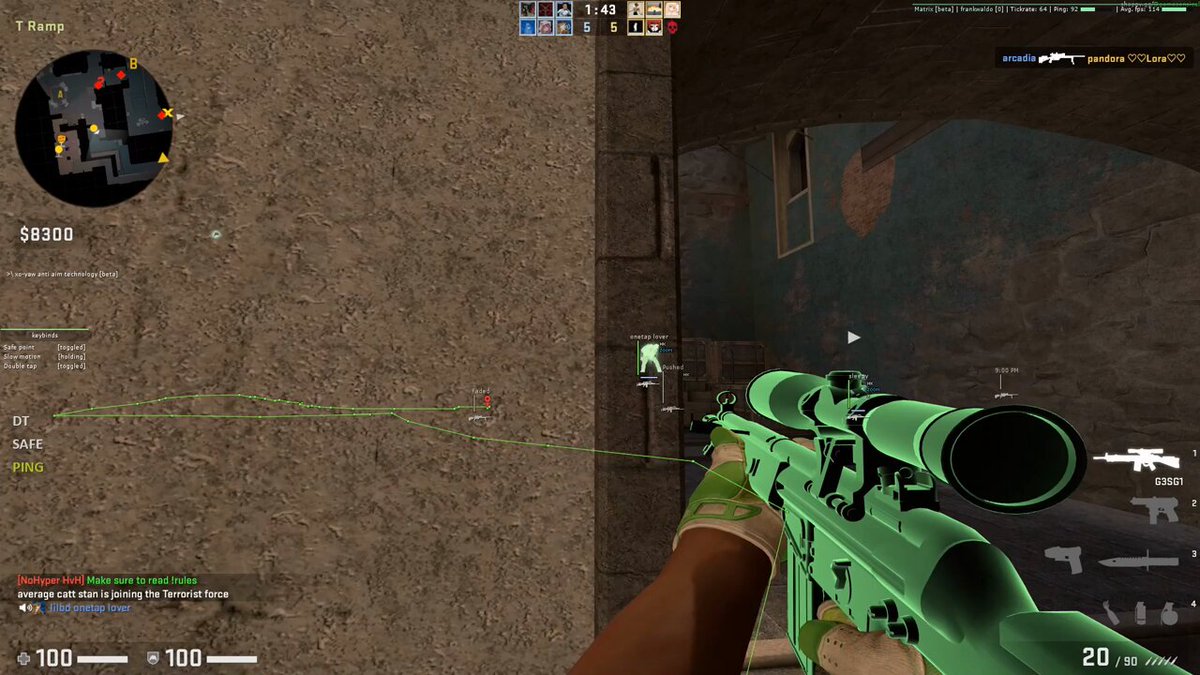
Counter Strike hacking is one of my guilty pleasures. This is a video of an AI tool built into one of the most popular HvH cheats on the market. HvH (Hack vs. Hack) is a game mode where everyone in the lobby is cheating. “If everyone is cheating, then how is it fun?” The game becomes something entirely different in this mode. Instead of focusing on physical reaction time, aim, and movement skills, players must concentrate on the quality of their cheats compared to those used by their opponents. The game essentially turns into a sandbox for software optimization, where cheaters compete against each other to see who has the better-written code and configuration. Players must use every tool available to keep up with everyone else in the scene. My favorite cheat, Anti-Aim (AA), is used to help protect players from getting shot by cleverly exploiting the game mechanics to fake the angle of their hitbox. It works by choking abs yaw packets to exploit a coding error in the game, causing your model’s position to appear bugged to other players. The server processes each command sent by the client in the order it receives them, then it updates animations for each command. After this, the server takes the latest information it has and sends it to other players. If you choke packets, you will essentially send all of your choked commands at the same time. Again, the server will look at what’s latest and send that to other players. Now, you should see the issue clearly: the client is missing loads of information and will start updating animations with incorrect information. This will lead to numerous inaccuracies in their animation state, most importantly their abs yaw (m_flGoalFeetyaw), which indicates where their feet are pointing. The creation of Anti-aim techniques significantly disrupted gameplay, giving users an extra unfair advantage. This compelled players to devise a solution— Resolvers are used to counter anti-aim by determining where the player’s hitbox actually is. One commonly used type of resolver is the old angle resolver. Old angle resolvers work by storing the previous angles from when the player wasn’t faking their position and later shooting at them. —forcing both sides—Anti-Aim developers and Resolver developers—to continuously improve their code and technique. HvH is an ever-evolving arms race where staying ahead is as much about innovation as it is about execution. Code rules all, and hitting p is the only goal. That’s what keeps me coming back. (Video: @peter2b2t, YouTube)

nv🐎

285,298 次观看 • 2 年前

CSS Tip! 🐳 You can add little details like this scale down on scroll effect with scroll-driven animations and some sticky positioning 🤙 section { animation: scale-down; animation-timeline: view(); animation-range: exit; } @​keyframes scale-down { to { scale 0.8; } ] In this smaller example, you can lean into using the position to drive an animation that scales itself down as it leaves the viewport (Seen on the Apple Vision Pro site 🍏) The nice thing here is that if you don't have scroll-driven animations, the user still gets a good experience ✨ So how do you do it? There isn't much to it header { transform-origin: 50% 0%; animation: scale-down both ease-in; animation-timeline: view(); animation-range: exit; view-timeline: --header; } @​keyframes scale-down { to { scale: 0.8 0.8; } } That's it. The layout makes use of position: sticky so that the element stays in the shot whilst you scroll the page. As it leaves the page, it scales down inside the 🫶 The other smol animation here is fading the overlay on the video out 😎 Real easy. You may notice the view-timeline you defined above for the 👀 header { view-timeline: --header; } You have a pseudoelement on the text content of the header that lives inside a header > section::before { background: hsl(0 0% 0% / 0.75); opacity: 1; animation: fade both linear; animation-timeline: --header; animation-range: exit-crossing 0% exit 0%; } @​keyframes fade { to { opacity: 0; } } You use a slightly smaller range on this with exit-crossing to fade it out before you start the scale down animation 🤏 That's it! Thought this smaller example would be easier to grok for people 🙏 It's also covered with JavaScript if you really want it for your sites 🤙 CodePen.IO link below 👇

jhey ʕ•ᴥ•ʔ

146,270 次观看 • 2 年前

Jordan Peterson: "If you can't fix your room, you can't fix your life" "Why should you even bother improving yourself? The answer is something like: so you don't suffer anymore stupidly than you have to. And maybe so others don't have to either. It's not some casual self-help doctrine. If you don't organize yourself properly, you'll pay for it. In a big way. And so will the people around you." Peterson continues: "You can say, 'Well, I don't care about that.' But that's actually not true, you do care about it. Because if you're in pain, you will care about it. It's very rare that you can find someone in excruciating pain who would say, 'Well, it would be no better if I was out of this.' Pain brings the idea that it would be better if it didn't exist along with it. It's incontrovertible." On how to start: "Look around for something that bothers you and see if you can fix it. You can do this in a room. Sit in your bedroom and think: 'If I wanted to spend ten minutes making this room better, what would I have to do?' You have to ask yourself that, it's a genuine question. And things will pop out. There's a stack of papers bugging you. Some rubbish behind your computer monitor you haven't attended to for six months. Cables tangled up." He explains why this matters: "If you were coming to see me for psychotherapy, the easiest thing would be to get you to organize your room. You think, is that psychotherapy? It depends on how you conceive the limits of your being. Start where you can start. If something announces itself as in need of repair that you could repair, fix it. Fix a hundred things like that, your life will be a lot different." On fixing what you repeat every day: "People tend to think of their daily routines as trivial. You get up, brush your teeth, have breakfast. Those probably constitute 50% of your life. People think, they're mundane, I don't need to pay attention to them. No, that's exactly wrong. The things you do every day are the most important things you do. Hands down. Just do the arithmetic." On staying within your competence: "Sometimes you don't know how to fix something. Imagine you're walking down the street and there's a guy who's alcoholic and schizophrenic and has been homeless for ten years. That's a problem. It would be good if you could fix it, but you haven't got a clue. You walk around that and go find something you could fix. Just because something announces itself as in need of repair doesn't mean it's you, right then and there, who should repair it. You have to have some humility. You don't walk up to a helicopter that isn't working and just start tinkering away." Peterson shares the key insight: "As soon as you give your mind a genuine aim, it'll reconfigure the world in keeping with that aim. That's actually how you see to begin with. You've all seen the video where you watch basketballs being tossed back and forth, and while you're doing that, a gorilla walks into the middle of the video and you don't see it. If you thought about that experiment for five years, that would be about the right amount of time to spend thinking about it." He explains what it reveals: "What it shows you is that you see what you aim at. If you can get one thing through your head, that would be a good one. You see what you aim at. One inference you might draw from that is: be careful what you aim at. What you aim at determines the way the world manifests itself to you. So if the world is manifesting itself in a very negative way, one thing to ask is: are you aiming at the right thing?"

Jaynit

68,550 次观看 • 3 个月前

I asked Garry Tan how to use meta prompting to get better at AI: "My partners at YC Jared Friedman and Pete Koomen showed me how to do this. You can take almost anything that you do all the time and just drop it into a context window. And then say, “Here’s a bunch of inputs and outputs." And maybe you also add a bunch of notes. And then you tell it, “Write me a prompt that can act as an agent that takes this input and makes this output over here.” You can do this for almost any type of knowledge work. And you can even introspect. "What are things you notice that I did to convert this from the input to the output?”. And then you can just start using the prompt. Initially, it’s going to suck. Because it’s just not that smart yet. But what’s funny is now, I also use it to Iterate my writing. You can be very direct, "I would never say that", "Don’t say it like this", or "Oh, you used the long word there, use the short word". Just speak to it conversationally. And then when you're happy with the output, you can use that new output to make a new prompt. "Based on this conversation, give me a better initial prompt that incorporates all the things we talked about." And you can do this with literally everything. And in theory, there’s so much it applies to that people do day-to-day. You could use it for tweets. You could use it for editing podcasts. You can use it for pretty much everything. I have a folder of prompts that I use all the time. My YouTube prompt is on v27 or something. I'll go through this process with all the different max models. I'll use GPT 5.2 Pro. I’ll use Grok. I'll use Claude. Then, I’ll take all the outputs from all the models and put them into Claude and say "Here’s my prompt, here’s the output from four LLMs, including yourself. Rate each response and tell me what the pros and cons of each approach are." And I usually say "give it to me in numbered form". And then you can agree with one, disagree with two, tell it three is this or that. And then after that, you say given all of this, synthesize it."

The Peel

51,632 次观看 • 4 个月前